Desert Online General Trading LLC
Dubai, United Arab Emirates
Desert Online General Trading LLC
Dubai, United Arab Emirates
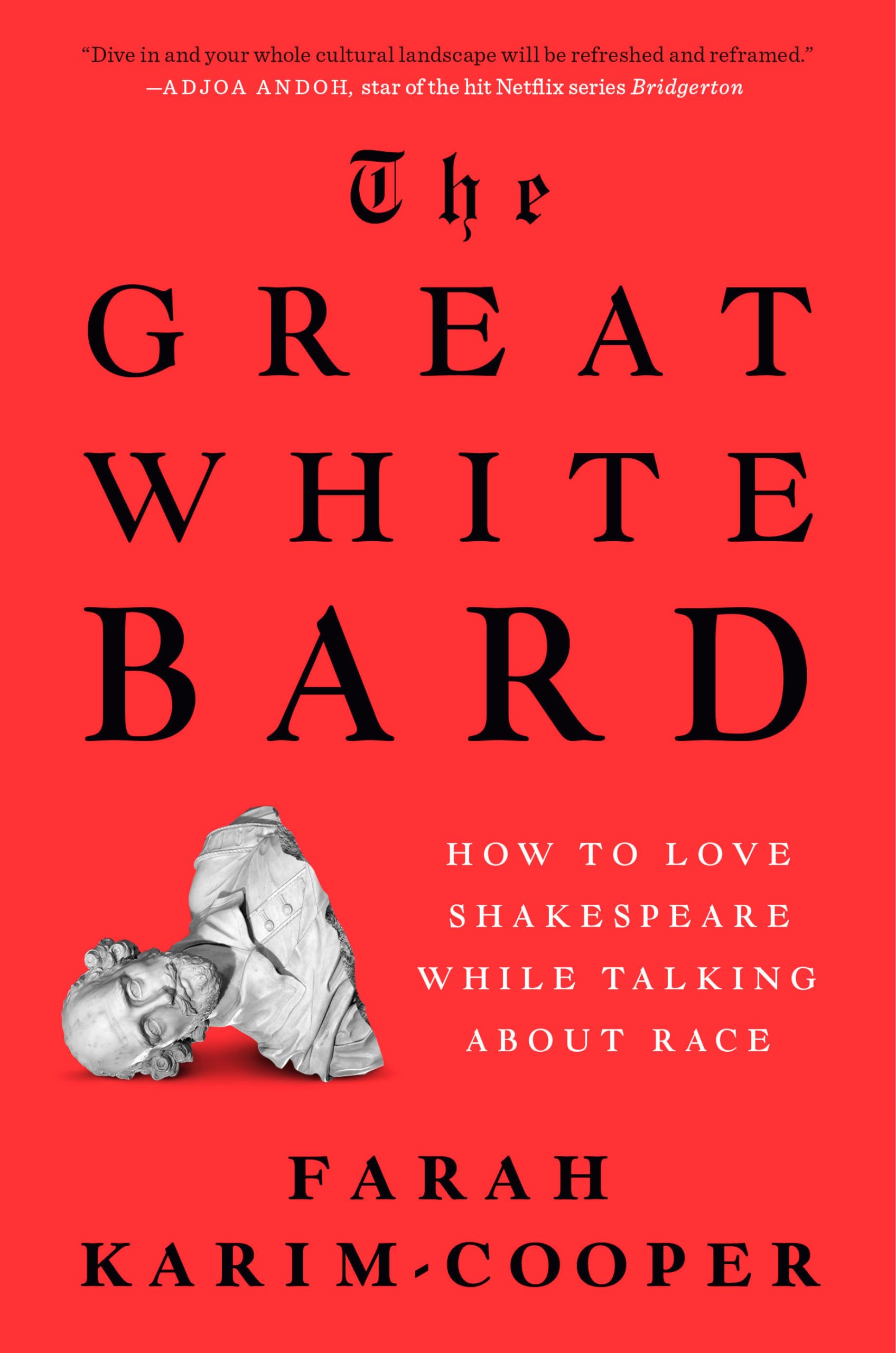
The Great White Bard: How to Love Shakespeare While Talking About Race
K**R
Great book!
Loved this book!
D**B
Excellence!
I am no Shakespeare scholar but it certainly gave me views that I had never thought about before. My wife used to teach high School and Shakespeare was a part of it. She would have loved your book! Dr Robert Seidel
J**E
Both fascinating and frustrating.
Both fascinating and frustrating.Fascinating because there is a wealth of information included, all quite detailed. Frustrating because I realized early on that I'm no longer familiar enough with Shakespeare's written works to fully take it all in. Hence, the problem was with me, not the book. It's simply been too long since I've done a deep dive into all things Shakespeare. As a result, I had to stop and spend some time quickly refreshing my memory as I read. As a result, I hesitated over the book rating. to be honest, for me personally it was probably a 3 star as it was slow going and at times I was simply, well, lost. For those more familiar with his works in detail, or a real interest in the focus, race as reflected in his works, however, this would easily be a 4/5 star. I've gone with the 4 star simply for simplification. I would suggest you refresh your memory on his works prior to reading, however.In any case, although it was obvious to me early on that this book wasn't really for me, I'm still glad I persevered and finished. While it didn't focus on William Shakespeare's life and what personally drove him, it does offer a fascinating, very in-depth look at his times. In the process, it traces how impressions of Shakespeare's characters and written word reflected racial and, yes, even sexual attitudes of the day. In addition, it follows up its determinations with the probably how and why for these attitudes at the time. While focused on race, yes, it also approaches the role of the notable female characters in his plays. It also provides a sense of what being in the pit before the stage reserved for those with less wealth must have been like. In fact, it highlights where the audience itself became a character of sorts as the play moved into or through the standing throngs. As one who'd have surely been there, that was intriguing to me.Bottom line, while I'm not going to detail the author's conclusions and findings -- I mean, the book is some 300+ pages long and each page is full of information -- I'll say that the author does an admirable job of supporting her thesis. Rather ironically, just as I finished reading, Shakespeare's works once again became a target for those who would restrict access to them. That issue is still undecided as I type. Let's just say, you may or may not agree with her but there is a great deal of food for thought provided, all thoroughly researched and documented. My thanks to #NetGalley and #PenguinGroupViking - #Viking for allowing me this intriguing look at the work of a man who is my 11th great uncle or something like that via his sister's lineage. I may not have taken it all in but it has made me curious enough to plan to do some refreshing of my memory, that's for sure.
L**R
tongue-tied
I’ve been on something of a Shakespeare immersion lately; having discovered the Globe theater versions on DVD. This form of producing the plays I find infinitely more enjoyable than curtained theater productions or movie productions. Comparing the Globe’s Henry V to, say, Branagh or the various TV or filmed theater productions, it becomes readily apparent how malleable the texts are.Trying to assess The Great White Bard has me somewhat tongue tied. I am empathetic to the author’s mission but unsatisfied with the author’s method. The flaw at the heart of her project is that it seems to me fundamentally intellectually dishonest to project onto the man, the historical Shakespeare, the playwright, some kind of moral agency for the unresolved ethical ambiguities in his plays about race and sexual roles inherent in his plays apparent to a 21st century public. About the man’s thought and what he intended for his plays, we can know little for sure. We can be sure he aimed to attract an audience to his plays and wrote them to achieve a certain artistic reputation among his peers, players and playwrights. A contemporary sensibility would like to think Shakespeare “one of us.” He lived in a different time, when the reach of his artistic and ethical ambition was anything but democratic, inclusive, anti-colonial, and multi-racial. It seems to me we can love his work and live with its limits.
Trustpilot
1 month ago
3 days ago