Desert Online General Trading LLC
Dubai, United Arab Emirates
Desert Online General Trading LLC
Dubai, United Arab Emirates

Full description not available
W**H
Well, that's it, I'm damned.
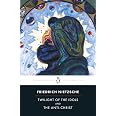
So after ‘Beyond Good and Evil’ there was only one book I could go to. Twilight of the Idols and The Anti-Christ.Anything with Anti-Christ in the title is going to make you hesitate, suck in a deep breath and have a vision of the eternal torture of your own soul within hellfire and brimstone, just for reading it. Quotes from the book like ‘The concept of God has hitherto been the greatest objection to existence. We deny God; in denying God, we deny accountability: only by doing that do we redeem the world’ also helps to reinforce the guilt you feel from reading it. However powering through that I found this the most enjoyable of the three books of Nietzsche I have read (so far).Getting used to the way Nietzsche writes is a lovely thing you truly start to appreciate the flow of his works. Where ‘Thus Spoke Zarathustra’ was a hard slog, this was easy, shorter, far more direct and far more antagonistic. Even with its utter contempt for actual grammar, which isn’t too much of an issue with me - if you can say what you have to say without putting a comma in the right place or a full stop, then fair play to you- it was a great read.To sum it up- The inebriated chap has moved from his seat in the pub (Read my review on ‘Beyond Good and Evil’ to understand what I mean here) and has moved out onto the street, right in front of those Bible people that get in the way in the High Street who find it enlightening to condemn your immortal soul for not listening to them, and is destroying them on every level of argument they have tried to attack him with.Kant, The British, The Germans, Christians, Jews, Marx, Socialists, Plato, Buddha, the apostles and even Christ himself- all are scrutinised for their oppression of the development of man. Their denial of everything desirable to humanity and their oppressive virtue and morals are fiercely attacked in a poetic, uncompromising and merciless way but, surprisingly, quite respectful. Indeed Nietzsche, through the Archetype of Dionysus, the horned God, dare I say it, the anti-Christ criticizes everything, dancing all the time and laughing crazily as the foundations of existence start to crumble around him. In fact the feeling you get from this book is one of a last stand. The final warrior of a defeated army, facing overwhelming odds attacks everyone and everything in his vicinity, killing or wounding them all before he falls. And in a sorts, it was.Twilight of the Idols and the Anti-Christ was originally two books, only one more book was published publicly after this before he died, something to do with Wagner who he used to be friends with (don’t hold me to that but that’s what I read) and that was privately published before Anti-Christ was publicly published. This is effectively his final work and undoubtedly you feel that this is the absolute end and he will go down in a blaze of glory.Though his attacks are slightly less structured than 'Beyond Good and Evil' and even less coherent in some places, the passion in his words keeps you reading, me, in almost one sitting, and when it finally ends you feel exhausted, like you have been battling with him against these symbols of oppression. Though it ends almost abruptly, it is clear that he has said his piece, faced his demons (well saints I suppose- he really doesn’t like St Paul) and has brought to an end the long, frustrating journey of man’s self-limitation imposed by religious dogma. You feel he has given you the keys to the prison with his dying breaths and it is now for you to take that step and free yourself from everything holding you back.Inspirational, enlightening and enjoyable, in a very guilty, I shouldn’t really like this but I do kind of way.I’m quite sure that my soul will be damned for eternity for reading this….. Oh well. Five stars to you, sir.
G**K
Perturbing!
Nietzsche is a genius, it’s kind of difficult to describe Nietzsche as good or bad, he is a genius writer and his command of language and vocabulary is incomparable, he’s as good as Shakespeare. Therefore, Nietzsche is a ‘good’ writer, however, good is a ambiguous term, I mean Nietzsche was not ‘good’ as in goodhearted like a Saint, he hated Christianity, theologians and priests, which to me all exemplify good heartedness. Therefore, Nietzsche was a very ‘good’ writer but an evil philosopher. Concerning Christianity Nietzsche is so opposite to most of us that he might as well be an ‘evil’ writer. Therefore, would it be right to call Nietzsche (in modern youthful terms) a ‘wicked’ writer? Booyackasha! Is that a ‘good’ thing? Most disturbingly, one can sense the origins of The Third Reich in Nietzsche’s evil philosophy and works. Nietzsche questioned Christianity before Adolf Hitler was even born, he attacked Christianity intellectually and philosophically, he broke Christianity, he made a breakthrough and made it possible and even feasible to be atheist, pagan and heathen, which is the root or cause of why the Nazis were so evil. The Holocaust happened not because of a ‘Jewish question’, it happened because of a ‘Christian question’, which no one more than Nietzsche (followed by the Nazis) asked and answered. Therefore, this book is exquisite linguistically, but it also leaves one feeling dispirited, disappointed and melancholy. The lesson is never question Christianity.
Y**S
Excellent book
Excellent condition. Perfect for who we gifted with it. Thank you.
M**H
Nietzsche with a sledgehammer!
Read this book years ago still to a degree impenetrable to the layman twilight of the idols I mean re read but more accessible. Antichrist much more readable and accessible guy deffo philosophies with a sledgehammer!
J**D
Mastering Ascendency.
I read books by authors I necessarily disagree with every so often. In many ways, Mr Nietzsche is no exception. 'Twilight of the Idols' is a fitting epitaph to the tombstone he began in the 'Birth of Tragedy'. He occasionally brings us back to reminisce on the value of Dionysian art and music, the ethos of anti-chritendom, which is precisely what 'Twilight of the Idols' was intended as - a precursor to the second title included in the volume, 'The Anti-Christ'.Looking at both titles in conjunction, together they paint a morbidly fascinating overview of Mr. Nietzsces own personal psychology in his out and out diatribe against all the values Christianity holds dear, the ever corrupt and insoluble Roman Catholic Church, Protestantism and finally Kant. He argues that Descartes had no use for meta-physics, whatsmore, that he didn't even know what they were. He argues Kant was an overblown ego maniac feuled by a need for subservience and control and that this control method was ordained in the name of priesthood given the title; 'Practical Reason'.The biggest problem I had with this work, is that although Mr. Nietzsche has written the book circa 1888, he seems to be stoking the fire of the Third Reich a bit, in both works, he can - by modern standards - be interpreted as an anti-semite, often making references to the 'Smelly'Jews, and liabating on the morality and ethics of Judaism as a whole. He clearly values Jewish learning as much as the Christian in his avid worship of its antithesis - Dionysos.Anyone who has studied Nietzsche even briefly will be familiar with his first rate analysis of the Dionysian/Appolonian mythos which he began in 'The Birth of Tragedy' and seemingly ran through most of his works referencing this one recurring theme throughout. He was fascinated by the Ancient Greeks, even in his contempt of Plato and Socrates Athenian School of Thought.Mr Nietzsche is in modern society considered a Master of Ascension. It's a bit perturbing given all the hype surrounding the Ascended Masters today, to read a book by a man, written in the 1800's which so clearly references this fact throughout. If you read the book, pay close attention to the number of times he uses the words 'ascending' and 'mastery' in both 'Twilight of the Idols' and 'The Anti-Christ'. Friedrich Nietzsche detested christian ideology and dogma when he was alive, it would seem, in death, he has subverted the Will of his Soul towards that of the Monad, towards one day unifying the Christian / Satanic Churches under the Banner of Human Evolution and Self-Sacrifice.I am left wondering, if he knew that - would he approve?
Trustpilot
2 weeks ago
1 month ago