Desert Online General Trading LLC
Dubai, United Arab Emirates
Desert Online General Trading LLC
Dubai, United Arab Emirates
Full description not available
S**H
Understanding pharma pricing is critical to the larger conversation of healthcare reform
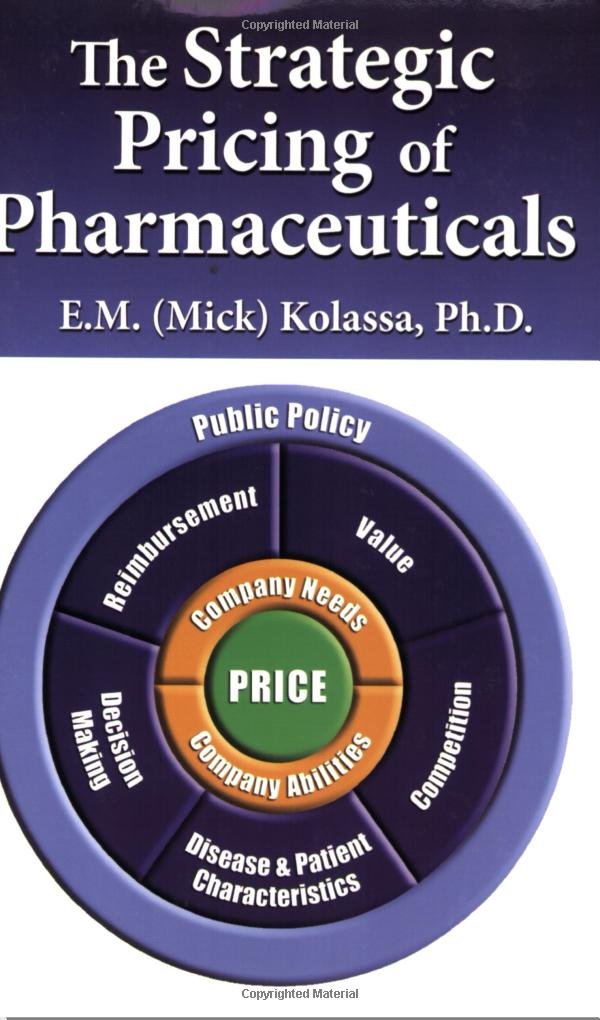
Pricing is a basic business process, but one that often does not get the executive attention it warrants. Pricing, especially value-based pricing, is a powerful way to align an organization around creating differentiated value for its customers. Can value play an equally important role in the healthcare system?This is a difficult question, and well beyond the scope of an Amazon review, but reading this book is a good step for those interested in how to improve healthcare in the US and other jurisdictions. Mick Kolassa's book looks at what makes pharmaceutical pricing unique:- Pharmaceuticals are subject to derived demand, demand is in response to medical need and the payer, prescriber (buyer) and user are generally different.- Pharmaceuticals are negative goods; those who purchase or consume them would generally prefer not to do so.- Pharmaceuticals are experience goods, we can only really know if they will work after we use them.These three characteristics make pricing pharmaceuticals different from pricing most other goods or services. If one is using value models such as Economic Value Estimation (see Tom Nagle The Strategy and Tactics of Pricing (5th Edition)) to understand prices one has to create models for Payers (governments and insurance companies), Prescribers (doctors), Care Providers (hospitals and clinics) and the poor patient (who often has little say in the matter, but will protest by not following prescriptions carefully).Pharmaceuticals are also part of fundamental value and social questions - "Is it ethical to deny a person a treatment that would save their life? "What happens if prices are too low and pharmaceutical company R&D dries up?" "Should a Payer have the right to control what drugs a "Prescriber can choose?"Mick Kolassa and his co-authors have extensive experience in all of these areas and offer important insights. They also cover the unusual role of contracts in the US healthcare system (contracts generally set the terms of trade rather than consummate actual sales) and look briefly at international issues.This book could be improved by more formal use of value modeling and more coverage of pharmacoeconomics and it would have been nice to have the many examples supplemented with some complete case studies that covered pricing questions from R&D though to the end of a molecules lifecycle. Hopefully the authors will publish such a book at some point.I hope we will see more books on pricing in specific segments. Books on pricing of industrial goods, B2B software, professional services, design etc. would all be valuable and help to put pricing and value at the center of business discussions.
A**R
Readable explanation of a very complex topic
Teaches the basics of pharma drug pricing -- which is complicated because it's not like a free market. Third party payers, lots of intermediaries, and lots of politics all vastly complicate what in many industries is a relatively simple job (figuring out your costs, figuring out what value you are creating in the world, and setting your price somewhere in between). Pharma pricing is not for the faint of heart, but it can be done well and done poorly. Mr. Kolassa gives some great examples of both, from history, while explaining the core concepts that can enable you to do it well.
A**3
Mentally Ill Business Major Who Doesn't Understand Economics
"We will admit that it is theoretically possible to set a price that is too high. This has occurred in European and Canadian markets, where the "social contract" between the health care system and the citizens differs drastically from that in the US. However, we have yet to identify such a problem in the US market." -pg 8In the first chapter the authors boldly set out to prove that violating the US healthcare market is in fact a responsibility of price setting and failing to do so is "leaving money on the table." If someone thinks a price is too high, it's because they have not been "made to understand" how the product is "valuable to them," which is the essence of value marketing. The authors adamantly refuse any economic models on supply and demand, instead promote forcing 'marketing' to consumers and physicians or forcing public policy changes to ensure buyers (i.e. dying patients) are obedient slaves, taken for every penny. This is both a bold and ignorant attack on modern capitalism, by people who think glossy marketing can undermine consumer power and clearly hold zero personal ethics.If you wander through this trash, you'll discover, apparently, patient preferences and needs, and you know, demand, should have zero influence on long-term drug prices. Instead drug companies must bamboozle doctors to prescribe inappropriate drugs on the basis of the "value" you marketed to them. Ah, and value doesn't relate to patient outcomes, but does correspond to sociological mind games. Oh, and don't forget to use political manipulation to protect your investment! Market-level checks and balances can and will be mocked and dismantled at every point according to this text, because politicians can be bought. After all, it's the pharmaceutical companies who are the real victims in this world. I mean, at least once a decade 'patient groups' or 'hospitals' try to stick up for themselves and let's be honest, cancer patients are the real villains here. But don't worry, this quick text will tell you how to put them in their place and undermine both capitalism AND democracy. It promotes everything but cannibalism.I wonder how the executives of the Medical Marketing Economics company are not in a jail cell. This book is nothing more than a vacuous business card to demonstrate how ignorant they are of medicine, economics, and morality and how willing they are to push cost-benefit analysis out of the window in favor of used-car salesman "always be selling" tripe.The text doesn't even pretend to understand modern economic theory, nor does it introduce at any point relevant statistics, theories, models, or equations, instead relying on the idea of the good ol' boys club to run medicine. Men, locked in a pharmaceutical room together, trying to figure out what the American public *can be induced to pay*, and how to make them bend over and squeal for stock holders is the sub-text of every line this filthy text. There is nothing academic or intellectual in this content. It's truly offensive that this comes from a university associate and despicable to think healthcare is manipulated in this way by people who are so profoundly ignorant and so flagrantly corrupt and incapable of understanding our "social contract" or capitalist roots.There are dozens of noble prize winners in economics who have offered brilliant and nuanced insight into pharmaceutical pricing and performance. There are dozens of textbooks about capitalism and medicine from reputable publishers. If you need to learn about this topic, pick a reputable source! NOT THIS! This text doesn't pretend to be anything other than a marketing of 10-quick tips for violating, pillaging, and stealing from the US healthcare market.May God forgive the people who read it and believe it. This is the Martin Shkreli type psychopath handbook, not a textbook. Woe to anyone I encounter, professionally, who dares to use these methods.
S**L
Good read
Great insight
C**A
Described perfectly, amazing price!
As described, great price!
A**R
Five Stars
Great book
D**N
A Must Book for Pharma and Medical Equipment Execs
This is his second book on pharmaceutical pricing and it is his best. I found it both insightful and informative. He unravels the complex issues of pharma pricing and integrates those issues to modern pricing theory. The book has clear examples and I enjoyed his discussions on framing, drivers of use and the impact of generics. This book has a wider application than just pharmaceuticals--anyone in the medical equipment or services field would find great insights. Enjoy.
Trustpilot
2 months ago
3 days ago