Some deliveries may take a little longer than usual due to regional shipping conditions.

DOWNLOAD THE APP


Customer Services
Copyright © 2025 Desertcart Holdings Limited
DOWNLOAD THE APP

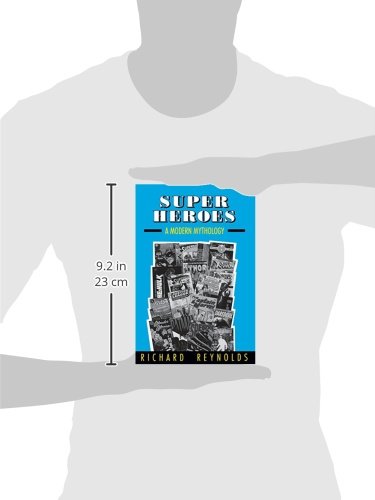
Super Heroes: A Modern Mythology (Studies in Popular Culture Series)
D**E
Reynolds is a Treasure
A very nice book. Reynolds has a wonderful knowledge of and appreciation for the comic book genre. This combined with his literary knowledge makes this book a very helpful resource for those doing research in the area. I had the pleasure of extending the conversation with Professor Reynolds at the Second International Conference on Superheroes at Oxford this year. The man is as delightful as his prose.
Z**0
I had hopes... but... WHAT.
I was intrigued until he began to launch on a bizzare tirade about the link between heroes, sexual violence and rape. The writer left me feeling not so much as enriched in the ways of comic knowledge, as he left me seriously concerned that the writer himself has skewed perceptions of sexuality I general.
J**H
Disappointing
I had high hopes for this book, but when I reached its analysis of major superheroes such as Superman and Batman, I felt the author was way off. I thought his finding that Superman was just an adolescent fantasy was very simplistic - where was any discussion of the duality of the human and alien, the conflict between the physical, alien might of Superman against the mental, human might of Lex Luthor? And when Batman was seen as 'angry all the time', that his driving force is not anger at the injustice that he suffered and that he sees every day, but rather anger at himself for note being able to stop what happened to his parents - and that his greatest foe is not the Joker, the man who is the opposite of all that Batman represents, but rather Two-Face, because the author thinks he represents the duality of Batman/Bruce Wayne - I lost all faith that the author knew what he was talking about. If you want a serious book about superheroes as modern mythology, look elsewhere.
C**B
Highly Insightful and Well-Written
In Superheroes: A Modern Mythology, Richard Reynolds does an excellent job of dissecting some of the origins of the superhero genre. Beginning in the 1930s and 1940s, he lays bare some of the prevailing ideas and iconography and puts superheroes in context. Reynolds also does an able job of analyzing The Dark Knight Returns and Alan Moore's Watchmen, as well as certain superhero origin stories. This book's only disappointment comes from the fact that his analyzes of superheroes' mythic origins don't go far enough - those looking for explicit comparisons to assorted mythic pantheons or full-throated examinations of how superheroes fall into legendary templates (except those of the Joseph Campbell variety) will be disappointed. However, an excellent and important read for anyone interested in comic books.
E**C
Great.
This book forever changed the way that I read superhero comics. Reynolds discusses the factors that are present in virtually every superhero comic since Superman was created. Some are apparent (devotion to justice, secret identitities), and some are subtle (lost parents, accountability only to one's own conscience). Virtually all factors are recapitulations of the developmental struggles of the primary audience of these comics: adolescent males. Reynolds continues by illuminating the grand, mythical nature of the comic-book universes, all stories blending into one vast "canonical" story, each comic becoming part of a larger continuity. This continuity shares several features of classical mythologies, which Reynolds explores in depth, citing the X-Men, the Watchmen, and the Dark Knight Returns series (among others) as evidence. Read this, it's great.
G**S
Super Heroes rock the world!!!
Best book I've read so far! I'd read it over and over if I were you!
S**P
Super insightful!
Super insightful and perspicacious. Reynolds is one of the top researcher in this field, and you can find so many clues of “why” in this book. Look forward to republishing in coloured version, not in black and white.
Trustpilot
2 weeks ago
3 weeks ago