⚡ Empower Your Energy IQ — Monitor, Alert, and Save Like a Pro!
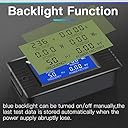
This multi-function AC panel meter with split core current transformer delivers precise real-time monitoring of voltage (80-260V), current (up to 100A), power, energy, frequency, and power factor. Featuring a large LCD with blue backlight, customizable overload alarms, and automatic data retention during outages, it’s the perfect tool for professionals seeking reliable, continuous electrical system insights and proactive energy management.


| ASIN | B07JB9B2QL |
| Best Sellers Rank | #17,251 in Tools & Home Improvement ( See Top 100 in Tools & Home Improvement ) #32 in Multi Testers |
| Brand | MORNING GROUP |
| Color | Black |
| Date First Available | October 10, 2018 |
| Is Discontinued By Manufacturer | No |
| Item Weight | 5.6 ounces |
| Item dimensions L x W x H | 3.42 x 0.95 x 1.85 inches |
| Item model number | PZEM-022 |
| Manufacturer | Wenzhou Morning Electronics Co., LTD |
| Measurement Type | Ammeter, Multimeter, Voltmeter |
| Min. Operating Voltage | 80 |
| Power Source | Corded Electric |
| Product Dimensions | 3.42 x 0.95 x 1.85 inches |
| Style | 1 Piece AC 100A Meter(Split Core Transformer) |
| UPC | 703931915688 |
3**O
NOT made in the USA, runs off 240Vac just fine
The current most helpful review says "Made in USA" when clearly these meters are not, these meters are made in China. Also, they do not HAVE to run off of 120Vac, they will run off 80-260V. With those corrections out of the way, these meters work well. This meter helped me identify a serious problem with a 5-ton Trane heatpump unit. And no, it's not hard to stop a Trane, all you need is a faulty low pressure sensor switch and it will not only stop but also start running backwards in mere milliseconds. Be advised these meters alarm on Power only. I knew what they did when I bought them, I only wish they had a version that could be set to alarm on voltage or current or all three via independent settings. It would be nice if there was an audible alarm of some sort. I also wish they had a mounting box or panel with an appropriate cutout. (product improvement suggestions) Line voltage varies and so therefore current draw will also vary and therefore Power varies (voltage times current). In my scenario I have a 5-ton Trane heatpump unit whose compressor liked to run backwards. If your heatpump sounds louder than normal or hits like a sledge hammer while running, it's running backwards. Contrary to popular belief, running backwards did not harm the motor nor the scroll compressor that the motor drives (this unit is 11 years old). However, it does eat a lot of energy for no gain. This needleslly increases the electric bill considerably. It is also interesting that when running backwards, the compressor (I put the meter in the heatpump on the leads running into the compressor) draws more current and therefore has more power consumption. When running correctly, this compressor draws 16.6 Amps at 234.9V as measured. When running backwards it draws 21.9 Amps at 235.7V as measured. That is a 32.5% increase in current and therefore power for no gain (ie no heating or cooling inside the house = total wasted energy). Once I knew that, then I needed a permanent means with alarm and real time display inside the house. That's where these meters saved the day. It is also interesting to note that the impulse from forward to reverse draws a very short (milliseconds) 100 Amp spike. I was curious, so I recorded this with a data logger that I also got here from Amazon, namely the Supco LCV LOGiT Current and Voltage Data Logger (1s minimum data interval was sufficient to catch it twice out of 4 times), and I saw it instantly on an oscilloscope also bought here on Amazon, namely the Owon SSO8192. These power meters are great to give a real time, portable and inexpensive current, voltage and power reading but are not usefull for capturing fast spikes like the more expensive equipment. What was causing this reversal was a defective low pressure switch on the unit. This switch would let the 24V contactor coil voltage drop intermittantly, and for less than a millisecond. The resulting sound has a BANG loud enough to shake the 4,000 sqft house (through the vent system) followed immediately by a louder running compressor as it starts running backwards (like it was digging deeper). From forward to reverse in milliseconds with a 100A spike. BANG! By shorting the leads running to the low pressure switch, the unit now runs as normal, no idea what this has done to longevity. My theory as to why this Trane 5-ton scroll heatpump compressor draws more amps in reverse, is because the compressor must have an internal anti-backflow valve or device of some kind. With this meter I was able to temporarily monitor directly inside the outdoor unit and I can now permanently monitor the current draw from inside the house by connecting this meter to the breaker box lines running to the heatpump outside. I also have the alarm set to 5.3kW (240V times 22 Amps). The fans draw 4.7 Amps. 16.6+4.7=21.3A running correctly. In reverse that would be 22+4.7=26.7A. This way, I will have an exact alert if the heatpump ever tries to reverse again. No need for hearing accuity of the compressor. Note I wired this inside the breaker box, directly across the breaker feeding the heatpump unit with the current sense transformer on one of the wires. The permanent fix for the heatpump was to replace the low pressure switch (simply put a new one in line and abandoned the old). We also replaced the contactor as the contacts were severly damaged. I had the start capacitor and hard start unit replaced for piece of mind. I will leave this meter in place as I do not know if this same failure or another such as the high pressure switch will fail again in the future. I appreciate the peace of mind this meter with flashing screen alarm provides. Note, you can turn the LCD off by pressing the button and yes, on alarm it will still flash. It holds the LCD backlight setting (on or off) through a power outage AS WELL AS the power alarm setting. 2 minutes tested. It may hold these settings longer, I don't know. But for my purposes, that is more than long enough for the guardian 22kw to kick on and the transfer switch to automatically kick in during a power outage. For my purposes I don't care, but I also noted it did hold the kWh accumulation for two minutes as well. The leads on the CT transformers are relatively short (about 4-6 inches), I soldered on an additional 2 ft of tined multistrand 20 AWG silicone insulated (600V) wire to them. Solder station (Andolar 60W), solder (60/40 rosin core) and wire (Haerkn) were also bought right here on Amazon. I used electrical tape (3M Super 88) bought right here on Amazon to insulate the joints, you can use heat shrink tubing for a more professional look. At $15.30 apiece if you buy two, this is a very inexpensive troublshooting and monitoring tool. I hope this helps someone.
A**A
Great units for generator current monitor
So far working well. There might me a SLIGHT discrepancy on values so not the most accurate devices, but close enough for government work. I like the design of the clamshell CT monitors. Great quality, bright enough to view in sunlight. They don't seem to consume much, but that might be the slight difference in values.. I wish they came with a gasket for installing on enclosures, but this worked very well for a DIY home generator monitor. Instructions are not the best, but AC supply is line and the other is the neutral. I used two of these to monitor each leg of the split single phase so one line was to red on one monitor, the other line went to black, and they shared the white neutral connections. I suggest using T connectors instead of splicing since the wire terminals are very small. You'll need something like a 24-18AWG but these are not provided.
N**T
Easy to install
Monitors energy use and easy to install just turn power off and make sure you put sensor going the right direction
A**Y
Breaks easy, have to figure it out, difficult mounting
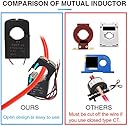
The pros: Love the blue backlighting Fairly accurate to the P=IV calc when the current is over 10A OK price The cons: Cheap plastic. The “hinge” on the current transformer (CT) is so thin it is barely reliable (mine broke almost instantly). If the CT cannot clamp tightly around the wire it is useless. Almost impossible to mount securely if you do not have a box to exactly fit it into (why no dog ears to screw down??) Short lead on the CT I wanted to see how much current my Prius Prime actually used when charging, so was excited to get this unit. It arrived pretty fast and was an OK price at $20. Considering all the info it provides I was OK with that cost. There are no written instructions on how to connect the CT part to the unit but there is a pretty good drawing on the back of the unit to show you which lugs to connect them to. You do have to also connect the unit to an AC power source and there is nothing included to do that. I used some wire and opted to connect it to a pig tail and plug into a wall socket as I did not want to try to connect it in circuit with the line I was charging the Prius on. I connected the CT around the HOT line in the breaker box and noted you really cannot easily snap shut the tab that is supposed to hold it. If the CT is not firmly closed it cannot get an accurate reading. My first try was less than half the proper values. While trying to adjust the hinge plastic on the CT broke, making it essentially useless unless you MacGyver it. I used some duct tape and a plastic wood clamp to securely fit the CT over the line and it started giving more proper readings. I cannot use it like that other than to test so the device is just a pile of plastic to me outside of a test like this. I owned it for all of 15 minutes before it became useless. With the MacGyver clamp in place, I got the following readings on the device. With minimal load on the circuit (fluorescent lights) the device read 2.43A, 123V and indicated 295W. I forgot to note the PF value. P=IV indicates the Watts should be 298.89 so the unit was off a few watts. The PF value may have closed that gap a bit there. I used a Commercial Electric ammeter to check the amp rating and it indicated 2.38A so at least one of those is off a tad. Connecting the Prius charger and starting the charge the readings became: 13.87A, 124V, 1.70kW. I think the PF fluctuated between .99 and 1.00, which means it would not make much of any impact on the final calculation. P=IV means the watts should have been 1.72kW, making it only off by around 0.02 at that higher load. Not bad in my thinking. My Commercial Electric meter indicated an Amp reading of 14.10A, so again the two devices are off by a bit. I strongly dislike the mount options. It is designed to slot into a rectangular hole with some small plastic tabs to hold it in. That means you have to engineer something like that. There are no other options on the device to mount it – no dog ears to apply a screw, nothing. Forget trying to wall mount it unless you build a rack to insert it into or MacGyver a mounting solution. Frustrating. The CT is on a very small lead. For bench work that is probably not a big deal but if you want to connect this to your breaker box to get real time readings that lead is too small. Since mine broke anyway I soldered in a longer lead line so I could connect into the box and set it on a shelf I had to quickly make. In short the device is pretty cool with what it displays for you, and seems to be fairly accurate at higher Amperage loads. Someone on here indicated it did not read above 5A but that is incorrect if you buy the 100A version, which I did (there is a 5A version which will limit you to only 5A or less). The problem is the CT is too cheaply made for the secure clamping it needs to have; if the CT is not securely connecting to itself (you’ll understand when you look at it) then it cannot read properly. Before I MacGyver’d it I would change the Amp value by almost 2A by squeezing the CT. My plastic wood clamp fixed that. But the design is not endearing to a long useful life for the device. If the manufacturer bolstered the CT hinge and clamp tab, and provided some dog ears so you can wall mount it, this would be a five star tool out of the box. No idea yet how long it will last.
V**E
Al contratio de lo que dice el vendedor SI funciona par medir 2 fases de 120v cada una en 240v. En este caso hay que alimentar el medidor con las 2 fases (no conectar el neutro) para tener la lectura en 240v y colocar las 2 fases a dentro de la dona y el medidor da lectura de la energia total... Perfecto par medir la carga de un generador 120/240 que utilizamos como respaldo por apagones y temporada de huracan...
A**R
Great quality. The voltage is spot on, unlike so many other similar devices I have tried.
S**L
No tengo el software para ver datos. Ya intenté descargar varios pero ninguno funciona. Tengo Windows 10. Me puede compartir un link para descargar el software. De antemano muchas gracias.
A**R
Great Devices. Bought 2 and hooked them up to each side of split phase twist lock connection coming out of my backup generator so I could confirm each side voltage and draw. You must of course sum the 2 readings (watts and volts) to determine total output and draw on the generator. Make sure you use separate AC to power each unit appropriate to the side it is measuring because generators don't always provide exact same voltage on both sides, for example the intelli-meters on Champions only show total voltage. If voltage on each side differs by more than three volts maybe the AVR and brushes need attention. These devices are really informative for balancing loads to the two sides of a generator output. My only criticism is the wiring instructions. The paper instructions in the box show wiring the device using a light bulb symbol and this is where it gets confusing. All light bulb sockets for safety are wired such that the hot is the tip of the bulb socket and the sides are the neutral, so you never get a shock or short when twisting in a screw bulb. Assuming that standard the instructions show the CT installed on the neutral wire when clamp type meters clamp the hot. To make matters a bit more confusing the wiring diagram on the back of the device shows the CT clamped on the hot. Apparently, this device doesn't care about polarity when wiring either the AC or the CT.
J**A
Équipement facile à installer ,donne de bon renseignements sur le voltage et le nombre de watts,
Trustpilot
1 month ago
1 day ago