
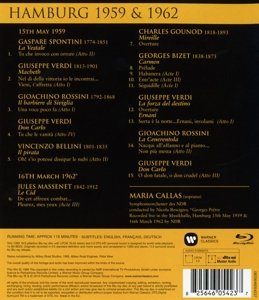


desertcart.in - Buy Maria Callas in Concert - Hamburg 59 & 62 at a low price; free delivery on qualified orders. See reviews & details on a wide selection of Blu-ray & DVDs. Review: Le passage le plus éloquent pour comprendre l'art de Callas c'est la grande scène finale du "Pirate" de Bellini. Elle l'avait chantée sur scène à la Scala avant d'être mondialement célèbre avec la Traviata de 1955, mais malheureusement aucun enregistrement n'avait été effectué (pas même de pirate, je crois). Dès les premières notes de l'orchestre la Diva est concentrée : on voit sur son visage tout le contraste des émotions qui se succèdent et on comprend que ses incarnations n'étaient pas prises à la légère, même durant un récital, elle vit vraiment le ressenti de l'héroïne qu'elle tient à faire vivre totalement, grâce à la musique et grâce au chant. Le timbre de la voix reste impressionnant, sa couleur, ses nuances, ont marqué l'histoire de l'opéra. Aujourd'hui il est très difficile, à la radio notamment, de dire tout de suite "Tiens, c'est la Netrebsko ou la Gheorghiu qui chantent!" alors qu'une Callas, une Caballé, ou un Corelli étaient identifiables instantanément. Le timbre de la voix est devenu "banal" et c'est bien dommage. Pour en revenir à ce récital il faut bien reconnaître que l'air d'entrée de Lady Macbeth ne donne pas le résultat que l'on se doit de réclamer à une interprète de cette classe, et d'ailleurs son regard malheureux vers le chef d'orchestre en dit très long sur sa propre frustration. Et que dire de cette Carmen dont elle n'a jamais appris les paroles de la Habanera (elle récidivera dans d'autres récitals) et qui frisent le ridicule au point de reconnaître que ce rôle qu'elle refusa toujours de jouer sur scène, ne lui convenait pas....Malgré ces quelques réserves il est bon de rendre hommage à cette cantatrice qui reste pour beaucoup un modèle de professionnalisme et de rigueur et qui hante encore les lieux où elle chanta : Milan, Paris, Londres, et bien d'autres encore... Review: カラスの歌っている時の顔の表情や、手のしぐさが見えるのは、歌を鑑賞するうえで大きな意味がある。うわさ通り。役の人物になりきって歌っていると思う。だから字幕がなくてもなんとなく、どんな気持ちで歌っているかが想像できる。字幕があればもっと感動するかもしれないと思った。カラスの映像付きのオペラがあればと思うが、ないね。
M**R
Le passage le plus éloquent pour comprendre l'art de Callas c'est la grande scène finale du "Pirate" de Bellini. Elle l'avait chantée sur scène à la Scala avant d'être mondialement célèbre avec la Traviata de 1955, mais malheureusement aucun enregistrement n'avait été effectué (pas même de pirate, je crois). Dès les premières notes de l'orchestre la Diva est concentrée : on voit sur son visage tout le contraste des émotions qui se succèdent et on comprend que ses incarnations n'étaient pas prises à la légère, même durant un récital, elle vit vraiment le ressenti de l'héroïne qu'elle tient à faire vivre totalement, grâce à la musique et grâce au chant. Le timbre de la voix reste impressionnant, sa couleur, ses nuances, ont marqué l'histoire de l'opéra. Aujourd'hui il est très difficile, à la radio notamment, de dire tout de suite "Tiens, c'est la Netrebsko ou la Gheorghiu qui chantent!" alors qu'une Callas, une Caballé, ou un Corelli étaient identifiables instantanément. Le timbre de la voix est devenu "banal" et c'est bien dommage. Pour en revenir à ce récital il faut bien reconnaître que l'air d'entrée de Lady Macbeth ne donne pas le résultat que l'on se doit de réclamer à une interprète de cette classe, et d'ailleurs son regard malheureux vers le chef d'orchestre en dit très long sur sa propre frustration. Et que dire de cette Carmen dont elle n'a jamais appris les paroles de la Habanera (elle récidivera dans d'autres récitals) et qui frisent le ridicule au point de reconnaître que ce rôle qu'elle refusa toujours de jouer sur scène, ne lui convenait pas....Malgré ces quelques réserves il est bon de rendre hommage à cette cantatrice qui reste pour beaucoup un modèle de professionnalisme et de rigueur et qui hante encore les lieux où elle chanta : Milan, Paris, Londres, et bien d'autres encore...
軽**ン
カラスの歌っている時の顔の表情や、手のしぐさが見えるのは、歌を鑑賞するうえで大きな意味がある。うわさ通り。役の人物になりきって歌っていると思う。だから字幕がなくてもなんとなく、どんな気持ちで歌っているかが想像できる。字幕があればもっと感動するかもしれないと思った。カラスの映像付きのオペラがあればと思うが、ないね。
P**E
If you want to see the intensity that Callas could generate in live performance, you need look no further than the very last item on this Blu-ray disc. Callas pulls out all the stops in giving a fiery rendition of "O don fatale" from Verdi's opera Don Carlo. You see her total physical involvement in the art of singing - she projects the drama with her whole body as well as her voice. Other sopranos who sing this aria seem as if they are asleep compared to Callas! These are my favourite five minutes of Callas on film. This Blu-ray contains the two prime live TV concerts that Callas gave in Hamburg, Germany in 1959 and 1962. Only ten TV concerts by Callas are known to survive and these are two of the best. There have been rumours of the existence of other complete Callas performance films, but, so far, ten is all we have. Only about seven precious hours of video in total compared to hundreds of hours of sound recordings of Callas! Unfortunately, Callas came to prominence in an era before the videoing of complete opera performances was well established so we don't have a complete opera by Callas on film (which is a terrible loss), only excerpts in ten live recitals. These two Hamburg performances contain excerpts from six operas that she sang complete: La vestale, Macbeth, Barber of Seville, Don Carlo, Il Pirata and Carmen. She made a complete studio sound recording of Carmen, but never did a complete performance on stage as she did with the other five, so it is fascinating to have her scintillating excerpts from Carmen on this disc. It suggests what she might have done with Carmen on the live stage. She is also exceptional and very dramatically involved in the extended 17 minute scene from Il Pirata. Warner's Blu-ray disc is slightly improved in sound and picture quality from the previous incarnation on DVD. These two recitals had been previously issued by EMI - defunct predecessor to Warner who has now inherited the whole official Callas catalog from EMI. If you already have the previous EMI issue of the Hamburg concerts, you will not find a dramatic improvement on the Warner re-issue so you may choose to stick with your DVD copy for now. Don't expect stunning picture quality on these videos. In the days before high definition video and early videotape, TV programs were recorded by a somewhat primitive technique known as a "kinescope" - basically a 16 millimetre movie camera in front of a studio TV screen. The results are good enough for us to appreciate Callas' artistry in these two videos and kinescopes helped preserve many great TV performances in the days before videotape. This Blu-ray is two hours long and subtitles are included in English, French and German. I enthusiastically recommend this Blu-ray to those who want to actually see Callas in performance - especially for those who are mainly used to just hearing her in her many, many sound recordings. If you don't already have the DVD version go out and buy this Blu-ray issue right away! By the way, the ten video concerts of Callas that are known to survive are: 1) November 25, 1956, excerpts from Tosca on Ed Sullivan Show (on YouTube complete, not officially published complete) 2) December 31, 1957, Casta Diva from Norma performed for Italian TV (on EMI DVD) 3) December 19, 1958, her Paris debut concert (on Warner) 4) May 15, 1959 , Hamburg concert (on Warner) 5) March 16, 1962, Hamburg concert (on Warner) 6) November 4, 1962, Covent Garden recital (on Warner) 7) February 9, 1964, Tosca Act Two from Covent Garden (on Warner) 8) May 18, 1965, Paris recital (on EMI DVD) 9) November 26, 1973, London recital with Giuseppe di Stefano (not officially published yet, but on YouTube) 10) October 19, 1974, Tokyo recital with Giuseppe di Stefano (on Warner Japan Blu-ray and DVD only)
P**P
In the 1950's decade, Maria Callas "was opera" in every sense of the word. Her voice was the fullest and the best of her entire career. And to top it all off, she was so lovely to look at too, with her slender feminine figure, and terrific stage personality too. In the past, with the exception of Renata Tibaldi, feminine opera singers gave the appearance of an NFL fullback!!! - just Big, bless their hearts!!! For all these reasons, Maria Callas is the supreme role model for all upcoming opera singers - one who they would all try to emulate, but never succeed - even those lucky enough to train at the Julliard School of Music. To find most of her published music, go to the Amazon website, and type in "Maria Callas" into the search mechanism, and hit "enter".
B**W
I already possessed this concert in adequate quality DVD and I purchased the blurry assuming that there would be an improvement in image quality. There is no improvement. In fact there is no discernible difference. Just buy the cheaper DVD
Trustpilot
2 months ago
3 weeks ago


