

Desert Online General Trading LLC
Dubai, United Arab Emirates
Desert Online General Trading LLC
Dubai, United Arab Emirates
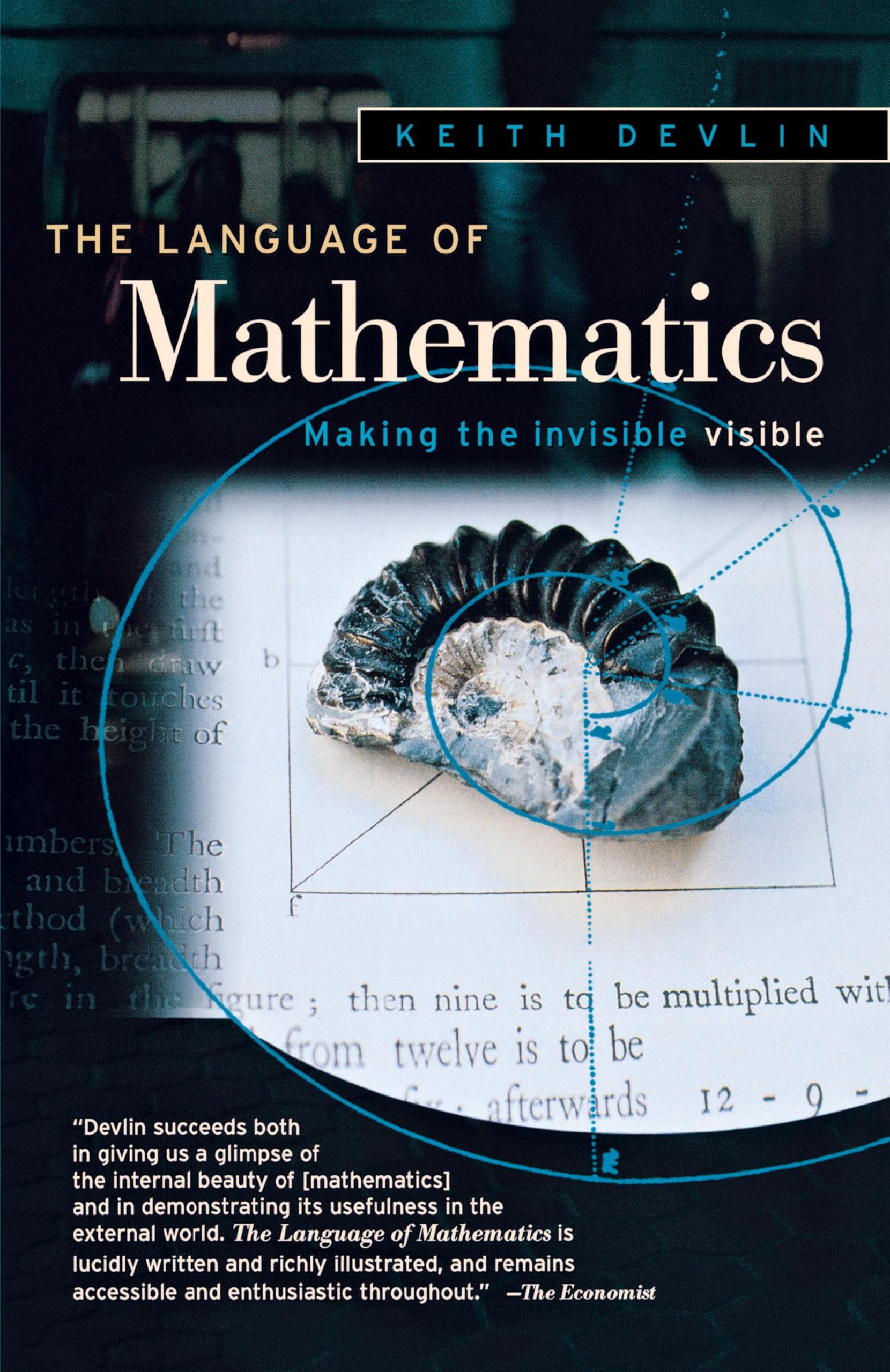
The Language of Mathematics: Making the Invisible Visible
M**.
Book Review Number Eight: year 2017
The Language of MathematicsFrom Omicron in Cetus this great, great book.The prologue itself is packed with gold; don’t skip it, it sets up the approach to the entire book…looking for patterns, discovering the geometric and numerical underpinnings of so many things, even when they are not apparent at first sight( or non sight if they‘re invisible): patterns of motion, reasoning, shapes, and chance.The first two chapters cover rational and irrational numbers, prime numbers, modular arithmetic, encryption, syllogistic reasoning and proof by mathematical induction. There are historical references mixed in, here and throughout the book. I found these first two chapters to be the most challenging. Why? The concepts don’t readily lend themselves to visual or geometric constructions. The patterns are there, but they must be drawn from murkier waters. Just push on; don’t let discouragement rise to the level of abandonment…because…From chapter three onwards it gets better. To include:The harmonic series, where the terms get smaller and smaller, but do they add up to a finite value? What do musical sound waves look like?The resolution of Zeno’s paradox by adjustments of the pattern; the author points out that an infinite series can sum to a finite value if the pattern is recognized and manipulated. But not always; just ask the harmonic series.If you’re the artistic type, chapters four and five, addressing the mathematics of shape and beauty, are for you. Alas, beauty it seems, is not in the eye of the beholder. Some sculptures and paintings are more pleasing to the eye, and certain works of music are more pleasing to the ear. Symmetry, perspective and projection are covered. How the Renaissance artists recognized and solved the problem of representing depth on a two dimensional canvas. The great da Vinci saves the day with foreshortened perspective and infinite convergence of lines. But there is also symmetry in certain math equations. These are abstract symmetries, not visual, and so equations take on a kind of “shape.” Interesting thought.Klein bottles, Mobius strips, the bending and twisting of Euclid’s world into new pastures of form and analysis.Knot theory is presented. Never heard of it, but very interesting…the DNA helix can be approached with knot math.What's the best way to stack grapefruits? Randomly or in the familiar arrangement of a pyramid? This is not so easily answered; read this book and find out.The book contains two sections of glossy color plates depicting a variety of computer generated weird surfaces.There are just too many concepts in this fascination book to go further. The book contains eight chapters, plus the prologue, which begins on page number 1 and ends on page number 338. Notwithstanding the first two chapters, there are many graphs and illustrations along the way. One more thing…Special bonus: For the reader who likes history, there is a very interesting discussion at the end of chapter two concerning the true authorship of The Federalist Papers. History has been silent on whether Hamilton or Madison wrote some of the papers. It turns out that everyone leaves a fingerprint in the way they write; a pattern exists (the frequency of select words, the use of punctuation, sentence length and so forth). An algorithm was developed to analyze with great accuracy these hidden fingerprints, and the correct authorship was determined.
J**Y
A bookseller that meets its promises
Book was as described, in good condition, delivered speedily.
C**R
A language easy to understand
When I ordered this book, I expected a book which would be overly simple in explanations and not very much depth. I was pleasantly surprised by its content. The book is very easy to understand and very readable. Some of the subjects I found a little boring, but that is to be expected in most books. Overall I thought this book captured my attention and helped me look at certain aspects of mathematics in a new manner. I enjoyed most chapters , but especially the topic of topology. Very easy to understand the basics thanks to explanations. I wholeheartedly encourage reading this book.
M**T
To see the world in a grain of sand.
Devlin's language of mathematics is an outstanding book "about" mathematics. It's best suited to lay audiences without any background in mathematics, I particularly disagree with other reviews which claimed that this work require any higher understanding of mathematics. In fact, if you are one of the people (including myself) who have not done any math or took a class or read a book relating to math since secondary school, this is a good place for you to start. I'm a lawyer who have spent much of a lifetime as a math-loathing individual. My mathematics education ceased 13 years ago when I was 17. But thanks to this book, with its blend of engaging narative history as well as concise-but-sharp explanations on the concepts of mathematics, I am now in love with mathematics for the first time in my life.This book needs not be read from cover to cover. Every discussion can stand on their own, and you are free to explore the content as your curiosity may lead. The first two chapters about what mathematical endeavor has been to manknid is brief but effective. I especially like the chapter on the mathematical induction; the subject was presented very clear yet powerful. The power of that simple exposition awakened something in me. I can only regret that I wasn't exposed to something like this when I was in school. It would have changed my life.However, if you want a proper mathematics education. This book is not up to that task. It is written only to educate lay people or just to whet an appetite for more serious treatment of math. In short, this is a book "about" mathematics, not a mathematics book. Therefore if you have a serious goal in reeducating yourself about math, I recommend "What is mathematics?" by Courant (it has got to be one of the best math books written in the past 60 years). Also books written by Prof John Stillwell definitely worth checking out. Stillwell wrote many books on fundamental concepts of mathematics without requiring deeper background than highschool mathematics.
Trustpilot
2 days ago
3 weeks ago