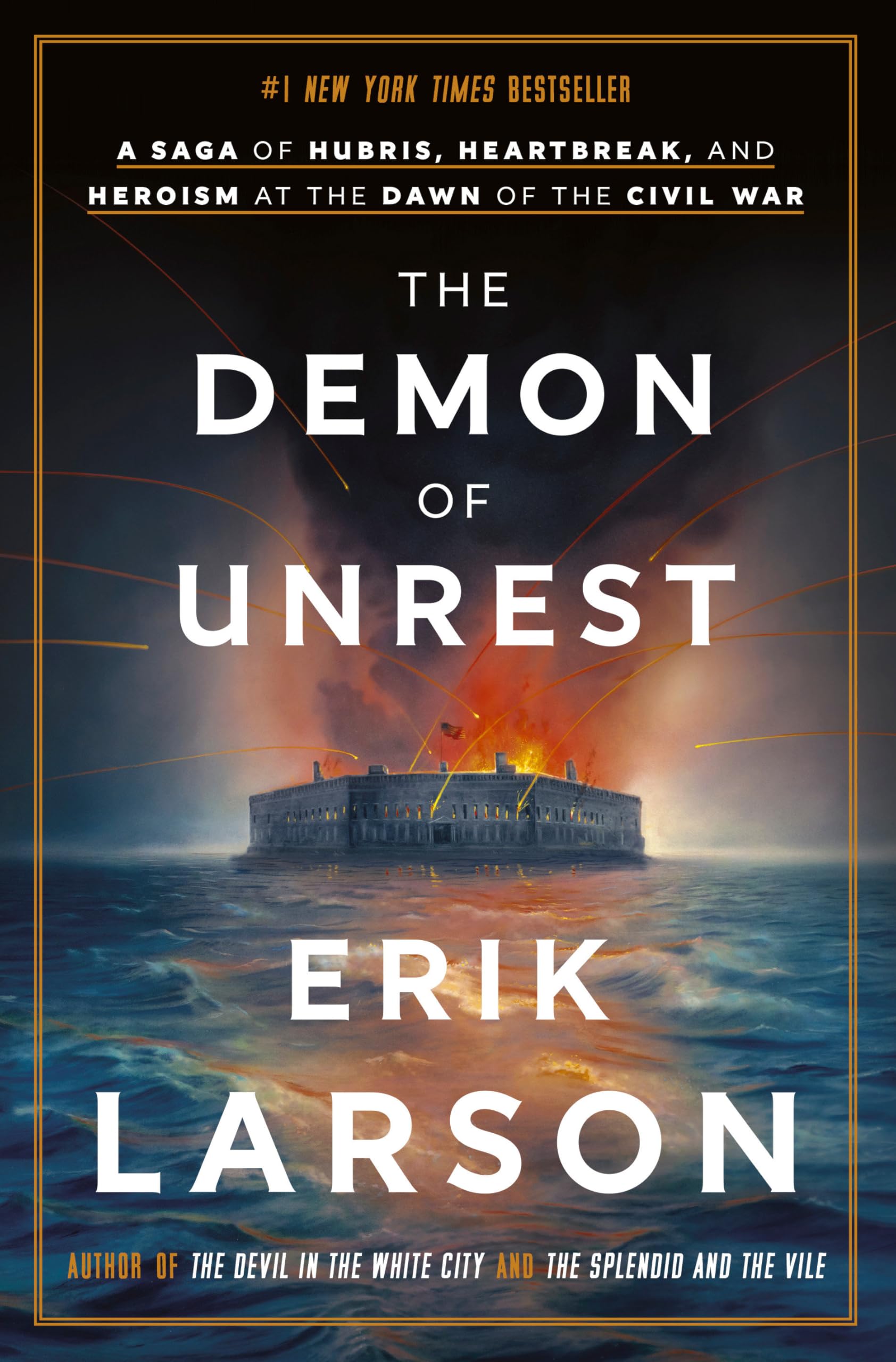
The Demon of Unrest: A Saga of Hubris, Heartbreak, and Heroism at the Dawn of the Civil War [Larson, Erik] on desertcart.com. *FREE* shipping on qualifying offers. The Demon of Unrest: A Saga of Hubris, Heartbreak, and Heroism at the Dawn of the Civil War Review: An appeal to the better angels of our nature... - At a time when our nation is perilously divided, Erik Larson publishes "The Demon of Unrest" and sounds a note of warning. He authors another winning work of narrative nonfiction detailing the events following the 1860 presidential election that propelled Abraham Lincoln to the White House and ushered in America's cataclysmic descent into civil war. Additionally, he brilliantly animates the famous characters of this period (Buchanan, Lincoln, Seward, and Davis) and lesser names such as Edmund Ruffin, James Hammond, and Mary Chesnut of the Southern planter aristocracy. Strikingly, the latter, products of generational slave ownership and owning as many as 400 slaves, vociferously and unashamedly champion the cause of slavery. Larson’s narrative serves as a cautionary tale, reminding us of the dangers of division and the importance of unity in our current social and political climate. From his extensive research, the author quotes from speeches, letters, diary entries, and other period documents revealing unapologetic pro-slavery sentiment. Through these Southerners' thoughts and comments, we learn just how, like Kudzu, slavery became wildly entwined with Southern culture. No matter how inexplicable or indefensible their position might be today, in the mid-19th century, these Americans believed it was their birthright to continue owning other human beings in the name of tradition and because slavery was so much a part of the Southern culture and rural economy. More importantly, with "The Demon of Unrest," Larson sheds light on how charged the issue of slavery was in the years leading up to Lincoln's election and, therefore, how inevitable secession would become. As always, the author’s character development is first-rate. Perhaps best of all is his treatment of Major Robert Anderson, a career U.S. Army officer and one of the central characters appearing throughout “The Demon of Unrest.” Anderson, the Fort Sumter, South Carolina commander, and gallant American patriot of the first order, became one of the early heroes of this period. We witness his painstaking preparations to fortify Fort Sumter, a U.S. Army garrison and initial Union stronghold, key terrain in the middle of Charleston Harbor and the annals of U.S. history. He and his charges remain alone on an island, steadfastly defending American ideals. Their challenge becomes existential on April 12, 1861, when the Confederates bombard the fort and two days later force its surrender to start the war. Claiming three-quarters of a million lives, the American Civil War, or the War Between the States, was a watershed event, the legacy with which we, as Americans, still live today. In addition to the author’s signature ability to capture the mood of a particular period or incident in history, Larson fans will recognize his trademark emphasis on meticulously mining historical documents to bring the story to life, for instance, capturing seemingly insignificant comments and minor actions of the characters so that we see that they, like us, were fully human. In detailing their activities, Larson transports us to an earlier age during which honor and chivalry in the Antebellum South held sway. Then, negotiations deadlocked, both sides determined not to move off their hardened positions, the nation tilts to war, and we readers have a ringside seat. The author helps us see firsthand how the Civil War, which resulted in more than 600,000 casualties over four years, was virtually a foregone conclusion. Larson writes fluidly but concisely, some chapters only a few pages long, and his sturdy vocabulary challenges readers to be Merriam-Webster-ready. His strength is pacing; he allows events to unfold in a way that captures the reader's attention and holds it transfixed for page after page. Like all his books, “The Demon of Unrest” reads like the story is happening in real-time. Larson achieves his objective; he sounds the alarm that another collapse into chaos is not far-fetched. Unrest in America is mounting. One reads "The Demon of Unrest" with his mouth agape, incredulous that these events happened and could happen again. Worry, anxiety, and fear grip the nation today just as they did in the deeply divided America of 1861. South Carolina, specifically Charleston, became ground zero for American turning on American and friend becoming foe. A charming U.S. city seemingly overnight morphed into a powder keg. Indeed, 1861 brought us a national Hatfield-McCoy moment, the American family riven by disagreement and debate. When considering our shrill and uncompromising public discourse and eroding confidence in U.S. government institutions today, readers of "The Demon of Unrest" can appreciate how easily the situation could devolve into another armed conflict. Above all else, Larson’s "The Demon of Unrest" reminds Americans that we must, in Abraham Lincoln's words, "appeal to the better angels of our nature." Review: Excellent story telling and a worthy time investment - I thoroughly enjoyed reading this book. I grew up in Pennsylvania, just outside Gettysburg, but have lived in Charleston, SC for over 10 years now and in SC for over 20. I found the author's bias toward southerners - their attitudes toward Yankees (yes, it's still a thing), their idea of honor, their society structure, etc. - all very accurate and very obviously telling. The author made no qualms of making his belief that the Civil War was exclusively based on the protection of slavery well known in the book. However, in Charleston the belief is (still) that they were fighting for State's rights and to protect their way of life, not necessarily to protect their right to own slaves. Larson truly hit the nail on the head with the dichotomy of the war's driving force and couldn't have more accurately captured the attitudes of those times and still now. Fort Sumter was vividly described and easily allowed readers to visualize the site, even for those who have never been here in person. My only negative for the book is that I felt some of the side stories could have been minimized just to keep the focus on the war. Ms. Mary Chestnut's storyline in particular I didn't feel contributed much to the story of Fort Sumter and the start of the Civil War, but would be an excellent basis for any number of spin-off stories about life in that era and/or in Charleston. If I could give this book a 4.5 out of 5, I would. Larson's research was impressive and obviously thorough. My only point deduction comes from the length that I think could have been cleaned up a little bit. Otherwise, this is a very worthy investment of time for history lovers!


| Best Sellers Rank | #2,064 in Books ( See Top 100 in Books ) #1 in American Civil War Biographies (Books) #1 in US Presidents #1 in U.S. Civil War History |
| Customer Reviews | 4.5 out of 5 stars 14,994 Reviews |
T**T
An appeal to the better angels of our nature...
At a time when our nation is perilously divided, Erik Larson publishes "The Demon of Unrest" and sounds a note of warning. He authors another winning work of narrative nonfiction detailing the events following the 1860 presidential election that propelled Abraham Lincoln to the White House and ushered in America's cataclysmic descent into civil war. Additionally, he brilliantly animates the famous characters of this period (Buchanan, Lincoln, Seward, and Davis) and lesser names such as Edmund Ruffin, James Hammond, and Mary Chesnut of the Southern planter aristocracy. Strikingly, the latter, products of generational slave ownership and owning as many as 400 slaves, vociferously and unashamedly champion the cause of slavery. Larson’s narrative serves as a cautionary tale, reminding us of the dangers of division and the importance of unity in our current social and political climate. From his extensive research, the author quotes from speeches, letters, diary entries, and other period documents revealing unapologetic pro-slavery sentiment. Through these Southerners' thoughts and comments, we learn just how, like Kudzu, slavery became wildly entwined with Southern culture. No matter how inexplicable or indefensible their position might be today, in the mid-19th century, these Americans believed it was their birthright to continue owning other human beings in the name of tradition and because slavery was so much a part of the Southern culture and rural economy. More importantly, with "The Demon of Unrest," Larson sheds light on how charged the issue of slavery was in the years leading up to Lincoln's election and, therefore, how inevitable secession would become. As always, the author’s character development is first-rate. Perhaps best of all is his treatment of Major Robert Anderson, a career U.S. Army officer and one of the central characters appearing throughout “The Demon of Unrest.” Anderson, the Fort Sumter, South Carolina commander, and gallant American patriot of the first order, became one of the early heroes of this period. We witness his painstaking preparations to fortify Fort Sumter, a U.S. Army garrison and initial Union stronghold, key terrain in the middle of Charleston Harbor and the annals of U.S. history. He and his charges remain alone on an island, steadfastly defending American ideals. Their challenge becomes existential on April 12, 1861, when the Confederates bombard the fort and two days later force its surrender to start the war. Claiming three-quarters of a million lives, the American Civil War, or the War Between the States, was a watershed event, the legacy with which we, as Americans, still live today. In addition to the author’s signature ability to capture the mood of a particular period or incident in history, Larson fans will recognize his trademark emphasis on meticulously mining historical documents to bring the story to life, for instance, capturing seemingly insignificant comments and minor actions of the characters so that we see that they, like us, were fully human. In detailing their activities, Larson transports us to an earlier age during which honor and chivalry in the Antebellum South held sway. Then, negotiations deadlocked, both sides determined not to move off their hardened positions, the nation tilts to war, and we readers have a ringside seat. The author helps us see firsthand how the Civil War, which resulted in more than 600,000 casualties over four years, was virtually a foregone conclusion. Larson writes fluidly but concisely, some chapters only a few pages long, and his sturdy vocabulary challenges readers to be Merriam-Webster-ready. His strength is pacing; he allows events to unfold in a way that captures the reader's attention and holds it transfixed for page after page. Like all his books, “The Demon of Unrest” reads like the story is happening in real-time. Larson achieves his objective; he sounds the alarm that another collapse into chaos is not far-fetched. Unrest in America is mounting. One reads "The Demon of Unrest" with his mouth agape, incredulous that these events happened and could happen again. Worry, anxiety, and fear grip the nation today just as they did in the deeply divided America of 1861. South Carolina, specifically Charleston, became ground zero for American turning on American and friend becoming foe. A charming U.S. city seemingly overnight morphed into a powder keg. Indeed, 1861 brought us a national Hatfield-McCoy moment, the American family riven by disagreement and debate. When considering our shrill and uncompromising public discourse and eroding confidence in U.S. government institutions today, readers of "The Demon of Unrest" can appreciate how easily the situation could devolve into another armed conflict. Above all else, Larson’s "The Demon of Unrest" reminds Americans that we must, in Abraham Lincoln's words, "appeal to the better angels of our nature."
A**N
Excellent story telling and a worthy time investment
I thoroughly enjoyed reading this book. I grew up in Pennsylvania, just outside Gettysburg, but have lived in Charleston, SC for over 10 years now and in SC for over 20. I found the author's bias toward southerners - their attitudes toward Yankees (yes, it's still a thing), their idea of honor, their society structure, etc. - all very accurate and very obviously telling. The author made no qualms of making his belief that the Civil War was exclusively based on the protection of slavery well known in the book. However, in Charleston the belief is (still) that they were fighting for State's rights and to protect their way of life, not necessarily to protect their right to own slaves. Larson truly hit the nail on the head with the dichotomy of the war's driving force and couldn't have more accurately captured the attitudes of those times and still now. Fort Sumter was vividly described and easily allowed readers to visualize the site, even for those who have never been here in person. My only negative for the book is that I felt some of the side stories could have been minimized just to keep the focus on the war. Ms. Mary Chestnut's storyline in particular I didn't feel contributed much to the story of Fort Sumter and the start of the Civil War, but would be an excellent basis for any number of spin-off stories about life in that era and/or in Charleston. If I could give this book a 4.5 out of 5, I would. Larson's research was impressive and obviously thorough. My only point deduction comes from the length that I think could have been cleaned up a little bit. Otherwise, this is a very worthy investment of time for history lovers!
G**.
Excellent writing, a great read
Great read. My first of this Author. He got off with a rocky start with me comparing preCivil War period with J6 entrapments. Turns out, despite his misguided politics, I enjoyed his writing style and learned somethings I did not know about the pre-war period from Lincoln’s election to the surrender of Fort Sumter. He uses Drew Gilpin Faust as a source for much of the history of Plantation owner and secessionist Hammond. I had just read her book This Republican of Suffering. It too was a first of her books I have read. For me the book flowed well with its chronological order. I learned just how much of a mess Buchanan left Lincoln in, and how much of a coward he was. He couldn’t get out of office soon enough. I was aware of Anderson’s courage, and difficulty of getting no support from Buchanan, and very little guidance and communication from Lincoln. Lincoln had his hands full at the time. I was not surprised to learn the ordeal of Ft Sumter had taken a terrible toll on Anderson. I don’t remember reading about that before, or if I did I must have been expecting such. You couldn’t help but feel sorry for the Major. He was literally caught between a rock and a hard place. And he had way more responsibilities dumped on him than his pay-grade qualified him for, nor any authority for him to set policy. The mail delays made his position just that much more dangerous and intolerable. In the end, he did his duty as best as he could with honor, and in doing so gained the respect of both the North and South. Truly, it is miraculous that there were no combat deaths at Sumpter, or the forts in Charleston Harbor. My wife and I have visited Ft. Sumter. It is humbling to imagine the bombardment Anderson and his garrison endured. While at the same time with little rest, and on reduced rations. Fire brand Edmund Ruffin’s suicide at the end of the story seemed like justice served to me. He was in large part responsible for promoting secession and the war. He took such pleasure in his hatred of the Yankees, even to his last breath he cursed them. After the Confederacy lost, the Northerners hated him just as much for having promoted it so tirelessly. He died just as he lived, filled with hatred to the end. I found it very interesting that the British Newspaperman William Russel understood the deep hatred the southern chivalry had for the North, and how naive the Lincoln administration, especially Seward in his belief that the southern chivalry were not serious about secession leading to war, and that Virginia, Tennessee and Arkansas would not join the Confederate States that had already seceded. Seward was a poor choice for Lincoln. His hubris in part only ensured that secession would lead to war. Ironic the Britt could see this, but many in the US couldn’t understand the honor code of the southern planters. In my humble opinion, the Dred Scott SCOTUS ruling really put the country on the course for war. One of the worst decisions ever handed out by SCOTUS, Roe vs Wade was almost as bad, and for similar reasons. The undervaluing of human life. And exempting a class of people from the very life, liberty and the pursuit of happiness guaranteed by our Constitution.
M**L
A detailed account of the lead up to the beginning our Civil War and the fall of Ft. Sumter
The Demon of Unrest, by Erik Larson, tells the story of the events leading up to the beginning of the American Civil War. The book covers the period from 1807 until the surrender of Ft Sumter in April 1861, but most of the story covers the events from the election of President Lincoln in November 1860 until the surrender. The story is very detailed and is based on diaries, journals, correspondence and news reports during this time. Larson identifies the leading proponents of secession: James Henry Hammond, of South Carolina, owner of over 300 slaves, and Edmund Ruffin, of Virginia. Larson also notes the raid on Harper’s Ferry by John Brown in 1859 and the effect it had on the entire south on the subject of secession. The story then goes on to the period from Lincoln’s election to the fall of Fort Sumter. Starting with South Carolina’s first debate on secession through the act itself on December 20, 1860, and their intent to seize all federal property and arms in the state, the fate of Fort Sumter was a major dilemma. Situated in the center of Charleston harbor it controlled ingress and egress to Charleston. South Carolina, considering themselves an independent nation, sent a delegation to Washington to negotiate relinquishing the fort to South Carolina; however, even President Buchanan knew formally negotiating with South Carolina would be seen as recognizing their independence. Throughout the whole crisis Buchanan did nothing decisive wishing to leave the crisis to the new President after he was inaugurated on March 4. Meanwhile, South Carolina, joined by the other states as they seceded, were building and fortifying batteries surrounding Fort Sumter. Even after Lincoln’s inauguration confusion, misunderstood orders and uncertainty of what action to take delayed any attempt to reinforce and resupply the fort; even when an attempt was finally made in April confusion on who had the authority to assign the navy ships to the mission meant that the Powhatan, the most powerful warship in the Navy, did not take part in the expedition. The relief fleet arrived too late to save the fort. This was an excellent, detailed and long account of the events leading up to the beginning of our Civil War. All of the important people leading up to this crisis were identified and their roles explained. This book is worth reading for those who want to know how to avoid such a crisis in the future.
M**N
The unfolding Civil War tragedy, expertly told
If you read this gripping tale with reasonable historical hindsight, knowing how the events expertly related here lead to the death of 750,000 American soldiers, and the injury of millions more, you cannot help but feel a searing pain in the pit of your stomach, and a deepening heartache as you note our contemporary political climate. Mark Twain said that "history does not repeat itself but it does rhyme". Catastrophe has a nasty habit of sneaking up on us, and this well-written history of the five months leading up to the onset of the Civil War is often quite unsettling. Any Civil War enthusiast will be familiar with the events detailed in this book. What author Erik Larson does carefully, and with technical skill, is provide coherence to what were a dizzying series of events, then to explain them carefully and clearly, and shape them with novelistic drive and tension. I've read enough dry academic history to appreciate Larson's ability to breath life into unfolding events. There is a place for straightforward factual academic description. It creates an ongoing chronicle that we can use to measure the significance of events. But there is also a place for unfolding an historical narrative that adds humanity to the story. It is through the scrim of living history that we can begin to understand why things happened the way that they did. Larson's skill lays in the way that he amasses relevant details, and then organizes them into something resembling a living tapestry, out of which history becomes more than merely a series of disconnected events. The Civil War started as something of a lark for so many on both sides. That is the tale related here. The opening tragedy of the Civil War was in how so many were so wrong. What was meant to be a 30 day war containing a single great battle that would decide the fate of our nation, morphed into four years of interminable all-out warfare that destroyed millions of lives. The only way for us to mitigate that horror is to learn its lessons and vow never to repeat them. Narrative history, the way it unfolds in The Demon of Unrest, is probably the best way to teach those lessons.
G**L
Compelling Civil War book.
If you are Civil War buff or just want more details to run-up to war, this book is for you. It was a bit too detailed for me but my friend loved it. Erik Larson always writes compelling and detailed books.
B**E
Ok
Ok
S**L
excellent history of the six months leading up to the civil war
Erik Larson is the best general history writer of our generation. I found the narrative fascinating, the writing excellent. I also have read his book on Churchill and recommend that too.
Trustpilot
1 month ago
5 days ago


