
DOWNLOAD THE APP


Customer Services
Copyright © 2025 Desertcart Holdings Limited
DOWNLOAD THE APP
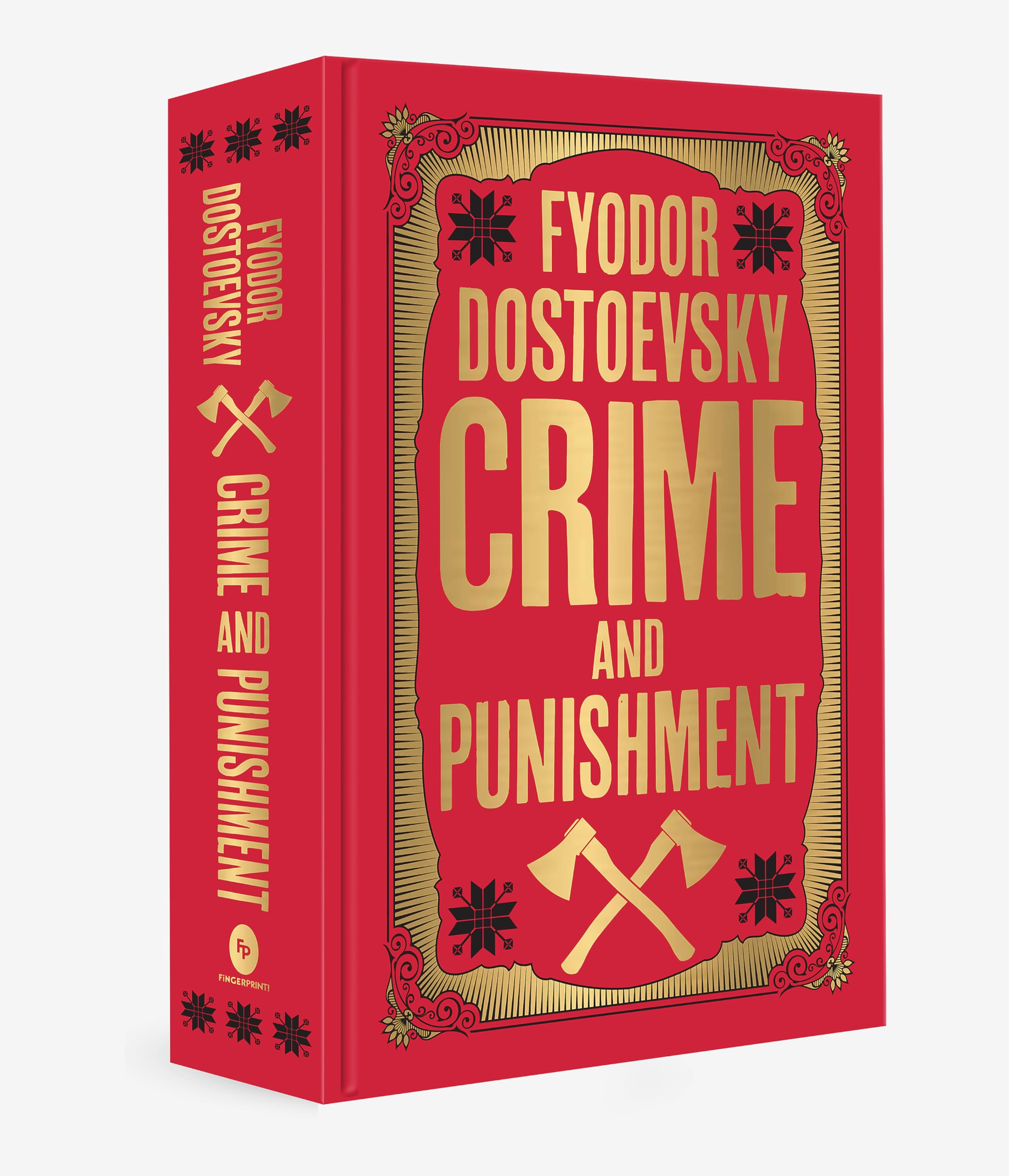
desertcart.com: Crime and Punishment: Deluxe Hardbound Edition: 9789354403798: Dostoevsky, Fyodor: Books Review: Easily one of the best classics I have ever read - Fyodor Dostoyevsky generally seemed to write books set in the quirky period of time sandwiched in between serfdom and the Communist Revolution in Russia somewhere in the late 19th century. It is a point in time which most people living today could not personally attest to or even have much knowledge about yet it seems oddly familiar in many ways to modern society. It is hierarchical with various classes having obvious advantages over the others yet it wasn't overly strict like a caste system from which one was cemented into a position in society and could not escape. It also had a strong bureaucracy which society seemed to value and hold in somewhat high regard due to an appreciation of the benefits it provides to a society in need of order and discipline while at the same time chafing at the ways in which it stifled creativity and personal freedom. Against that backdrop this book paints a portrait of a young man who commits a robbery and murder which he argues about for a fair portion of the book within his own mind as he lurches back and forth between despising himself and feeling justified in doing it "for the greater good." There is also a fair amount of characters in this book who push and pull the main character from various directions as he processes what he has done and how he really feels about it and someone much smarter than me has probably analyzed if these characters had any symbolic meaning or not, but they seem like an odd mix. The main character is a university student driven to crime by desperation mixed with intellectually inspired notions of class warfare. He meets a man at a tavern who is an alcoholic and befriends him early in the book only to later meet the mans daughter and develop a relationship with her. The woman is somewhat similar to the main character in that she is badly conflicted as well in that she professes to be a Christian yet makes a living as a prostitute due to her family being so desperately poor. She becomes a sort of moral voice for the main character. The main character's sister also appears in town and there is a whole subplot about how she is going to marry a wealthy man to help her family while at the same time being pursued/blackmailed by another man who is obsessed with her only to reject them both for an idealistic third man. There is also a detective who joins the cast at some point and suspects the main character of his crime even though he has little real evidence. He thereafter engages in a psychological game with the main character to break him into confessing. The story also has odd similarities to Doctor Zhivago and the Tell tale Heart. Edgar Allen Poe wrote the Tell tale Heart in the 1840's and FD didn't write this story until the 1860's while Doctor Zhivago was written sometime in the early 1950's but whether any are similar to another intentionally or due to mere coincidence is beyond my knowledge. I am just noting that because I kept thinking about it while I read it and so many of the characters reminded me of characters from there. In any event, the real theme of this book seems to be the conflict between faith and reason. The main character knows things he is doing (or has done) are wrong, but justifies many of them intellectually and politically only to feel conflicted about them. In the end though the book is really about a journey through the process of faith and reason while at the same time offering a commentary of what the author must have perceived as a rise in intellectual and political thoughts and actions at the expense of morality and truth. Perhaps he divined the coming Revolution or maybe the book is not that deep. I really am somewhat uncertain but I know that I enjoyed reading it and each time I read it I end up thinking more deeply about what the author means, what he was thinking and if he was trying to say something I am not yet grasping. All of these to me are good signs that a book is worthy of reading and enjoying. Review: A Psychological Masterpiece in a Stunning Edition - This deluxe hardbound edition of "Crime and Punishment" is absolutely beautiful - gold-embossed cover, thick cream pages, and a ribbon bookmark. It's the kind of edition that makes you want to slow down and savor every page, which is exactly what Dostoevsky deserves. And what a novel this is. I'd read it years ago in college and remember finding it heavy going, but returning to it as an adult was a completely different experience. Raskolnikov's psychological unraveling after committing murder is one of the most intense character studies I've ever encountered. The guilt, the fever dreams, the cat-and-mouse game with Porfiry - it's absolutely gripping. What surprised me most was how modern it feels. The existential questions Dostoevsky wrestles with - about morality, suffering, redemption, and what makes us human - are as relevant today as they were in 1866. And despite the darkness, there's genuine compassion throughout, especially in the character of Sonia. The translation in this edition is excellent and very readable. The binding is solid and the typesetting is clean and generous, making it easy on the eyes for such a substantial read. If you're going to read this masterpiece, do it right with this edition. It's an heirloom-quality book that does justice to one of literature's greatest psychological thrillers. Absolutely worth every penny.
| Best Sellers Rank | #26,230 in Books ( See Top 100 in Books ) #11 in Russian & Soviet Literature (Books) #182 in Classic Literature & Fiction #456 in Literary Fiction (Books) |
| Customer Reviews | 4.4 out of 5 stars 15,921 Reviews |
J**.
Easily one of the best classics I have ever read
Fyodor Dostoyevsky generally seemed to write books set in the quirky period of time sandwiched in between serfdom and the Communist Revolution in Russia somewhere in the late 19th century. It is a point in time which most people living today could not personally attest to or even have much knowledge about yet it seems oddly familiar in many ways to modern society. It is hierarchical with various classes having obvious advantages over the others yet it wasn't overly strict like a caste system from which one was cemented into a position in society and could not escape. It also had a strong bureaucracy which society seemed to value and hold in somewhat high regard due to an appreciation of the benefits it provides to a society in need of order and discipline while at the same time chafing at the ways in which it stifled creativity and personal freedom. Against that backdrop this book paints a portrait of a young man who commits a robbery and murder which he argues about for a fair portion of the book within his own mind as he lurches back and forth between despising himself and feeling justified in doing it "for the greater good." There is also a fair amount of characters in this book who push and pull the main character from various directions as he processes what he has done and how he really feels about it and someone much smarter than me has probably analyzed if these characters had any symbolic meaning or not, but they seem like an odd mix. The main character is a university student driven to crime by desperation mixed with intellectually inspired notions of class warfare. He meets a man at a tavern who is an alcoholic and befriends him early in the book only to later meet the mans daughter and develop a relationship with her. The woman is somewhat similar to the main character in that she is badly conflicted as well in that she professes to be a Christian yet makes a living as a prostitute due to her family being so desperately poor. She becomes a sort of moral voice for the main character. The main character's sister also appears in town and there is a whole subplot about how she is going to marry a wealthy man to help her family while at the same time being pursued/blackmailed by another man who is obsessed with her only to reject them both for an idealistic third man. There is also a detective who joins the cast at some point and suspects the main character of his crime even though he has little real evidence. He thereafter engages in a psychological game with the main character to break him into confessing. The story also has odd similarities to Doctor Zhivago and the Tell tale Heart. Edgar Allen Poe wrote the Tell tale Heart in the 1840's and FD didn't write this story until the 1860's while Doctor Zhivago was written sometime in the early 1950's but whether any are similar to another intentionally or due to mere coincidence is beyond my knowledge. I am just noting that because I kept thinking about it while I read it and so many of the characters reminded me of characters from there. In any event, the real theme of this book seems to be the conflict between faith and reason. The main character knows things he is doing (or has done) are wrong, but justifies many of them intellectually and politically only to feel conflicted about them. In the end though the book is really about a journey through the process of faith and reason while at the same time offering a commentary of what the author must have perceived as a rise in intellectual and political thoughts and actions at the expense of morality and truth. Perhaps he divined the coming Revolution or maybe the book is not that deep. I really am somewhat uncertain but I know that I enjoyed reading it and each time I read it I end up thinking more deeply about what the author means, what he was thinking and if he was trying to say something I am not yet grasping. All of these to me are good signs that a book is worthy of reading and enjoying.
R**R
A Psychological Masterpiece in a Stunning Edition
This deluxe hardbound edition of "Crime and Punishment" is absolutely beautiful - gold-embossed cover, thick cream pages, and a ribbon bookmark. It's the kind of edition that makes you want to slow down and savor every page, which is exactly what Dostoevsky deserves. And what a novel this is. I'd read it years ago in college and remember finding it heavy going, but returning to it as an adult was a completely different experience. Raskolnikov's psychological unraveling after committing murder is one of the most intense character studies I've ever encountered. The guilt, the fever dreams, the cat-and-mouse game with Porfiry - it's absolutely gripping. What surprised me most was how modern it feels. The existential questions Dostoevsky wrestles with - about morality, suffering, redemption, and what makes us human - are as relevant today as they were in 1866. And despite the darkness, there's genuine compassion throughout, especially in the character of Sonia. The translation in this edition is excellent and very readable. The binding is solid and the typesetting is clean and generous, making it easy on the eyes for such a substantial read. If you're going to read this masterpiece, do it right with this edition. It's an heirloom-quality book that does justice to one of literature's greatest psychological thrillers. Absolutely worth every penny.
P**K
A Psychological Thriller
The only thing that kept me from doing a 5-star rating was the difficulty in keeping track of characters, a drawback in other Russian novels I've read, too. Perhaps I should have started a list of characters, but that would have felt too much like reading in preparation for class discussion. However, Kindle's "X-Ray" feature was very helpful whenever I wasn't quite sure which character was involved. The story itself was very engrossing, reminding me of epsiodes of "Law & Order: Criminal Intent" and "Criminal Minds" in written form. Once the exciting force gets things moving, Dostoevsky's omniscient, third person point of view provides an intriguing view into the mind of a man trying to plan "a perfect" crime. Once the crime has been committed, the protagonist almost immediately begins agonizing over how something he forgot to do (or did) might reveal that he is the guilty person. Interjected into this situation are his sister and mother, who decide to move close to him; and his existing friends, who express concern and fear over his changed behavior. Of course, a crime novel would be incomplete without detectives and other police officials, and there are just enough of them to create all manner of havoc in the protagonist's already overly stressed mind. Eventually the question of whether he'll be discovered is superceded by the question of how he'll be caught. Or will he turn himself in because he's ashamed that his "perfect" crime fell far short of that goal? As in most Russian novels, philosophies about crime, the people who commit it, and the price they pay physically, mentally, and personally are at the forefront. At one point, the protagonist somehow rationalizes that he belongs to the "type of people" whose crimes deserve recognition and appreciation, rather than punishment. If you enjoy the "True Crime" section of your local bookstore, I think you might like this one.
T**N
Reading so exciting!
"Out of Shakespeare, there is no more exciting reading than Dostoevsky" -- Virginia Woolf. I agree. I would like to add that, in all of Dostoevsky, there is no more exciting reading than "Crime and Punishment." Let me take that a step further. In "Crime and Punishment," there is no more exciting reading than Constance Garnett's translation of THE climactic exchange between murderer Rodion Romanovitch Raskolnikov and detective Porfiry Petrovitch: " 'Then...who then...is the murderer?' he (Rodion Romanovitch Raskolnikov) asked in a breathless voice, unable to restrain himself. " Porfiry Petrovitch sank back in his chair, as though he were amazed at the question. 'Who is the murderer?' he repeated, as though unable to believe his ears. 'Why, you, Rodion Romanovitch! You are the murderer,' he added, almost in a whisper, in a voice of genuine conviction. " Wow! It just doesn't get any better, any more exciting, any more dramatic than that. Better than any other translator, Constance Garnett knocks the reader out of the armchair!! See for yourself. Compare. I could prove my point by quoting from another translation or two. But that would only bore you. And where's the fun in that? Not there. But here. Here in Chapter Two of Part Six of Dostoevsky's "Crime and Punishment" AS TRANSLATED BY CONSTANCE GARNETT. I don't care whether a translation is true to the original or not. Truth has no place in the world of dramatic fiction. If a translation improves upon the original, so much the better. Shakespeare improved upon Plutarch, did he not? For those who insist on literal translation, I would advocate for interlinear translation, which would allow us Engloids to "read between the lines" of the Russian original. I first read Constance Garnett's translation of Dostoevsky's "Crime and Punishment" when I was a student at Boston Latin School, fifty years ago. That translation seems to have gotten better with age. I would like to say the same about my self. But I won't. I can't. Why not? I'll tell you why not! I do not live "in the world of dramatic fiction." That's why not. Cheers! Happy reading!! P.S. For more on Dostoevsky and "Crime and Punishment," please see Joseph Frank's "Dostoevsky: the Miraculous Years, 1865-71," and Mikhail Bakhtin's "Problems of Dostoevsky's Poetics." P.P.S. Eureka! I have found it!! By "it," I mean the "little fact" that Porfiry tells Raskolnikov he (Porfiry) has, but won't reveal. Part Six, Chapter Two. OK. So. Porfiry refuses to tell Raskolnikov what his "little fact" is. Very well. Be that way. I, by contrast, am not so coy. I will tell my fellow Amazonians what Porfiry's "little fact" is. Porfiry's "little fact" is Raskolnikov's phony "pledge" item: a tightly wrapped-and-tied piece of metal-and-wood that Raskolnikov had made at home. Part One, Chapter Six. Raskolnikov told the pawnbroker it was "a silver cigarette case," handed it to her, and then murdered her. Part One, Chapter Seven. It was found in her hand after the murder. Epilogue. So. There you have it. Porfiry's "little fact" you can "get your hands on." Part Six, Chapter Two. How about that! Bingo!! "Never mind all this psychology stuff," as Porfiry might put it. Raskolnikov's phony "pledge" item in the murdered pawnbroker's hand was physical evidence that placed Raskolnikov right there, right then: at the murder scene, at the time of the murder. Got 'im. SECOND THOUGHTS FROM A DOUBTING THOMAS: We readers of Part One, Chapters Six and Seven, know all about the connection between Raskolnikov and the phony "pledge" item that was found in the pawnbroker's hand after the murder. Epilogue. My guess is that said "pledge" item was the "little fact" that Porfiry mentioned in Part Six, Chapter Two. Be that as it may, I ask myself whether Porfiry would have been able to link that "pledge" item to Raskolnikov -- without the benefit of Raskolnikov's confession!? We readers know that the "pledge" item found in the pawnbroker's hand after the murder was Raskolnikov's homemade decoy. Part One, Chapter Six. It was designed to -- and it did -- absorb all the attention of the pawnbroker. Part One, Chapter Seven. Diverted and pre-occupied with untying and unwrapping the "pledge" item, the pawnbroker became unaware of Raskolnikov as he opened his coat, pulled out his axe, and raised it over her head. Id. After the murder, the "pledge" item was found in the pawnbroker's hand. Epilogue. OK. So. There you have it. The "little fact." Part Six, Chapter Two. The thing "you can get your hands on." Id. That raises this question: Was there anything in, on, or about the "pledge" item that could connect it to Raskolnikov? I don't know the answer to that question. I think I'm so smart. And yet, I'm stumped. I really am. Assuming the "pledge" item found in the hand of the murdered pawnbroker came from the murderer, such a murderer must have known that the pawnbroker made loans secured by "pledge" items. Such knowledge, however, was common knowledge. Everybody knew. But not everybody would be allowed in by the pawnbroker. There were no signs of entry having been forced. So, the pawnbroker must have let the murderer in. Whom would she let in? Someone she knew. A known customer, quite likely. A known customer bearing a "pledge" item. Raskolnikov was the last customer to come forward and claim valuables pawned before the murder. So, in a narrow field of promising suspects (i.e., customers of the pawnbroker), Raskolnikov was the one who stood out. But still! Raskolnikov's delay in coming forward is psychological or behavioral evidence, not physical evidence, not a "thing" that you can "get your hands on." Part Six, Chapter Two. By contrast, the "pledge" item found in the hand of the murdered pawnbroker IS physical evidence. Epilogue. How could Porfiry connect Raskolnikov to that "pledge" item? That is the question. The easy answer is that Raskolnikov's confession made the connection. Epilogue. The more difficult question is this: What if Raskolnikov had not confessed? How could Porfiry have connected Raskolnikov to the "pledge" item found in the murdered pawnbroker's hand? By other physical evidence? By psychological and/or behavioral evidence? By something else? By some other way? I wonder. I also wonder whether Porfiry's "little fact" might be the stone under which Raskolnikov hid what he had stolen from the pawnbroker. Raskolnikov told Zametov about the stone; Zametov told Porfiry; and Porfiry asked Raskolnikov to leave a note about the stone if he decided to commit suicide. Such a note would give Porfiry a "thing he could get his hands on," together with Raskolnikov's own handwriting connecting him to it. Oy! All this writing, all this thinking, all this reading, all this . . . What, in the end, what does all this come down to? I am left guessing, wondering, thinking, writing. What if Porfiry's "little fact" was something other than the "pledge"? something other than the stone? something else entirely? something I did not write down? something that did not even occur to me? What then? Who knows? Who can say? I, for one, cannot say. For, I do not know. I want to know. But I do not know. I am left wondering. To this day, this hour, this moment, that is all I can do. I can only wonder. And THAT, to my way of thinking, is not a bad state of mind to be in. Not bad at all. Good, actually. Even wonderful. Yes. Of course. Now I see it clear and say it plain: It is wonderful to wonder! PENULTIMATE PARAGRAPH: By continually referring to Alyona Ivanova not by her name, but as "the pawnbroker," I took away her identity, her personality, her life. I did not intend to do so. Nor would I want to do so. And yet, I did do so -- unintentionally, inadvertently, not knowing what I did. Unfortunately, this is one of those contexts in which a person is identified not by who they are (Alyona Ivanova) but by what they do (pawnbroker). So, please. Help me out here. Do me a favor. When you read "pawnbroker," think "Alyona Ivanova." ULTIMATE PARAGRAPH: Rodion Romanovitch Raskolnikov deserved the death penalty. Alyona Ivanova and her step-sister Lizaveta did not. Their lives were infinitely more valuable and virtuous than his. They did not coldly and calculatedly butcher two innocent defenseless old ladies. He did. They did not deserve to die. He did.
C**P
Stirring, Intense, Shocking... a Masterpiece of Literature
Over the course of my 47 years I've read many classics of 19th- and 20th-century literature. This was my first novel by Dostoevsky but it won't be my last. Crime and Punishment may be the most gripping novel I've ever read, and I didn't just read the story... I consumed it voraciously. I was mesmerized, enthralled, anxious, and confounded at times. Even that was good and a part of the reading experience. It's true that it takes some work to read Dostoevsky, but it's worth the effort. He has a style all his own. I had to re-read certain passages multiple times to understand fully the scope of a particular conversation or event, as the author intended. However, the process for me was never tiresome; I wanted to soak in every detail. I won't rattle on about the story itself -- others have already done that here, and probably more effectively than I could do anyway. Let me just say that the premise of the novel is compelling, the characters are first-rate, and the ever-crumbling dynamics between Raskolnikov and his friends and family are painfully realistic. The reader gets a bird's-eye view into the innermost workings of an agonizingly conflicted mind. For me, Crime and Punishment was a profound and satisfying reading experience, one that will stay with me forever. This isn't so much because of the subject matter or the "moral of the story", which warns against over-intellectualizing and getting swept up in the social thinking of the day. No, what I liked best was how the author got me to care intensely about almost every character in the story. I know now why author Michael D. O'Brien (Sofia House, Father Elijah) was influenced by Dostoevsky, and why he is often compared favorably to the Russian storyteller.
J**E
What to do with this book?
**Warning: Spoilers** I don't think I've ever come across a book quite like Crime and Punishment. Usually, I can at the very least quickly classify a book in the broad terms of "I liked it" or "I didn't like it." Crime and Punishment doesn't really fit in this paradigm. I can't tell you if I liked it or not, because I don't know. In fact, it almost defies description at all. Nevertheless, I will say what I can about Dostoyevsky's novel. The basic plot centers on a young man named Raskolnikov who commits a double murder early on in the story. The rest of the book details the slow, agonizing punishment of that crime, which for him is an internal battle between his intellect, which says that he has done no wrong, and his conscience, which informs him that what he did was in fact very wrong. His internal strife slowly eats away at Raskolnikov to the point where he confesses his crime and is sent to Siberia for hard labor. While in Siberia, his suffering for his misdeeds reaches a climax, and as a result he finds redemption and is reanimated as a person. His soul is restored. The positive elements of the book are several: First, there are multiple scenes which evoked strong emotional reactions as I read. Dostoyevsky had an amazing ability to write viscerally. Second, the novel displays (accurately, in my view) the destructiveness of adhering to a false worldview. Raskolnikov came close to breaking down throughout the story, precisely because he could not reconcile his worldview with reality. Conversely, the author represents well the transformation or regeneration that occurs with true repentance--a lesson that will forever ring true. There are several negative elements of the book, though. As is typical with Russian literature, it is a heavy, long read. I personally could not say that I enjoyed reading it, but while hard, it was worthwhile. (Perhaps it is the literary equivalent to eating one's vegetables?) In addition, Dostoyevsky had several side stories that dealt with the current events of the day--events with which I was completely in the dark. I admit, this is probably more of a commentary on myself than the book, but since I am not in academia and have precious little time to read as it is, it makes little sense for me to study up on such details just to read a book. Overall, I am just not sure what to do with this book. It speaks to the reader on multiple levels and contains much that is good, but it was not particularly a "good read" in the sense that it was not a book I would recommend to curl up with next to a fire. Reading it was more like running a marathon without knowing where the finish line was. On balance, I am rating this book 3 stars, which I freely admit may reflect more on me than Dostoyevsky's classic work.
D**W
My love/hate relationship with this novel
Never have I had such a love / hate relationship with a novel. To be fair, there wasn't anything I necessarily hated about Crime and Punishment, rather, there were just so many times I was frustrated with it. In an earlier update I made as I was reading this I compared the book to jazz and as a precursor to novels such as 'Manhattan Transfer' and the modern art movement. I still stand by that statement but I feel Dostoyevsky's novel was more of a fitful start to the 'modern' movement and that it would take a much more conscience effort by later writers to really improve this style of novel writing. Of course, Dostoyevsky didn't set out to write the first 'modern' novel, but he was reacting to modern life and the freedoms that come with it. And that's the odd thing about this book - the freedom that suffocates our characters. True, most everyone in the book is wretchedly poor and thus shackled by poverty or alcoholism or pride or some other wicked vice, but they're free to decide how to behave in such a setting. Everyone is bothered by regrets; except Sofia (the hooker we never see turn a trick and who has the now over-done 'heart of gold' trope) but they're all regrets that were of their own conscience making. They chose to kill, or be lecherous, or terrible in some other way and they knew it and they all regretted it. There was no one to guide them - everyone in authority was either non existent or corrupt in some way - and so this 'modern' world has to be navigated blind. And that's the problem. All this freedom is stifling. Nobody knows what to do. Nobody knows if they even have free-will. Nobody has an identity - except, of course, Sofia. Raskolnikov kills two people just to feel something, anything, to see what he's 'made of', what his place in society is and when he gets to Siberia he finally feels free because he now knows his place. And he resents it, which is pretty funny and probably this joked is missed because the rest of the book is so damn depressing, but it's funny that he hates it all but at least he knows what to hate. It's a wonderful joke Dostoyevsky tells here and makes the rest of the book worth it. So I'm not sure the book could have been written any different, but the claustrophobia of it all, the long soliloquy's that, while fascinating, really go on and on and on and never really resolve anything - which is why it's funny when Razumikhin says we'll talk our way to the truth. The fact Dostoyevsky was able to pull this novel off is a feat and makes the book earn its place as a true masterpiece. I personally don't think I ever want to revisit it and I'm wary of reading more Dostoyevsky, but I loved that the book challenged me so much and it did have some wonderful moments that are truly unforgettable - the horse beating, the murders, anything concerning Svidrigailov. As a student of human behavior (and I use the term cautiously after reading this book), Crime and Punishment is a must read for its psychology and for its art. I can't give it 5 stars (so arbitrary, but here we are) because of my own personal tastes, but it is a '5 star' novel in every regard. I loved it and I hated it; which is why it was almost perfect.
A**4
A Soul’s Descent and Redemption
Fyodor Dostoevsky’s Crime and Punishment is a gripping plunge into guilt, paranoia, and ultimate redemption. Raskolnikov’s unraveling—panic and odd behavior begging for discovery—hooks you, while the emotional payoff of love and forgiveness lands hard. The scope and characters are deep, though not overwhelmingly epic, and the prose, while chatty and initially tricky, grows engaging with its underlying meanings: shame, isolation, and pain> The slow first half drags slightly, but the powerful themes make it a standout.
Trustpilot
3 days ago
1 month ago