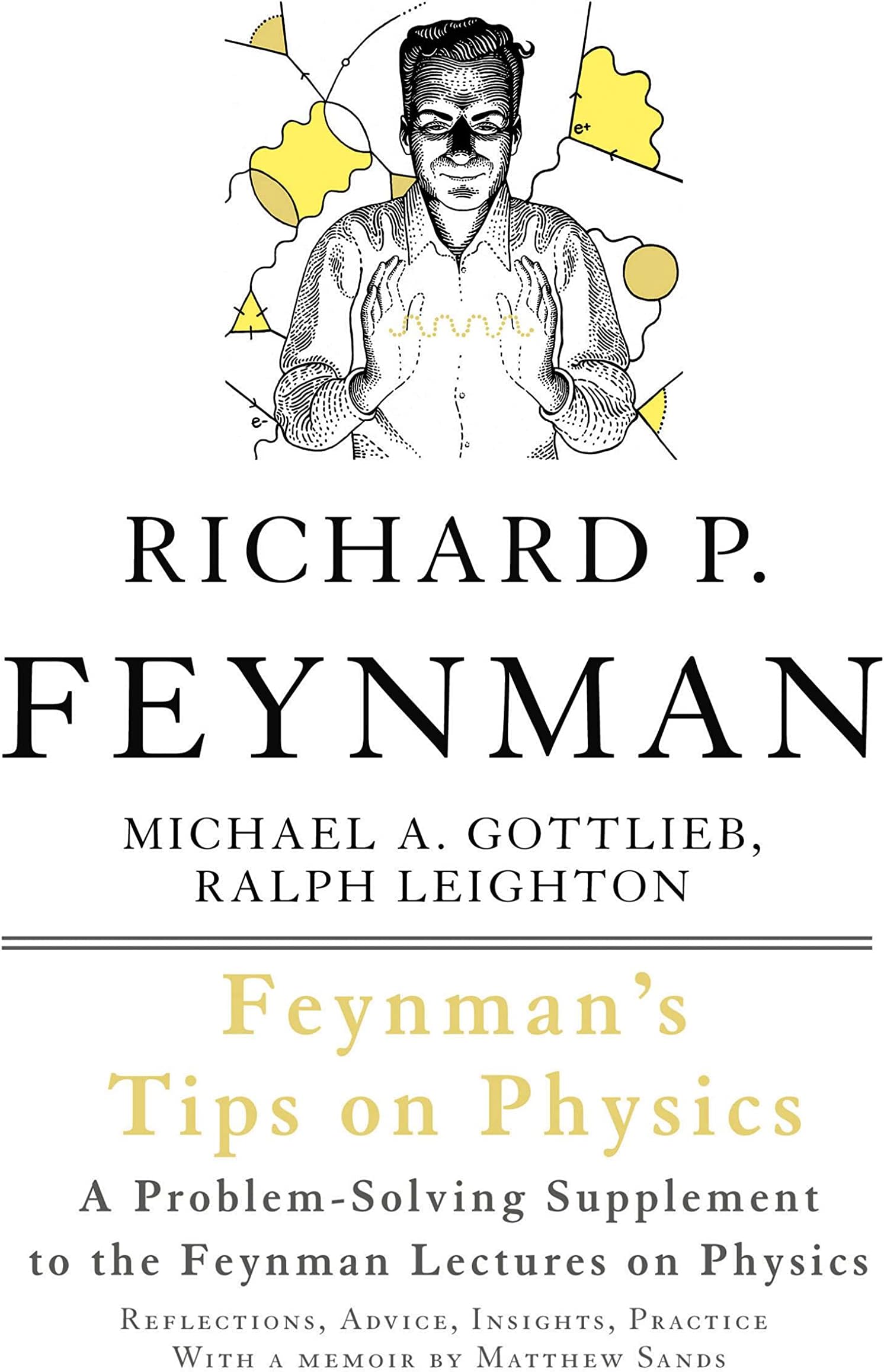
Feynman's Tips on Physics: Reflections, Advice, Insights, Practice
Product ID: 57640236
Buy anything from 5,000+ international stores. One checkout price. No surprise fees. Join 2M+ shoppers on Desertcart.
Desertcart purchases this item on your behalf and handles shipping, customs, and support to Denmark.
Buy Feynman's Tips on Physics: Reflections, Advice, Insights, Practice 2 by Gottlieb, Michael, Feynman, Richard, Leighton, Ralph, Gottlieb, Michael, Leighton, Ralph, Feynman, Richard (ISBN: 9780465027972) from desertcart's Book Store. Everyday low prices and free delivery on eligible orders. Review: Feynman = Physics - Feynman's books are the best ones to learn Physics, or rather to learn how to manage a physical problem, that does not depend on how many formulas we know. Basically, Feynman teaching's method is not based on explaining all the formulas or all the mathemtical derivation, but he tries is to teach how to think about a physical problem. I strongly suggest to every student who is attending a Physic course to read "Tips on Physics". It is a pleasure to read and helps to figure out the most important physical concept that a student should have. At the end of the book, there are some nice and challenging exercises. It is not possible to learn Physics without doing exercises! Review: Great book - Great book , as described , arrived really quickly


| Best Sellers Rank | 95,584 in Books ( See Top 100 in Books ) 207 in Scientific History & Philosophy References 237 in History of Science (Books) 476 in Popular Science Physics |
| Customer reviews | 4.7 4.7 out of 5 stars (352) |
| Dimensions | 13.84 x 2.16 x 20.96 cm |
| Edition | 2nd |
| ISBN-10 | 0465027970 |
| ISBN-13 | 978-0465027972 |
| Item weight | 209 g |
| Language | English |
| Print length | 208 pages |
| Publication date | 29 Jan. 2013 |
| Publisher | Basic Books |
A**O
Feynman = Physics
Feynman's books are the best ones to learn Physics, or rather to learn how to manage a physical problem, that does not depend on how many formulas we know. Basically, Feynman teaching's method is not based on explaining all the formulas or all the mathemtical derivation, but he tries is to teach how to think about a physical problem. I strongly suggest to every student who is attending a Physic course to read "Tips on Physics". It is a pleasure to read and helps to figure out the most important physical concept that a student should have. At the end of the book, there are some nice and challenging exercises. It is not possible to learn Physics without doing exercises!
G**R
Great book
Great book , as described , arrived really quickly
D**S
Replacement for this book taken by my son's colleague
My son owned this book in the hardback version. I had purchased it as part of a gift for his successful completion of his M.Sc. Sadly it proved to be too tempting for one of his colleagues and it was removed from his office. The paperback was bought as a replacement. The contents are well worth reading and using for reference on occasion.
C**D
As you'd expect
Very good book, playful and educational. I'd have loved to have been taught by the great man himself.
J**A
Interesting.
Girls didn't do physics when I was at school so I never really understood what it was about. I found this book really helpful.
W**G
Whilst I would not recommend this for a lay reader
100 or more years from now Feynman will be valued and admired for all the reasons he is valued and admired right now, and this collection epitomises the breadth and depth of a remarkably gifted man. He never patronises or talks a subject down, but he always respects the reader/listener. Whilst I would not recommend this for a lay reader, anyone with a maths or engineering background will fall in love with physics all over again.
J**Y
Total enthusiasm
Typical Feynman fayre , this is a must read for anybody with any interest in Physics.
C**E
Feynman's Typs on Physics
The book is very well structuresd, written, and also compact. A perfect complement to the theory 3 books, Feynam lectures on Physics.
M**A
Ótimo produto muito bem apresentável. O conteúdo ainda está sendo analisado.
L**Z
Good roman, reportage, has a simple language for understand.
B**N
A basic book of physics by a brilliant scientist and teacher. Presentation of the subject is lucid and simple.
S**T
What can I say that was not said! It's a great book. Everybody should read all of his books.
P**L
'Feynman's Tips on Physics' - actually assembled by Michael A. Gottleib and Ralph Leighton, is a gem that may well be in disguise, because too many may believe it's only of benefit to first year Calculus Physics students. This is emphatically not so, because as any of us who've taken the Physics GRE know, the bulk of the questions arrive from 1st and 2nd year undergrad courses, and thus Chapter Five ('Selected Exercises') is terrific preparation, say along with using GRE Test booklets for drills. Before Chapter Five, one has the solid basis for approaching physics problems thoughtfully as opposed to mechanically. Too often, physics students are tempted (when confronted with the problem sections at the end of chapters) to just want to grab the nearest formula or equation and pump in numbers. Despite the fact we may teach or try to impart the underlying principles, say in the principle of the rocket (Ch. 3. pp. 80-88), students inevitably want to take short cuts....especially in our hyper-tech culture with Facebook, Twitter beckoning for attention. Feynman bids the student 'Slow down!' and master the physical principles before jumping the gun. As noted above, this is beautifully illustrated with his examples of the 'rocket' problem. His "roller machine" thought experiments (Chapter Two, pp. 50 -63) are also wonderful in terms of stimulating class discussion, say as an introduction to Newtonian mechanics. I also loved his treatment of escape velocity (pp. 64-66) and satellite motion (via Kepler's laws) on pp. 71-76, which is significantly better than that portrayed in many 1st year astronomy books. As for his extensive Chapter Four, dealing with aspects of gyroscopic motion, while some may pooh-pooh it as overly obsessive about one form of dynamical motion, the payoff comes from p. 125 when we see the varied applications: to the Earth's nutation, to angular momentum of the planets (as it relates to the nebular hypothesis) and to angular momentum in quantum mechanics. In other words, the gyroscopic motion acts as the basis for forging a unifying theme. I was also extremely gratified that the authors included Chapter One on 'Prerequisites' because to me they nailed most of the basic areas many students are deficient in. This includes differentiation of products and quotients (pp. 19-22), vectors (including writing vector notation - say for the components contributing to the Hall current, or other examples) and differentiating vectors. Perhaps other instructors haven't had such problems, but when I taught the Calc Physics courses I often found I had to go back to show the basics to all of these operations! The students had entered the course without having the math prerequisites! To put it frankly, this is a book I wished had been available when I was teaching Calculus Physics for A-level 25 years ago. But today I can see it would be a useful adjunct to any first year calculus physics course. Though line integrals (pp. 30-33) aren't usually taken at this stage. These are typically reserved for the first actual year of taking Classical Mechanics, say applied to the 'principle of least action'. As is well known by most who've read or used Fenyman's 'Lectures on Physics', the original problem with them was that too many had perceived they were designed for a first year physics course at Caltech, but in the end this proved too ambitious. In fact, the (live)original Feynman lectures themselves (get hold of any of the available audio tapes and play them) could probably have been considered an ambitious honors approach to physics- and the published 'Lectures' as an advanced resource text. I certainly made use of many of its individual sections when I taught A-level physics and Calc physics - for example the fantastic section on planetary motion - to encourage student projects. Having both the 'Lectures' and this book 'Tips on Physics', makes for an excellent repository of supplemental resource materials. In this sense I don't diss one (e.g. 'Tips') and extol the virtues of the other ('Lectures') but view them as complementary resources with the 'Tips' more immediately useful in getting 1st year physics students' problem -solving skills to the level they need to be to progress. Strategically-selected sections of the 'Lectures' can then assist in reinforcing the problem solving skills and completing higher level objectives.
Trustpilot
1 month ago
1 day ago