
DOWNLOAD THE APP


Customer Services
Copyright © 2025 Desertcart Holdings Limited
DOWNLOAD THE APP
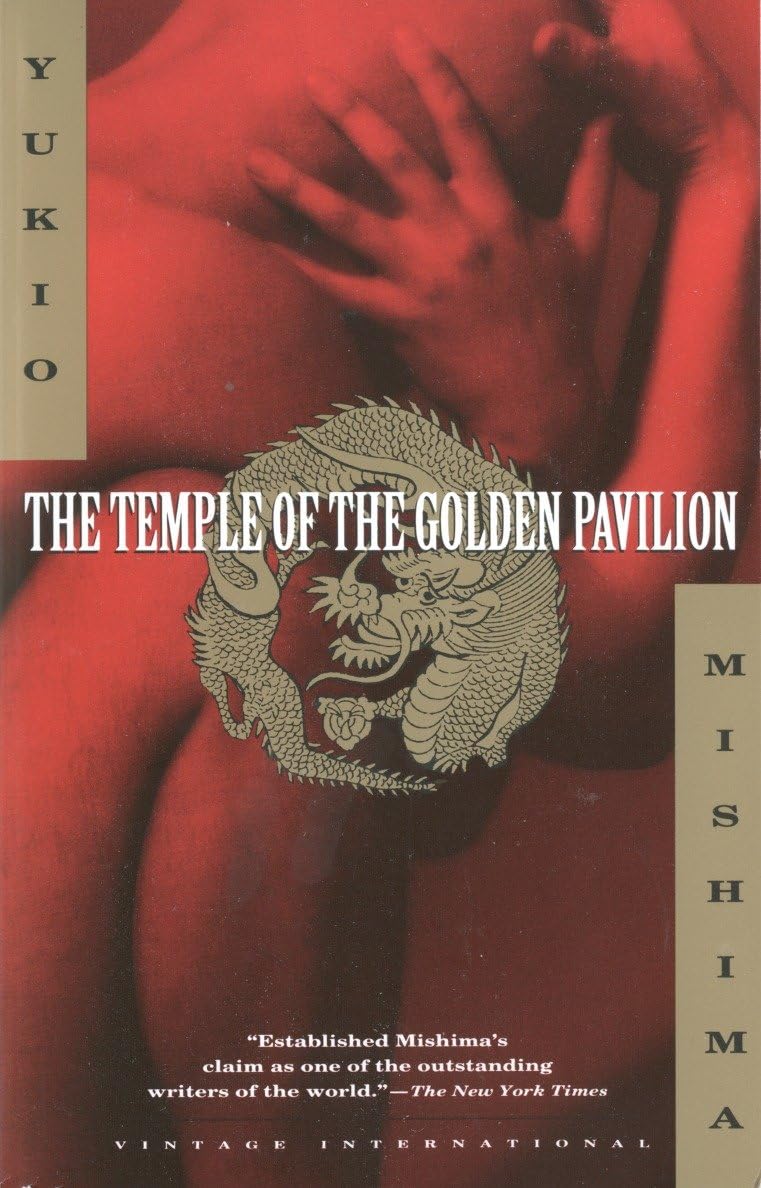
desertcart.com: The Temple of the Golden Pavilion: 9780679752707: Yukio Mishima, Ivan Morris, Nancy Wilson Ross, Fumi Komatsu: Books Review: Every Mishima novel is its own unique, integral universe. This is a true story. - It's said that even the most exalted auteurs are mainly rewriting their one driving vision in various incarnations. Hitchcock, Truffaut, Melville, Godard come to mind. Even though I'm necessarily viewing Yukio Mishima's ouevre through the refracted lens of various English translators, in my ongoing binge I am coming to the realization that, like Stravinsky, Mishima remakes his language, his choreography, his orchestration, his POV, his most intrinsic philosophy, his narrative trajectory wholly invested and recreated in each unique work. The Temple of The Golden Pavilion is a novel based on true events. Mizoguchi is a Zen acolyte, son of a Buddhist priest, apprenticed at the Golden Pavilion. We are witness to his coming-of-age, pathologically, beginning from an abusive act of ultimately inhumane hypocracy from his father, through his Travis Bickle trajectory into evangelistic mania and ultimate catastrophe. (Don't make the same mistake I did by reading Nancy Wilson Ross' inadequate introduction; just read from Mishima's beginning.) Not since Joseph Heller's extraordinary incipient descent in Something Happened have I read such a compelling and repelling narration of incipient madness. The tyranny of beauty, the purity of evil, the pervasive sense of 'unease', so clearly in kinship with the German 'unheimlich': uncanny; the uncontrollable trembling of the hands indicative of psychosis only given voice and witness by Mariko, this Taxi Driver's Whore With a Heart of Gold; the inviolate and indestructible quality of human life and the immortality and fragility of symbols and structures. The crazier he gets, the more hallucinatory and beautiful the prose becomes. Beginning in a place of utter, ascetic and emotionless inception, Mishima escalates Mizoguchi's perverse but inexorable pursuit of knowledge into an ecstasy, an unfettered erotic and evangelical incendiary impulse. Review: The master at work - Writers like Mishima resonate through history. He is also a man who spoke his mind and backed up those thoughts with action. If he said he was going to do something, he did it, including killing himself at the end of the writing of the Sea or Fertility. His writings will live forever

| Best Sellers Rank | #58,117 in Books ( See Top 100 in Books ) #16 in Japanese Literature #864 in Coming of Age Fiction (Books) #3,767 in Literary Fiction (Books) |
| Customer Reviews | 4.6 out of 5 stars 645 Reviews |
C**Y
Every Mishima novel is its own unique, integral universe. This is a true story.
It's said that even the most exalted auteurs are mainly rewriting their one driving vision in various incarnations. Hitchcock, Truffaut, Melville, Godard come to mind. Even though I'm necessarily viewing Yukio Mishima's ouevre through the refracted lens of various English translators, in my ongoing binge I am coming to the realization that, like Stravinsky, Mishima remakes his language, his choreography, his orchestration, his POV, his most intrinsic philosophy, his narrative trajectory wholly invested and recreated in each unique work. The Temple of The Golden Pavilion is a novel based on true events. Mizoguchi is a Zen acolyte, son of a Buddhist priest, apprenticed at the Golden Pavilion. We are witness to his coming-of-age, pathologically, beginning from an abusive act of ultimately inhumane hypocracy from his father, through his Travis Bickle trajectory into evangelistic mania and ultimate catastrophe. (Don't make the same mistake I did by reading Nancy Wilson Ross' inadequate introduction; just read from Mishima's beginning.) Not since Joseph Heller's extraordinary incipient descent in Something Happened have I read such a compelling and repelling narration of incipient madness. The tyranny of beauty, the purity of evil, the pervasive sense of 'unease', so clearly in kinship with the German 'unheimlich': uncanny; the uncontrollable trembling of the hands indicative of psychosis only given voice and witness by Mariko, this Taxi Driver's Whore With a Heart of Gold; the inviolate and indestructible quality of human life and the immortality and fragility of symbols and structures. The crazier he gets, the more hallucinatory and beautiful the prose becomes. Beginning in a place of utter, ascetic and emotionless inception, Mishima escalates Mizoguchi's perverse but inexorable pursuit of knowledge into an ecstasy, an unfettered erotic and evangelical incendiary impulse.
C**L
The master at work
Writers like Mishima resonate through history. He is also a man who spoke his mind and backed up those thoughts with action. If he said he was going to do something, he did it, including killing himself at the end of the writing of the Sea or Fertility. His writings will live forever
F**N
Lovely, disturbing
Disturbing, because The Temple delves deeply into the mind and motivations of a sick individual, making understandable if not nearly inevitable, his horrible destructive deed. The fact that the plot parallels the true story of the Temple of The Golden Pavilion's destruction (in 1950)makes the story all the more chilling and suspenseful. Ultimately,this novel will usher the thoughtful reader into areas of self reflection concerning the nature of beauty, unattainable perfection, and the harshness of life. Lovely, because Mashima is adroit at immersing the reader into a serene and beautiful world, even if it is one seen trough the eyes of a problematic individual. Several reviewers mentioned 'repetitive" or "heavy" - I think that most readers of Japanese writing will not find this so, rather The Temple Of The Golden Pavilion paints a picture of a whole life seen through the eyes of one person, so the perceptions are necessarily narrow. The story unfold through the eyes of an isolated, lonely and flawed young man, who despite his speech impediment has many privileges, and several opportunities to overcome his self doubt. This is not an uplifting book. Some of Mashima's other works are more of a joy to read; I definitely would not recommend this book as your first Japanese nor your first Mashima novel. Some suggestions: the sweet, hopeless love story with a hidden edge, Spring Snow, or the lyrical and poetic Sound Of The Waves.
A**R
Accessible Mishima and a broody visual psychological thriller
Great introduction to Mishima's work and a fantastic way to think about the Kyoto area as you travel. Mishima imagines a psychologically disturbing experience of destruction, and makes it seem natural and understandable. Did you ever wonder about the effect of fires, wars, floods, earthquakes and direct human destruction on a society where historical memory is formed from totally destructable timber? The human force can be seen as another natural element bringing destruction and creation. Beauty is only as reliable as your ability to imagine it's destruction and renewal. It is never permanent. Perhaps it's the only book I ever read where the decision to live reflects the utter despair of the hero. Great fun!
J**Y
Mishima is a literary genius
Mesmerizing writing, an unforgettable story, and narration which makes the insane and absurd seem all too relatable. I read this book for a college course, but I will never forget it. I am currently rereading it and continuing to gain appreciation for its depth, delicate character development, and masterful writing. No setting seems as mystical and foreign as the Golden Temple, and no protagonist is more of an anti-hero than the young Mizoguchi, who is out of touch with reality to the point where the reader, through Mizoguchi's eyes, will experience difficulty getting a solid grip on the reality within the narrative. This novel documents Mizoguchi on his quest to unleash his inner self onto the outer world and destroy the epitome of beauty which taunts him every day. Not a light read, but you may find yourself unable to put it down.
T**N
Outstanding non-fiction novel
In 1950, a psychologically deranged acolyte burned down one of Japan's national treasures. Mishima enteres the mind of the perpetrator, crafting a fictional account of "How could anyone do something like this?" The story follows the antagonist, a physically ugly stuttering child, as he wages a mental war against beauty in general, and the Temple of the Golden Pavilion in specific. The greatness of the work is in how it shows, rather than tells. The narrator mispercieves people's reactions, misinterprets Zen parables, and sees the world in a very different light. As the reader, we are left to fill in the spaces ourselves. Despite cultural barriers, the translation is strong enough to allow us to fill in the blanks. In a sense, this could be called the predecessor to Truman Capote's In Cold Blood. Through deep research and interviewing, Yukio Mishima creates a psychological explanation of a major public crime. Mishima preceded Capote by several years, and could be credited with inventing the non-fiction novel. In all, this is a fantastic work. As acts of random violence and terrorism still remain unexplained, the novel finds itself remarkably timeless.
L**T
A disturbing portrait that sheds light on Zen Buddhism and radical nihilism.
The Temple of the Golden Pavilion (1956) by Yukio Mishima Book Review by Mary P. Warning: Graphic and sexual content, recommended for an adult audience. Background and Summary: Based on a shocking crime involving the torching of a National Treasure in 1950, Mishima framed the factual record of the perpetrator’s trial and masterfully crafted the vivid narrative of a Zen Buddhist acolyte, whose obsession with beauty reflects a dark pathological history and nihilistic worldview. Set in imperial Japan, at the onset of WWII- Pacific War, from the bombing of Tokyo to foreign occupation of post-war Japan, the character driven plot is structured around chapters that chronicle the growth and education of the main character, Mizoguchi (ages thirteen to twenty-one). He moves from his hometown on Cape Nariu to attend middle school in Maizuru, transitioning to Rinzai Academy in Kyoto after his father’s death, where he serves as an acolyte under Father Dosen at the Golden Temple, and with the Superior’s recommendation, enters Otani University. In his vision, the Golden Temple symbolizes “a beautiful ship crossing the sea of time” (20); immutable and eternal, its shadow reflected on Kyoko pond is viewed “more beautiful than the building itself,” because its architectural structure represents a combustible carbon relic of the past. Main Characters: Mizoguchi, portrayed as a lonely and unhappy stutterer, unable to vocalize articulately, yet aptly streams inner thoughts of his outer reality by revealing dysfunctional relationships with his parents; and voices negative views of women as treacherous (his mother and Uiko) or loose (harlots). A social psychopath lacking compassion, he distances his feelings from his sadistic actions, and blames others, such as the American GI for intimidating him, and scorns Father Dosen’s silence in not confronting his transgressions, while mocking his hypocrisy and weakness for prostitutes. By comparison, his friendship with the gentle, kind-hearted, well-intentioned Tsurukawa, is viewed as brightness, the polar opposite of his darkness, as Tsurukawa’s positive spin on life whitewashed his own ugliness to nothingness, and turned “all shadows into light” (83). In contrast, his association with the self-sufficient, club-footed Kashiwagi can be seen as negative, because of his twisted logic, barbed paradoxes, and dogma that a physical existence without attaining love is sufficient in itself. Viewed through a distorted lens—“to live and destroy were one and the same thing” (112) ―a chilling developing psychotic picture of Mizoguchi emerges. Evaluation of Work: Four stars for balancing artistic characterization with vivid imagery in The Temple of the Golden Pavilion, Mishima reveals pathological insights into the schizophrenic mind that allows the darkness of the night to cloak the darkness of the heart, and reflects the nihilistic worldview that life is meaningless and absurd. Symbols of beauty and desire should be destroyed, in order to detach and free oneself from a world of illusion. Paradoxically, attachment brings pain, but detachment releases joy.
C**E
Mishima: Japanese Golden Pavilion
Another sensitive and deeply lovely novel from Yukio Mishima. I read recently that the book influenced Yoko Ono’s art, which inspired me to purchase the book. The pace is like a Zen meditation navigating all the byways in a self-contained world both of uplifting beauty and of life-changing heartbreak. I highly recommend this book for anyone interested in Japan’s Zen Buddhist culture.
Trustpilot
4 days ago
3 weeks ago