
DOWNLOAD THE APP


Customer Services
Copyright © 2025 Desertcart Holdings Limited
DOWNLOAD THE APP


🖨️ Elevate your 3D prints with marble elegance and pro-grade precision!
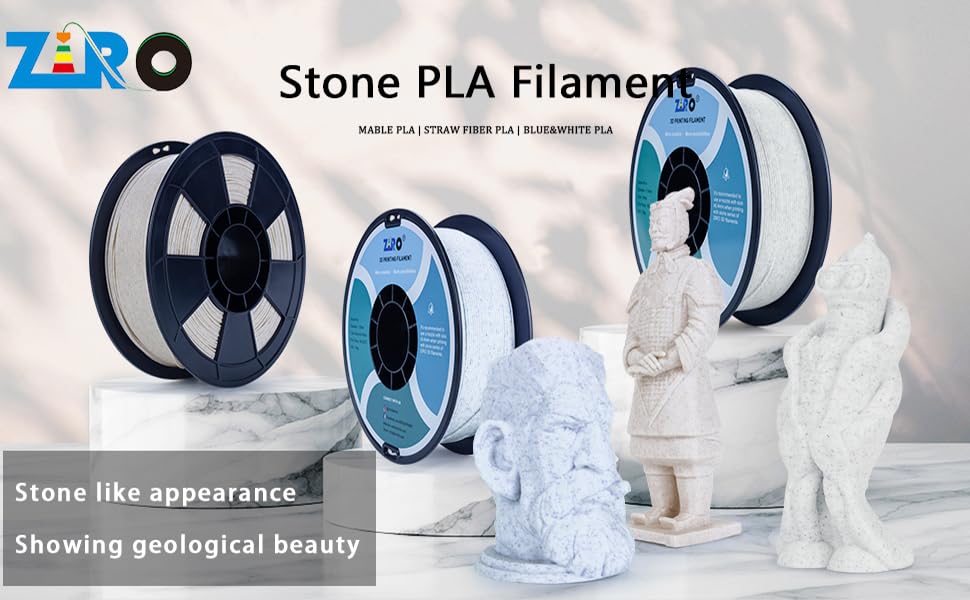
ZIRO PLA Marble Filament is a 1.75mm diameter, 1KG spool of premium polylactic acid filament designed for FDM 3D printers. It delivers a unique marble-like finish with excellent dimensional accuracy (±0.03mm), strong bed adhesion, and minimal warping. Vacuum-sealed and neatly wound, it ensures consistent, clog-free printing compatible with most 3D printers, perfect for professional-quality models, sculptures, and decorative items.



| ASIN | B01IIAC2MW |
| Best Sellers Rank | 1,279 in Business, Industry & Science ( See Top 100 in Business, Industry & Science ) 123 in Filament 3D Printing Materials |
| Brand | ZIRO |
| Brand Name | ZIRO |
| Colour | Marble |
| Country Of Origin | China |
| Customer Reviews | 4.3 out of 5 stars 3,573 Reviews |
| EU Spare Part Availability Duration | 3 Years |
| Item Diameter | 1.75 Millimetres |
| Item Weight | 1 Kilograms |
| Item diameter | 1.75 Millimetres |
| Item weight | 1 Kilograms |
| Manufacturer | ZIRO |
| Material | Polylactic Acid |
| Material Type | Polylactic Acid |
| UPC | 713145908109 |
| Unit Count | 1000.0 gram |
L**J
Incredible value, really good quality filament. Definitely my new go-to for PLA-CF
Prints easily (like any other PLA), but has much less warping than pure PLA. Very neat winding, very consistent print quality, and the carbon fibres give a really nice surface texture. It seems to have genuine chopped fibres, as opposed to powdered CF, which is very nice. It's as good as any other PLA-CF I've used, but the value is phenomenal. A bit cheaper than most, but absolutely of equal quality. The spool also came with a small sample of colour gradient PLA, and a small amount of nozzle cleaning filament, as well as a separate reusable ziploc bag. Completely unexpected, but a lovely surprise. I've bought a lot of filament before, and not once have they included free samples of other filaments, and the cleaning filament is always super useful. The spool itself was fantastic value, even without the added extras, so I'm very happy with this purchase. I was a bit hesitant to buy from a brand I'd never seen before, but will certainly be buying this again. Have shared pictures of the first (not perfect) print, the same print after some sanding, and the free samples.
A**W
Love this, ziro is my go to for sparkly filaments
I’ve been using the ZIRO Carbon Fiber PLA filament for several prints now, and it’s become one of my favourite specialty materials for more demanding models. The addition of roughly 15% carbon fiber within the PLA matrix makes a real difference—printed parts feel noticeably stiffer and more premium than standard PLA, with a matte textured finish that looks great straight off the machine. Print behaviour has been very consistent. I ran multiple prints with standard hardened nozzles (0.4 mm recommended) and found extrusion was smooth, the spool wound cleanly, and I didn’t encounter tangles or major feeding issues. The diameter accuracy is tight (±0.03 mm is claimed) and in practice I’ve been getting parts that calibrate well, fit well, and don’t suffer from warping or layer separation. The aesthetic is a strong selling point: the fibre-filled finish gives a “carbon composite” look, which works really well for display items, mechanical covers, props and parts where I want a functional but stylish result. It’s especially good for prints where durability matters and looks matter too. There are a few things to keep in mind though: like all carbon-filled filaments, this one is more abrasive on nozzles—so I always use a hardened steel nozzle rather than a standard brass one. Also, though it prints well at recommended settings (200-220 °C nozzle, 50-60 °C bed), I noticed finer details (very thin walls or delicate spike elements) sometimes need a slower print speed or extra cooling to prevent the fibre reinforcement from shadowing detail. Overall, if you’re printing functional parts or want a professional finish, ZIRO’s Carbon Fiber PLA is a great choice. Reliable, tough, and visually striking—definitely one I’ll keep in the filament rotation.
D**8
Not bad... but a pain to dial in
I got some of this filament for a glow in the dark "Jeloseum" sign (for anyone wondering, it's an in-joke from my VRChat friend circle) and it's really cool stuff. So cool in fact that when I modified my printer and changed the extruder to a bowden style with an e3D V6, I printed the carriage mount out of it! So... onto the issues... I had to ramp the temperature up initially as running it too low caused the nozzle to clog very quickly. Running this filament between 210 and 220*c (I recommend 215*c or to ramp it up in 5*c increments). I also found out that running an 0.6mm nozzle helps with clogging a bit and so moved onto a 0.6mm for convenience. It took me quite a few print tests to actually get this stuff to print properly at a sane temperature. Also, this filament, unlike most other PLA is very slightly hygroscopic and it might be an idea to dry it off if you have had it in storage without a dessicant for a few weeks or print in a humid environment like I have to. Not doing so can cause bubbling and missed extrusions if your filament has absorbed sufficient moisture to do so. Besides that, this stuff sticks well to the print bed, looks dope af when you do thin walled prints and can see the supports inside, the diameter is very consistent . Also, as seen in the photos, put a blacklight behind this stuff and it glows like crazy!! It also has a nice afterglow when it's been hit with regular light, although due to the fact it's blue it doesn't last all that long. Maybe a good 10-30 minutes under a regular incandescent light and longer if it's been hit with sunlight. There's a scientific reason why but I won't go into it here. I'd recommend that anyone who's just starting out with 3D printing holds off a little on getting this stuff until they have learned how to properly dial in a print profile for more exotic stuff like this. This filament can be a real pain to tune for initially, but the payoff is huge. I'll definitely be considering getting more when my spool runs out because it's fun to print under the light of a blacklight :)
A**R
Very tough filament which yields great quality prints
I think I'm in love with this stuff - I needed something tougher than 'reguiar' PLA for an ongoing project (dual bottle-cage mounts for my mountain bikes) and this fits the bill beautifully. After a couple of false starts with a clogged nozzle, I've found that it prints really well on my AnyCubic i3 with a hot-end temperature of 220C and a bed temperature of 70C (could probably get away with lower, but it works for me). The resulting prints are not only _very_ tough compared to regular PLA, but they look really attractive too with the plastic cooling down to a rather cool-looking titanium grey. Even at 0.2mm resolution the layers aren't noticeable unless you really look. Even better, the bed adhesion is absolutely fantastic - for the first time in a while I'm able to print things without using a raft (see below ...) - I printed a 160x50x3mm flat plate with just a 10mm brim and there was no warping at all. The end result, with 80% infill, was considerably more rigid than a similar object printed with 'regular' PLA. There are a couple of gotchas, though: - Good as it is, this stuff will make mincemeat of brass nozzles over time since the carbon fibres make it quite abrasive. You don't notice it on a completed print but you will notice it when you print several large objects and your nozzle starts clogging. Hardened nozzles are a must, although you may need to increase your hot-end temperature accordingly. There's nothing to stop you using brass nozzles, just be prepared to change them more often. - If you print something with a raft, be prepared to have fun separating it from the main print. For most practical purposes, you'll probably get away with just using a skirt or brim, even for large objects. - You'll need to run your hot-end at a higher temperature because of the carbon fibre - whilst I can print 'normal' PLA at 190-200C, the carbon-fibre PLA only gave me consistent results at 220C - anything less just wasn't happening. I now keep a 'carbon fibre' preset in Cura which gives me consistently good results. I'm using the standard AnyCubic hot-end and didn't need to make any mods whatsoever. I've had good results with Ziro filament in the past, but this stuff really is top notch.
N**E
Glorious Green Glow
Wonderful filament, glowes bright green, especially when charged with UV light. Any glow in the dark filament containing phosphorus seems to be more susceptible to becoming brittle and absorbing moisture - it's the same with this filament, I simply pop it in the filament dryer and it works like new again 😃 this is the best glow in the dark filament I've tried which creates consistent and smooth layered prints
M**H
Small parts only. Very keen on semi-blocking nozzle
This my third brand of CF reinforced filament - I chose it because the brand that I used before with great results now has lots of reviews agreeing it used to be good but has now gone south! I've tried a range of temperatures on my printer (extruder is Hermera). The material seems non-uniform and produces semi-blockages at irregular intervals. In the left-hand photo you can see my first print - starting at c. 200C. You can see a batch of 4 dips in extrusion to c.65% every meter or so. Each of these resulted in breaks in layers and very poor layer adhesion. I spotted this was happening and increased temperature to 215C. It stayed a bit wobbly so eventually I increased to 225C at which point it seemed to stabalise. But, then that blocked completely and the print failed. Today I tried another go, starting at 230C. This is the second graph. As you can see, extrusion is more regular - but not nearly as good as a normal filament. However, towards the end you can see the c. 3m of badly underextruded material- again a partial blockage. This print did complete, but as you can see from the part photo there are a few poorly extruded layers near the end of the print. In both prints I'm working at maximum stepper current of 1.3A. The second had topped out tension- which I think is why it worked a bit better. Generally structurally strong along the filament and layer adhesion is otherwise OK. So best to take great care with this filament. If you must pick it I would recommend: * higher temperatures * lots of extrusion pressure * small parts * very careful inspection * nothing where a weak layer would cause functional problems for the part.
B**T
Really good glow, really good price.
Excellent glow after being left in sunlight. Prints very nicely at high speed on my ender 3v3. At 220. Shipping was super fast. Print feels nice and sturdy. Price was spot on.
M**S
Very poor bed adhesion
I’ve been printing for about 4 years now but have never had a problem with bed adhesion with pla before. Using a p1s with a textured pei sheet, every single print has at the minimum warped/partially lifted or just come off mid print. This does not behave like pla at all. To put it in perspective, the prime line can just be removed with a light touch mid print or it falls off mid print. With a higher bed temp (65c) and glue (never had to use glue before) I’ve been able to get the part I wanted stick enough to print with a warping level I can tolerate but most of the prints have been waste. It looks fine once printed though so maybe if you have supertack plate or something then it’s worth picking up as it’s reasonably priced but in my case the cost has been offset by the failures. Edit: I've updated the review from 2>3 stars due to good customer service. A refund was offered and we also went through some support checks of the settings I'd used. The recommended settings I'd already tested though so it didn't solve the issue for me. I have ordered a supertack plate, this may solve the problem in the future but I don't have much left to test with at this point.
Trustpilot
1 day ago
2 months ago