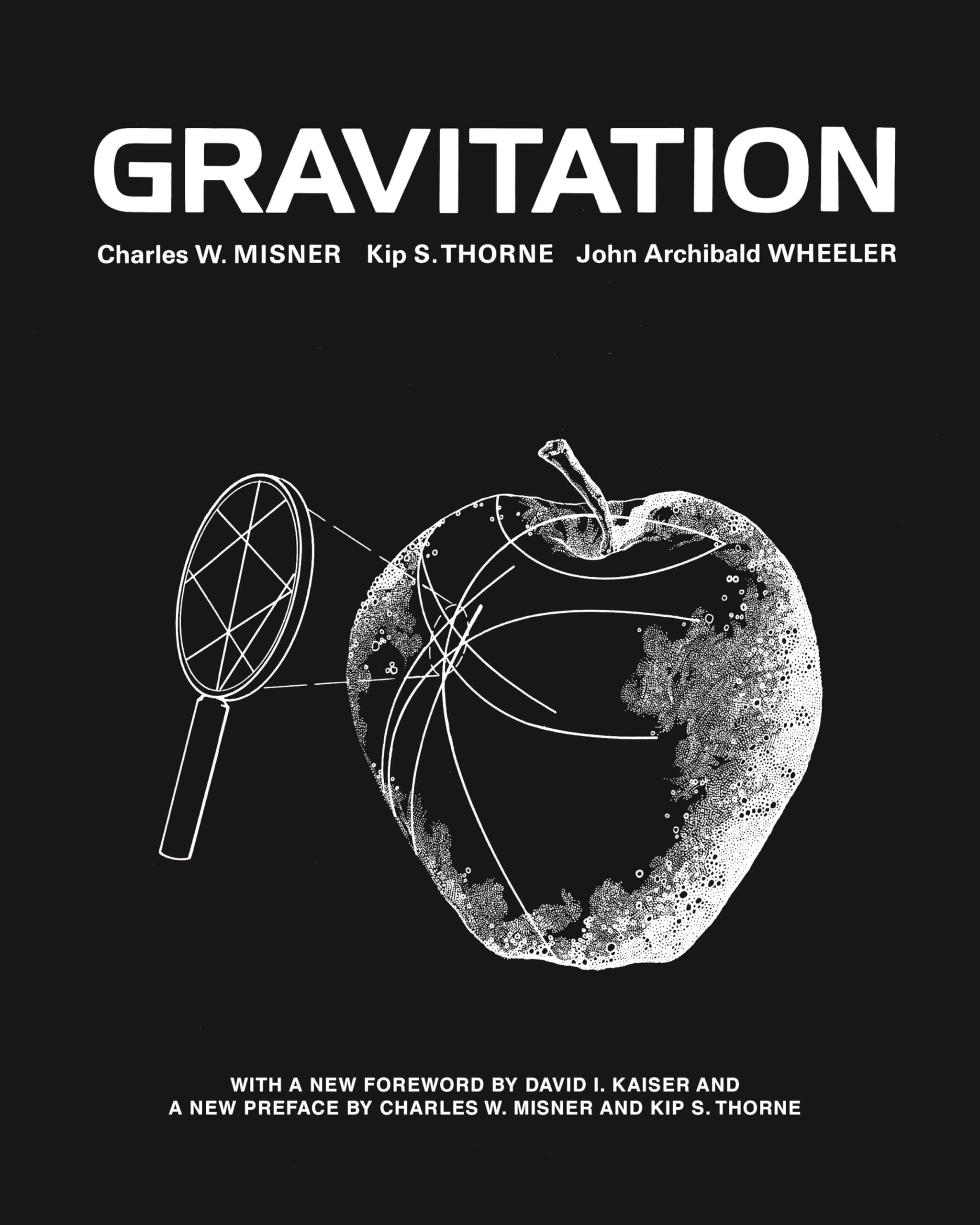
Gravitation
Product ID: 49269660
Buy anything from 5,000+ international stores. One checkout price. No surprise fees. Join 2M+ shoppers on Desertcart.
Desertcart purchases this item on your behalf and handles shipping, customs, and support to Denmark.
First published in 1973, Gravitation is a landmark graduate-level textbook that presents Einstein’s general theory of relativity and offers a rigorous, full-year course on the physics of gravitation. Upon publication, Science called it “a pedagogic masterpiece,” and it has since become a classic, considered essential reading for every serious student and researcher in the field of relativity. This authoritative text has shaped the research of generations of physicists and astronomers, and the book continues to influence the way experts think about the subject. With an emphasis on geometric interpretation, this masterful and comprehensive book introduces the theory of relativity; describes physical applications, from stars to black holes and gravitational waves; and portrays the field’s frontiers. The book also offers a unique, alternating, two-track pathway through the subject. Material focusing on basic physical ideas is designated as Track 1 and formulates an appropriate one-semester graduate-level course. The remaining Track 2 material provides a wealth of advanced topics instructors can draw on for a two-semester course, with Track 1 sections serving as prerequisites. This must-have reference for students and scholars of relativity includes a new preface by David Kaiser, reflecting on the history of the book’s publication and reception, and a new introduction by Charles Misner and Kip Thorne, discussing exciting developments in the field since the book’s original publication. The book teaches students to: Grasp the laws of physics in flat and curved spacetime Predict orders of magnitude Calculate using the principal tools of modern geometry Understand Einstein's geometric framework for physics Explore applications, including neutron stars, Schwarzschild and Kerr black holes, gravitational collapse, gravitational waves, cosmology, and so much more Review: An all-purpose utility for your home office needs - When my PhD adviser recommended me this classic of general relativity, I was not prepared for the breadth of use that I would find for it! Pouring over pages and pages of this masterpiece, from the foundings of special relativity to the differential geometry that underlies general relativity to the chapters on gravitational waves that portend the era of gravitational wave astronomy we now find ourselves in, you quickly realize that the true beauty of this textbook exists outside its pages. Truly, following the first week of purchase until now (amounting to about two months), I have found that I got my money's worth without ever opening the inky black hard cover of this absolute unit. From its smooth, tactile surface to its brick-like dimensions, I have found so many more uses for Gravitation than I ever gambled for. In the evening, after a long day of drawn-out Zoom calls, Gravitation is the nightstand on which I empty the contents of my pocket or leave other books. Before, my neck would hurt from constantly craning forward to the blue light of my laptop screen. But, with Gravitation, I've found an excellent laptop stand, and my neck hurts no longer. When my wrist hurt from reaching towards that low, low mouse all day, I put the mouse on top of Gravitation and, aghast, found that Misner, Thorne and Wheeler had done it again. This masterful work of theirs healed my ailing wrist. On the occasion I needed to hold my door open, I would find that other textbooks (such as Gravity, by Hartle), never had the disposition to be up for the job. Indeed, the door would simply close anyways, and I would cry, "Why, God? Why haven't you given me a textbook with the sheer mass necessary to hold this door open?" And, I remember that one clear July morning when Gravitation arrived on my doorstep and I felt it in my hands, I knew: my prayers had been answered. Dear friends, I make no higher recommendation than for you to purchase this textbook. Review: Advanced General Relativity - This book is a classic for graduate students or working professors in physics or mathematical physics. It is a comprehensive introduction to the subject. This fine used paperback copy saved me a lot of money!

| Best Sellers Rank | #91,394 in Books ( See Top 100 in Books ) #5 in Astronomy & Astrophysics #10 in Physics of Gravity (Books) #130 in Astrophysics & Space Science (Books) |
| Customer Reviews | 4.8 out of 5 stars 938 Reviews |
N**.
An all-purpose utility for your home office needs
When my PhD adviser recommended me this classic of general relativity, I was not prepared for the breadth of use that I would find for it! Pouring over pages and pages of this masterpiece, from the foundings of special relativity to the differential geometry that underlies general relativity to the chapters on gravitational waves that portend the era of gravitational wave astronomy we now find ourselves in, you quickly realize that the true beauty of this textbook exists outside its pages. Truly, following the first week of purchase until now (amounting to about two months), I have found that I got my money's worth without ever opening the inky black hard cover of this absolute unit. From its smooth, tactile surface to its brick-like dimensions, I have found so many more uses for Gravitation than I ever gambled for. In the evening, after a long day of drawn-out Zoom calls, Gravitation is the nightstand on which I empty the contents of my pocket or leave other books. Before, my neck would hurt from constantly craning forward to the blue light of my laptop screen. But, with Gravitation, I've found an excellent laptop stand, and my neck hurts no longer. When my wrist hurt from reaching towards that low, low mouse all day, I put the mouse on top of Gravitation and, aghast, found that Misner, Thorne and Wheeler had done it again. This masterful work of theirs healed my ailing wrist. On the occasion I needed to hold my door open, I would find that other textbooks (such as Gravity, by Hartle), never had the disposition to be up for the job. Indeed, the door would simply close anyways, and I would cry, "Why, God? Why haven't you given me a textbook with the sheer mass necessary to hold this door open?" And, I remember that one clear July morning when Gravitation arrived on my doorstep and I felt it in my hands, I knew: my prayers had been answered. Dear friends, I make no higher recommendation than for you to purchase this textbook.
J**.
Advanced General Relativity
This book is a classic for graduate students or working professors in physics or mathematical physics. It is a comprehensive introduction to the subject. This fine used paperback copy saved me a lot of money!
A**R
A Classic in the Field
The authors Misner, Thorne and Wheeler (MTW) produced a tour de force with this book. A must have for anyone with any interest in physics. The book is weighty in accordance with its name. The illustrations and mathematical details and descriptions are brilliant. At this stage I have read a several early chapters and dipped into later chapters of interest. This is a very solid and dense book due to the material, so not a light quick read despite the excellent explanations of the authors. The book Gravitation is frequently referenced by other books so is great to have it on hand to get a good and detailed explanation of any idea you might read elsewhere. The hard cover version of this book, republished by Princeton University Press (October 24, 2017) is excellent and really does justice to the quality of the work.
D**Y
Worth it's weight, and boy is it heavy.
I bought this book to try and brush up on some of the physics that it's been a while since I took, in order to defend my dissertation in theoretical physics later this spring. This book, in the hardback form will put a dent in your leg if you leave it there too long. I'm a physician, and I remember when I made the mistake of buying the single hard bound version of "Cecil's Textbook of Internal Medicine," and I had to lug that monster everyday all over the campus. I played college football, so it's not like I couldn't handle it, but it was a bit unwieldy. I would love to see a version of this that came in two softcover volumes, but, for me, it's not worth docking it a star over. Otherwise this is a great, user friendly treatise on the subject. I could see reading this book just for the enjoyment of learning the subject better. It's much better than the textbook I used back when dinosaurs stomped on the Terra. Of course there were only 4 planets known at the time, so this book is definitely an upgrade. If you're looking for a way to understand the cosmos better, I've never seen a better book. Later 'taters. dc
P**O
A Complete Guide to General Relativity
This is the most complete text on general relativity I have seen. It goes into exhaustive detail, which makes it a source for serious students.
W**3
A volume which bends nearby space-time
This book with its three distinguished authors is the definition of a classic. Beyond its considerable heft, sufficient in itself to bend nearby space-time, it presents the material in a way which is intuitive and rigorous to the physics … but in a language familiar to the modern presentation of the mathematics. The student is often confronted with the unfamiliar notation of Einstein’s way of presenting differential geometry, and his General Theory. This same student who has not seen GR before, but who has taken college physics, and learned advanced calculus, feels familiar with the language of differential forms, tangent spaces, inner products, and manifolds … but often feels lost in the tensorial presentation. Do I already know this math? … Is there some vast theory I must master before even reading this material? Wheeler et al. solve this problem by providing a bridge between all three perspectives and languages. So one can see the physical theory, the Einstein notation and the modern manifold presentation all connected, and all describing the same thing. Masterful.
E**R
Very good when paired with a geometrically inclined book on SR and a rigorous book on Diff Geometry
Overall, the book is good. I am being generous giving it 4 stars, and the first half is much better than the 2nd half. It needs to be paired with a good book on geometric special relativity and a good book in differential geometry such as Tensor Analysis on Manifolds by Bishop and Goldberg. Before diving in I should say I have a PhD in math and am learning GR in my spare time. Just so that you know where I am starting from. Also, I should mention that the construction quality of the new reprint that I bought is absolutely fantastic. The paper is bright, the equations and figures are beautiful, the margins are wide, the chapters are sown in leaves and not glued in, and the book can open flat beautifully on my desk or in my hands. Given the overall good content, the bang for the buck is fantastic. MTW is a famously wordy book. I've never read a text of mathematics or physics that rambles more than this book. Its goal is to motivate as much intuition as possible while still covering the material rigorously (at least by physicist standards). However, sometimes it goes overboard in the motivation department, to the detriment of fundamental material. An example of this are exercises 13.8 to 13.13 which cover fundamental curvature identities in the form of brief exercises. For 1200+ pages of material on general relativity I would expect to find a proof of the zero divergence of the Einstein tensor. I just write out my proofs/solutions to exercises in the margins which are thankfully quite large. And to be fair to the authors, everyone who wants to learn General Relativity should prove these fundamental identities for themselves. However, expect a lot of interesting results to be left as exercises. To summarize this particular critique, sometimes they spend too much time talking about easy aspects of relativity and too little talking about more difficult aspects. Another gap is that in 1200 pages on general relativity, the pull-back of a map between manifolds is never defined or used. This means the authors do not give the limit definition of the Lie derivative in Chapter 18 (or in Exercise 21.8) and so this chapter discusses "gauge invariance" in an old (and somewhat antiquated) way in terms of coordinate changes, as opposed to using Lie transport. Perhaps even worst is the omission of Cartan's magic formula, which truly deserves its name. Another strange omission is the Landau-Raychoudhri equation. The first part of the book covers special relativity and does an ok job, but is not a good primary source. For that, Gourgoulhon's masterpiece Special Relativity in General Frames is supreme. Another book is Synge's classic on Special Relativity. Chapter 6 has some great exercises, though. Chapters 8 through 14 are all excellent and worth the price of the book, in my opinion. Chapter 12 on Newton-Cartan theory is superb. As is, Chapter 11 on geodesic deviation (Straumann's General Relativity is also pretty good on this and is worth consulting on the side) and chapter 13 on curvature arising from a metric. One quick note here before moving forward. In section 11.4 the authors give the relationship between curvature and holonomy (that is, the fact that a vector parallel transported along a closed curve does not come back to the same value it started with in the presence of curvature). The heuristic derivation summarized in equation 11.15 is not complete. The final term is order 2: \Delta a \Delta b. But all of the terms which combined to give this were from Taylor expansions up to only order 1, \Delta a or \Delta b. Technically the authors should have expanded the terms to order 2, i.e. to (\Delta a)^2 and (\Delta b)^2. Luckily all of these terms cancel upon the anti-symmetrization in a and b, so the formula holds. Chapter 14 is a really great discussion of the Cartan formalism (using tensor-valued p-forms). Much better than that given in Straumann's textbook General Relativity (2013) or Wald's textbook. I have found other presentations to be lacking, so for me personally this chapter alone has been worth the price of the book. The authors leave out the tensor product symbol in every tensor valued p-form, but this shouldn't be too much of a notational difficulty for a mathematically minded reader. Note, the general exercises (especially 14.17 and 14.18) in this chapter are absolutely crucial and the reader should do them. There are some exercises where one guesses curvature forms for specific metrics. These aren't as important. Chapter 15 starts out too fluffy (as in too many words and too little math) and overall lacks mathematical rigor. The first 3 sections are meant to be motivational. They lack all rigor and, frankly, clarity. They could have been summarized as a few paragraphs. In section 4 the mathematical clarity starts to pick up. The authors jump a bit from their definitional object (basically equation 15.12) to the main formula (15.16), so I simply wrote out the details of the proof in the margins. I plan to read this chapter more deeply later, but at this time I don't feel that I have yet mastered the Cartan formalism, so take my critique with a grain of salt for this one. It feels like the entirety of chapter 15, which culminates in the Einstein equation in the form of equation 15.25, just boils down to exercise 14.18. In that exercise one computes *T, d*T, and ends up with d*G = 0 for the Einstein tensor G (viewed as a vector valued 1-form) by equation 13.52, all in about a page of calculation, instead of an entire chapter! Chapter 18 is quite fluffy, as well. The equation 4a of box 18.2 is simply the 1st order expansion of the Lie transport of the coordinates. A similar comment applies to equation 4b for "gauge" transformations of perturbations h_{\mu,\nu} of a metric. A more modern, and far superior presentation of it is given on page 441 of Wald. Exercise 18.5 is quite lovely, with a full solution given. Chapter 19 is also too lacking in rigor and precision to be read very deeply (this seems to be the case with track one portions later in the book). However, the exercises are computationally long and difficult. The one that I felt worth doing was exercise 19.2 on the precession of a free gyroscope that the book explicitly says to be "held at rest" in the coordinates giving the metric 19.5, the far field metric of a weakly gravitating and rotating source (which at the moment I believe is known as the Lense-Thirring metric). Note that this is different from the more common case of a freely falling free gyroscope (whose spin vector, aka angular momentum vector, would thus be parallel transported, not merely Fermi-Walker transported). In this exercise this gyroscope "at rest" relative to the coordinates is thus accelerated. The one "solution" I saw online from a Chinese student's notes is in fact not a solution at all, as it makes unwarranted assumptions such as the parallel transport of the spin vector and is not at all clear with respect to the basis the calculation is in. Finding the appropriate basis is the crux of the matter. In addition, I actually believe there is an error in the hint given by the authors: if one where to construct the metric using the hinted dual basis one would see that they are orthonormal up to order O(r^-2), but the precession Omega (given in equation 19.10) is of order O(r^-3), thus they are not orthonormal to the required precision. My solution is as follows: First noting that the spin vector of a free gyroscope is Fermi-Walker transported. Next, note that the gyroscope follows a particular accelerated worldline. Being at rest in the center of mass coordinates of the gravitating source giving the metric gives the gyroscope's 4-velocity as expressed in those coordinates. From there derive an orthonormal frame for the gyroscope "tied" to the coordinates, and whose time-like member is the 4-velocity of the gyroscope (always dropping terms O(r^{-4}) or higher). Then from this basis deriving the dual basis. Writing out the fermi walker transport equation for the gyroscope in the orthonormal basis, then using equations 13.23 and 13.21 in this orthonormal basis to write out the Christoffel symbols of the first kind. Actually carrying out this calculation of the Christoffel symbols is a pain in the a**, and the student must not forget to keep terms of order O(r^{-3}) and throw away terms of higher order at all steps. My solution was 9 pages of handwriting. At this moment I believe my approach is the most direct approach possible that is mathematically and physically rigorous. Wikipedia refers to this as the Lense-Thirring precession, but I haven't thought about how it relates to the precession experienced by a freely falling gyroscope yet, so I can't say atm if it is essentially the same in that case. Chapter 20 reads like a survey and is quite boring. It continues the weak field theory, covering the calculation of 4-momentum and angular momentum for an isolated gravitating source and deriving some nice surface integrals for them in the asymptotically flat coordinates. Briefly introduced is the Landau Lifshitz pseudo tensor and how it can produce such surface integrals. The whole point being that such surfaces are far from the source, so integrals over them (such as the system 4-momentum and angular momentum) are independent of its internal structure. Other than this the chapter is all over the place and it pretty much ends on a wordy survey of self-gravitation. Chapter 21 is the chapter I was most looking forward to. It is also the meatiest chapter in the book. Unfortunately, the chapter is a good example of focusing too much and too long on vague "intuition" and not enough on mathematical detail. The chapter covers three separate but related topics in general relativity: a) the Lagrangian formulation of GR, b) the initial value problem of GR, and 3) the Hamiltonian formulation of GR. The authors should have devoted separate chapters to each (on each one can find entire books). I will rate each section of this chapter out of 10. The introductory section 2.1 is good as an introduction, pretty much summarizes what will be presented, and does so in little mathematical detail, which is to be expected for an introduction. However, it babbles on for too long and more of its ink and pages should have been left for more details for later sections: 5/10. Section 2.2 is a 6/10. It gives an introduction to the Lagrangian approach of General Relativity, mentioning both the Hilbert and Palatini variations, and decides to go with Palatini. Pages 491, 492, and 500 start the discussion off very well, with the standard variations. Then pages 501 and 502 become very very hand wavy, with a brief introduction to tensor densities and their covariant derivatives. The authors would have been much better off presenting the Hilbert Variation as opposed to the Palatini variation as the integral at the top of page 501 would immediately be the integral of a divergence and could be integrated (easily done with the help of Cartan's magic formula). Page 503 covers a crucial result, that "general invariance" implies the vanishing divergence of the variation of a invariant integral. The authors do not give a rigorous proof. I wrote mine out in the margins. See Straumann's General Relativity, section 3.3.3 for a full mathematical proof. The same proof applies to the "ambitious" part of exercise 21.3 (when remembering to recall that \delta L / \delta g^{\alpha, \beta} = 0 for a field that satisfies its field equation. Section 21.3 is a 7/10, overall a very good discussion of the variation of the field. Here the authors admit a further weakness of the Palatini variation: that it makes it difficult to include fields which make use of the covariant derivative in the expression of their Lagrangian density. Section 21.4 is quite good, an 8/10. The authors do a good job motivating the material on a 3+1 spacetime split. The reader should draw their own picture to see how the metric formula 21.40 arises as it is not very easy to see it in Figure 21.2. The reader should also remember that the 3 metric g_ij is just i*g where i is the injection of the hypersurface into M, and then immediately forget this fact because you will always work in adapted coordinates. Oh, and the authors do not actually define adapted coordinates, but this is what other books are for. Section 21.5 is OK. I'd give it a 6/10. The presentation is good, but the reader should give a) their own derivation of how the connection coefficients of the induced connection on the hypersurface relate to the connection coefficients of the ambient manifold, b) their own derivation of equations 21.57 and 21.58, c) should see why 21.58, for example, implies that the induced connection on the hypersurface is the Levi-Civita connection of the induced metric g_ij on the hypersurface. The reader should also see that equations 21.62 and 21.63 are just orthogonal decompositions w.r.t. the normal n. The equation after 21.66 is just a simple application of 21.61 and 21.64 and doesn't require 21.65 or 21.66 which are both notational nonsense. Note that the first line of 21.67 uses 21.58 while the second line is just 13.23, and the third line uses 21.57. To rigorously see 21.69, the reader should consider an observer fixed in the spatial coordinates. A little algebra/calculus shows that the set {t \equiv const} is their simultaneity hypersurface (as it is everywhere orthogonal to their 4-velocity), and so represents their definition of simultaneity. Ndt is their increment of proper time (where dt is an increment of coordinate time) and a is the radius of 3-space they measure in their simultaneity. 21.70 is just an application of 21.67 with N_i = 0. The authors decide to switch to a much more convenient basis in 21.71. The 1-forms should look familiar from 21.40. In them, the metric takes a particularly simple form: g^{nn} = -1 and g^{ni} = 0. The calculation of curvature in equation 21.74 is quite good. At this point I wrote my solution to Exercise 21.6 in the margins so that the formula for the corresponding curvature components would be next to those given by the authors. Formula 21.77 does not need an orthogonal basis to be used, as the authors seem to think. The authors forget the special form that the metric coefficients take in the basis 21.71: g^{nn} = -1 and g^{ni} = 0. One derives 21.77 by simply applying this formula, 21.75, the fact that by its symmetry K_i^j = K^j_i, and some basic symmetries of the curvature (13.40 + 13.43). Similar for 21.80. Exercises 21.5,6,7,8 are all good. 21.9 gets into applying Guassian coordinates. Parts a and b should be easy. Part c is just 21.67 in Gaussian coordinates. Exercise 21.10 is a very good exercise. The reader should definitely do it. Note that the divergence term remaining is div( \nabla_n n + Tr(K) n ), which is reiterated in equation 21.88. Section 21.6 is quite nice (an 8/10) IF you did exercise 21.10. Note that the authors do not prove 21.84 (not hard) nor 21.86 (harder, because it requires Exercise 21.10). After this, the entire chapter reduces to a survey, with little to no detail. Whether you read this remainder of the chapter (36 pages worth!) is up to you, but it is so lacking in detail that you lose nothing from skipping it. If you want to learn about the initial value problem of GR or the Hamiltonian formulation, look elsewhere. Chapter 22 is pretty good. Again, having at hand a second source (such as Gourgoulhon, Synge, Tolman 1934) only helps. Sections 2, 3, and 4 are all excellent. Special mention must be made of Equation 22.2, which really caught my attention. It is such a basic fact and I immediately considered how to prove it as soon as a saw it. To my surprise however, its proof is far from trivial. The proof outlined in Exercise 22.1 is simply not sufficient to me. There is a "proof" of it in Section 21.3.2 of Gourgoulhon, but it is not actually rigorous either. To prove it one must consider a fluid worldline between proper times \tau and \tau + \Deta \tau. At the lower end one must extend out a geodesic rest space of the worldline as in section 13.6. A small chunk of this near the fluid worldline is the only valid definition of a 3-volume to relative to this fluid moving observer. A certain set of fluid worldlines pass through this 3-volume at time \tau. The intersections of precisely these fluid worldlines with the corresponding rest space of the reference worldline at \tau + \Delta \tau is what counts as the flowed 3-volume at the beginning. This top and bottom, along with the walls formed by the bounding fluid worldlines form a little 4-cylinder in spacetime near the reference worldline. Consider the integral of the divergence of the fluid 4-velocity field u in this cylinder. By essentially the Stoke's theorem this reduces to an integral over the boundary, but the integral over the cylinder walls vanishes due to these being tangent to u. One then computes the difference of these two integrals (top and bottom) by making use of the relative velocity of the nearby fluid elements relative to the reference worldline. This is a tedious calculation. The other exercises are pretty good and not as difficult. I didn't try exercise 22.7 because I did not want to get sidetracked. Section 22.5 starts out with weak motivation (the reader is assumed to have studied EM waves in a prior course) but goes on to give a lovely derivation of the laws of Geometric Optics in curved spacetime from Maxwell's equations. Chapter 23 is great. A nice derivation of the equations of structure of a static, spherically symmetric system is given, including the Oppenheimer-Volkov equation. Chapter 24 is mostly words. Chapter 25 has a nice, though elementary discussion of Killing vector fields. It also has some really good exercises in exercises 25.1 to 25.6. In addition, it has an elegant derivation of an equatorial geodesic in section 25.3. But at some point becomes handwavy and rambling. Chapter 26 is kind of a let down. It starts by saying that perturbation calculations are too long to include in the book, but that the authors will make one exception for the benefit of the reader and write out full details. Except this doesn't happen, as major details of the calculation are skipped. Moreover, the authors refer to the difference between the perturbed and equilibrium situations as "coordinates" in Section 26.2 b. This is wrong. The coordinates are the same for both. It is the metric that is different. Also, equation 26.5, which the authors present as obvious is far from obvious. It requires a somewhat lengthy 1st order calculation after one has already calculated the fluid 4-velocity given in equation 26.6. At this point I skipped chapters 27 through 30 (on cosmology) because I could tell it was going to be the authors rambling for 100 pages, when only 30 would have sufficed. I was also more interested in gravitational collapse and gravitational waves as these seem to be more mathematically interesting than the simplified cosmologies. And there's the character limit for a review on Amazon. The rest of the book is nothing to brag about. It continues with wordy, watered down presentations. A good (bad) example is the discussion on spinors. I'd say the first half is much better than the second.
C**T
Fine
A real weighty time, but so clear and well written.
F**T
The Holy Bible of Gravitation
- Langue: anglaise - Prérequis: L3/M1 Physique fondamentale, solide bagage mathématique conseillé. - Etat à la réception : impeccable, malgré l'emballage peu précautionneux. - Contenu et lisibilité : édition 2017 impeccable, nouvelle préface indiquant les endroits de l'ouvrage où il faut compléter l'étude par celle d'autres ouvrages plus récents. L'ouvrage sépare son contenu en deux "tracks". Track 1: le contenu est incontournable ; Track 2: contenu complémentaire, à choisir selon les centres d'intérêts de chacun, compréhensibles si tous les Tracks 1 qui le précèdent ont été traités (sauf indication explicite du contraire). Bref c'est la Bible, mais à compléter, bien sûr, par d'autres.
R**J
Beyond expectations but not enough!!!
The book appears daunting at first glance, but once you break it down into appropriate sections, it provides a very understandable presentation of general relativity and motivates its concepts effectively. However, a lingering question remains: How much of this theoretical framework is truly open to empirical testing? General relativity defines geodesic motion in a way that makes deviations from it challenging to even consider. Yet, as both a practical measurement tool and a theoretical system, it is fundamentally grounded in a simple principle: We assume local Lorentzian flatness for space and time, measuring geodesic deviation relative to this assumption to establish a more accurate global geodesic throughout the manifold, accounting for the distorting effects of gravitation. The book contains substantial mathematical content, but it also includes informative diagrams and explanatory boxes that reinforce the material. Each section explains the motivation behind relevant equations and their outcomes in plain language. Additionally, the book delves into the historical development of general relativity, featuring quotes from influential figures like Newton, Einstein, Penrose, Hawking, and Dicke. Overall, I found this logical development easier to follow than what I encountered in Penrose’s Road to Reality, although I now have a deeper appreciation for that work as well and may revisit it. The practical significance and application of general relativity are more transparent, rather than obscured by mystifications related to complex numbers. I need other books to explore more in-depth.
A**N
¡Excelente!
Llegó excelente, muy buena edición la de pasta dura
B**0
Heavy book that makes understanding gravity a lightweight task
Weighing about 6 pounds, the book is not a light one to be honest. Neither is the subject. But the authors have gone to a great extent to simplify the content for the reader. There are two tracks in the book and newcomers should skip the advanced track and continue with the basic one. The authors do not skip just to the physics but spend considerable portion of the book to build up the mathematical foundations. A lot of GR texts skip this and to be honest and a new reader is left to fend for herself on subtleties of differential geometry. And then of course the book itself is a beautiful thing to own. I read it with white gloves. The cover has a matte finish and the paper is of very high quality. The typography is brilliant! It is such a pleasure to read this book.
I**Y
It’s beautiful but maybe not for everyone
This is an excellent text in Einstein’s Theory of Relativity and contains a lot of advanced topics which makes the effort learning GR far more fruitful. The book is separated into two tracks and lots of annotations throughout the book to highlight certain points and what previous knowledge is required before tackling a chapter. It has a unique writing style that took me a while to get use to but I am learning to appreciate it more with each read. Idiosyncratic seems to be the common word to describe the style of writing so I’ll go with that. Nonetheless I can definitely see why this has been a common text used for such a long time (it is a really, really good text). I recommend using this as a supplemental text to Wald’s or Carroll’s book on relativity depending on your level. If you are learning this topic for the first time, A First Course in General Relativity by Schutz is an excellent text to go with this this. If I am not mistaken, I believe Schutz completed his PHD under Kip Thorne but don’t quote me on that. There are some sections out of date (mainly to do with advancements in experimental observations) but which ones are out of date have clearly been highlighted at the beginning of the text in the 2017 re-print. This makes it far easier to know what you are safe to read through and not learn out dated material. The actual physical quality of the book is surprisingly good considering the relatively cheap price. Compare this price to Goldstein’s hardcover Classical Mechanics text and you’ll see it what I mean.
Trustpilot
1 week ago
1 month ago