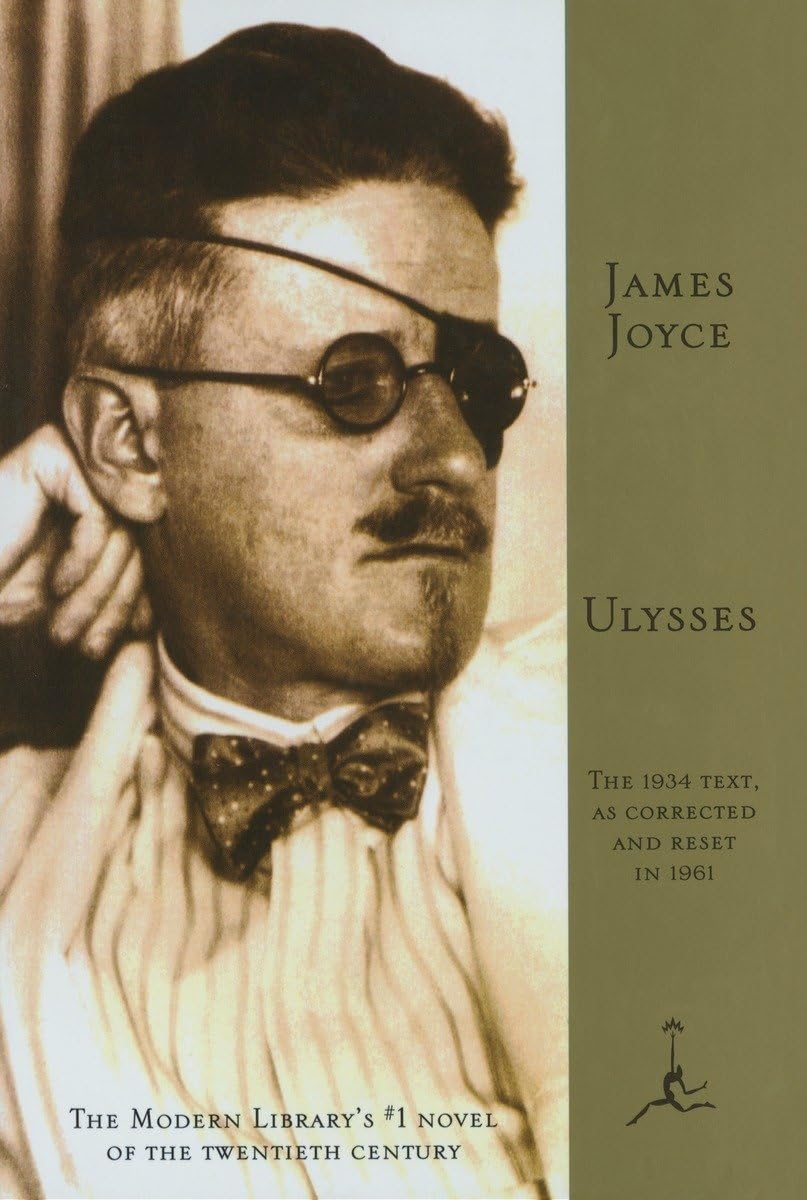
Ulysses (Modern Library 100 Best Novels)
Product ID: 4830759
Desertcart purchases this item on your behalf and handles shipping, customs, and support to Denmark.
Ulysses (Modern Library 100 Best Novels) [Joyce, James, Ernst, Morris L.] on desertcart.com. *FREE* shipping on qualifying offers. Ulysses (Modern Library 100 Best Novels) Review: Encyclopedic and Heartfelt - Last semester I took a seminar class on James Joyce, and of course no class on Joyce would be complete without reading Ulysses. We spent the last half of the semester on Ulysses, and now that I've reviewed both Dubliners and Portrait of the Artist, I think it's finally time for me to talk about my experiences with Joyce's most famous/infamous novel. Ulysses picks up approximately one year after Portrait of the Artist as a Young Man ends, and begins with our old friend Stephen Dedalus, who is navigating the world of Dublin, working as a teacher, and still trying to be an artist in a place that continuously leaves him feeling isolated, alone, and without a home. While the first three chapters focus on Stephen, the rest of the book focuses on a new character, the famous Leopold Bloom, a Dublin Jew who, after eating a breakfast of mutton kidney, leaves the house to go about his daily business, all-the-while knowing that his wife, Molly, is planning an affair later that afternoon. That knowledge, the isolation he feels from his fellow Dubliners, the death of his young son ten years ago, and many other things weigh on his mind as we follow him about the affairs of his day. His path crosses and recrosses that of Stephen, and eventually the two outcasts finally meet and have a real conversation. Taking place in slightly less than 24 hours, Ulysses is an epic of the ordinary, a single day that contains every conceivable high and low. Now, if you've ever heard anything about Ulysses, I'm sure you've heard that it's nearly impossible to read. It has gained a nearly mythic status in the bookish world as an impenetrable wall of stylistic experimentation and dense allusion. The only hope for the intrepid reader is to consult many guides and source-books that will lead them through the labyrinth. To be honest with you, this is partially true. There were plenty of times when I didn't know what was happening, and I assure you that I missed most of the allusions and references to historical events. And yes, I did use a guide when I read it, which was a big help. More importantly, I also had a class full of people to discuss each chapter with and to keep me on schedule. (I do recommend reading this book with a friend. It's more fun that way.) But I want to make one thing very clear: The myth is only partially true. Because while I did not catch many of the allusions and references, I mostly understood what was happening in terms of plot and location. While I may not have understood the meaning of every sentence, I did understand the meaning of most paragraphs. And while I didn't always see exactly how each stylistic invention connected thematically to Bloom's journey, I could certainly appreciate the beauty and craft of Joyce's writing. Reading Ulysses is like being at the ocean; you have to let the waves of text wash over you without trying to analyze every single piece of sand. Understanding every single allusion is not necessary to enjoy the novel as a whole. You might miss a few of the jokes, but I promise you will be ok. The guide I used and which I would highly recommend, James Joyce A to Z, had brief summaries of each chapter in terms of plot and any major thematic elements, and that is all I needed in order to thoroughly enjoy myself. I think that oftentimes we as readers get too caught-up in "getting" the book that we forget to really read it. Ulysses is, first and foremost, an experience. If you get too caught up in trying to "understand" it, you'll miss all the fun. Fun? Yes, fun, because Ulysses is a deeply funny, witty, engaging, and beautiful book. First of all, Joyce is a phenomenal writer, and it would be a challenge to find a novel with more beautiful or more varied writing than this one. Some passages are just heart-stopping in their elegance. I literally stopped and reread some passages just so I could hear them again; they were that beautiful. Others were incredibly technically impressive, showing Joyce's amazing command of the English language (and others). Joyce's amazing skills as a writer mean that he is capable of making the wittiest puns and the funniest satires I have ever read. No, really. From the pub to the graveyard, from political arguments to prostitution, from the romantic novel to the epic catalog, there is nothing that Joyce can't laugh at. I never thought I would say this, but Ulysses literally made me laugh out loud. But of course this novel isn't all fun and games. There are tender, honest moments here more touching than nearly anything else put into print. There is heartbreak here, not of the cheesy faux-tragic kind that you find in a Nicholas Sparks novel, but honest emotion felt by ordinary people in situations that are all too real. Though Ulysses very often made me laugh, on a number of occasions it also made me cry. It touched me, because it spoke to that part of me (and, I think, of many of us) that knows what it's like to feel alone, regretful, and lost. That realism, that honesty of emotion and situation, is what sets Ulysses apart. The strange style, the encyclopedic allusions, the weird diversions, all of these serve to represent reality in all of its complexity, beauty, and sadness. Ulysses is funny, crafty, beautiful, and heartbreaking, but it is all of those things because it is real. If you've ever read my reviews before, you'll notice that this one is rather different. This time I haven't talked very much about technique or writing style, though really this would be the perfect novel to do that. And part of me does want to pull out my analytical brain and tell you all about Joyce's tricks and techniques and themes. I would feel accomplished for breaking down such a complex novel, and you would maybe feel like you learned something. But I don't think I'm going to do that this time. This time I think I'm going to focus on other things. Because despite all the intellectual enjoyment I got from untangling and discussing the themes and techniques, and despite the aesthetic enjoyment I found in Joyce's language, what struck me the most about Ulysses was its emotional honesty, especially in the characterization. For the first three chapters I felt nothing but empathy and pity for Stephen. I wanted to be his big sister, to comfort him, to let him know that he wasn't alone and that he could make it. And then I met Leopold Bloom, and slowly, cautiously, not without reservation, I fell for him, completely and utterly. Not in a romantic way, but as a human being, an all-too-real human being who had emotions and quirks that I could see and understand like those of an old friend. I fell in love with the way that he always tries to figure things out, to calculate, explain, and reason, even if his explanations are often incorrect, more pseudoscience than real science. I fell in love with his desire to please everyone, to make everyone happy, to avoid conflict wherever possible. I love that he maintains his optimism despite everything that happens to him. I love the way he always walks on the sunny side of the street, is conscientious about his money, and loves to eat good food. I wanted nothing more in the world than for him to actually meet Stephen, because I needed to see what would happen when these two characters whom I cared so much about finally met. And yes, sometimes Bloom creeped me out a little with his thoughts about sex or bodily functions. Sometimes I got annoyed with him for being so passive, and I yelled at him to stop being such a pushover already. But when he had the chance to finally show some courage, I cheered him on with all of my heart, and when he stood up for Stephen my heart nearly burst I was so proud of him. Leopold Bloom was so lonely, so hopeful, and so real, and in the end it was the force of his character (and, to a lesser extent, Stephen's) that really made Ulysses shine. Ulysses is a novel that takes place in a single day, and yet somehow seems to encompass the whole world. It's strange and difficult and sometimes frustrating, and to be honest I wouldn't recommend it to those who don't like their books to be a puzzle or who get frustrated when they don't understand what is going on. But if you do like a challenge, then I think you'll find that every frustration in Ulysses is paid back a thousand times over in beauty and enjoyment. I promise that you won't catch everything on your first read-through; I know I didn't. But that did not take away from my enjoyment of the novel in the slightest. I know I'll come back to it some day, maybe a chapter at a time here or there, and that no matter when or how often I return it will always have something new to offer me. Rating: 5+ Recommendations: Don't get too weighed down with guides. Just read it and enjoy it, and check chapter summaries or historical events if you get lost. Ulysses is an experience, so just dive in. Note: This is a review of the Revised Gabler Edition, which is that one you should read. Review: Not Much to Add to What's Been Already Been Said About This Book. I Just Love It. - So much has been written about this revolutionary novel by James Joyce. My review will hardly add anything that hasn't already been said. All I will say is if you love literature and are a fan of the developments in prose from modernism, postmodernism and similar movements, it is your duty to read Ulysses. You wouldn't have the achievements of writers and publications like Nabokov, Woolf, Anthony Powell, Pynchon, Gaddis, Rushdie, Borges, David Foster Wallace,or even McSweeneys without the sprawling experiment undertaken by Joyce in these pages. Here, he tells a story set completely in the minds and actions of his characters over the course of one summer's day (June 16th, 1904) in Dublin, Ireland. Through this stream of consciousness technique, Joyce gives us not merely a story but a book grappling directly with the human mind, with all its lofty and not-so-lofty thoughts. Mixed with introspection and philosophical ponderings are mundane thoughts about business and colleagues, fears about infidelity, insecurity, masturbation, farting, sex jokes, food and toilet humor. The entire spectrum of human thought is given in its subversion of the bourgeois morality of the English novel. Yet this is not the only innovation Joyce makes with his novel. He also fragments his narrative with different narrative styles indicating the different types of thoughts and events that are being dealt with in each chapter. In a chapter about his business, the narration is entirely in the form of newspaper advertisement clippings. A visit to a bordello is narrated as a gaudy popular play. A chapter about masturbation at a beach is narrated as a cheesy romance novel. The last chapter is pure stream of consciousness with the gas turned high, as we go through almost every thought Leopold Bloom's wife has about her husband and their marriage. In homage to its inspiration - Homer's Odyssey - the overall book is structured according to the Odyssey's structure, with the main characters mirroring those of the Greek Epic (Stephen Dedalus - Telemachus, Leopold Bloom - Odysseus (Ulysses in Latin - hence the novel's name) - Molly Bloom - Penelope) and the overall events of the novel being a mundane parallel to what happened in the original poem. Already what I've said barely touches on what's so great about this (I'm not an eloquent literary critic) but all I can say is do not be put off by the complicated nature of this work. It is not an easy read by any means but it is an incredibly engaging, intensely moving and outright hilarious work about everyday things that completely changed the game as to what novels could do. Even though literature has moved on considerably from Ulysses' brand of modernism and the type of toilet humor it dished out pales in comparison to what's common media today, it is still an entertaining, down to earth and clever book. Not the overly intellectual, pretentious behemoth that its sometimes dismissed as. You do yourself a disservice if you don't at least try to read it. Ok there, I've said enough platitudes. Go out and read!
| Best Sellers Rank | #118,634 in Books ( See Top 100 in Books ) #167 in Classic Literature & Fiction #213 in Psychological Fiction (Books) #602 in Literary Fiction (Books) |
| Customer Reviews | 4.2 4.2 out of 5 stars (3,973) |
| Dimensions | 5.7 x 1.5 x 8.3 inches |
| Edition | Reprint |
| ISBN-10 | 0679600116 |
| ISBN-13 | 978-0679600114 |
| Item Weight | 1.7 pounds |
| Language | English |
| Part of series | Modern Library 100 Best Novels |
| Print length | 816 pages |
| Publication date | September 5, 1992 |
| Publisher | Modern Library |
R**E
Encyclopedic and Heartfelt
Last semester I took a seminar class on James Joyce, and of course no class on Joyce would be complete without reading Ulysses. We spent the last half of the semester on Ulysses, and now that I've reviewed both Dubliners and Portrait of the Artist, I think it's finally time for me to talk about my experiences with Joyce's most famous/infamous novel. Ulysses picks up approximately one year after Portrait of the Artist as a Young Man ends, and begins with our old friend Stephen Dedalus, who is navigating the world of Dublin, working as a teacher, and still trying to be an artist in a place that continuously leaves him feeling isolated, alone, and without a home. While the first three chapters focus on Stephen, the rest of the book focuses on a new character, the famous Leopold Bloom, a Dublin Jew who, after eating a breakfast of mutton kidney, leaves the house to go about his daily business, all-the-while knowing that his wife, Molly, is planning an affair later that afternoon. That knowledge, the isolation he feels from his fellow Dubliners, the death of his young son ten years ago, and many other things weigh on his mind as we follow him about the affairs of his day. His path crosses and recrosses that of Stephen, and eventually the two outcasts finally meet and have a real conversation. Taking place in slightly less than 24 hours, Ulysses is an epic of the ordinary, a single day that contains every conceivable high and low. Now, if you've ever heard anything about Ulysses, I'm sure you've heard that it's nearly impossible to read. It has gained a nearly mythic status in the bookish world as an impenetrable wall of stylistic experimentation and dense allusion. The only hope for the intrepid reader is to consult many guides and source-books that will lead them through the labyrinth. To be honest with you, this is partially true. There were plenty of times when I didn't know what was happening, and I assure you that I missed most of the allusions and references to historical events. And yes, I did use a guide when I read it, which was a big help. More importantly, I also had a class full of people to discuss each chapter with and to keep me on schedule. (I do recommend reading this book with a friend. It's more fun that way.) But I want to make one thing very clear: The myth is only partially true. Because while I did not catch many of the allusions and references, I mostly understood what was happening in terms of plot and location. While I may not have understood the meaning of every sentence, I did understand the meaning of most paragraphs. And while I didn't always see exactly how each stylistic invention connected thematically to Bloom's journey, I could certainly appreciate the beauty and craft of Joyce's writing. Reading Ulysses is like being at the ocean; you have to let the waves of text wash over you without trying to analyze every single piece of sand. Understanding every single allusion is not necessary to enjoy the novel as a whole. You might miss a few of the jokes, but I promise you will be ok. The guide I used and which I would highly recommend, James Joyce A to Z, had brief summaries of each chapter in terms of plot and any major thematic elements, and that is all I needed in order to thoroughly enjoy myself. I think that oftentimes we as readers get too caught-up in "getting" the book that we forget to really read it. Ulysses is, first and foremost, an experience. If you get too caught up in trying to "understand" it, you'll miss all the fun. Fun? Yes, fun, because Ulysses is a deeply funny, witty, engaging, and beautiful book. First of all, Joyce is a phenomenal writer, and it would be a challenge to find a novel with more beautiful or more varied writing than this one. Some passages are just heart-stopping in their elegance. I literally stopped and reread some passages just so I could hear them again; they were that beautiful. Others were incredibly technically impressive, showing Joyce's amazing command of the English language (and others). Joyce's amazing skills as a writer mean that he is capable of making the wittiest puns and the funniest satires I have ever read. No, really. From the pub to the graveyard, from political arguments to prostitution, from the romantic novel to the epic catalog, there is nothing that Joyce can't laugh at. I never thought I would say this, but Ulysses literally made me laugh out loud. But of course this novel isn't all fun and games. There are tender, honest moments here more touching than nearly anything else put into print. There is heartbreak here, not of the cheesy faux-tragic kind that you find in a Nicholas Sparks novel, but honest emotion felt by ordinary people in situations that are all too real. Though Ulysses very often made me laugh, on a number of occasions it also made me cry. It touched me, because it spoke to that part of me (and, I think, of many of us) that knows what it's like to feel alone, regretful, and lost. That realism, that honesty of emotion and situation, is what sets Ulysses apart. The strange style, the encyclopedic allusions, the weird diversions, all of these serve to represent reality in all of its complexity, beauty, and sadness. Ulysses is funny, crafty, beautiful, and heartbreaking, but it is all of those things because it is real. If you've ever read my reviews before, you'll notice that this one is rather different. This time I haven't talked very much about technique or writing style, though really this would be the perfect novel to do that. And part of me does want to pull out my analytical brain and tell you all about Joyce's tricks and techniques and themes. I would feel accomplished for breaking down such a complex novel, and you would maybe feel like you learned something. But I don't think I'm going to do that this time. This time I think I'm going to focus on other things. Because despite all the intellectual enjoyment I got from untangling and discussing the themes and techniques, and despite the aesthetic enjoyment I found in Joyce's language, what struck me the most about Ulysses was its emotional honesty, especially in the characterization. For the first three chapters I felt nothing but empathy and pity for Stephen. I wanted to be his big sister, to comfort him, to let him know that he wasn't alone and that he could make it. And then I met Leopold Bloom, and slowly, cautiously, not without reservation, I fell for him, completely and utterly. Not in a romantic way, but as a human being, an all-too-real human being who had emotions and quirks that I could see and understand like those of an old friend. I fell in love with the way that he always tries to figure things out, to calculate, explain, and reason, even if his explanations are often incorrect, more pseudoscience than real science. I fell in love with his desire to please everyone, to make everyone happy, to avoid conflict wherever possible. I love that he maintains his optimism despite everything that happens to him. I love the way he always walks on the sunny side of the street, is conscientious about his money, and loves to eat good food. I wanted nothing more in the world than for him to actually meet Stephen, because I needed to see what would happen when these two characters whom I cared so much about finally met. And yes, sometimes Bloom creeped me out a little with his thoughts about sex or bodily functions. Sometimes I got annoyed with him for being so passive, and I yelled at him to stop being such a pushover already. But when he had the chance to finally show some courage, I cheered him on with all of my heart, and when he stood up for Stephen my heart nearly burst I was so proud of him. Leopold Bloom was so lonely, so hopeful, and so real, and in the end it was the force of his character (and, to a lesser extent, Stephen's) that really made Ulysses shine. Ulysses is a novel that takes place in a single day, and yet somehow seems to encompass the whole world. It's strange and difficult and sometimes frustrating, and to be honest I wouldn't recommend it to those who don't like their books to be a puzzle or who get frustrated when they don't understand what is going on. But if you do like a challenge, then I think you'll find that every frustration in Ulysses is paid back a thousand times over in beauty and enjoyment. I promise that you won't catch everything on your first read-through; I know I didn't. But that did not take away from my enjoyment of the novel in the slightest. I know I'll come back to it some day, maybe a chapter at a time here or there, and that no matter when or how often I return it will always have something new to offer me. Rating: 5+ Recommendations: Don't get too weighed down with guides. Just read it and enjoy it, and check chapter summaries or historical events if you get lost. Ulysses is an experience, so just dive in. Note: This is a review of the Revised Gabler Edition, which is that one you should read.
M**B
Not Much to Add to What's Been Already Been Said About This Book. I Just Love It.
So much has been written about this revolutionary novel by James Joyce. My review will hardly add anything that hasn't already been said. All I will say is if you love literature and are a fan of the developments in prose from modernism, postmodernism and similar movements, it is your duty to read Ulysses. You wouldn't have the achievements of writers and publications like Nabokov, Woolf, Anthony Powell, Pynchon, Gaddis, Rushdie, Borges, David Foster Wallace,or even McSweeneys without the sprawling experiment undertaken by Joyce in these pages. Here, he tells a story set completely in the minds and actions of his characters over the course of one summer's day (June 16th, 1904) in Dublin, Ireland. Through this stream of consciousness technique, Joyce gives us not merely a story but a book grappling directly with the human mind, with all its lofty and not-so-lofty thoughts. Mixed with introspection and philosophical ponderings are mundane thoughts about business and colleagues, fears about infidelity, insecurity, masturbation, farting, sex jokes, food and toilet humor. The entire spectrum of human thought is given in its subversion of the bourgeois morality of the English novel. Yet this is not the only innovation Joyce makes with his novel. He also fragments his narrative with different narrative styles indicating the different types of thoughts and events that are being dealt with in each chapter. In a chapter about his business, the narration is entirely in the form of newspaper advertisement clippings. A visit to a bordello is narrated as a gaudy popular play. A chapter about masturbation at a beach is narrated as a cheesy romance novel. The last chapter is pure stream of consciousness with the gas turned high, as we go through almost every thought Leopold Bloom's wife has about her husband and their marriage. In homage to its inspiration - Homer's Odyssey - the overall book is structured according to the Odyssey's structure, with the main characters mirroring those of the Greek Epic (Stephen Dedalus - Telemachus, Leopold Bloom - Odysseus (Ulysses in Latin - hence the novel's name) - Molly Bloom - Penelope) and the overall events of the novel being a mundane parallel to what happened in the original poem. Already what I've said barely touches on what's so great about this (I'm not an eloquent literary critic) but all I can say is do not be put off by the complicated nature of this work. It is not an easy read by any means but it is an incredibly engaging, intensely moving and outright hilarious work about everyday things that completely changed the game as to what novels could do. Even though literature has moved on considerably from Ulysses' brand of modernism and the type of toilet humor it dished out pales in comparison to what's common media today, it is still an entertaining, down to earth and clever book. Not the overly intellectual, pretentious behemoth that its sometimes dismissed as. You do yourself a disservice if you don't at least try to read it. Ok there, I've said enough platitudes. Go out and read!
L**A
Je ne conseille pas de lire Ulysse dans cette édition. En effet le texte est écrit au kilomètre sans séparation entre les parties et les chapitres. Et ce ne sont pas là les seules fautes d'édition !! Il est extrêmement difficile au lecteur de se repérer dans un tel labyrinthe. J'en veux pour preuve une amie anglaise qui a décidé d'arrêter la lecture de ce livre au bout de 3 pages (sur 410). Après de multiples recherches sur internet, j'ai pu reconstituer le texte et incorporer les têtes de chapitre totalement absentes de cette édition. En revanche, je trouve le texte merveilleux. On y côtoie la culture classique et européenne (et davantage encore) de Joyce associée à l'esprit et à l'histoire de l'Irlande ainsi que la culture et les traditions irlandaises tantôt exposées, tantôt suggérées sous la plume extrêmement talentueuse de Joyce. Pour un anglophone, la lecture n'est pas difficile, mais il convient toutefois de se documenter (voir par exemple les annotations mentionnées dans différentes éditions ou dans des volumes séparés) car le contenu du livre est extrêmement riche et requiert une culture quasi universelle. On se laisse bercer par la musique des mots (allitérations, assonances et analogues, etc.). Cette promenade d'une journée dans Dublin permet de découvrir la ville et ses traditions, la vie quotidienne de ses habitants au début du XXème siècle. L'exploration de Dublin par des personnages dont Joyce nous expose le cheminement de leurs pensées au fil de leurs déplacements et de leurs rencontres est géniale ! En effet, lorsqu'on se promène nos pensées vagabondent, entraînant des réminiscences, des reviviscences, des associations d'images, de sons, de parfums, etc.. voire même des fantasmes.. qui ont peut-être fait dire que Joyce était un malade mental. Je réfute cette thèse et dis que Joyce était un génie possédant un talent et une culture immense.
P**I
Would recommend
J**U
Libro indispensable para tu lectura en inglés.
M**N
Desde hace varios años quería leer este libro, y me está encantando.
A**A
Il prodotto risponde a tutte le caratteristiche con cui è stato presentato: il prezzo è più che ottimo, le condizioni anche (contando che mi è stato venduto come usatola copertina ha qualche piega, giustamente, ma all'interno è praticamente NUOVO) e, cosa ancora più apprezzabile da parte mia, mi è stato consegnato CON LARGO ANTICIPO rispetto alla data di consegna prevista. Che dire, sono pienamente soddisfatta e pronta a nuovi acquisti presso questo rivenditore.
Trustpilot
2 weeks ago
1 week ago