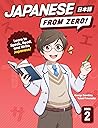

Buy Japanese from Zero! 2: Proven Techniques to Learn Japanese for Students and Professionals 3rd by Trombley, George, Takenaka, Yukari (ISBN: 9780976998112) from desertcart's Book Store. Everyday low prices and free delivery on eligible orders. Review: Japanese from Zero 2 - I have just finished book 2 of this series and whilst it is definitely more difficult than the first book, it is still satisfying to work from and builds on the knowledge you have previously gained. I have studied Japanese on and off for many years, but when I decided to 'get serious' with studying this wonderful language, this is the series of books I chose to study from. The accompanying videos on YouTube were a huge consideration for me. This is extremely clear to work from and the explanations make it easy to grasp the concepts of forming sentences and using the language you learn. It even manages to explain quite complex ideas in a clear way, although I did struggle from chapter 9 onward, as this is where it introduces informal forms (in past, present and positive and negative forms) and a little more grammar. I had to take it slow and keep reinforcing what I'd learnt, but bit by bit it is sinking in. Like the first book, this has a workbook built into it, with reading and writing exercises (with an answer guide at the end of each chapter this time, rather than in the back like in book 1) and these exercises really help you grasp and solidify what you have learnt in that chapter. This books also teaches you Katakana and I love the way that as you progress through the book the words are gradually built up with each Katakana you learn, until by the end everything is written in Hiragana and Katakana and you can read and understand written Japanese. Kanji will come in book 3!. The author has also written a book called Kanji from zero, which covers Kanji a little more. But learning Hiragana and Katakana so quickly and effortlessly is a huge win and will impress native Japanese and will also enrich your experience when you travel in Japan. This isn't necessarily a book that'll teach you lots of phrases you can use on your holidays, right off the bat, but instead builds a solid language framework and introduces vocab, so you can build your own sentences and actually understand the language. This is much better than simply learning by rote. This also includes lots of foreign words that Japan has borrowed, which is why there is Katakana and these vocab are easier to learn as they already feel familiar. I also like how the author teaches a style of Japanese that is actually used and which is useful when in the country. Some courses will teach very formal and stilted Japanese, and whilst the author does teach you polite forms, he also teaches language that sounds more natural. As someone who wishes to use Japanese when I am in the country, this is essential for me and will hopefully open up another side of Japan that I may not have seen. My personal way to use this book was to read through each chapter to familiarise myself with the material, then watch the accompanying YouTube video for that lesson to get a clearer idea of pronunciation and any tough parts. Then I'd go back and work though the chapter in a slower, more methodical way, answering the exercises and making notes. I used the Ankidroid app to make up flashcards for all the words and phrases from each chapter, so I could study and test myself when out and about. And I also used a notebook to write up mind maps and mnemonic techniques for the more 'non-sticky' words. In conjunction with this course I also listened to Michel Thomas cd's in the car, JLPT audio CD's and used an excellent Particles dictionary (which I have also reviewed on desertcart). Using all these techniques together has really helped the info in this course sink in and start to build a decent framework to build upon. This course is great to work from and really progresses well from what you have already learnt. You quickly grasp difficult concepts, feel as if you actually understand the way the language is formed and the accompanying videos are light hearted and a wonderful additional media to aid your study. I can't recommend this series enough and if you wish to seriously learn Japanese and unlock your full potential, then give this a try and see what it can do for you. Review: Great Book For People Interested In Learning Japanese - The second entry in the Japanese From Zero! series is just as good as the previous one, containing extensive grammar rules, vocabulary and, of course, katakana, albeit with a few changes in the layout and designs of the pages. This book starts off where the previous book ended, so if you haven't already purchased the first one it's essential that you complete it first, as you will be very confused if you start this one with no previous knowledge of the Japanese language. This book covers vocabulary and types of sentences that you'd use in your day to day life, talking about formal and informal forms of words, providing cultural context so you don't say anything offensive or strange, and giving lessons on other useful things to know, and it's a very effective learning tool, even if you're teaching yourself (which I did). Although the layout and structure of this book is very learner-friendly and accessible, the book unfortunately has a few editing errors, which generally consist of kana that you haven't learned yet appearing in words in vocabulary lists. If you don't understand what that means, all of the Japanese words in the book start off being spelt in Roman lettering, which you are reading right now, but as you learn more kana, the symbols that you have learnt start being implemented into the spellings of those words. For example, the Japanese word for cake would start off being spelt as "keeki", but when you learn the symbol for "ke", it will be spelt in the later chapters as "ケ-ki". This system is incredibly useful, as it drills the symbols you know into your head so you know them by reflex, but sometimes words are written in full kana due to incorrect editing, forcing the reader to go to the glossary at the end of the book to see what the symbol sounds like. Whilst being a minor issue, I thought that this was important to mention, as some people may become confused and think that they didn't know some kana that they should have learnt earlier, or think that maybe they skipped a bit of the book where you learn the new kana. Besides the minor errors, this book is greatly helpful and plentiful in content that assists learners and teaches them new concepts/grammar rules effectively. If you're interested in learning Japanese for either professional reasons or out of interest, I'd recommend no other book series to you than Japanese From Zero!, as it doesn't overload you with information and allows you to learn at your own pace. For the amount of content here, the price is completely justified, so if you want to start learning this intricate and fascinating language, look no further and purchase this book.


S**O
Japanese from Zero 2
I have just finished book 2 of this series and whilst it is definitely more difficult than the first book, it is still satisfying to work from and builds on the knowledge you have previously gained. I have studied Japanese on and off for many years, but when I decided to 'get serious' with studying this wonderful language, this is the series of books I chose to study from. The accompanying videos on YouTube were a huge consideration for me. This is extremely clear to work from and the explanations make it easy to grasp the concepts of forming sentences and using the language you learn. It even manages to explain quite complex ideas in a clear way, although I did struggle from chapter 9 onward, as this is where it introduces informal forms (in past, present and positive and negative forms) and a little more grammar. I had to take it slow and keep reinforcing what I'd learnt, but bit by bit it is sinking in. Like the first book, this has a workbook built into it, with reading and writing exercises (with an answer guide at the end of each chapter this time, rather than in the back like in book 1) and these exercises really help you grasp and solidify what you have learnt in that chapter. This books also teaches you Katakana and I love the way that as you progress through the book the words are gradually built up with each Katakana you learn, until by the end everything is written in Hiragana and Katakana and you can read and understand written Japanese. Kanji will come in book 3!. The author has also written a book called Kanji from zero, which covers Kanji a little more. But learning Hiragana and Katakana so quickly and effortlessly is a huge win and will impress native Japanese and will also enrich your experience when you travel in Japan. This isn't necessarily a book that'll teach you lots of phrases you can use on your holidays, right off the bat, but instead builds a solid language framework and introduces vocab, so you can build your own sentences and actually understand the language. This is much better than simply learning by rote. This also includes lots of foreign words that Japan has borrowed, which is why there is Katakana and these vocab are easier to learn as they already feel familiar. I also like how the author teaches a style of Japanese that is actually used and which is useful when in the country. Some courses will teach very formal and stilted Japanese, and whilst the author does teach you polite forms, he also teaches language that sounds more natural. As someone who wishes to use Japanese when I am in the country, this is essential for me and will hopefully open up another side of Japan that I may not have seen. My personal way to use this book was to read through each chapter to familiarise myself with the material, then watch the accompanying YouTube video for that lesson to get a clearer idea of pronunciation and any tough parts. Then I'd go back and work though the chapter in a slower, more methodical way, answering the exercises and making notes. I used the Ankidroid app to make up flashcards for all the words and phrases from each chapter, so I could study and test myself when out and about. And I also used a notebook to write up mind maps and mnemonic techniques for the more 'non-sticky' words. In conjunction with this course I also listened to Michel Thomas cd's in the car, JLPT audio CD's and used an excellent Particles dictionary (which I have also reviewed on Amazon). Using all these techniques together has really helped the info in this course sink in and start to build a decent framework to build upon. This course is great to work from and really progresses well from what you have already learnt. You quickly grasp difficult concepts, feel as if you actually understand the way the language is formed and the accompanying videos are light hearted and a wonderful additional media to aid your study. I can't recommend this series enough and if you wish to seriously learn Japanese and unlock your full potential, then give this a try and see what it can do for you.
Z**A
Great Book For People Interested In Learning Japanese
The second entry in the Japanese From Zero! series is just as good as the previous one, containing extensive grammar rules, vocabulary and, of course, katakana, albeit with a few changes in the layout and designs of the pages. This book starts off where the previous book ended, so if you haven't already purchased the first one it's essential that you complete it first, as you will be very confused if you start this one with no previous knowledge of the Japanese language. This book covers vocabulary and types of sentences that you'd use in your day to day life, talking about formal and informal forms of words, providing cultural context so you don't say anything offensive or strange, and giving lessons on other useful things to know, and it's a very effective learning tool, even if you're teaching yourself (which I did). Although the layout and structure of this book is very learner-friendly and accessible, the book unfortunately has a few editing errors, which generally consist of kana that you haven't learned yet appearing in words in vocabulary lists. If you don't understand what that means, all of the Japanese words in the book start off being spelt in Roman lettering, which you are reading right now, but as you learn more kana, the symbols that you have learnt start being implemented into the spellings of those words. For example, the Japanese word for cake would start off being spelt as "keeki", but when you learn the symbol for "ke", it will be spelt in the later chapters as "ケ-ki". This system is incredibly useful, as it drills the symbols you know into your head so you know them by reflex, but sometimes words are written in full kana due to incorrect editing, forcing the reader to go to the glossary at the end of the book to see what the symbol sounds like. Whilst being a minor issue, I thought that this was important to mention, as some people may become confused and think that they didn't know some kana that they should have learnt earlier, or think that maybe they skipped a bit of the book where you learn the new kana. Besides the minor errors, this book is greatly helpful and plentiful in content that assists learners and teaches them new concepts/grammar rules effectively. If you're interested in learning Japanese for either professional reasons or out of interest, I'd recommend no other book series to you than Japanese From Zero!, as it doesn't overload you with information and allows you to learn at your own pace. For the amount of content here, the price is completely justified, so if you want to start learning this intricate and fascinating language, look no further and purchase this book.
M**.
Japanese from Zero 2, The journey continues!
The second book in the series continues from where the first book left off. It contains a lot more information this time around. Of course it goes without saying but you will need to have either read and understood the first book or at the very least have a decent understanding of basic Japanese such as Ko, So, Do words and simple sentence structure and grammar like asking questions for example. You WILL also need to know Hiragana as this book is filled from the start. However Kanji knowledge is not required nor is Katakana however knowing the latter will help if you do know it already. Much like the first book in the series, this one will teach you new vocabulary, grammar and some insights into the Japanese language and culture. The book is substantially bigger than the previous one and really does up the ante with the use of both markers/particles uses and the complexity of the grammar used. The best way to describe it is if the first book is teaching you to talk like five/six year old then this one by the end will be more like a 8/9 year old. There are some great in-depth descriptions for most areas although some of the particle uses could have done with some more detail as it is easily the hardest area of the language and more examples would have been helpful. The book is filled with questions on every other page and comes with a full answer sheet after each chapter. This time around, the book will teach you the second Japanese alphabet, Katakana. I personally found this one to be the harder of the two to remember but much like the previous book it slowly introduces a handful of letters and then replaces the English with the new symbols. While I already knew Katakana by the time I got this book I can assume it does work as it did for Hiragana in book 1. However, it should be mentioned that this book does contain some typos and errors in both the English and the Japanese. Now I’m no expert in the subject but a few times I did have to check words in a dictionary as I am certain they do not appear in this book. So to summarise, if you read the first book and found it helpful then this is a great continuation of that. Much like the first one you will use this book many times over the course of your learning experience. Before moving onto book 3 I would recommend going through this book a few times as it contains vital information you will need.
Q**E
A downgrade in quality
I found the first book in this series to be incredibly helpful and thorough, however I feel like book 2 is a significant downgrade in quality and quantity of material. I have also noticed a multitude of spelling and grammatical mistakes both in English and Japanese. In addition the whole book has a very deep frying oil smell to it, every single page smells like a deep fat fryer which is a little off putting.
A**K
Even better than Book 1
After going through Book 1 twice, I was ready to take the plunge. Again, the book shares the same clear layout as Book 1. It contains many different types of learning activity to encourage learners to keep practising. Each chapter uses a new topic (e.g. my cat) to present the language. The topics chosen seem very relevant to normal life and not as esoteric or specific as some texts, where focus has been on business trips or such like. Here it's down to earth subject matter for everday life. Some of the example conversations are quite funny too which helps memory retention and I think are included for light relief. Book 1 had some strange little typo's and other odd choices for language but Book 2 seems to have none of those. There are some particularly excellent sections regarding the explanations of particles, something that should and is done concisely. This is an often recurring theme; concepts are explained with a minimum of fuss. Above all, the book will increase your fluency. You are exposed to many language patterns and get a chance to practice the language in a multitude of ways. As it should be. Good job to the authors. Book 3 already on its way.
S**X
A Very Entertaining and Inspirational Learning Book on Japanese
The title says it all. I have book one so it was fitting to have its follow-up. It's such an enjoyable book that it kept me engrossed and up well into the early hours of the morning. The book gives the reader exercises and simple phrases and tells how they should be pronounced. I have already learnt a handful within an hour. It's just practise and getting used to it. After that, you are speaking the language. Being Asian I wanted to learn my mother-tongue and I simply just love the sound of it and was practising in the mirror and it felt really nice. Thank you so much, Amazon. You fulfilled another dream of mine.
C**E
More of the same simple grammar, with easy to understand explanations
This book coasts along at a similar speed to the first JFZ. It goes over quite a lot more basic grammar and provides you with a good pile of vocabulary to learn. It is also chocked full of practice questions with answers included. At the end of the book, you'll probably be able to understand quite a bit of Japanese, although you will not be able to read it yet, given the book doesn't introduce kanji yet.I actually managed to get through this textbook quite easily, as I had been using other sumplements for my learning.
J**H
The best japanese course online or offline
I have just started this book after finishing the first one. I have tried before the most popular nihongo books such as Japanese for busy people, Genki etc... but they become boring or they rush after a while. Japanese from Zero is very well designed book. The pace and the lessons are perfect and contains tons of exercises and practical examples. And man, my japanese really has improved a lot. You can find for free on Youtube videos for every lesson and those videos are like a proper japanese class. The difference is that you are not paying hundreds of pounds for the lessons. This is the definitive Nihongo book.
Trustpilot
1 month ago
1 week ago