
DOWNLOAD THE APP


Customer Services
Copyright © 2025 Desertcart Holdings Limited
DOWNLOAD THE APP
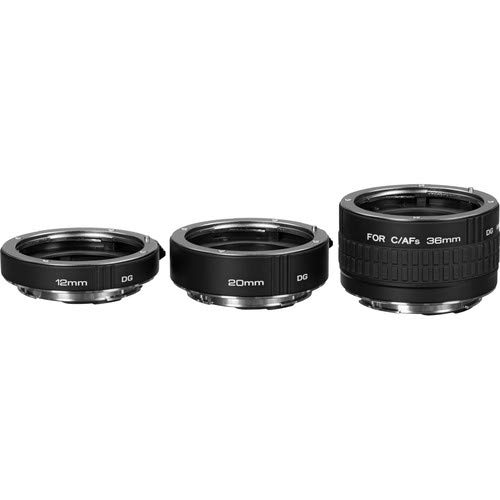
🔬 Get closer, capture sharper — transform your lens into a macro powerhouse!
The Kenko Auto Extension Tube Set includes three precision tubes (12mm, 20mm, 36mm) that extend your Canon EOS lens’s focusing range for stunning macro photography. Designed without optics, these tubes maintain full autofocus and TTL exposure functionality, enabling professional-grade close-up shots without sacrificing image quality. Compatible with most Canon EF and EF-S lenses, this set offers flexible magnification options and durable construction, making it a must-have for millennial pros seeking to elevate their creative edge and never miss a detail.
| Best Sellers Rank | #74 in Lens Extension Tubes |
| Customer Reviews | 4.3 out of 5 stars 291 Reviews |
C**N
Excellent addition to any macro photographers toolkit albeit slightly expensive
The Kenko Macro Automatic Extension Tube Set for Canon EOS is a set of 3 extension tubes that you can mix and match to give you different levels of "magnification" (more on this in a bit). You get 12mm, 20mm and 36mm tubes that you can use singly or mix and match to give you a maximum of 68mm. Extension tubes do not contain any glass/optics and are designed to enable a lens to focus closer than its normal minimum focusing distance. As such they effectively magnify your subject. The extension tubes are mounted between your lens and the camera body to create more distance between the lens and your sensor. By moving the lens further away from the camera sensor, the lens is forced to focus much closer than normal and your image is essentially cropped. The greater the length of the extension tube, the closer the lens can focus. Basically the sensor captures a smaller amount of the image with the rest of the image being outside of the sensor. You have to take into account the focal length of your lens when applying extension tubes. For example, if you have one of the 50mm Canon primes, you cannot use the full 68mm of the extension tubes as you will never be able to focus the object. I done a great deal of research into extension tubes and which ones to get before deciding to go with the Kenko Automatic tubes. The automatic part of the Kenko set is that each tube has a series of connectors which relay information from the camera to your lens and vice vera. Thus all the EXIF data is passed on, auto focus, aperture etc. all work just as if the lens was connected directly to your camera. The Kenko tubes work with both APS-C and full size cameras and lenses (basically EF (Full Frame) and EF-S (APS-C) lenses). I've tried out a variety of lenses with this Kenko set including but not limited to 18-135 EFS, 70-300EF and 100L EF Macro lens. All the lenses I have tried have worked without problem. I have even used this extension set along with a Metabones III adapter to on my Sony A7 full frame again without incident. By giving you three separate extension tubes you have much greater flexibility in the amount of magnification you desire and working with a proper macro lens (e.g. Canon EF100L 2.8 USM Macro) you can get extremely close into a subject. You can however use these lenses to turn a non-macro lens into a sort-of macro if you don't want to spend the money specifically on a macro lens (if you are interested in macro photography you really do need a specific macro lens). For example I used these extension tubes with my 70-300mm lens to get some quite detailed and sharp images of flowers and insects. When shooting macro, you have a very narrow depth of field and it is also harder to keep a subject in perfect focus (a tripod really is a must). Using extension magnifies these effects. The only downside to the Kenko set of extension tubes if the price. They are well constructed, fit tightly and work very well but I still think $200 is a little much when all they really are is a set of tubes and connecters (no optics). Overall a great addition to a macro photographers toolkit and I carry these around in my camera bag everywhere I go.
P**A
Awesome tubes! You will be able to get super close to your subjects but focus is very sensitive -use a tripod & remote shutter
I am a serious hobbyist photographer. I have never made a full-time living doing photography (but I have had sporadic periods of good part-time/freelance income). I currently shoot on a Canon 6D and this is my first foray into macro photography. I first started with magnification filters, but I could not figure out how to get tack-sharp focus with them. They did enlarge nicely so the blur could have been user error. Anyway, I read about extension tubes while trying to research my blur problem. After a quick Google about extension tubes, I found the Kenko tubes. Reviews looked favorable so I ordered. I am really glad that I did. These tubes are pricier than most of the others on Amazon, but after reading reviews about tubes breaking and getting stuck in the camera/on the lens (or lenses being to heavy and breaking away from the plastic tubes) I didn't want to cheap out. These tubes are just hollow plastic tubes. They connect to the camera on one end (just like your lenses do) and to the lens of your choice on the other end. Basically, the tubes put distance between your lens and the mirror of your camera. You can use all of the included tubes (3 of them) together or any combination you choose. At first, I tried this with my 14mm wide angle lens. I never got it to work....I only saw black even with the camera pointed towards the sun in full daylight. After I Googled the problem, I came to the conclusion that you can not go too small or it doesn't work (I never tried it again with the 14mm). Next, I tried it with my nifty fifty and it was soooo exciting. It worked! You have to been close up to your subject to focus...if you try to dial in something across the room with the tubes installed all you will see is blur. Put something right in front of it and it will pop into view. I did find out very quickly that I would not be able to hand hold the camera and get sharp shots very often. A flash could help (even in broad daylight) possibly, but I didn't want to use one. Instead, I opted to use longer exposures to get the pictures. My 50mm usually requires about 1.5 feet to focus but with all of the extension tubes tacked on, I was able to get within an inch of my subject. The area in focus using my setup was very slim...if the camera move half a millimeter I lost the focus. If the wind blew the flower, I lost the focus. If I swayed with the camera, I lost the focus. Basically, the field of focus is VERY narrow (I will practice more and try wider apertures to hopefully remedy this). I have a full size semi-professional tripod. It can not get any closer to the ground than about 2 feet. This is way to far of a distance for my camera to focus with the tubes installed (think a couple of inches at most from your subject...not feet). To get the camera closer to the ground and my subjects (ants and flowers) I attached an articulating arm to a cheaper, smaller tripod and added a small ball head. I was able to bend it, adjust it and rotate it until I could focus on my subject. I frankensteined it together and it was awkward because sometimes the camera would end up completely upside down and I was trying to compose through the viewfinder (next time I plan to attach my tablet to use as a monitor). This is my first experience using the Kenko's. I think things will only go up from here! I did just receive a macro focusing rail in the mail today and I am waiting for a macro tripod to be delivered this week also. I think with the right equipment I can get truly stunning results. I think that if you are a beginner macro enthusiast like me, you should definitely get these to learn with before dropping $800-$1200 on a dedicated macro lens. I would also recommend that you buy a mini tripod (one that can get on the ground level or practically ground level) if you plan to capture things that are low. Also different lenses will allow you to be farther away and use these. My last tip would be to use a wireless remote to release the shutter (or wired shutter release) or your cameras timer to release the shutter. This will reduce camera movement and picture blur. I also tried a few shots with my kit lens and the images were fine. I really like these tubes and I would purchase them again. I would also recommend these to a friend. I am attaching the pictures that I took on my first time out with these tubes. No previous experience so blame me, not the tubes for any ugly blur ;) Narrow depth of field is great though, in my humble opinion.
T**K
Your lens is now a macro lens!
This is the best extension tube set out there. If you're ever eyeballing a wicked macro lens, but it's way too out of your budget, then this extension tube set will do the job. It can turn ANY of your lenses (assuming you bought the one that is compatible with your camera) into a macro lens. And you don't lose image quality either. The other great thing about this is that it's electric, so even though you lose light as you get closer, you can still change the aperture, iso and shutter settings. You can always opt for the way cheaper Fotodiox tube set, but that one doesn't allow you to change settings, so that can be a problem. This is a very affordable set and I cannot recommend this enough. The amount of detail you can get from those extreme close ups with all three attached is unreal. For a test exercise, try taking shots of a coin, cereal, a knife and your favorite action figure. The amount of detail you can see is something you would have never been able to spot or notice with your naked eye. This set gives you all those amazing details. A very good set if you're into macro photography and your client is corporate and wants macro shots of his or her product. This is even great for shooting video. But you can't move the lens at that close, it has to be a still shot. You can place it, and move the object you're shooting instead. Anyway, I highly recommend this set. You won't get a better deal than this and you save money. Lots of money.
A**R
Solid, easy to use, work great
I bought these in part because I switched to a full-frame camera, making my Tamron 90mm macro lens considerably less useful. So far I have used them with the Tamron 90mm macro (12mm extension) to make it a functional macro lens for insects again, and with the Canon 300mm F/4 (36mm). I almost always shoot handheld, using a flash for closeup macro but not with the long lens. The macro + 12mm extension is a great combination, making it possible to again use the macro lens for larger subjects. Autofocus still works fine, although I don't always use it for macro, depending on what I'm photographing. The 300mm F/4 + 36mm extension is a perfect dragonfly setup for most species, allowing me to get close enough to fill the frame on larger species. Again, autofocus works fine, as does aperture (unlike with macro, where I usually use f8 or f11, I use a variety of apertures for dragonflies) I haven't yet tried stacking more than one extension tube, but expect that will allow me to get closer to damselflies and small dragonflies, while still retaining more working distance than I would get with a macro lens. I haven't yet tried the extension tubes with my 35mm reverse macro set, but I will soon. The Kenko tubes are solid and slip on and off easily, and seem to be well-made. The one potential issue is that it is possible to bump the release lever if you're not careful. It's unlikely that the lens will fall off, but it's a good idea to be careful and aware of the possibility. Honestly, I didn't fully understand the purpose of extension tubes before I got them, but now I wouldn't go without them. They're incredibly useful. Just be aware that they function by *reducing your working distance*. If you want to magnify more without getting closer to your subject, you want extenders/teleconverters or diopter filters, not extension tubes. If you want a large depth of field with your subject sharp all the way through...no lens or extension tubes will give you that, but you might want to google "focus stacking" (it's a physics problem). If you are ONLY planning to do reverse macro, where you lose autofocus and control the aperture via a manual aperture ring, you don't need the electronics in these and can buy much cheaper, electronics-free extension tubes.
S**E
Stop searching, click buy...
If you're looking for a set of extension tubes for your Canon EOS camera, stop hunting around and get these. The tubes are well built, fit precisely, and do a wonderful job. Yes, they DO transmit the full lens functions, so you retain AF and lens communication. Do be aware, if this is your first time playing with extension tubes, that even though AF control is transmitted, there are other factors that can cause AF to stop working. If you stack on all 3 tubes, your camera will cease to provide AF for reasons that have nothing to do with these extension tubes. Remember that with an extension tube you're changing the amount of available light and the DOF, beyond the normal range of use for AF. That said, manual focus is usually the choice when using extension tubes anyway. If you have concerns about weather sealing, I'm not entirely sure these tubes will hold up against far more expensive tubes provided by Canon. Since owning these I've been greatly enjoying the macro-capabilities my normal lenses can now perform. I've also run into several pro-photographers who own these, adding to the reassurance of my purchase. So again, make sure you know the basic concepts behind an extension-tube before you buy, but when you're ready, get these. You'll be happy and you'll have far more left in your pocket, too!
K**S
Does the job it's supposed to do
This tube set fits both the Canon EOS EF and EF-S style lenses. I have both kinds and confirmed that they all fit snuggly. I've used these tubes for a couple of weeks now and couldn't be happier with them. The fact that you get a 12mm, 20mm AND a 36mm is great value for money, I have found the best magnification comes from using a true macro lens (100mm 2.8L) with these tubes although the focal length of such lenses means that the focus distance isn't really effected that much. Where it really shows a marked difference is on my 24-70mm 2.8L with this lens and these tubes I can bring the focal plane inside the lens, obviously not what you'd want to do, but you can change the zoom and pull the focus out to mere millimeters from the lens glass. The depth of focus when using these tubes is minute, in some cases only a millimeter. I find that rather than adjust the focus on the lens I simply zoom in or out to get the correct part of the picture in focus (or of course, close the aperture down and extend your DOF). A tripod is highly recommended, but I have successfully taken shots while steadying the camera against another object, just remember to hold your breath! Also, when you're this close to your subject, you should think about some off camera light source like wireless flashes, or of course you can use a ring flash. Fit and Finish: While it's not Canon... the fit and finish on these tubes is very good, I have no complaints, the tubes fit together very well with little to no play in them. Their connection to the camera and to the lenses is very good. I've hung heavy L lenses off of them without issue.
E**N
Great for Macro, making a little cheap...
This set is great to work Macro with many lens if not all. Depending on the lens that are used on, one can use only one 12mm tube (wide angle) or the three stacked togheter with a 200mm lens. In any case they work perfect for achieveng really close focusing distances and very close to 1:1 magnification. A quite important problem is, however, the very narrow depth of field. This is something that some people may want to have a look at before buying this set since macro lens achieve a little longer depth of field I beleive. About the making of the set I feel they are somewhat cheap, yet it doesnt feel like they are going to break. Apart form the 12mm tube, the tubes feel solid, work well electronically, very light and assemble on and off easily (yet when they are assembled a little play from the tube to the lens can be noticed). The 12mm tube is difficul to put and remove from lens or the other tubes, it requires to put some force to assembly it on the lens (or to assemble the lens on it). This one I dont think I'll be using much couse im kinda nervous that it may damage the mounting of the lens. Still if I have to I will put it on since is not catastrophic... This made me think about the canon tubes and that I wouldnt be having this kind of trouble with'em. Maybe the lower cost did mean lower construction quality...
D**S
Works great with long lenses
I find that the Kenko Extension tubes work as described. I originally purchased the Canon version of the extension tubes but found the 12mm not useful enough to keep at the price I paid for it. I then purchased the Kenko version and really cannot tell any difference in build quality from the Canon version. Since my use of these tubes is a little different than most, I wanted to share my experience in case someone else had the same thoughts and concerns. While I do use these tubes on my 50mm lens, my primary use is with my Canon 300 mm 4.0L and my 400 mm 5.6L lenses. While none of the lenses I have are specifically macro lenses, my 300 mm and 400 mm have always taken spectacular close-up shots of small items. So my main concern is whether or not these tubes would fit snugly with my large and heavy lenses and would the construction of the Kenko tubes cause damage to my camera or lenses due to the weight of the lenses. I am happy to report that the extension tubes do fit snugly to my camera and all of my lenses. Obviously, I do not leave the tubes and my long lenses attached when not actively shooting, but I am not concerned that the extra weight of the long lenses will cause damage while shooting. The construction of these tubes is pretty solid and on par with the Canon version of these tubes.
Trustpilot
3 days ago
2 weeks ago