
DOWNLOAD THE APP


Customer Services
Copyright © 2025 Desertcart Holdings Limited
DOWNLOAD THE APP
![Monastic Diurnal 8th Edition [Traditional Monastic Breviary of 1963]](https://m.media-amazon.com/images/I/51Hw+0Vmk4L.jpg)
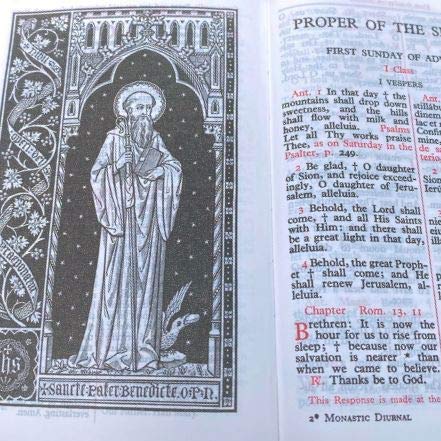
Monastic Diurnal 8th Edition [Traditional Monastic Breviary of 1963] [Catholic Church] on desertcart.com. *FREE* shipping on qualifying offers. Monastic Diurnal 8th Edition [Traditional Monastic Breviary of 1963] Review: YOU WON'T REGRET PURCHASING THIS NEW EDITION - [UPDATED] THE MONASTIC DIURNAL: INVALUABLE PART OF THE HERITAGE OF THE LITURGY OF THE LATIN OCCIDENT Some history would illustrate the beauty and singularity of this text. Pope Paul V allowed the Benedictines to preserve their proper Rite for the Divine Office in his Bull "Ex injuncto nobis" (1 October 1612) according to the ordinance in the Bull "Quod a nobis" of Pope St. Pius V (9 July 1568) that dispensed certain Dioceses and Religious Orders from the obligation of adhering to the Roman Breviary reformed by order of the Œcumenical Council of Trent. The Congregation of Sacred Rites promulgated the typical edition of the Monastic Breviary on 24 January 1615. When Pope St. Pius X commenced a momentous reform of the Roman Rite by his Bull "Divino afflatu" (1 November 1911), the Abbot-Primate of the Benedictine Order, the Most Rev. Dom Fidelis von Stotzingen, requested the Apostolic See to approve an adaptation of the new reforms for the Monastic Breviary. By authority of Pope Benedict XV, the Congregation of Sacred Rites granted the request on 28 April 1915. When the Congregation of Sacred Rites promulgated further reforms for the Roman Rite in the Decree "Novum Rubricarum" (26 July 1960) by authority of Pope St. John XXIII, the Abbot-Primate of the Benedictine Order, the Most Rev. Dom Benno Gut, followed the example of his above-mentioned predecessor and the same Roman Congregation promulgated a new typical edition of the Monastic Breviary on 15 December 1962. This is the typical edition of the Monastic Breviary from whence the text of this latest edition of the Monastic Diurnal was taken, originally published by H. Dessain at Michelin, Belgium, and imported to the States. This text is also the edition that is available to recite canonically by authority of Pope Benedict XVI's Motu Proprio "Summorum Pontificorum" (7 July 2007), though Pope Francis may modify this in light of the long-expected legislative reforms of his Apostolic Letter “Traditionis custodes.” The reforms mentioned above did not affect the substance of the Monastic Office, the heart of which is the Psalter. With Pope St. Pius X having done away with the old Roman Psalter of immemorial origin, the Monastic Psalter is now the most ancient liturgical psalter in the Latin Occident, having been ordained by St. Benedict in his Holy Rule (chapters viii-xviii) in the 6th century. The Latin texts of the Hymns predate the recension of Pope Urban VIII, which made the Hymns of the Roman Breviary conform to Classical meter. The Monastic Rite had enthusiastically embraced the programme of reform established by Pope St. Pius X for the Roman Rite by giving precedence to the Dominical and Ferial Offices above the Sanctoral Offices. Decades before the reforms of Pope St. John XXIII, the Benedictines had already eliminated the "Semi-Duplex" rite in the Sanctoral Offices, expunged a great number of Saints' Feasts from the General Calendar of the Order, and had imitated the Ambrosian Rite in reducing all "Duplex" Feasts to commemorations in the Quadragesimal and Passiontide Seasons. The Monastic Rite had anticipated the limitation of the Athanasian Creed "Quicumque" to Trinity Sunday alone (which the Roman Rite did in the simplification of the Rubrics promulgated by the Congregation of Sacred Rites by authority of Pope Pius XII in 23 March 1955) when it conformed to the reforms of Pope St. Pius X. RELATIVE SIMPLICITY OF THE MONASTIC BREVIARY The Monastic Breviary relatively easy to recite when one considers the Roman Breviary: Compline almost never varies, and the Little Hours have the same Psalms Tuesday through Saturday, with Psalm 118 (Vulgate numbering is used here) divided amongst Prime, Terce, Sext and None on Sunday and also throughout the latter three Little Hours on Monday. This arrangement stays the same even in the Solemn Feasts (except during the Sacred Triduum). Monastic Lauds has almost invariably Psalm 66 to commence it, with the famous penitential Psalm 50 on Ferias and most II Class Sundays, and ending almost always with the three last Psalms in the Psalter (148, 148, 150). Monastic Vespers has only four Psalms or divisions thereof (Roman Vespers has five). A singular aspect of the Monastic Breviary is the prominence of the Dominical Prayer, the "Pater noster," preceded by the Kyries in each Canonical Hour. WHY ONLY THE DAY HOURS? Monastic Matins has twelve Psalms or divisions thereof, on all Sundays, Ferias and Feasts, having six in two Nocturns (except during the Sacred Triduum) with additional three Canticles at the third Nocturn for Sundays and I Class and II Class Feasts. There are four lessons at each Nocturn for Sundays and I Class and II Class Feasts, making a total of twelve lessons. Ending Matins is always the Ambrosian Hymn "Te Deum" and the recitation or chant of the Gospel lesson that is to be found in the Mass that corresponds to that Office. As can be seen from the above notes, Monastic Matins is intimidatingly gargantuan. This is why this tome could not have included the text of Matins, and why Nuns who were involved with teaching and other Missionary activities were dispensed from its choral recitation even before the Second Vatican Council. ABOUT THIS NEW EDITION This new 2020 edition of the Farnborough reprint of the Dessain Monastic Diurnal of 1963 has several advantages in comparison to earlier editions published by St. Michael's Abbey Press. There is an updated Table of Movable Feasts (2021-2051). There are notes ("On the Composition of the Hours" and "On Celebrating Saints not Included in the Calendar") which are very helpful. The Latin text and translation of the prayers formerly recited before praying the Office ("Aperi, Domine") and afterwards ("Sacrosanctæ") are included, along with the Lord's Prayer, Angelic Salutation and the Apostles' Creed. There is a beautiful woodcut illustration of St. Benedict, taken from the ornate editions of the Breviarium Monasticum published by Desclée in the 19th century (this is the only illustration). The volume itself is significantly thinner and more portable, with a sturdy slipcase. I cannot recommend this book enough. It contains a precious liturgical heritage that can boast of almost fourteen centuries: almost 1,400 years since the first Benedictines prayed the Psalms exactly the same way as contained in this Monastic Diurnal! Well for the Day Hours anyways... Even if you already own the original 1963 Dessain Monastic Diurnal, or previous Farnborough editions thereof, this new edition is worth the investment. -------------------------------------------- Due to the Apostolic Letter issued “Motu proprio” by the Supreme Pontiff Francis “Traditionis custodes” on the use of the Roman Liturgy prior to the Reform of 1970 (16 July 2021), all references to "forma extraordinaria" have been removed. Despite the very necessary and sound restrictions of Pope Francis, the Benedictine liturgy as it existed in Pope S. John XXIII's ponitificate will always endure as historic witness to the beauty of the Church's euchological tradition. Review: Gorgeous & "meaty" but steep learning curve - My favorite office for a thousand reasons. Definitely geared toward people already experienced praying the office so there is a lot of flipping between pages and ommitted understood portions (ie. the Gloria at the end of all the Psalms, repeated closing prayers, etc) It definitely took me a little while to figure out,but once i put in some sticky tabs for easy reference and found a good system with my ribbons, it has been smooth sailing. Sometimes the charts and references/terminology can be challenging for beginners to understand, but if you stick with it long enough and are willing to deal with the learning curve, this office has been one of the most spiritually beneficial disciplines I have ever undertaken. I can't imagine ever stopping for the rest of my life. It is beautifully made and bound with the perfect number of ribbons for the major sections (but I still use 2 holy card bookmarks for the seasonal and feasts sections, and sticky tabs for repeated psalms, ie. the Magnificat and the Benedictus). I wouldn't call it a "prayer book" persé because it definitely has a proper use and design (not a random compilation of prayers) but I LOVE the English translation (beautiful and "meaty"). Tons of fodder for contemplation, but also a wonderful companion for simply learning Latin in context because of how well everything is aligned. If you wonder why you "aren't" being fed in your Faith, maybe its because you haven't learned how to pray the office. Buy this. Committ. Stick it out. It will change your life. God bless.
| ASIN | B08N5Q4YS8 |
| Best Sellers Rank | #89,897 in Books ( See Top 100 in Books ) |
| Customer Reviews | 4.6 4.6 out of 5 stars (103) |
| Item Weight | 15.5 ounces |
| Language | English |
| Publication date | January 1, 2020 |
| Publisher | St Michael's Abbey |
M**G
YOU WON'T REGRET PURCHASING THIS NEW EDITION
[UPDATED] THE MONASTIC DIURNAL: INVALUABLE PART OF THE HERITAGE OF THE LITURGY OF THE LATIN OCCIDENT Some history would illustrate the beauty and singularity of this text. Pope Paul V allowed the Benedictines to preserve their proper Rite for the Divine Office in his Bull "Ex injuncto nobis" (1 October 1612) according to the ordinance in the Bull "Quod a nobis" of Pope St. Pius V (9 July 1568) that dispensed certain Dioceses and Religious Orders from the obligation of adhering to the Roman Breviary reformed by order of the Œcumenical Council of Trent. The Congregation of Sacred Rites promulgated the typical edition of the Monastic Breviary on 24 January 1615. When Pope St. Pius X commenced a momentous reform of the Roman Rite by his Bull "Divino afflatu" (1 November 1911), the Abbot-Primate of the Benedictine Order, the Most Rev. Dom Fidelis von Stotzingen, requested the Apostolic See to approve an adaptation of the new reforms for the Monastic Breviary. By authority of Pope Benedict XV, the Congregation of Sacred Rites granted the request on 28 April 1915. When the Congregation of Sacred Rites promulgated further reforms for the Roman Rite in the Decree "Novum Rubricarum" (26 July 1960) by authority of Pope St. John XXIII, the Abbot-Primate of the Benedictine Order, the Most Rev. Dom Benno Gut, followed the example of his above-mentioned predecessor and the same Roman Congregation promulgated a new typical edition of the Monastic Breviary on 15 December 1962. This is the typical edition of the Monastic Breviary from whence the text of this latest edition of the Monastic Diurnal was taken, originally published by H. Dessain at Michelin, Belgium, and imported to the States. This text is also the edition that is available to recite canonically by authority of Pope Benedict XVI's Motu Proprio "Summorum Pontificorum" (7 July 2007), though Pope Francis may modify this in light of the long-expected legislative reforms of his Apostolic Letter “Traditionis custodes.” The reforms mentioned above did not affect the substance of the Monastic Office, the heart of which is the Psalter. With Pope St. Pius X having done away with the old Roman Psalter of immemorial origin, the Monastic Psalter is now the most ancient liturgical psalter in the Latin Occident, having been ordained by St. Benedict in his Holy Rule (chapters viii-xviii) in the 6th century. The Latin texts of the Hymns predate the recension of Pope Urban VIII, which made the Hymns of the Roman Breviary conform to Classical meter. The Monastic Rite had enthusiastically embraced the programme of reform established by Pope St. Pius X for the Roman Rite by giving precedence to the Dominical and Ferial Offices above the Sanctoral Offices. Decades before the reforms of Pope St. John XXIII, the Benedictines had already eliminated the "Semi-Duplex" rite in the Sanctoral Offices, expunged a great number of Saints' Feasts from the General Calendar of the Order, and had imitated the Ambrosian Rite in reducing all "Duplex" Feasts to commemorations in the Quadragesimal and Passiontide Seasons. The Monastic Rite had anticipated the limitation of the Athanasian Creed "Quicumque" to Trinity Sunday alone (which the Roman Rite did in the simplification of the Rubrics promulgated by the Congregation of Sacred Rites by authority of Pope Pius XII in 23 March 1955) when it conformed to the reforms of Pope St. Pius X. RELATIVE SIMPLICITY OF THE MONASTIC BREVIARY The Monastic Breviary relatively easy to recite when one considers the Roman Breviary: Compline almost never varies, and the Little Hours have the same Psalms Tuesday through Saturday, with Psalm 118 (Vulgate numbering is used here) divided amongst Prime, Terce, Sext and None on Sunday and also throughout the latter three Little Hours on Monday. This arrangement stays the same even in the Solemn Feasts (except during the Sacred Triduum). Monastic Lauds has almost invariably Psalm 66 to commence it, with the famous penitential Psalm 50 on Ferias and most II Class Sundays, and ending almost always with the three last Psalms in the Psalter (148, 148, 150). Monastic Vespers has only four Psalms or divisions thereof (Roman Vespers has five). A singular aspect of the Monastic Breviary is the prominence of the Dominical Prayer, the "Pater noster," preceded by the Kyries in each Canonical Hour. WHY ONLY THE DAY HOURS? Monastic Matins has twelve Psalms or divisions thereof, on all Sundays, Ferias and Feasts, having six in two Nocturns (except during the Sacred Triduum) with additional three Canticles at the third Nocturn for Sundays and I Class and II Class Feasts. There are four lessons at each Nocturn for Sundays and I Class and II Class Feasts, making a total of twelve lessons. Ending Matins is always the Ambrosian Hymn "Te Deum" and the recitation or chant of the Gospel lesson that is to be found in the Mass that corresponds to that Office. As can be seen from the above notes, Monastic Matins is intimidatingly gargantuan. This is why this tome could not have included the text of Matins, and why Nuns who were involved with teaching and other Missionary activities were dispensed from its choral recitation even before the Second Vatican Council. ABOUT THIS NEW EDITION This new 2020 edition of the Farnborough reprint of the Dessain Monastic Diurnal of 1963 has several advantages in comparison to earlier editions published by St. Michael's Abbey Press. There is an updated Table of Movable Feasts (2021-2051). There are notes ("On the Composition of the Hours" and "On Celebrating Saints not Included in the Calendar") which are very helpful. The Latin text and translation of the prayers formerly recited before praying the Office ("Aperi, Domine") and afterwards ("Sacrosanctæ") are included, along with the Lord's Prayer, Angelic Salutation and the Apostles' Creed. There is a beautiful woodcut illustration of St. Benedict, taken from the ornate editions of the Breviarium Monasticum published by Desclée in the 19th century (this is the only illustration). The volume itself is significantly thinner and more portable, with a sturdy slipcase. I cannot recommend this book enough. It contains a precious liturgical heritage that can boast of almost fourteen centuries: almost 1,400 years since the first Benedictines prayed the Psalms exactly the same way as contained in this Monastic Diurnal! Well for the Day Hours anyways... Even if you already own the original 1963 Dessain Monastic Diurnal, or previous Farnborough editions thereof, this new edition is worth the investment. -------------------------------------------- Due to the Apostolic Letter issued “Motu proprio” by the Supreme Pontiff Francis “Traditionis custodes” on the use of the Roman Liturgy prior to the Reform of 1970 (16 July 2021), all references to "forma extraordinaria" have been removed. Despite the very necessary and sound restrictions of Pope Francis, the Benedictine liturgy as it existed in Pope S. John XXIII's ponitificate will always endure as historic witness to the beauty of the Church's euchological tradition.
C**.
Gorgeous & "meaty" but steep learning curve
My favorite office for a thousand reasons. Definitely geared toward people already experienced praying the office so there is a lot of flipping between pages and ommitted understood portions (ie. the Gloria at the end of all the Psalms, repeated closing prayers, etc) It definitely took me a little while to figure out,but once i put in some sticky tabs for easy reference and found a good system with my ribbons, it has been smooth sailing. Sometimes the charts and references/terminology can be challenging for beginners to understand, but if you stick with it long enough and are willing to deal with the learning curve, this office has been one of the most spiritually beneficial disciplines I have ever undertaken. I can't imagine ever stopping for the rest of my life. It is beautifully made and bound with the perfect number of ribbons for the major sections (but I still use 2 holy card bookmarks for the seasonal and feasts sections, and sticky tabs for repeated psalms, ie. the Magnificat and the Benedictus). I wouldn't call it a "prayer book" persé because it definitely has a proper use and design (not a random compilation of prayers) but I LOVE the English translation (beautiful and "meaty"). Tons of fodder for contemplation, but also a wonderful companion for simply learning Latin in context because of how well everything is aligned. If you wonder why you "aren't" being fed in your Faith, maybe its because you haven't learned how to pray the office. Buy this. Committ. Stick it out. It will change your life. God bless.
A**R
Overall nicer appearance, and much better feel due to being considerably thinner
First, note that the five stars is expectation rather than experience. I just received this breviary today and have just a few comments. 1. Content-wise, it appears to be virtually identical to the 7th ed. which I have had for a few years. However, 2. It is considerably thinner, approx. 1.25" thick vs. approx. 2" for the previous edition (see picture). The overall cover/page dimensions are very slightly larger as well, but not really enough to make a difference. The thickness DOES make a difference, however. The 7th-ed. was so thick as to be a bit unwieldy. The 8th ed. fits comfortably in my hand. 3. Obviously, that thickness has to come from somewhere. The pages are what I would term "Bible paper," noticeably thinner than previously. That does not seem (again, with only brief skimming through it) to result in noticeable bleed-through and ghosting of type. 4. The cover, while still stiffer than I hoped, has a marginally smoother "feel" to it, which I like. 5. The gilt edges of the pages seems to be of higher quality and consistency. My 7th edition looks very mottled and uneven, almost ugly in appearance. 6. The gold embossing on the spine appears to be sharp; time will tell how well it holds up. The blind-stamped front and back of the jubilee medal of St. Benedict (on back and front, naturally) also appears to be deep and sharp enough that the larger text can be read if you hold it so the light hits it righ. 7. The end papers have a nice repeating pattern (about an inch-diamond individually) of a papal tiara, a shell, a fleur-de-lys, and a bee (I think; a bee signifies several things in Catholic iconography, including Christ's resurrection) 8. Some have mentioned loose binding, even pages loose or falling out. So far (again, I just got it today) it seems to be well-bound to me. Overall, I'm quite pleased. Overall, the 8th ed. seems to be a considerably nicer book. However, again, the interior is the same as the 7th ed. If you already have the 7th ed., it's up to you to decide if the difference is enough to justify dropping about $80 on the 8th ed.
R**N
The Benedictine Monastic Diurnal for the Day Hours Lauds - Compline 1962 text in 1963 lighter weight format is beautifully produced. The book itself is light, beautifully bound with silk ribbands, clear dark print on pristine white page. If you have good vision this is perfect, but the print must be 8 point so for anyone for whom that will be difficult one might suggest the 12 point series of paperback versions of the Benedictine Rite hours as produced by the Monks of Clear Creek Abbey USA.
S**D
Poor quality. Not even one year old and already coming apart. I paid big $$ for this. Used very gently. This should not have happened.
A**O
The book is magnificent in its content and in the quality of manufacture, the English translation is beautiful. Only I thought I had a leaf with the magnificat and the benedictus and it wasn't. Maybe the previous editions did have it.
P**M
Dreadful packaging for such an expensive book.
Trustpilot
2 months ago
2 months ago