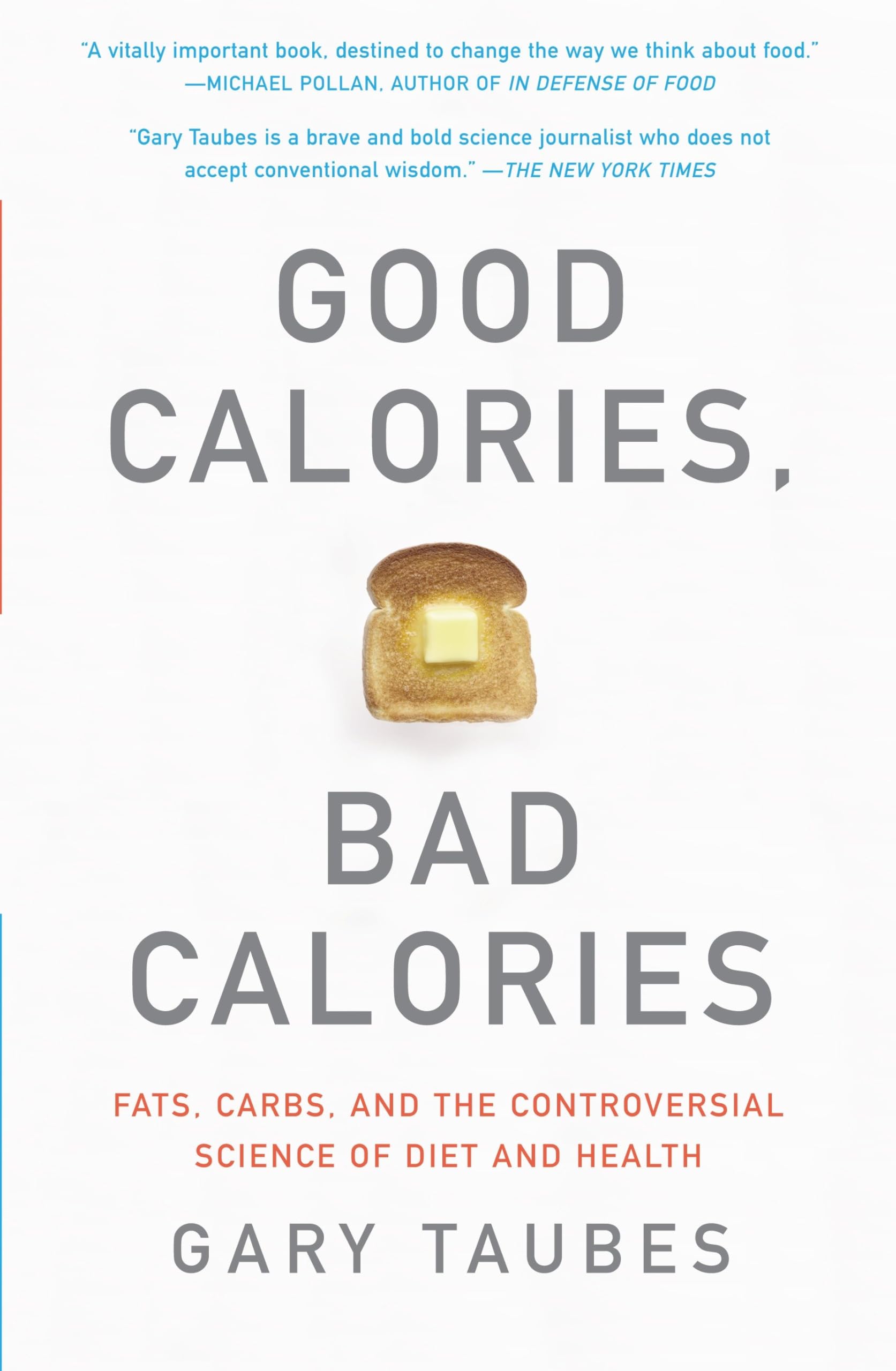
Good Calories, Bad Calories: Fats, Carbs, and the Controversial Science of Diet and Health [Taubes, Gary] on desertcart.com. *FREE* shipping on qualifying offers. Good Calories, Bad Calories: Fats, Carbs, and the Controversial Science of Diet and Health Review: Both the big picture and the little details - A book this detailed and controversial is difficult to review without writing another book in the process. Since many reviews have already covered much of the content and conclusions, I'll try to say things that aren't already in the list of 156 reviews so far (that I recall). (...which is not easy.) This book is a review of science. That the science happens to be about nutrition is primary only if that is your actual interest. People interested in the nature of science and its process, politics and pitfalls, should find this fascinating even if they never gave a thought to why fat seems so much easier to gain than to lose (particularly in the larger amounts), or to why the "diseases of civilization" (diabetes, heart disease, Alzheimer, schizophrenia, cancer, etc.) are skyrocketing. There are several critically important topics in nutrition and related areas that could have been added to this, but I suspect a 2000 page book would have been difficult to sell. It's obvious he had to choose a focus and a linear path through a gigantic topic. As part of the fact that it is a science review and not a novel or diet book, there are a few important considerations. 1. It is a review of science; it is not science itself except in the form of intelligent inquiry and review; it is not "research". Taubes is not a formal researcher, though he is science-trained and specializes in investigating and writing about science. In short, this is OLD research, not NEW research: it's just that it's research many people probably either don't know about or learned about rather differently. 2. Aside from a small 'final conclusions' bit, there isn't really anything to argue about in terms of 'disagreeing with Taubes' in this; rather, people would have to argue with the actual research reviewed. Readers could complain about what is included or excluded ('too much' some say, 'not enough' say others), that's about it. Even if one disagrees with Taubes's overview-conclusions, the degree of careful detail combined with the linear-layout and the courage to present a truly alternative view on highly politicized issues (some of his ideas left me stunned, they were so new to me!), is worthy of respect. 3. This book is just slightly like a nutritional version of 'Forbidden Science' (about Archeology), and I translate the point of it rather like this: "For those formally educated, here's the stuff you probably didn't learn, or didn't learn in this way for sure, and of what you did learn, here's a new look at some of the assumed cornerstones of belief-system edifices. And for those not formally educated, here's a trail through history and science to start with: here's what's accepted then and now, and here's an alternative path to consider." What readers want to do with all that is entirely up to them. The most important thing is getting the information into the larger world to be at least considered and brought to light finally or differently in some cases; what part of all this turns out to be right, or wrong, or misunderstood, or differently understood, in the end is less the issue here than just finally beginning some kind of dialogue on these important points. 4. I doubt the Final Answer[tm] of nutrition is yet at hand, and so I'm sure there must be plenty of areas to further explore and in the end, it might not all agree with the general framework Taubes ended up with (or, it might--I don't know). It's a review of so many different studies and related areas, that it is highly unlikely any single work could be perfect or perfectly complete on all that -- it would have to be 10x its length, at least, and be written from a century in the future. The important thing is that the book became available at all, because it is the first thing courageous enough to "question authority" to this degree, detailed enough to provide a jumping-off point for legitimate medical people to re-evaluate some old ideas on their own, and yet readable enough to provide an entry gateway to at least a small portion of the layman public. 5. This is an educational book, but it is not entry-level except for very good readers with some understanding of basic science. This is no dumbed-down textbook; this actually requires some decent cognitive skills. I found it fascinating, but although I can read about 800 pages in a day if I have all the daylight hours, it took me a full week to wade through it in long evenings after work. (This might have gone faster, did I not have to keep stopping to rant and rave to a friend about things in the content!) If you are not a strong reader, I do not recommend it unless you have a year to work on it. 6. The book is very dense in information, and this is its strong point and its purpose. That means if you're not into the topics of science or nutrition etc., it's either going to put you to sleep or fry your brain. I loved it: the world has more than enough simple diet books for laymen. What we really needed was a book that combined science detail with readability, and science history with the commercial present, for an understanding of how we got to where we are, and what that means to science, to nutrition, to health, and to our future, both as individuals and as a species. 7. On the problem side, the publisher's presentation makes this seem like a "diet book". This is not a paint-by-number eating plan. If you want a book about what to eat and when and how to count it, there are many, but this isn't one of those. It's also not a "pleasant afternoon reading," unless you're a fairly serious intellectual. That is sure to disappoint many who are unlikely to be willing to get through it. (Some people are simply better with other forms of learning than dense text, and this really IS "dense text".) It is a good thing this book is not exactly for the masses, though, since I think if we could take all this information and distill it into sound-bytes that the public would easily understand, there might be lynch mobs arriving at some health agency doorways. ** I feel that nobody in the field of medicine could write this book: they'd be ruined for the degree of questioning the party line/ status quo, and if they were researchers they wouldn't get funding from any of the all-pervasive sources (generally, the food industries killing us and the pharmaceutical industries not-curing but eternally-treating us), and the problem is, a person educated in that system is highly unlikely to break out of the mold to find this road to begin with, unless they are really exceptionally independent thinkers. Gary's position as a science writer, and the years he put into studying this, combined with him having no major vested interests in the conclusions (such as some of the more consumer-book authors of lowcarb diet plans), is the perfect combination. It's too 'heavy' to ever make him much money I bet (too small an audience), nowhere near worth the hours and years he put into it, but I hope that he doesn't regret the work, because I'm sure many people are genuinely grateful for the book -- I am. ** I'm from a family of huge women. Women who basically diet constantly for 20, 30, 40 years and they're still fat. I was fairly athletic until my mid-20s, when two years of a very intense, work+school+commute, sleep deprived, high stress, not eating daily except mega-carbs right before sleep, resulted in a massive rapid weight gain. Later when traditional dieting didn't work at all for me, I simply gave up, not willing to be neurotic daily about something my family made seem unsolvable. (OK, I nearly shot myself over it in all honesty, but once I got over myself, I moved on.) About 15 years later (now huge), I was hospitalized for untreated asthma infections. While there I had a heart-rate reaction to days of steroids plus pain and a situation, and that got me assigned a cardiologist (though I had no heart condition). When I got out of the hospital and visited him, he wrote me a prescription to the Protein Power Life Plan book by the Drs. Eades. Helluva drug: I've kept off over 125lbs for 18 months now, and medical symptoms (acid reflux, complexion problems, severe asthma, allergies, unexplained rashes, chronic exhaustion, brain-fog, bloating, etc.) all vanished within weeks of making an effort to ditch most carbs and increase protein and fat and add some supplements (no exercise involved). In fairness, this can't all be attributed to lowcarb, because getting off gluten (solely by accident to begin) is a good chunk of the symptom resolution. I am exercising more now that I can finally move enough to do some of it. (I can mow my lawn, weed it, rake it, shovel soil for the garden. As of September 18 2006 when I went on lowcarb, I couldn't even stand for 60 seconds without screaming back pain, couldn't walk around a store. The changes in my life are radical.) But my respect for Taubes's book is not because of my experience; rather, it's because he finally gave me a way to help my brain's intellectual understanding connect with my body's experiential reality. I really needed to understand some of this which seemed very confusing as it contradicted all the tenets of "pop science". I am no expert on anything, and I was cynical about "lowcarb" at first, but the results have been good enough to change my life, and my future, and make me seriously interested in the subject. I may never be thin, but at least I've learned enough to head off destruction. Reading about why poor science, social good-ol-boys and political peer pressure has resulted in the train wreck of modern nutrition/healthcare, realizing that nearly 20 years of my life were basically trashed as a result of believing the government's advice, made me a little homicidal for awhile, but I recovered. Now, I'd just like to see some decent, intelligent dialogue and research happening thanks to this guy's gutsy exploration and road map to another view. I'm guessing not too much will happen and he'll have to get old and die before the larger world recognizes just how important this book is (was) at this time. If you are interested in these subjects and you read very well, this book is the boss. No matter what you believe or don't about nutrition, this book is worth a read. Review: Compelling Look at the Science of Diet and Health - In the interest of full disclosure, I'll start by saying I received an advance copy of the book Good Calories, Bad Calories: Challenging the Conventional Wisdom on Diet, Weight Control, and Disease, by Gary Taubes, to review; my acceptance of an advance copy came with no strings; I was neither asked to write a review nor was it implied if I chose to, that it be positive. That said, it's a good thing I received an advance copy - with over 600-pages of content, notes and bibliography, it's a dense reading adventure! That's not to say it's difficult to read or understand; quite the contrary, I found it to be well-written and a compelling page-turner. Then again, this is the genre of writing I enjoy most - content that is well researched and strongly supported with references, citations and evidence...so you can imagine my excitment as I opened my copy and dug right in! I was not disappointed. I've held my review up until today as I was interested in watching how the media was going to play the release of the book. I wondered, would the various shows and articles encourage their viewers and readers to read the book, or would they seek to discredit Taubes to discourage any real discussion about his positions presented and the research he believes supports them? Save for a couple of appearances and reviews, the silence around the release of the book is deafening. Taubes appeared on Good Morning America last week. The GMA website provides an excerpt from the book to read online and a video clip from the on-air segment (on same page), along with an area to leave comments. Later (same day) Taubes was featured on Nightline. The Nightline website provides a transcript of the show, a video-clip of the segment and an area for comments too. This week, the Lifestyle: Health & Fitness section on Reuters published its review titled Count your calories. In the Reuters article we find a glimpse of what is the at the heart of the book, "Good Calories, Bad Calories" examines an alternative hypothesis to the calorie- and fat-centric idea through decades of literature and clinical data on diet and obesity, Taubes says. It's another way to explain observations about diet and weight gain, he says, one for which strong data existed. "If we had taken this other fork in the road," he asks, "what would we have come to believe?" The book is, in a word, a masterpiece; not because I think Taubes is right with all his conclusion, but because I feel he took the right approach to evaluate the science - he approached the research from the perspective of a skeptic; that despite his own beliefs at the start, he was going to let the data speak for itself and take him where it led from hundreds of studies published over the last century. Before I continue with the review of the book, let me say that I believe good science requires one be a true skeptic; a good researcher, a scientist, then is not a proponent of any particular point of view, but remains cognizant of the fact that trials finding support for or refuting a hypothesis are both valuable in our quest for understanding; that seeing and believing the data, both in support of or refutation of a hypothesis, is the primary goal in scientific inquiry. Simply put, letting the data speak for itself and remaining skeptical that your own belief in a hypothesis may in fact be wrong, is an important part of the process in scientific discovery; if one cannot remain open to the idea a hypothesis may be wrong, one cannot reject hypotheses that fail when put through the rigors of testing. Which brings me back to the book. Taubes tackles a number of issues in the book, notably the history of how we got where we are today with public health policies and dietary recommendations, and why, even without good science to support our policies as they developed, they were formed and promoted as fact to the population at large. He then tackles what was two competing hypotheses at the time we hit the crossroad in our search for understanding how diet plays a role in disease: the diet-heart hypothesis and the carbohydrate hypothesis. He asked, "If we had taken this other fork in the road, what would we have come to believe?" The only way to begin to answer that question is to set aside what you think you know, set aside preconceived notions and dig into Taubes book. It's rich with citations for studies lost in the noise and debate; filled with data and findings that for too long collected dust until he brushed them off for a second look; and leaves the door wide open for us to begin to really examine all the data we have. The full weight of the evidence, Taubes contends, led him to conclusions he did not anticipate himself at the start; conclusions that are controversial but open-ended for more discussion, interpretation, analysis and trial. Perhaps you too may find yourself in the same predicament at the end of Good Calories, Bad Calories: Challenging the Conventional Wisdom on Diet, Weight Control, and Disease; until you read it though, you just can't know, can you? I highly recommend the book, for those who firmly hold carbohydrate restriction is scientifically valid and for those who firmly hold limiting dietary fat is scientifically valid. At the end of the day our quest isn't to prove what is believed right, it's to discover what is rightly to be believed. Taubes doesn't just argue that what we're told is wrong, he provokes us to examine our beliefs about a healthy diet by providing a wealth of data from hundreds of studies reviewed in his research in writing the book to argue the validity of the scientific process. That is, he presents a compelling arguement that the supportive data used to maintain the status quo of the diet-heart hypothesis and our current dietary guidelines is not as sturdy as we're led to believe, and makes the case that for well over a century there has been, all along throughout the last century, the competing alternate theory, the carbohydrate hypothesis, that has been ignored despite compelling data. No matter what one currently believes, this book is an eye-opening examination of the science and the history that led us to where we are today; a compelling review of the weight of the evidence from both sides; and a resource rich with citations that allow us to begin examining and questioning the validity of our beliefs in the connections between diet and health.


| Best Sellers Rank | #106,593 in Books ( See Top 100 in Books ) #59 in Low Carb Diets (Books) #161 in Low Carbohydrate Diets #229 in Other Diet Books |
| Customer Reviews | 4.5 4.5 out of 5 stars (2,277) |
| Dimensions | 6.06 x 1.32 x 9.15 inches |
| Edition | Reprint |
| ISBN-10 | 1400033462 |
| ISBN-13 | 978-1400033461 |
| Item Weight | 1.51 pounds |
| Language | English |
| Print length | 640 pages |
| Publication date | September 23, 2008 |
| Publisher | Vintage |
P**R
Both the big picture and the little details
A book this detailed and controversial is difficult to review without writing another book in the process. Since many reviews have already covered much of the content and conclusions, I'll try to say things that aren't already in the list of 156 reviews so far (that I recall). (...which is not easy.) This book is a review of science. That the science happens to be about nutrition is primary only if that is your actual interest. People interested in the nature of science and its process, politics and pitfalls, should find this fascinating even if they never gave a thought to why fat seems so much easier to gain than to lose (particularly in the larger amounts), or to why the "diseases of civilization" (diabetes, heart disease, Alzheimer, schizophrenia, cancer, etc.) are skyrocketing. There are several critically important topics in nutrition and related areas that could have been added to this, but I suspect a 2000 page book would have been difficult to sell. It's obvious he had to choose a focus and a linear path through a gigantic topic. As part of the fact that it is a science review and not a novel or diet book, there are a few important considerations. 1. It is a review of science; it is not science itself except in the form of intelligent inquiry and review; it is not "research". Taubes is not a formal researcher, though he is science-trained and specializes in investigating and writing about science. In short, this is OLD research, not NEW research: it's just that it's research many people probably either don't know about or learned about rather differently. 2. Aside from a small 'final conclusions' bit, there isn't really anything to argue about in terms of 'disagreeing with Taubes' in this; rather, people would have to argue with the actual research reviewed. Readers could complain about what is included or excluded ('too much' some say, 'not enough' say others), that's about it. Even if one disagrees with Taubes's overview-conclusions, the degree of careful detail combined with the linear-layout and the courage to present a truly alternative view on highly politicized issues (some of his ideas left me stunned, they were so new to me!), is worthy of respect. 3. This book is just slightly like a nutritional version of 'Forbidden Science' (about Archeology), and I translate the point of it rather like this: "For those formally educated, here's the stuff you probably didn't learn, or didn't learn in this way for sure, and of what you did learn, here's a new look at some of the assumed cornerstones of belief-system edifices. And for those not formally educated, here's a trail through history and science to start with: here's what's accepted then and now, and here's an alternative path to consider." What readers want to do with all that is entirely up to them. The most important thing is getting the information into the larger world to be at least considered and brought to light finally or differently in some cases; what part of all this turns out to be right, or wrong, or misunderstood, or differently understood, in the end is less the issue here than just finally beginning some kind of dialogue on these important points. 4. I doubt the Final Answer[tm] of nutrition is yet at hand, and so I'm sure there must be plenty of areas to further explore and in the end, it might not all agree with the general framework Taubes ended up with (or, it might--I don't know). It's a review of so many different studies and related areas, that it is highly unlikely any single work could be perfect or perfectly complete on all that -- it would have to be 10x its length, at least, and be written from a century in the future. The important thing is that the book became available at all, because it is the first thing courageous enough to "question authority" to this degree, detailed enough to provide a jumping-off point for legitimate medical people to re-evaluate some old ideas on their own, and yet readable enough to provide an entry gateway to at least a small portion of the layman public. 5. This is an educational book, but it is not entry-level except for very good readers with some understanding of basic science. This is no dumbed-down textbook; this actually requires some decent cognitive skills. I found it fascinating, but although I can read about 800 pages in a day if I have all the daylight hours, it took me a full week to wade through it in long evenings after work. (This might have gone faster, did I not have to keep stopping to rant and rave to a friend about things in the content!) If you are not a strong reader, I do not recommend it unless you have a year to work on it. 6. The book is very dense in information, and this is its strong point and its purpose. That means if you're not into the topics of science or nutrition etc., it's either going to put you to sleep or fry your brain. I loved it: the world has more than enough simple diet books for laymen. What we really needed was a book that combined science detail with readability, and science history with the commercial present, for an understanding of how we got to where we are, and what that means to science, to nutrition, to health, and to our future, both as individuals and as a species. 7. On the problem side, the publisher's presentation makes this seem like a "diet book". This is not a paint-by-number eating plan. If you want a book about what to eat and when and how to count it, there are many, but this isn't one of those. It's also not a "pleasant afternoon reading," unless you're a fairly serious intellectual. That is sure to disappoint many who are unlikely to be willing to get through it. (Some people are simply better with other forms of learning than dense text, and this really IS "dense text".) It is a good thing this book is not exactly for the masses, though, since I think if we could take all this information and distill it into sound-bytes that the public would easily understand, there might be lynch mobs arriving at some health agency doorways. ** I feel that nobody in the field of medicine could write this book: they'd be ruined for the degree of questioning the party line/ status quo, and if they were researchers they wouldn't get funding from any of the all-pervasive sources (generally, the food industries killing us and the pharmaceutical industries not-curing but eternally-treating us), and the problem is, a person educated in that system is highly unlikely to break out of the mold to find this road to begin with, unless they are really exceptionally independent thinkers. Gary's position as a science writer, and the years he put into studying this, combined with him having no major vested interests in the conclusions (such as some of the more consumer-book authors of lowcarb diet plans), is the perfect combination. It's too 'heavy' to ever make him much money I bet (too small an audience), nowhere near worth the hours and years he put into it, but I hope that he doesn't regret the work, because I'm sure many people are genuinely grateful for the book -- I am. ** I'm from a family of huge women. Women who basically diet constantly for 20, 30, 40 years and they're still fat. I was fairly athletic until my mid-20s, when two years of a very intense, work+school+commute, sleep deprived, high stress, not eating daily except mega-carbs right before sleep, resulted in a massive rapid weight gain. Later when traditional dieting didn't work at all for me, I simply gave up, not willing to be neurotic daily about something my family made seem unsolvable. (OK, I nearly shot myself over it in all honesty, but once I got over myself, I moved on.) About 15 years later (now huge), I was hospitalized for untreated asthma infections. While there I had a heart-rate reaction to days of steroids plus pain and a situation, and that got me assigned a cardiologist (though I had no heart condition). When I got out of the hospital and visited him, he wrote me a prescription to the Protein Power Life Plan book by the Drs. Eades. Helluva drug: I've kept off over 125lbs for 18 months now, and medical symptoms (acid reflux, complexion problems, severe asthma, allergies, unexplained rashes, chronic exhaustion, brain-fog, bloating, etc.) all vanished within weeks of making an effort to ditch most carbs and increase protein and fat and add some supplements (no exercise involved). In fairness, this can't all be attributed to lowcarb, because getting off gluten (solely by accident to begin) is a good chunk of the symptom resolution. I am exercising more now that I can finally move enough to do some of it. (I can mow my lawn, weed it, rake it, shovel soil for the garden. As of September 18 2006 when I went on lowcarb, I couldn't even stand for 60 seconds without screaming back pain, couldn't walk around a store. The changes in my life are radical.) But my respect for Taubes's book is not because of my experience; rather, it's because he finally gave me a way to help my brain's intellectual understanding connect with my body's experiential reality. I really needed to understand some of this which seemed very confusing as it contradicted all the tenets of "pop science". I am no expert on anything, and I was cynical about "lowcarb" at first, but the results have been good enough to change my life, and my future, and make me seriously interested in the subject. I may never be thin, but at least I've learned enough to head off destruction. Reading about why poor science, social good-ol-boys and political peer pressure has resulted in the train wreck of modern nutrition/healthcare, realizing that nearly 20 years of my life were basically trashed as a result of believing the government's advice, made me a little homicidal for awhile, but I recovered. Now, I'd just like to see some decent, intelligent dialogue and research happening thanks to this guy's gutsy exploration and road map to another view. I'm guessing not too much will happen and he'll have to get old and die before the larger world recognizes just how important this book is (was) at this time. If you are interested in these subjects and you read very well, this book is the boss. No matter what you believe or don't about nutrition, this book is worth a read.
R**A
Compelling Look at the Science of Diet and Health
In the interest of full disclosure, I'll start by saying I received an advance copy of the book Good Calories, Bad Calories: Challenging the Conventional Wisdom on Diet, Weight Control, and Disease, by Gary Taubes, to review; my acceptance of an advance copy came with no strings; I was neither asked to write a review nor was it implied if I chose to, that it be positive. That said, it's a good thing I received an advance copy - with over 600-pages of content, notes and bibliography, it's a dense reading adventure! That's not to say it's difficult to read or understand; quite the contrary, I found it to be well-written and a compelling page-turner. Then again, this is the genre of writing I enjoy most - content that is well researched and strongly supported with references, citations and evidence...so you can imagine my excitment as I opened my copy and dug right in! I was not disappointed. I've held my review up until today as I was interested in watching how the media was going to play the release of the book. I wondered, would the various shows and articles encourage their viewers and readers to read the book, or would they seek to discredit Taubes to discourage any real discussion about his positions presented and the research he believes supports them? Save for a couple of appearances and reviews, the silence around the release of the book is deafening. Taubes appeared on Good Morning America last week. The GMA website provides an excerpt from the book to read online and a video clip from the on-air segment (on same page), along with an area to leave comments. Later (same day) Taubes was featured on Nightline. The Nightline website provides a transcript of the show, a video-clip of the segment and an area for comments too. This week, the Lifestyle: Health & Fitness section on Reuters published its review titled Count your calories. In the Reuters article we find a glimpse of what is the at the heart of the book, "Good Calories, Bad Calories" examines an alternative hypothesis to the calorie- and fat-centric idea through decades of literature and clinical data on diet and obesity, Taubes says. It's another way to explain observations about diet and weight gain, he says, one for which strong data existed. "If we had taken this other fork in the road," he asks, "what would we have come to believe?" The book is, in a word, a masterpiece; not because I think Taubes is right with all his conclusion, but because I feel he took the right approach to evaluate the science - he approached the research from the perspective of a skeptic; that despite his own beliefs at the start, he was going to let the data speak for itself and take him where it led from hundreds of studies published over the last century. Before I continue with the review of the book, let me say that I believe good science requires one be a true skeptic; a good researcher, a scientist, then is not a proponent of any particular point of view, but remains cognizant of the fact that trials finding support for or refuting a hypothesis are both valuable in our quest for understanding; that seeing and believing the data, both in support of or refutation of a hypothesis, is the primary goal in scientific inquiry. Simply put, letting the data speak for itself and remaining skeptical that your own belief in a hypothesis may in fact be wrong, is an important part of the process in scientific discovery; if one cannot remain open to the idea a hypothesis may be wrong, one cannot reject hypotheses that fail when put through the rigors of testing. Which brings me back to the book. Taubes tackles a number of issues in the book, notably the history of how we got where we are today with public health policies and dietary recommendations, and why, even without good science to support our policies as they developed, they were formed and promoted as fact to the population at large. He then tackles what was two competing hypotheses at the time we hit the crossroad in our search for understanding how diet plays a role in disease: the diet-heart hypothesis and the carbohydrate hypothesis. He asked, "If we had taken this other fork in the road, what would we have come to believe?" The only way to begin to answer that question is to set aside what you think you know, set aside preconceived notions and dig into Taubes book. It's rich with citations for studies lost in the noise and debate; filled with data and findings that for too long collected dust until he brushed them off for a second look; and leaves the door wide open for us to begin to really examine all the data we have. The full weight of the evidence, Taubes contends, led him to conclusions he did not anticipate himself at the start; conclusions that are controversial but open-ended for more discussion, interpretation, analysis and trial. Perhaps you too may find yourself in the same predicament at the end of Good Calories, Bad Calories: Challenging the Conventional Wisdom on Diet, Weight Control, and Disease; until you read it though, you just can't know, can you? I highly recommend the book, for those who firmly hold carbohydrate restriction is scientifically valid and for those who firmly hold limiting dietary fat is scientifically valid. At the end of the day our quest isn't to prove what is believed right, it's to discover what is rightly to be believed. Taubes doesn't just argue that what we're told is wrong, he provokes us to examine our beliefs about a healthy diet by providing a wealth of data from hundreds of studies reviewed in his research in writing the book to argue the validity of the scientific process. That is, he presents a compelling arguement that the supportive data used to maintain the status quo of the diet-heart hypothesis and our current dietary guidelines is not as sturdy as we're led to believe, and makes the case that for well over a century there has been, all along throughout the last century, the competing alternate theory, the carbohydrate hypothesis, that has been ignored despite compelling data. No matter what one currently believes, this book is an eye-opening examination of the science and the history that led us to where we are today; a compelling review of the weight of the evidence from both sides; and a resource rich with citations that allow us to begin examining and questioning the validity of our beliefs in the connections between diet and health.
C**Y
Questa è la seconda copia che compro di questo libro. L'ho regalata ad un amico con cui spesso si parla di alimentazione. È un testo illuminante sui pericoli dell'eccesso di carboidrati che caratterizza l'alimentazione moderna. In più, è argomentato in maniera solidissima, con riferimenti così vari e dettagliati alla ricerca scientifica e alla storia della scienza dell'alimentazione da far comprendere come si è arrivati agli attuali modelli alimentari, alle loro criticità e le possibili alternative. Il tutto scritto in maniera rigorosissima ma accessibile. Un esempio di giornalismo di divulgazione scientifica confortante in un panorama editoriale dove toppo spesso l'argomento è vittima dell'improvvisazione e della polemica.
A**W
Gary Taubes schafft es mit diesem bahnbrechenden Werk die Zusammenhänge der letzten 200 Jahre Wissenschaftsgeschichte in Medizin, Ernährungs"wissenschaft" und anderen nach zu zeichnen und so ein klares, unglaublich mutiges und differenziertes Bild der Entstehung, Ursachen, Hintergründe und Lösung vieler, ernährungsbedingter Volksleiden wie Adipositas, Übergewicht, Diabetes II, etc. dem Leser zu vermitteln. Der klaren, sehr spannenden Aufbereitung der wissenschaftlichen Fakten und menschlichen Schwächen zahlreicher (überbewerteter und fälschlich als vertrauenswürdig bewerteten) Wissenschaftlicher und v.a. auch Pseudo-Wissenschaftler, ebenso wie Politiker gebührt Dank und Hochachtung. Es wird verständlich, warum über Jahrzehnte Falschinformationen und Meinungen einzelner den Bevölkerung, gerade in USA und Deutschland als "Ernährungsempfehlungen" verkauft wurden (wenig Fett, viele Kohlenhydrate z.B.), welche dazu führten (und immer weiter dazu führen), dass Übergewicht, Adipositas, Diabetes, jedes Jahr weiter zunehmen und nicht nur die Mehrheit unserer sog. reichen Industriestaaten davon betroffen ist, sondern bald unglaubliche 70 oder gar 80% nach div. Schätzungen. Zeit aufzuwachen aus dem Informationsnetz an Falsch- und Fehlinformationen, schlechter und Pseudowissenschaft, das überwiegend Meinungs-basiert ist und dem überwiegend keinerlei ernst zu nehmende Wissenschaft zu Grunde liegt. Es ist durchaus als bahnbrechend zu bezeichnen, im Laufe der 650 Seiten fallen einem viele Zusammenhänge wie Schuppen von den Augen. Vieles klärt sich. Zum Beispiel, dass Reduktionsdiäten nur eine 1%-ige Erfolgschance haben und gleichzeitig als das Non-Plus-Ultra von allen Fachgesellschaften zur Gewichtsabnahme empfohlen werden. Wobei von vielen Stellen deren mangelnde Wirksamkeit inzwischen teilweise wenigstens erwähnt wird. Was diese jedoch nicht daran hindert sich gleichzeitig zu widersprechen und, wie die Deutsche Gesellschaft für Ernährung oder die Deutsche Diabetes Gesellschaft (ebenso wie deren amerikanische Pendants), weiterhin diese als einzig wirksame Methoden empfehlen. Ebenso, dass - und das ist zentral - die wichtigsten Ursachen der Übergewichts- und Adipositas-Epidemie ein (wie auch immer gearteter) "Bewegungsmangel" und eine "erhöhte Nahrungsaufnahme" seien (v.a die angeblich so schädlichen Nahrungsfette). Die Verwechslung von Ursache und Wirkung an dieser Stelle ist einschneidend. Die dargelegten (wissenschaftlich unstrittigen) Zusammenhänge von Kohlenhydrat-reicher Nahrung > dauerhaft erhöhtem Insulinspiegel > Aufbau von Körperfett und Verhinderung des Verbrauchs von Körperfett, ist einleuchtend. Und dennoch weitgehend ignoriert in der Fachwelt. Und in den Bevölkerungen oft unbekannt. Das Buch beschreibt auch ein- und nachdrücklich, welche unglaublichen Vorgänge im Bereich der Forschung im Bereich Medizin (v.a. chronische Krankheiten und Adipositas, bzw. Übergewicht) und Ernährung die letzten Jahrzehnte beherrschten: schlechte oder völlig vernachlässigte Wissenschaft, Aufstellen von unbewiesenen Behauptungen und jahrzehntelanger Ignoranz und stetiges Verkaufen von persönlichen Meinungen als wissenschaftliche Ergebnisse. So konnte z.B. bis heute der Zusammenhang von Nahrungsfetten und Krankheiten wissenschaftlich nicht bewiesen werden (was auch von Fach-Autoritäten gerne anders dargestellt wird, aus welchen Gründen auch immer). Ebenso wenig, und das ist wohl der größte Verdienst von Gary Taubes, wurde seine Kohlenhydrat-Hypothese bisher ausreichend wissenschaftlich erforscht und wird glasklar verständlich, warum - z.B. aus Ignoranz und schlechter Wissenschaft vermutlich - was sich nach diesem Buch jedoch ändern dürfte. Nachdem die in Medizin, Ernährungswissenschaft und Gesundheitspolitik vorherrschenden Meinungen eben genau das sind - Meinungen, und nichts davon einer wissenschaftlichen Überprüfung stand hält, kann die Wahrscheinlichkeit, dass Gary Taubes Kohlenhydrat-Hypothesen richtig sind, als sehr hoch angesehen werden. Dieses aufrüttelnde Werk sollte jeder Mediziner, Ernährungswissenschaftler, Gesundheitspolitiker, Forscher in den betreffenden Disziplinen und alle direkt von Übergewicht, Adipositas, Diabetes, und allen Volkskrankheiten betroffenen Menschen lesen und sein Wissen sollte in Grundschulen unterrichtet werden. Es schafft einmalige Klarheit. Das Wissen über die wissenschaftliche Faktenlage zu Kohlenhydraten und die schädlichen Auswirkungen auf den Stoffwechsel der allermeisten Menschen und die genannten, bekannten Volkskrankheiten, könnte vielen Millionen Menschen helfen, endlich gesund zu werden oder gesund zu bleiben. Eines der mit Abstand bedeutendsten Bücher überhaupt.
G**S
Great read for those interested in understanding how main stream diet advice had gotten it so wrong
T**R
WOW. Just wow. This book is an amazing tour de force which really spells out how such twisted messages around carbs/fat/fibre/sugar have reached the public - in a scandalous way. A real expose of a book. It describes how many myths have been perpetuated by the media; how academics and their personal allegiances and personalities have influenced the outcomes of scientific research in a very non-scientific way; and exactly why carbs are so bad for us. I am immediately going to read all other books written by Gary Taubes. This book is VERY INVOLVED, so if you are looking for a simple overview or you don't want to get lost in the nitty gritty detail, it may not be the best book for you - but if you love to get stuck in and make decisions based on facts themselves, then this is THE book. I think it is possibly the best book I've ever read from a readable-science perspective...
C**S
Voici un livre acheté il y a un moment... et j'ai mis longtemps avant de mettre mon nez dedans ! Je n'avais peut être pas fait attention aux critiques précédentes, dorénavant je l'ai avalé et je tiens à lui faire de la pub. Pour les francophone, Gary Taubes est Julien Venesson aux USA. Un journaliste scientifique sans parti pris, qui s'intéresse à chaque bout d'un fait soit disant scientifiquement démontré, et qui nous expose sur différents sujet comme le cholestérol, les glucides, le sucre ajouté, l'obésité, le diabète ou le fonctionnement de l'insuline, un historique des connaissances et l'évolution des études pour chaque thème, ce qui est fort appréciable pour comprendre le cheminement de la pensée moderne actuelle, mais aussi qui met en lumière avec quelle facilité, et je dirais, par quelle sur-simplicité la science a su parfois se noyer dans son verre et passer à côté d'explications sensées, lorsqu'on prend un minimum de recul et qu'on n'arrive pas avec des préjugés. Bref, cela se lit bien si vous n'êtes pas un pro de l'anglais, pensez à avoir un traducteur pour quelques mots de vocabulaire mais globalement ce livre est riche, et à mettre en parallèle de travaux plus récents pour ceux qui souhaitent comprendre une prise de poids et essayer de s'en sortir par l'alimentation, car ce ne sont pas des médicaments qui vous aideront, encore moins des restrictions selon moi. Et pour ceux qui prennent un traitement contre le cholestérol ou ont des valeurs en dehors de ce que l'on pourrait aussi remettre en question, les intervalles de tolérance, cela vous ouvrira votre raisonnement et vous montrera que dans une majorité des cas, la solution se trouve dans votre frigo et vos placards. Lisez le et appréciez, toujours avec de la mesure, rien n'est absolu.
Trustpilot
2 weeks ago
3 days ago


