
DOWNLOAD THE APP


Customer Services
Copyright © 2025 Desertcart Holdings Limited
DOWNLOAD THE APP
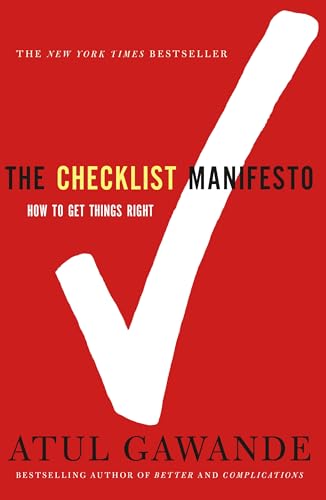


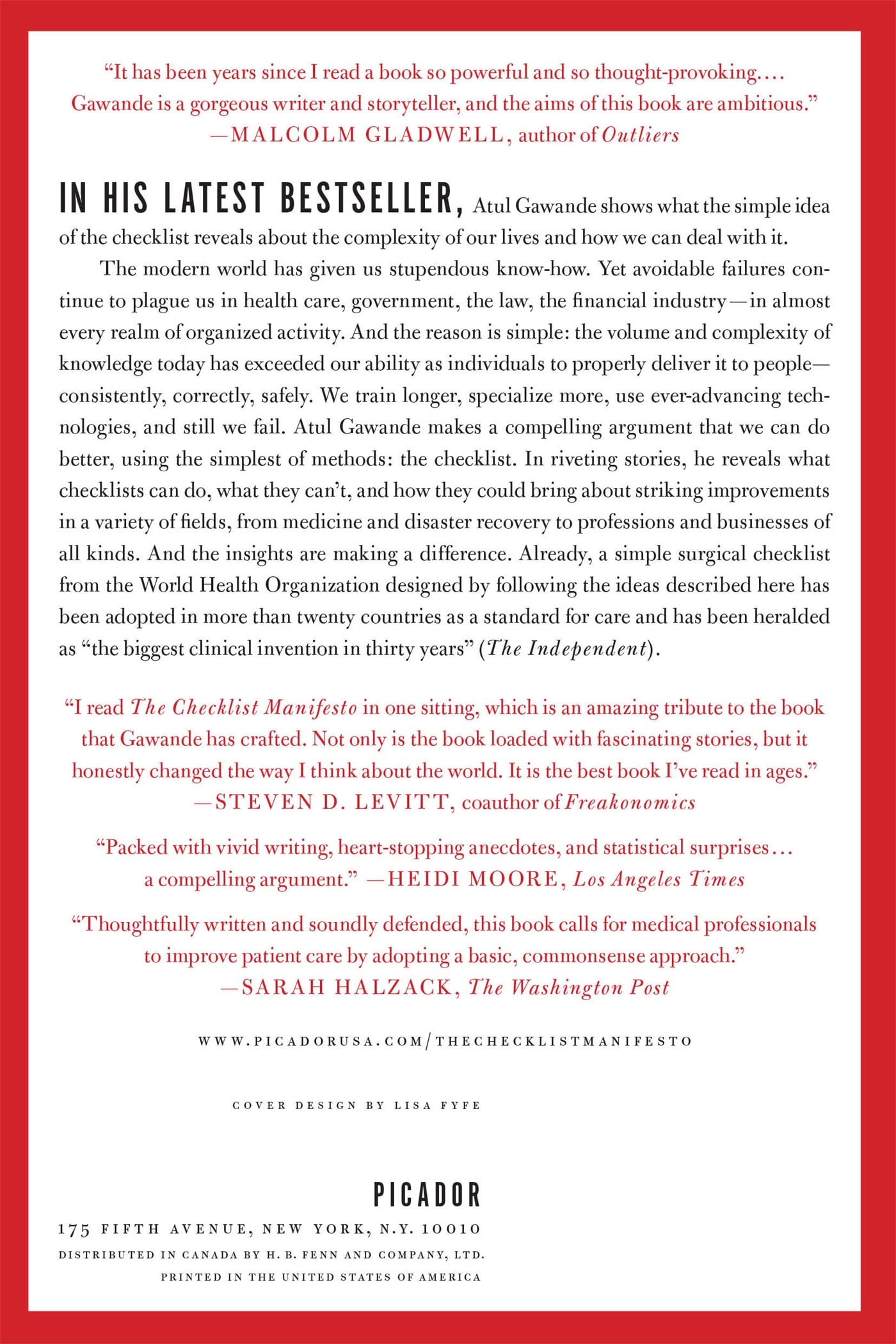
✅ Fly through complexity with the ultimate checklist playbook! 🚀
The Checklist Manifesto by Atul Gawande is a bestselling, critically acclaimed book that reveals how simple checklists can dramatically improve outcomes in medicine, aviation, construction, and business. With over 14,000 reviews averaging 4.5 stars, it combines compelling real-life stories and scientific research to show how disciplined checklist use saves lives, boosts teamwork, and enhances efficiency in complex, high-stakes environments.



| ASIN | 0312430000 |
| Best Sellers Rank | #4,475 in Books ( See Top 100 in Books ) #1 in Family Practice Medicine #6 in Time Management (Books) #9 in Workplace Culture (Books) |
| Customer Reviews | 4.5 4.5 out of 5 stars (14,861) |
| Dimensions | 5.54 x 0.57 x 8.22 inches |
| Edition | First Edition |
| ISBN-10 | 9780312430009 |
| ISBN-13 | 978-0312430009 |
| Item Weight | 2.31 pounds |
| Language | English |
| Print length | 240 pages |
| Publication date | January 4, 2011 |
| Publisher | Metropolitan Books |
J**N
Fly the Airplane!
I measure a great book by how often I'm reading sections to my long-suffering wife/listener. Another indicator: I read the book slowly, tasty morsel by tasty morsel. Lastly, there's serious emotion when I turn the last page--somehow hoping it could go on and on. This book scores 10s on all counts. Really? A book about checklists is that good? Yes. If you enjoyed Malcolm Gladwell's Outliers: The Story of Success , you'll love this one. [x] 1. Atul Gawande, a surgeon and staff writer for The New Yorker, leads the World Health Organization's Safe Surgery Saves Lives program. If you didn't believe in checklists before, you'll be a born-again checklist-maker after Chapter 1. [x] 2. He quotes a 1970s study on "necessary fallibility." It cites two reasons we fail at stuff: a) ignorance and b) ineptitude. In the latter, "...the knowledge exists, yet we fail to apply it correctly." [x] 3. Caution! If you're having surgery soon, or have friends or family facing the knife, you may want to skip this book--or ask your surgeon's views on operating room checklists. (In a recent global experiment, a two-minute pre-surgery team review of a standard checklist has dropped infection rates, death rates and complication rates by a staggering amount.) [x] 4. Pilots have long been the checklist gurus--but the art and science of well-crafted checklists have not found favor in other professions or industries...yet. The Captain Sully story, though expected, still caused my heart to beat fast. You'll appreciate how checklists saved the day for the "Miracle on the Hudson." [x] 5. The chapter, "The End of the Master Builder," takes you into the elite world of checklists created under the hardhats of McNamara/Salvia, a Boston high rise construction firm. The dingy construction trailer is long gone. In its place, "...on the walls around a big white oval table, hung sheets of butcher-block-size printouts of what were, to my surprise, checklists." [x] 6. Checklists are "ridiculously simple." What seems obvious, isn't. Checklists enhance teamwork--even among virtuoso surgeons. "There's a reason much of the world uses the phrase, operating theater." [x] 7. Boeing's checklist expert uses "pause points" when building checklists for pilots in crisis. Within each pause point, he limits the checklist to between five and nine items. I had no idea that there were checklist connoisseurs. [x] 8. For crisis lists, decide whether you want a DO-CONFIRM checklist (do what your gut tells you, then go back and confirm you did it) or a READ-DO checklist (more like a recipe). [x] 9. Gawande interviewed the managing partner of a California investment firm who is a checklist zealot. He cited the "cocaine brain" that researchers often experience when investigating company financial reports. Without a thorough checklist (honed over years of experience), a greed mode kicks in and wipes out thoughtful discernment. They use a "Day Three Checklist" to avoid disasters. "Forty-nine times out of fifty, he said, there's nothing to be found. `But then there is.'" [x] 10. "Fly the airplane," amazingly, is the first item on a checklist for engine failure on a single-engine Cessna airplane. "Because pilots sometimes become so desperate trying to restart their engine, so crushed by the cognitive overload of thinking through what could have gone wrong, they forget this most basic task. FLY THE AIRPLANE." In one study of 250 staff members (surgeons, anesthesiologists, nurses and others), 80 percent reported that the new checklist had improved the safety of care and 78 percent "actually observed the checklist to have prevented an error in the operating room." Yet, 20 percent gave it a thumbs down. Then Gawande asked one more question, "If you were having an operation, would you want the checklist to be used?" A full 93 percent said yes!
A**E
10 Highlights of This Book
I looked over the other reviews of this interesting book, and there are many of them that you will find very useful--so I'll just try to list some highlights. As Dr. Gawande points out, a checklist can't be too long (people won't use it), yet it must succinctly cover the most essential considerations of the situation at hand. Although what follows isn't a checklist, I'll try to focus on the most essential characteristics of Dr. Gawande's book: First, this is an easy-to-read, engaging book. I'll bet that you will find it hard to put down. It is interesting enough to make you want to read the book and serious enough to deliver important messages. Second, the value of using checklists springs directly from the complexity of modern life, whether we're talking about surgery (the author is a surgeon), flying an airplane or building a skyscraper. By the way, in reading this book I have developed a newfound appreciation of how complex the construction business can be. Third, checklists are not just for simple, straightforward tasks. Checklists help people communicate and work together better, especially when the unexpected occurs. Fourth, checklists are important regardless of the time available. Indeed, when the cockpit crew of US Airways flight 1549 lost both engines over New York City, they had only three minutes of airtime remaining. The first thing they did was to get out their checklists. (You can read Captain Sully Sullenberger's excellent book for more details.) Fifth, checklist usage has saved numerous lives, including one of Dr. Gawande's patients. His candor in discussing that episode is laudable. Sixth, humans being human, mistakes will inevitably occur. Checklist usage is important when the potential cost of human mistakes is great. Seventh, the mere act of creating a checklist focuses the mind on the most important characteristics of our tasks. Eighth, like anything else, it takes practice to produce and use checklists effectively. Ninth, practice comes from commitment and personal discipline. Indeed, one of the most important things Sully Sullenberger did was to maintain his composure and discipline, even while the gravity of his situation must have been racing through his mind. Tenth, as I read this book, my mind frequently reflected on how a checklist approach could be applied in some of the business and academic practices that I am familiar with. That's the real beauty of this book--it gets the reader thinking about ways to improve life.
N**A
The book takes off gruelingly, but picks up the pace and reads like an exciting quest in search of holy check list. The book has inspired me to introduce check lists in some routine tasks i perform at work.
K**E
I’ve had the checklist manifesto in my “to-read” list for about 5 years now. It’s a book I’ve had reccomended to me many times and, in a nutshell, it’s a manifesto for the use of checklists. Atul Gawande who wrote it is a surgeon who has a history of process improvement projects. The checklist manifesto is his attempt to convince people that checklists, simple as they are, can massively improve the output quality and consistency of tasks that we repeat frequently. What is more surprising though, is that his research uncovers that even in areas where there are complex problems for which we can’t cheklist – checklists can help significantly in resolving complex and unforeseen problems. The thesis is simple. Checklists raise output quality and consistency. The reason they do this is simple – we overestimate our ability to routinely perform series of tasks dramatically. In scenarios where there is stress or complication, the rate at which we overestimate our ability rises dramatically. Gawande examines three key scenarios – flight checklists, large scale construction projects and his own home – the operating theater. IN each scenario, he tackles simple, routine problems and also complicated and complex problems. What emerges is a surprisingly strong case for checklists as a tool to ensure consistency, and to change behavior, and also as a tool to aid resolution in complex and unforeseen circumstances. The bottom line is that we are inadequate repeaters of routine tasks, people routinely skip steps for one of two reasons – either they just forget through distraction or inattention, or they don’t know about, or don’t believe in the efficacy of a step – so they skip it. In each of these cases, checklists function as a kind of spot audit – telling people that they didn’t perform a step, and ensuring that they do. In many cases, authority was granted to people responsible for overseeing the checklist to stop a process if people didn’t perform it as written. What followed in each case, was a dramatic improvement in performance – in one case, a US hospital system had 1500 fewer yearly deaths after introducing checklists to key procedures. Routine tasks aside, complex tasks were also found to benefit. IN routine simple and complicated tasks, the series of steps required to be carried out were documented in order so that they could be directly followed. In Complex tasks however, this wasn’t possible because what was required to be done was typically an emergent phenomenon like an accident or disaster and needed to be analysed and dearth with on the fly. While task based checklists were not capable of operating in this environment, what was shown to produce results was checklists describing mandating communication among team members and the best results were found in cases that included delegation of authority to act away from a central organisation. The book contains excellent tips on how to make checklists work. It boils down to keep them short, precise, and practical. They don’t over-describe – they provide reminders of only the most critical and important steps. The point of invocation of the checklist needs to be clear for it to be useful. Checklists also come in two distinct types – Do-confirm and read-do. One is about an audit of what you carried out, the other provides steps to follow – which you do in order and tick off. Checklists should also be a maximum of 5 to 9 items – which is cognitively about all we can handle. There is also some very specific advice on formatting – right down to fonts and typeset. One interesting point made repeatedly was that there were substantial improvements in the ability to cope with crises by teams that came together at the start of a surgery to work through the checklist. Checklists are the simplest way to protect you, and others, from you – and the systematic mistakes you make by believing that you’re systematic – when you’re not. They’re also the simplest way to get an advantage without being smarter or first, you can be more thorough – EVERY time
R**A
Greta book that help me with getting the things right!
H**3
Good one, covering practices across industries. If followed properly, life changing book.
K**I
It is not like a guidline for utilising checklist, but have so many stories around the importance of checklist with many examples from many industries.
Trustpilot
1 day ago
1 month ago