
DOWNLOAD THE APP


Customer Services
Copyright © 2025 Desertcart Holdings Limited
DOWNLOAD THE APP

⚡ Power up your precision — monitor like a pro, optimize like a boss!
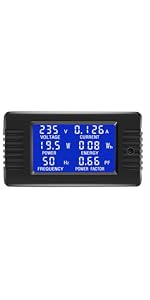
The bayite DC 6.5-100V 0-100A Digital Power Meter is a compact, professional-grade multimeter that simultaneously measures voltage, current, power, and energy with a large LCD display. Featuring a 100A current shunt, overload alarms, and energy data retention, it’s ideal for solar, battery, and off-grid systems, delivering reliable, real-time power insights in a sleek, easy-to-install package.



| ASIN | B013PKYILS |
| Best Sellers Rank | #77,293 in Tools & Home Improvement ( See Top 100 in Tools & Home Improvement ) #113 in Multi Testers |
| Brand | bayite |
| Color | Blue |
| Date First Available | August 10, 2015 |
| Is Discontinued By Manufacturer | No |
| Item Weight | 7 ounces |
| Item dimensions L x W x H | 3.33 x 1.75 x 0.96 inches |
| Item model number | PZEM-051 |
| Manufacturer | bayite |
| Maximum Operating Voltage | 100 Volts (DC) |
| Measurement Type | Multimeter, Voltmeter |
| Min. Operating Voltage | 6.5 Volts |
| Power Source | DC |
| Product Dimensions | 3.33 x 1.75 x 0.96 inches |
| Specification Met | CE, RoHS, UL |
| Style | Ammeter, Voltmeter, Power Meter |
| UPC | 711463670166 |
C**O
Precision monitoring with a compact footprint—ideal for DIY power systems.
The bayite DC 6.5–100V 0–100A LCD Power Meter is a fantastic tool for anyone working with DC circuits, especially in solar, battery, or off-grid setups. I installed it in my camper van to monitor battery performance, and it’s been incredibly accurate and responsive. The LCD display is crisp and easy to read, even in low light, showing voltage, current, power, and energy all at once. I appreciate the real-time feedback—it helps me catch inefficiencies and optimize usage. Installation was straightforward, and the unit feels well-built for long-term use. For the price, it delivers professional-grade insight into your power flow.
M**S
After three years it's still working flawlessly
Almost three years ago to the day I bought this and it's still working well in my system. It was a little confusing how to program it at first but once you learn it, it's easy. Best $16 I've ever spent, I highly recommend it.
N**3
in addition it's also really nice to know how much energy specific things in the ...
I have a pop-up camper that I regularly use in locations where there is no electric power available. As a result, it's important that I have an idea as to how much energy I've consumed from my deep cycle battery, in addition it's also really nice to know how much energy specific things in the camper actually use. Installation wasn't complicated but is a little time consuming since you have quite a bit of wiring to do. Granted this is not the manufacturer's fault, this is just the reality of what needs to be done to measure the current. Pro: I would say that the unit is accurate. The measured current matched the specs of several different devices on my camper. The moment I turned those devices on the load was accurately reflected on the bayite. This will certainly give me a lot more confidence in my electrical system when I'm camping. I'm very happy with the product overall. However, I'm holding back one star for the following reasons: 1. Viewing angle: You really need to be looking straight-on to read the numbers on the display. They're not very vivid and can't really be seen at an angle. This is a bit annoying in a pop-up camper as the only place to really mount this is at floor level. So to read it, you pretty much need to get down to the floor. 2. The plastic "clips" that are supposed to retain the unit in the "wall" are junk and break if you just look at them. There is no means to attach the product to the wall with proper screws. This really isn't a huge issue though, a little bit of glue worked well to hold it in place.
A**H
Excellent for monitoring RV solar setups
I have been using these bayite meters for almost three years now, not only in my travel trailer, but in my shed solar setup. The CHARGE and DISCHARGE meters in my photos are my original meters purchased in April 2019 and the SOLAR and INVERTER meters are the newer models ordered in April 2022. The only differences I can discern is the button on the front. The older meters had a recessed button and you needed a pen or pin to press it, whereas the newer model has a low profile button but can easily be pressed with just a finger, no device needed. The picture attached is before I upgraded the system: 10A controller with 200W solar array (upgrading to a 30A and 300W next) and these pictures were taken under partial tree shade in the late afternoon sun. The TT is running a 2000W modified sine wave inverter off a 385AH flooded lead acid battery bank, which powers mostly a residential mini fridge in the TT outside kitchen, wired through a 120V manual transfer switch to the GFCI outlets. You can see that the INVERTER load from the fridge is about 6A, while the solar output is about 4A, which correlates to the almost 2A battery discharge (including other low current devices: RV fridge circuit board, USB outlets, display lights). This type of setup is great for monitoring and measuring the performance of your batteries and solar system and if you have enough solar available or if your inverter loads are too much. To see what your actual amp-hour draw is, divide the ENERGY output by 12 (or whatever voltage you are running) to get AH so you can size your battery bank appropriately. My setup needs about 186 AH max per day and I am adequate on capacity but really should add an additional 100AH (of course I should add an additional 100W of solar too, but really there isn’t a hard ceiling to the max specs, just mind your budget). I boondock occasionally, but consider myself more of a touring adventurer, meaning I drive long distances in between destinations and camp mainly overnight in the forest or dispersed. My tow vehicle provides charging power along with the solar panels to recharge my batteries and my last 24 hours yielded 166 AH used so I never get below 50% of my battery bank. The extra 100W will help with the charge too once complete. I 3D printed a couple of meter mounts in black ABS and mounted them outside of the RV’s control panel. I could have also flush mounted them for a lower profile look but I think they look pretty good the way they are now. I used some spare Cat 6 and some jacketed landscape wiring to run from the RV batteries to the control panel. I would recommend finding some type of stranded small gauge wire for ease of crimping onto ring terminals and heat shrink tubing to protect them from separating while attached. Using ring terminals is the most secure to attach to the shunts but you can use spades or bare wire too. A good option for mounting is directly attaching the shunt to the negative battery terminal or inverter post, just remember to attach ALL load negatives on the other side of the shunt to accurately capture all discharging loads on the meter. The diagram provided by bayite on this site in the manufacturer pictures show to connect the solar meter/shunt AFTER the controller, which is a correct installation if you want to know how much power the solar controller is sending to your batteries. Bayite also provides a link to a modified diagram where the solar meter/shunt (included in my review pictures) is connected BEFORE the solar controller, directly in line from the solar panels, which will provide the meter with information with how much power your solar panels are actually producing. Each wiring is correct but provides different information; the voltages will differ as connecting before the controller will show the solar panel voltage whereas connecting after will show the battery voltage. Your shunt may have cuts in them, which is completely normal as it’s how they’re calibrated. Other reviews here say they have cuts and that they are damaged, but that’s inaccurate. These meters are good displays especially for solar controllers that don’t have displays or don’t show enough information. Great product, great longevity, and great information displayed for nerd like me who like to watch the numbers go up and down as conditions change.
M**Y
Excellent and easy
Excellent
L**.
Lacks input power reading and SOC features
Works as advertised, however it is not capable of tracking power sent into the battery or giving a state of charge. Basically just an amp meter for your battery that reports instantaneous power draw and cumulative power consumption. Other options in this price range have better features.
V**C
It does what is set to do: tells you the state of your battery bank. Very accurate and easy to wire. Recommended.
M**A
I am using 4 of these meters to monitor my solar battery system: - Battery in - Battery out - Inverter out and - Charge controller out Installation: I found it them easy to use and install. Acuracy: I am very happy with it's performance and acuracy, I've tested it against other meters, charge controller displays and multimeters. Support: I had to contact their customer service as there was some confusion (created by me) and they were super helpful. Usage environment: I am using this with a 24V battery system (Voltax), a Epever 200W inverter and 1200W of Canadian Solar panels. You can see them in action on my EcoAmbitionsAustralia YouTube channel in more detail.
J**R
No complaints. Invaluable to a novice to evaluate parasitic current draw.
H**A
A tiempo y cumple su proposito
L**S
very good small monitoring center to track the battery charge and discharge.
Trustpilot
1 month ago
2 months ago