
DOWNLOAD THE APP


Customer Services
Copyright © 2025 Desertcart Holdings Limited
DOWNLOAD THE APP

🎧 Elevate your voice, own the room — PodMic means business.
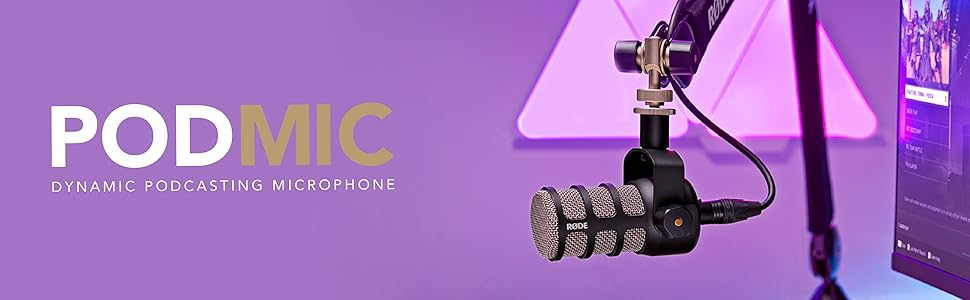
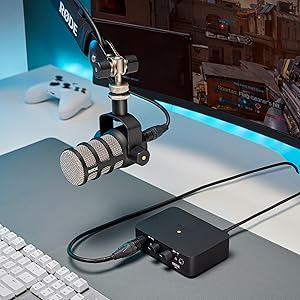
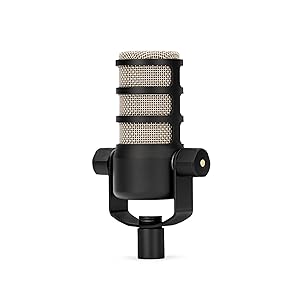
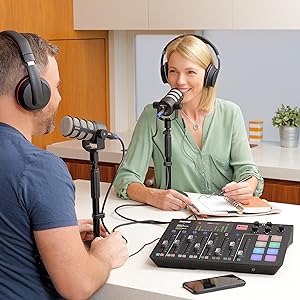
The RØDE PodMic is a professional-grade dynamic microphone designed for podcasting, streaming, and voice recording. Featuring a durable full metal body, internal shock mounting, and a built-in pop filter, it delivers rich, balanced sound while minimizing vibrations and plosives. Optimized for seamless integration with the RØDECaster Pro but compatible with any quality audio interface, it offers exceptional broadcast-quality audio at an accessible price point.

| ASIN | B07MSCRCVK |
| Best Sellers Rank | #162 in Musical Instruments ( See Top 100 in Musical Instruments ) #3 in Multipurpose Dynamic Microphones |
| Color Name | PodMic Black |
| Customer Reviews | 4.8 4.8 out of 5 stars (6,857) |
| Date First Available | March 17, 2009 |
| Frequency Response | 20 Hz |
| Global Trade Identification Number | 00698813005567 |
| Hardware Platform | PC |
| Impedance | 150 Ohms |
| Is Discontinued By Manufacturer | No |
| Item Styling | Yoke |
| Item Weight | 2.07 pounds |
| Item dimensions L x W x H | 9 x 6 x 4 inches |
| Item model number | PODMIC |
| Manufacturer | RØDE Microphones |
| Material | Metal |
| Material Type | Metal |
| Microphone Form Factor | Table Array |
| Number of Channels | 1 |
| Power Source | Corded Electric |
| Product Dimensions | 9 x 6 x 4 inches |
| Signal-to-Noise Ratio | 78 dB |
| UPC | 698813005567 |
J**E
Are you picking up what I am putting down?
Rode is a well known brand and has been for many years. I expected a lot out of this microphone, and boy did it deliver. The microphone, out of the box, is a simple plug and play set up which make it very consumer friendly and easy to use functionality. The feel of the microphone screams a quality product with high durability in the event you knock it around, or worse, drop it. It has a full metal casing to protect the insides. The size of the microphone makes it easy to work with, though it is on the heavy side. The quality of the recordings are incredibly high. After utilizing this microphone and showing my recordings to friends and family, they were blown away at how professional it sounds. One drawback, and this is like this for all microphones, is the sensitivity of it will allow outside noises to be picked up and that may require some post-processing to eliminate. It is moderately decent at reducing plosives, but I would recommend a wind screen or pop filter for better elimination of that. Additionally, the price range for quality is hard to beat. Pros: Great construction and materials, easy plug and play, Excellent quality Cons: Heavy Overall: I have been impressed with this microphone, even more than my others that I own (AT2020), and will recommend and new comer or veteran to use it. 5/5
B**R
Rode PodMic, an excellent microphone at a very reasonable price.
This is the mic for me. Simple as that. To expand on that first sentence a bit, I've tried quite a few other microphones, but have never felt they captured my voice quite right. The Rode PodMic does just that, and at a price that can't really be beat. I purchased the PodMic for the first time back in '22-'23, but was on a mic-hopping journey, so sold it around that time to try others. While listening to recordings over the years (from this and other mics) I realized the Pod was the one for me and my voice, so I bought it again and have been using it since. Its also a very high quality, well constructed little microphone, feels like an absolute tank. Not only feels that way, I have dropped this thing from about 6' on accident, and it still sounds perfect. Anyway, as said in the first sentence, this is the mic for me. Is it the mic for you? Can't say, but at this price you might as well grab it and give it a shot.
S**H
Professional Radio Sound When Paired with a FetHead
The Setup: I use the Rode PodMic alongside a Rode Procaster for my home podcast. My signal chain is high-spec: the mics run through a Triton Audio FetHead In-Line and FetHead Filter, then into my Pyle 12-Channel Mixer, and finally into a Tascam DR-60D MKII. I also route PC audio and live phone calls through the mixer. Performance & Audio Quality: The PodMic is built like a tank and delivers a rich, broadcast-style tone. However, it is a low-output mic. By using the FetHead, I get that essential 27dB clean boost, which means I don't have to touch the gain knobs on my Pyle mixer. This results in a crisp, clear sound with absolutely no background hiss, even when recording live phone calls or mixing in background music from my PC. Build and Design: Internal Pop Filter: It does a great job taming plosives, though I find the FetHead Filter helps roll off even more low-end rumble for a cleaner recording on my Tascam. Integrated Swing Mount: Makes it incredibly easy to position, and the all-metal construction feels very premium for the price. Room Rejection: The cardioid pattern is excellent. It picks up my voice clearly while ignoring the noise from my PC fans or the room. Final Verdict: On its own, the PodMic is a good mic, but when you put a FetHead in front of it and run it through a decent board like the Pyle, it becomes a pro-grade broadcast tool. It’s the perfect choice for anyone who wants that "radio voice" without spending $400+ on a Shure SM7B.
J**A
A high quality mic for people on a budget
I got two of these mics for myself and my co-host for our podcast, and I honestly couldn't be happier with them. They are very sturdy mics, and a lot heavier than I thought they would be. I was expecting a lot cheaper material considering how affordable they are. I started using them for podcasting but now I use them for just about everything with audio, including Twitch streaming. These are also excellent mics if you are unfamiliar with XLR setups and aren't a professional audio engineer but are looking to get a professional sound from your audio. I bought a Behringer audio interface and some amazon basics cables for my setup and it was very easy to get everything going and sounding the way I wanted. It also drastically helped with audio editing, switching from Yeti microphones, I don't have to do nearly as much manual work on audio to get it to sound great. I will say, the one thing I did have trouble with on this microphone is the gain. It took a while to adjust it to a reasonable gain level solely because you have to be VERY close to these mics for it to pick up and, admittedly, I am a very loud person naturally so I tend to keep myself a little further back from mics. This isn't really the fault of the mic though, so it is by no means a reflection of the product. Just something to keep in mind; if you are a naturally louder person, and have a louder or more projective voice... you'll need to do some extra testing with these mics. One more thing to add, my co-host has extremely loud S's, which this mic seems to not be great at naturally filtering out. Not unexpected but just note, if you or whoever is using this mic have loud or high-pitched S sounds, you'll really need to utilize a De-Esser in whatever recording software you use. (The mic is very good at filtering out Plosives on its own though, so that shouldn't be too much of an issue). An all-around fantastic product from Rode, and I hope they make some more mics for content creators that are in this affordable category. You've earned yourself a loyal customer! :)
R**N
The build quality, the sound quality, the appearance, are amazing.
T**M
I bought this mic after wanting it for over a year now and it sounds amazing truly podcast quality but there are things you will need too get it running well and without a problem mostly also this mic is super heavy like you can feel the quality just from holding it alone. You are gonna need an xlr cable duh and also a audio interface again duhhh but don't cheap out on these unless you want to get a gain booster which are hard af too buy like finding one in stock that won't break the bank will be like finding a grain of sand. Also get a good xlr cable most aren't expensive and mine was 4 pounds and feels good and won't break. If you are in a windy environment get a pop filter to put over it as the internal pop filter is crap and basically not even a feature. Also if you already have a boom arm or any kind of mic arm it should support it as it supports both 5/8" and 3/8" threaded mic stands so no need for a new one or a janky or overpriced adaptor. My only complaints are the fact they advertise a pop filter built in which I'm sure there is too a degree but it does nothing compared too a real one. And also how on my boom arm it doesn't like too screw on securely as the built in shock mount or stand can turn allowing the mic to move where ever needed means I tighten it as much as I would like but it's not a deal breaker. Overall an amazing microphone and sounds incredible for the price(excluding cables and interface and maybe gain booster if needed) and the fact that with some simple EQ it can sound just like the SM7B which seems too be the standard for mics like these I don't know why when this thing exists. So in short in my opinion (baring in mind i came from a blue snowball condenser mic) this thing is insanely good for the price and I don't think I will ever swap mics now. So if you can afford it get it unless you find something you like more. But if you want a good quality and amazing sounding mic for under 100 pounds then this is the one for you but please do listen to sound tests before you decide as not everyone likes the same sound I like :)
R**.
I absolutely love this mic, it has completely transformed the way my voice sounds on podcasts and voice-overs—it’s warm, clear, and has that rich broadcast tone you'd expect from much more expensive microphones. It feels incredibly solid and well-built, with a heavy all-metal body that screams quality. I’m using it with an audio interface, and once it's properly dialed in, the sound is crisp with minimal background noise, even in a less-than-perfect room. No need for an external pop filter either—the built-in windscreen does a great job. If you're confused about which microphone to get, check this out. First let's look at Dynamic vs. Condenser Microphones **Dynamic Microphones** * Great for podcasting, voice-overs, and live performances * Handle loud sounds well and are less sensitive to background noise * Very durable and can take a beating * Don't pick up fine audio details as clearly as condenser mics * Example: Rode PodMic **Condenser Microphones** * Best for studio vocals, singing, or acoustic instruments * Very sensitive and capture more detail and high frequencies * Can easily pick up room noise, echoes, or background sounds * Usually require phantom power from an audio interface or mixer Now let's check out USB vs. XLR Microphones **USB Microphones** * Plug directly into your computer's USB port * No extra equipment needed—great for beginners * Usually limited to using one mic at a time * Less flexibility to upgrade your setup later * Example: Blue Yeti **XLR Microphones** * Use professional 3-pin XLR cables and require an audio interface or mixer * Provide better sound quality and more control over audio settings * Allow you to upgrade different parts of your setup over time * Require more setup, but offer better long-term value and performance * Example: Rode PodMic with Focusrite Scarlett Solo I hope this helps :)
S**S
Heb verschillende mics in studio, dynamisch en condenser. Wilde deze testen ook voor zang. Zonder meer goed, weegt wel bijna een kilo, maar kwaliteit. Zeer tevreden. Verbaast mij dat hij zo klein in prijs is
A**H
Great sound pickup
Trustpilot
1 day ago
2 weeks ago