
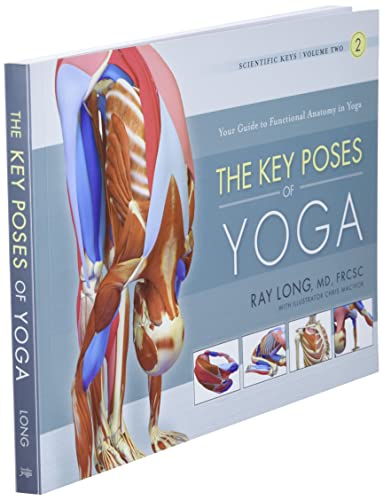


The Key Poses of Yoga: Scientific Keys, Volume II [Ray Long, Chris Macivor] on desertcart.com. *FREE* shipping on qualifying offers. The Key Poses of Yoga: Scientific Keys, Volume II Review: Must-have for yoga practitioners and anatomy students - I have been carrying this book around with me for weeks since I bought it. The author's easy-to-understand descriptions of physiological and anatomical structures are excellent (Golgi organ, reciprocal inhibition, spinal cord reflexes of stretching, etc). Beyond that, I simply cannot rave enough about the groundbreaking, astounding digital images of the musculoskeletal structures that display the specific muscle agonists and antagonists being utilized in the asanas. What clarity! I spend a lot of time on anatomy websites like Get Body Smart and others, and this book's images take all of their images to the next level and complement the understanding of exactly which structures are being used, where they are in relation to the bones of their insertion and attachment points, and how the entire body should align. What does this mean for the yoga practitioner? She/he can now consciously contract the right muscles while simultaneously relaxing the antagonist muscles within any pose to go deeper into the pose easily (by understanding reciprocal inhibition), and instructors can use this book as a valuable tool for teaching the fine alignment points that constitute the proper asana to help their students receive the full benefits from the pose. I am enjoying this book thoroughly and strongly recommend it for anyone even remotely interested in yoga, anatomy, muscles, fitness, or just plain beautifully rendered digital images. Review: Un-stall your yoga practice - I've been in and out of yoga for many years, and have been trying to get back on track for the last year or two. As exercise programs go, yoga was the only thing that's ever worked for me, but somehow I haven't managed to get that old feeling back. I bought this book a while back, and thought, why not take another look at it and see what help it might offer. Wow. Some books offer way too much in the way of exactly how a pose is supposed to work; you've seen them, the ones where they spend several pages going into great detail about every possible muscle twitch. (Dr. Long's other books do this, yes, but you're reading those books because you want to know how to fix that one last little kink in a pose, or how to get more out of it. That's an entirely different situation from figuring out how to get started.) Other books don't offer enough, so you give up after a while because you're not getting anywhere. This book is just right. For the beginning yogi, or someone getting back into it after some time away, this is a terrific start. I'm finding that the poses feel better and I can hold them longer without a struggle. And I feel much better afterward; where I'd been thinking, what did I do that for, now, while I can't explain exactly how, I do feel a lot better. Not every pose is detailed in here, but there's enough to get a good start on your practice. Thanks, Dr. Long.
| Best Sellers Rank | #28,108 in Books ( See Top 100 in Books ) #41 in Yoga (Books) #61 in Anatomy (Books) |
| Book 2 of 2 | Scientific Keys |
| Customer Reviews | 4.8 4.8 out of 5 stars (1,406) |
| Dimensions | 7.8 x 0.8 x 10.9 inches |
| Edition | 3rd |
| ISBN-10 | 1607432390 |
| ISBN-13 | 978-1607432395 |
| Item Weight | 1.95 pounds |
| Language | English |
| Print length | 224 pages |
| Publication date | November 1, 2009 |
| Publisher | BandhaYoga |
J**Y
Must-have for yoga practitioners and anatomy students
I have been carrying this book around with me for weeks since I bought it. The author's easy-to-understand descriptions of physiological and anatomical structures are excellent (Golgi organ, reciprocal inhibition, spinal cord reflexes of stretching, etc). Beyond that, I simply cannot rave enough about the groundbreaking, astounding digital images of the musculoskeletal structures that display the specific muscle agonists and antagonists being utilized in the asanas. What clarity! I spend a lot of time on anatomy websites like Get Body Smart and others, and this book's images take all of their images to the next level and complement the understanding of exactly which structures are being used, where they are in relation to the bones of their insertion and attachment points, and how the entire body should align. What does this mean for the yoga practitioner? She/he can now consciously contract the right muscles while simultaneously relaxing the antagonist muscles within any pose to go deeper into the pose easily (by understanding reciprocal inhibition), and instructors can use this book as a valuable tool for teaching the fine alignment points that constitute the proper asana to help their students receive the full benefits from the pose. I am enjoying this book thoroughly and strongly recommend it for anyone even remotely interested in yoga, anatomy, muscles, fitness, or just plain beautifully rendered digital images.
P**2
Un-stall your yoga practice
I've been in and out of yoga for many years, and have been trying to get back on track for the last year or two. As exercise programs go, yoga was the only thing that's ever worked for me, but somehow I haven't managed to get that old feeling back. I bought this book a while back, and thought, why not take another look at it and see what help it might offer. Wow. Some books offer way too much in the way of exactly how a pose is supposed to work; you've seen them, the ones where they spend several pages going into great detail about every possible muscle twitch. (Dr. Long's other books do this, yes, but you're reading those books because you want to know how to fix that one last little kink in a pose, or how to get more out of it. That's an entirely different situation from figuring out how to get started.) Other books don't offer enough, so you give up after a while because you're not getting anywhere. This book is just right. For the beginning yogi, or someone getting back into it after some time away, this is a terrific start. I'm finding that the poses feel better and I can hold them longer without a struggle. And I feel much better afterward; where I'd been thinking, what did I do that for, now, while I can't explain exactly how, I do feel a lot better. Not every pose is detailed in here, but there's enough to get a good start on your practice. Thanks, Dr. Long.
J**N
Great for those new to anatomy in yoga teacher training!
I'm in a 200 hr. yoga teacher training and realized I needed a lot more knowledge about anatomy since I basically had (almost) NONE. Reviews of Kaminoff's "Yoga Anatomy" got great reviews for those who had a basic working knowledge of anatomy already. For those of us who didn't, many people recommended Ray Long's 2 books, "The Key Muscles of Yoga" and "The Key Poses of Yoga". So, that's where I started. Dr. Long's books are fantastic! Big color-coded pictures with limited (manageable) text. I started w/ "The Key Muscles of Yoga" as recommended; that gave me a basic working knowledge of the muscles, bones, ligaments, tendons, joints and their actions, insertion/origin, synergists, antagonists. Then I moved on to his next book, "The Key Poses of Yoga" which is fabulous! Again - lots of detailed pictures with bulleted info about muscles in the legs, pelvis, arms, back, shoulders that are or should be engaged in the pose to make it a safe and effective pose. This info will be really helpful when teaching the "what & why" anatomical details of a pose. His chapters are organized around backbends, forward bends, twists, hip openers and the like. I highly recommend both of his books. After this, I think I'll be ready for the more in-depth detail in Kaminoff's book, "Yoga Anatomy". Already though, I feel like I have a enough basic information to teach poses safely. I know there's a lot more to learn in this regard, but hey, I gotta start somewhere!
P**O
Understanding the Interior You
If you are a yoga instructor or practitioner, both volumes by Ray Long will help you to understand the interior body of yoga poses better. By remembering and visualizing the extremely clear illustrations during your practice, your poses will become more balanced and symmetrical--this is hugely beneficial. The narrative provides a clear understanding of how the body works--since muscles don't actually "stretch" an understanding of how the muscle spindle provides for what we call "flexibility" or "stiffness" is invaluable (and gives everyone HOPE), especially for those students who don't believe they can be successful yogis unless they can touch their toes. I can't wait for the next volumes to become available. These books are foundational, a "must" for anyone who is serious about practicing yoga. And--if you are interested in Iyengar yoga, they are even more important with their emphasis on alignment. As BKS Iyengar has said, "alignment IS enlightenment". The integration of all the koshas begins with an extremely precise physical alignment, and Long's volumes provide an excellent aid for all of us who struggle with asymmetrical bodies.
A**E
Das Buch besteht aus 2 Hauptkapiteln. Im 1. Kapitel, dem theoretischen Teil, werden allgemeine Dinge über Muskelfunktion, Biomechanismus, Dehnung, Golgi Tendon Organ usw. erklärt. Im 2. Kapitel werden die Hauptasanas aus den folgenden Bereichen vorgestellt: - Vorbereitende Positionen - Sonnengruß - Standhaltungen (Tadasana, Uttanasana, Vrksasana, Trikonasana, Virabhadrasana II, Utthita Parsvakonasana, Ardha Chandrasana, Parsvottanasana, Virabhadrasana I, Virabhadrasana II, Parivrtta Trikonasana, Parivrtta Parsvakonasana, Prasarita Paddottanasana, Garudasana, Utkatasana) - Hüftöffnende Übungen ( Baddha Konasana, Supta Padangusthasana: Bent Knee Version, Supta Padangusthasana A, Supta Padangusthasana B, Supta Padangusthasana: Revolving Variation) - Vorwärtsbeugen (Janu Sirsasana, Dandasana, Trianga Mukhaikapada Paschimottanasana, Ardha Baddha Padma Paschimottanasana, Paschimottanasana, Navasana, Ubhaya Padangusthasana, Parivrtta Janu Sirsasana, Parighasana, Kurmasana) - Drehungen (Seated Twist, Marichyasana III, Marichyasana I, Ardha Matsyendrasana) - Rückbeugen (Salabhasana, Urdhva Mukha Svanasana, Purvottanasana, Ustrasana, Danurasana, Urdhva Danurasana, Eka Pada Rajakapotasana I) - Arm-Balance(Adho Mukha Svanasana, Visisthasana, Chataranga Dandasana, Adho Mukha Vrksasana, Bakasana, Titibasana, Pincha Mayurasana) - Umkehrhaltungen (Sirasana, Sarvangasana, Halasana) - Restorative Positionen (Balasana, Supported Setu Bandha Sarvangasana, Viparita Karani, Savasana) Zu jeder dargstellten Asana gibt es auf 2 Seiten die wichtigsten Informationen zur Anatomie und dazu entsprechende Bilder, die das Skelett sowie die betroffenen Muskelgruppen in der Asana zeigen und so veranschaulichen, was aus Anatomie Sicht im Körper passiert. Ich kann das Buch nur empfehlen, da es die Hauptasanas abdeckt und zu jeder Asana die wichtigsten anatomischen Informationen vermittelt. Die Bilder sind genial gemacht und helfen dabei die Anatomie besser zu verstehen. Man hat auf 2 Seiten alles zu einer Asana Übersichtlich auf einen Blick. Das Buch hilft einem wirklich dabei die Asanas anatomisch zu verstehen und korrekt auszuführen, auch wenn man keinen medzinisches Hintergrundwissen hat. Danke Ray Long für dieses geniale Buch!
C**N
I love to see all this very good explanations of the main postures and what’s is going on in the body it’s very helpful
J**K
This book is amazing such detail about Anatomy and the breakdown of individual poses . The pictures are so detailed clear and precise . The text is informative and precise . Although the book is expensive it is well worth the money . An essential book for any yoga teacher .
M**A
Perfect to have a clear vision of body. Really useful to focus deeply on your body during practice... More awareness
A**R
This book goes into deep detail about the scientific background of the key poses of Yoga. Very useful book for yoga teachers. Great illustrations!
Trustpilot
2 months ago
3 weeks ago


