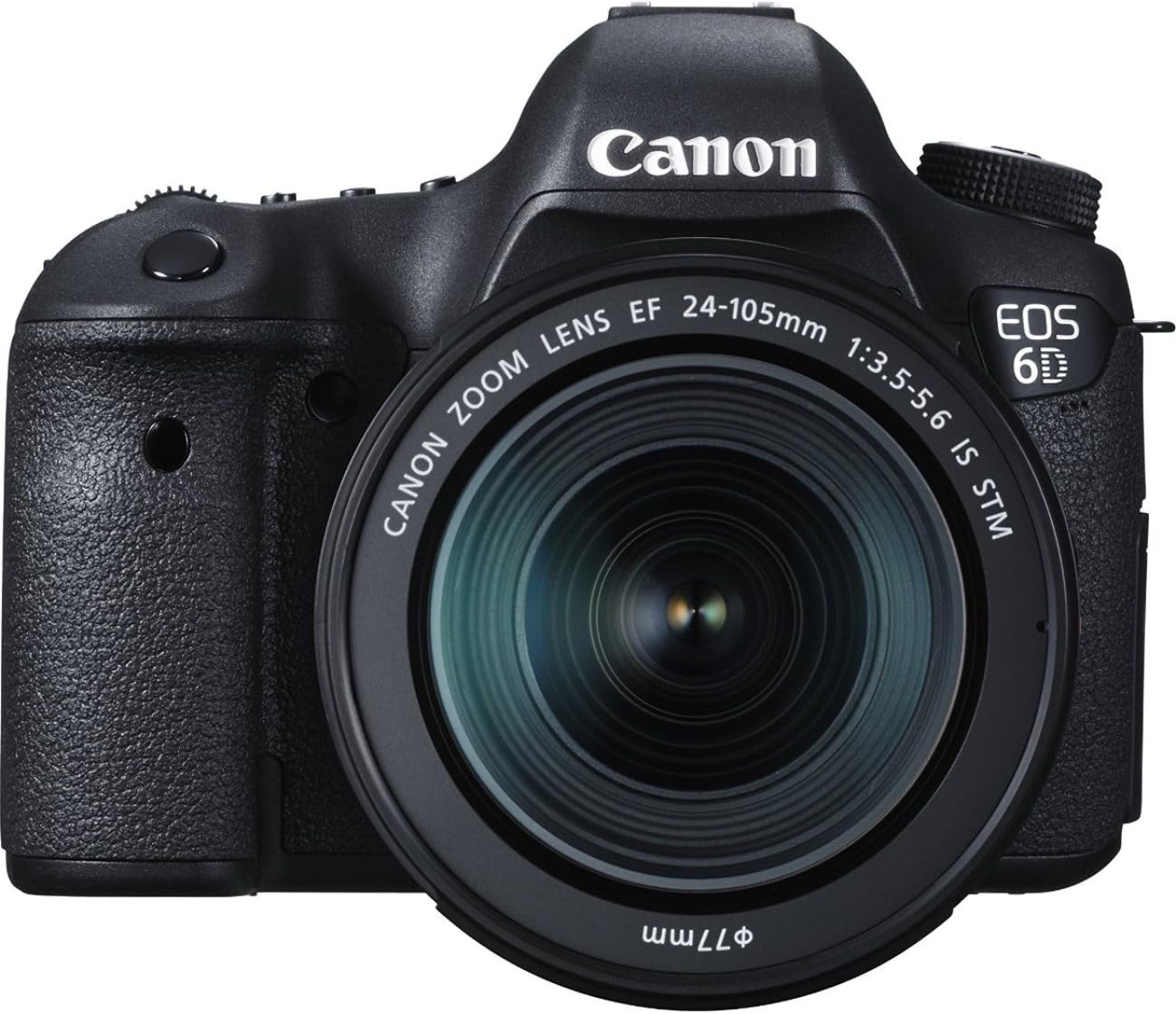
📷 Elevate your vision with the Canon EOS 6D — where full-frame power meets wireless freedom.
The Canon EOS 6D EF24-105mm STM Kit combines a 20.2MP full-frame CMOS sensor with an 11-point autofocus system and DIGIC 5+ processor to deliver professional-grade image quality and low-light performance. Featuring built-in Wi-Fi and GPS, it enables seamless wireless image transfer, remote shooting, and location tagging. Its versatile ISO range up to 102,400 and full HD video capabilities make it ideal for creative professionals and serious enthusiasts seeking a compact yet powerful DSLR experience.


| ASIN | B00RKNMFLM |
| Batteries | 1 Lithium Ion batteries required. (included) |
| Best Sellers Rank | #154,341 in Electronics ( See Top 100 in Electronics ) #217 in DSLR Cameras |
| Customer Reviews | 4.7 4.7 out of 5 stars (1,072) |
| Date First Available | January 4, 2015 |
| Is Discontinued By Manufacturer | No |
| Item Weight | 2.82 pounds |
| Item model number | 8035B106 |
| Manufacturer | Canon Cameras US |
| Product Dimensions | 11.1 x 8.86 x 7.4 inches |
D**N
Upgraded from a T2i crop to the 6D
I upgraded from a Rebel T2i w/ 18-135. Here's are my thoughts after taking the camera out on a shoot last night with the 24-105mm L. Ergonomics: Coming from a T2i, one thing that was incredibly difficult to get used to was where the ISO button is located at. It's no longer an isolated button but now a part of a group of 5 other buttons. The buttons are laid out as AF -> Drive -> ISO -> Metering -> LCD light. On the 5D MK3, the buttons are Metering/White balance -> AF/Drive -> ISO/Exposure -> LCD Light. The reason this is important is because from an ergonomic perspective, it's normal to just shift your right index finger from the jog wheel straight down to the ISO button and it's the first button right there. On the Canon 6D, I have to move my finger down and shift it over. I'm getting used to it, but I can't count how many times I've tried to change my ISO and I kept hitting the Metering button and kept taking my eye out of the viewfinder to make sure I didn't change any metering values. Luckily, even if you hit the metering button, settings don't change until you move the jog wheel. So if you're looking through the viewfinder and you hit a button and ISO doesn't show up, then shift your finger left one button. I'm sure this will just take time getting used to. The viewfinder is significantly brighter which was something I never appreciated until using the 6D. In regards to the focal points, the number of focal points seems to make a larger impact on this full frame camera than it did on my crop body (which only had 9 AF points which seemed plenty on the T2i) That is, all 11 of the focal points are towards the center of the frame and on the full frame it seems like there's a lot of places left "open" with no focal points. In other words, it seems like the focal points only cover about 50% of the viewfinder coverage whereas on my crop body (with only 9) it felt like the focal points covered 75% of the viewfinder. Does this matter in the real world? I've not yet to run into any problems, and I suppose one could always use live view focus if for whatever reason one needed a much more precise focus than the 11 AF points. The quality of the center AF point however is superb, and I was surprised I was able to get focus in some situations where my crop body failed in low light situations. In regards to low light image quality, I hated using anything ISO 3200 or higher on my crop body. Pictures were usable but often image quality suffered in graininess and I wouldn't use them for anything professional and even ISO 1600 was borderline but acceptable on my T2i. On the 6D however, I am impressed with the images at ISO 6400, and so far pretty good results at ISO 12800 as well. This was actually one of the biggest driving factors in me upgrading from a crop to a full frame, and I can say that the 6D does not disappoint in this regard. The in-camera HDR is pretty effective. I was surprised at how easy it was to take HDR images without a tripod and have them automatically stitch together and still come out looking good. I am of the mentality that there are certain photos that HDR absolutely adds to a picture, but other times it can distract. The fact that it's so easy to get an HDR picture without a tripod in the field is definitely a plus for me. Keep in mind though that the HDR function will only be available if you are shooting in JPEG mode, so if you're currently set in RAW you'll have to change that setting before setting up the in camera HDR. Once you're finished with any HDR shots, you'll also have to remember to put your camera back in RAW mode. Another nice feature is that there are different raw sizes. RAW - 20MP @ 5472x3648, RAW(M) - 11MP @ 4104x2736) and RAW(S)- 5MP @ 2736x1824. Exactly what it sounds like, but something I wasn't used to seeing on my T2i which always shot in full-size RAW. So if I'm just going out not doing anything serious, it's nice to have the option of a smaller file size while still retaining the benefits of a RAW image. Then again, if I'm not doing anything serious, I would probably just use a cell phone camera. Therefore, neither a pro or a con. In regards to the Wifi features, I will say that the remote EOS app (Android and iPhone) is a far better solution than an articulating screen. When doing self-portraits, it is nice to be able to frame the picture with your phone remotely (remote shooting feature). After my shoot last night, I connected my phone and stuck the camera in the bag as I walked to my car. It felt a lot nicer reviewing my pictures through my phone (and deleting the ones I didn't like) using a touch interface. This is not necessarily a pro or a con, but it was refreshing and I found it to be a better solution as I could zoom with two fingers, pan, etc. I can also see that having a tablet with a larger screen would be useful in reviewing photos in the field. One other thing to mention is that transferring RAW files is pretty slow wirelessly, and it's probably quicker to just pop out the card and stick it in than it is to turn on the wifi settings in camera and then connect through the app. Overall, I'm very satisfied in the upgrade from a T2i to this 6D and I feel it was the correct choice over the 5D MK3 for the following reasons (in order from greatest to least benefit: Slightly better ISO performance (1/2 stop from what I read) over the MK3 -- This may simply be due to the lower resolution / MP count. Slightly improved (-3EV) center focus (as opposed to the -2.5EV on the MK3) ~$900-$1000 dollar price difference Wireless / Remote EOS app. (The MK3 supports this but at the cost of a $500 dollar add-on) The MK3 would be a better choice because: More focal points Slightly higher resolution Location of the ISO button (just my opinion) Dual Card slots (although for me this has zero purpose.) Faster FPS (also has zero purpose cause if I ever need to 'machine gun' my camera 4.5 FPS a second is still plenty fast on the 6D) Update: Canon has released a statement saying that they will allow the center point of the 5Dmk3 to autofocus at F/8 with a firmware update in April of 2013. That opens up a lot of cheaper lens solutions (100-400L 4-5.6) to be used with a 1.4TC to have a max reach of 580mm while retaining autofocus at f/8. This may have been a bigger decision point had I had known about this before purchasing the 6D. However, to the 6D's support, you can swap out the standard focusing screen with an EF-S focusing screen for manual focus. There's also live view focusing, so it's not really a dealbreaker. Update: 1/1/2013 Couple of additional thoughts as I've had this camera. The EOS Remote shooting app for Android and iOS is really a great thing to have on a camera. I just got back from vacation with family and friends and as soon as I took a family photo (some were of people who I didn't know) I was able to ask them for their phone or email address and immediately send it to them. Almost like a modern day Polaroid. I also was able to get impromptu shots of me with my friends by setting the camera on my camera bag and doing the framing with the three of us sitting in front of a fireplace. I've also thought about the lack of dual card slots a bit more, and I think that if you're going to earn money off your camera it might be better to get the 5D MK3 just in case you happen to have a card failure while shooting a wedding or other one time events that you can't reshoot. It's nice to have the extra insurance, but that's about all it gives you. Granted, I doubt a card failure would happen during an important shoot, but it's possible and could prevent you from delivering a product. I think if you're team photographing that this camera supplements a 5dmk3 well, but I like the extra insurance of having backups *just* in case a card failure were to happen as a single shooter. Certainly not a deal breaker by any means, but just food for thought.
M**W
Awesome Camera!
I'll keep this review simple as I'm not an advanced professional but more of a serious enthusiast at this point. The feel and build of this camera is top notch; it feels like a brick in the hands and handles nicely. The 24-105 lens is very tight and also smooth but I do have to say after using it for a couple of weeks it does now creep when held straight down. Wow on the low light capabilities of this thing! I can push it up to 10,000 iso and get images as clean if not cleaner than on my 40d at 1,600. Obviously the crop factor is gone but what some may not know is that you get at least a full stop more bokeh using the same aperture lens. f4 is more like 2.8 on a full frame so you have more creative room to work with blur wise. Another thing that I have learned is that the high iso capabilities of this camera are not only handy in low light but for landscape shooting at higher apertures without a tripod; which is something that I often shoot. I can bump up my aperture to f16 and still easily hand hold shots with no blur in average lighting with a higher iso. I don't see huge differences in sharpness with this camera and lens combination in bright scenes compared to my 40d with the 17-55 lens but the dynamic range is better and the colors are very vibrant and true. The luminosity of the images is also better. Again not huge differences but enough to make that extra difference that makes me feel like the camera is actually capturing how my eye saw it. I often felt with my 40d that the images were almost there but not quite. The auto focus is primitive compared to the 5dMK3 but works extremely well in low light and can pick up focus in very dim scenes near darkness. When I put my 85 1.8 prime on this thing I can literally shoot in the dark hand held with only ambient window light or auto focus on a single star. At 10,000 iso with the same lens I am picking up roughly 10 times the light as my 40d which means I can shoot stars at f1.8 with only a half a second shutter time. Bumping up the iso to 25,000 does start to introduce a bit of noticeable noise but the images are still useable which I find amazing. The biggest lack I constantly found with my 40d was the iso limit and need for more light sensitivity. You can truly shoot indoors with no flash with a 1.8 lens at moderate iso and even with the 24-105 when you bump the iso way up. The wifi is extremely handy to review and post pictures to facebook but it is a bit slow. I use the wifi a lot for previewing my images and it's nice to be able to delete the ones from your camera you don't want right from your phone or tablet, very cool feature. Complaints; no built in flash to control speedlights which does kinda suck. But again, if you want a 5d3 go pay an extra 1,700 bucks. The lens creep is a little annoying but it is an L lens with weather resistance and an o ring where the barrel slides so it won't be a dust pump like the famed 17-55 was on my 40d. Overall the 24-105 is a very nice lens with true L quality build but just be prepared for it to break in a little. The limit of 1/4000 shutter isn't a big issue for me since I've rarely shot speeds higher than this on my 40d nor have ever really needed the 6 frames per second vs. the 4.5 this one shoots. Having a built in flash to control my speedlight would have been very nice but considering there is a wifi and gps unit under the roof is a reasonable trade off as the gps is something I have not yet used but anticipate it being very useful for those remote landscape shoots I will be doing. I have read a lot of complaints about the maximum 180 flash sync speed being a downfall, but lets face it, when you end up using high speed sync the shutter speed are generally above 250 anyway and don't think it's that much of a difference to split hairs over. You have to remember that you are getting the same IQ quality as the much more expensive 5dmk3, maybe even slightly better high iso performance and low light focusing, wifi AND gps. If you usually shoot indy cars or close up touch downs that need that extra fancy, high speed focusing system then money is probably not an issue for you anyway so go get the 5d instead. For a poor guy like myself who is trying to break into the pro field and wants top notch IQ and low light performance this camera is plain awesome for the price. And for those complaining about the 97 percent view in the view finder get real, if anything it helps because if you didn't give yourself quite enough room composing to fit in the top of your kids baseball cap you will have that tiny bit extra when you see it on screen. Bottom line is you get full frame IQ and very high iso capabilities which simple expand the possibilities of what you can shoot. With my 40d shooting an indoor wedding with my 85 1.8 I was still left quite unsatisfied with the blur and grain of the images. With this camera you can shoot the highest quality images with no flash with a prime lens in doors with ambient light. Yeah you will see some faint noise begin to show up at 10,000 iso but not much which is very impressive. I get more noise on my 40d at 800 iso than this on 10,000 At this iso with a large aperture lens you will pick up more light hand held than your eyes can even pick up in very dim scenes. I get very crisp and clean images with accurate and saturated colors shooting my son in a room with no flash and only two 60 watt bulbs illuminating the whole room. I find myself going wow quite often with a big smile on my face when I go back and look at the images I have shot of my son indoors where this camera literally leaves my 40d on the shelf collecting dust. If you're still on the fence ask yourself what you shoot often. If you shoot weddings or your kids birthday party with no flash or landscapes than I would say this thing is a game changer going from a cropped camera, especially in low light. The extra blur you get at the same aperture is also nice as I often find 1.8 on my prime to be almost too narrow to get focused shots all the time from moving people. Bumping it up to 2.8 or so I still get many times more light sensitivity than my 40d considering I can boost the iso as high as 10,000 without hesitation, or even higher if you need it with a little extra grain. Also that little bit extra dynamic range this full frame sensor provides coupled with vivid and true color reproduction just gives the images that extra edge that can make the difference between a good image and a professional looking image. The IQ difference once you go above 800 iso compared to a crop camera begin to become very big and this is where the full frame really comes into its element and shines, quite literally. Full frame opens up a whole new field of low light and hand held high aperture landscape shooting. UPDATE: Another BIG thing I am noticing is how much you can recover dim or bright photos in Bridge or Lightroom. It is amazing to see what looks like a photo lost in darkness or blown in brightness and drag the exposure slider back to make it perfect. There is more than what first meets the eye to the full frame capabilities. Again an area where this camera blows my 40d's doors off.
D**O
The camera handles well, the image quality is what you would expect from a full frame camera, The low light performance is really good, high ISOs show low noise and the focus system works well in the dark. I have used the camera with the lens kit (24-105mm) in heavy rain with out any issue, the camera is only weather sealed, but it had handle a lot of abuse with out any issue. The focusing is slow when using the "live view" or doing video, I won't recommend this camera if your main propose is to take video, however for stills is a great buy.
K**S
Muy buena camara, para uso rudo, llevo tres años con ella y sigue como si nada, una de las mejores por su precio
A**L
I've had this kit for a year and taken 20,000 photos. I'm very satisfied with the quality of the camera, and truly enjoy features such as the GPS and low light photo quality. I understand where it stands in the Canon lineup and what the advantages and disadvantages are. As an enthusiastic picture taker - not a professional - it does everything I want and need. After buying this kit, I started investigating Canon's professional line of lenses, the 'L' series of lenses. I now understand the difference between the STM lens included with this model when compared with the L series. I have since also added L lenses to my 6D to get absolutely incredible results. Since then, I haven't touched the STM lens that comes in this kit, and I don't intent to use it again. It captured wonderful memories of my family's 6-week trip around Europe - which was the reason for purchasing the camera in the first place - but since having experienced better lenses, I wouldn't consider non L lenses anymore. My recommendation would be as follows: if you already know that you will want L lenses, then I wouldn't recommend this kit but rather just the 6D body by itself. But if you don't plan to spend thousands on lenses and expect to make good use out of less expensive lenses - or simply use this kit without adding more lenses to your collection - then this is a very good kit.
R**Y
Ironic that this was my last choice amongst many technological wonders when I started looking. Sony and Olympus among others have amazing tech to offer but in the end a camera introduced in late 2012 got my money. I do have a history with Canon like the T2i and 10D so I have accumulated lenses, flashes, wireless triggers etc. But I was willing to do a clean start and almost did. My trusty T2i is a really good camera and still is. The 6D is very similar in a lot of ways but is amazing in others. If you are into astrophotography I don't think you could make a better buy. I thought I knew what to expect. Yes the high iso lack of noise is just astonishing. You can literally shoot comfortably to 12 800 or more if needed. But just every day photos the notch has been raised. Is that because of the full frame sensor, I would say definitely. The colours are typical Canon which is to say excellent. I wanted to take my photography to the next level and not get bogged down with tech. Don't get me wrong other companies have amazing cameras but in the end I want the best photos possible. Things like battery life is important to me so a lot of the mirror less cameras can't compete. I do a bit of everything as far as photos go from portraits, weddings, landscapes and you guessed it astrophotography. The 11 focus points can be good or bad depending on whats important. Its a simple system to which I customized the rear multi controller to handle the duties to which I want focus to be at. This is where Sony among others have eye focus which is so compelling on a lot of camera bodies. In body stabilization is another game changer as well. But where the Canon lacks it delivers where it counts. Just amazing photo quality. The 6D is no sports camera so if thats important go a model up to the 5D Mark3 or get a crop sensor 7D Mark2. Wifi on the camera surprised me. I enjoy sending photos to my iPhone. Too bad JPEG only. But I like it and its useful. GPS is nice too. I know its at the very end of its life cycle so a new 6D Mark2 is just around the corner. The good thing about getting a camera at the end of its cycle is the discounted price. Big bang for the buck on this one for sure. I have only had the camera over a week and shot a few hundred photos so far, but I am sure it will do me for years to come. One word of caution. I think my 6D is grey market. No Canadian/USA Warranty card in the box. Does that mean I have no warranty? I don't know. I will try to register with Canon Canada and see what happens. UPDATE: Yup no warranty or probably paid work either, from Canon, if something should go wrong. The camera is great and makes great photos. No regrets. Had photos done up to 24x36 inches and the results are excellent. Something to be said about full frame camera. Don't think I could go back to smaller sensors.
K**2
sul prodotto poco da dire. é un vero e proprio gioiello di tecnologia. rapida e dalle prestazioni uniche. Il rivenditore inoltre è una persona precisa ed affidabile il massimo dei punti mi sembra il minimo in questi casi
Trustpilot
2 months ago
1 week ago