

Desert Online General Trading LLC
Warehouse # 7, 4th Street, Umm Ramool, Dubai, 30183, Dubai
Desert Online General Trading LLC
Warehouse # 7, 4th Street, Umm Ramool, Dubai, 30183, Dubai
Full description not available
K**R
Neo-Darwinian Orthodoxy: A Quantum-Saltational-Multiverse?
"Black box is a whimsical term for a device that does something, but whose inner workings are mysterious--sometimes because the workings can't be seen, and sometimes because they just aren't comprehensible."(1) Michael Behe"All the world's a stage.And all the men and women merely players;They have their exits andTheir entrances,And one man in his time plays many parts." Shakespeare - As You Like It, Act II, Scene VII wholeheartedly agree with Phillip Johnson's assertion about non-theists having a belief and "faith" in philosophical naturalism while, in my opinion, prematurely dismissing Christian theism with rhetorical slight of hand--retreating somewhat disingenuously into the rhetorical safe habour of "methodological naturalism" for example. What became very apparent as I read through the book is that non-theists, agnostics and atheists alike, tend to engage in double-standards when being critical of religion and of Christianity in particular. Johnson brillantly illustrates this by drawing an analogy between the "separate but equal" ideology of Jim Crow and similar obstructionist practices employed by Darwinists in their attempt to maintain an artificially constructed dichotomy between scientific belief/knowledge of facts vs subjective/blind religious belief in faith.(2) I recommend a survey of the many Amazon book reviews of Bart Ehrman's works, for example, which provide an overview of the prejudicial language and spirit of atheists and agnostics when they engage the religious domain; they attempt to setup a strawman argument premised on this very artificial dichotomy that has been so eloquently deconstructed by Johnson.You know, I always find it just a lil' humorous when non-theists, as a general rule, suggest to theists like me about the "subjectivity" of blind religious faith vs the empirical basis of the scientific method when history has recorded that most branches of modern science trace their roots back to contributions made by Christian scientists of 17th and 18th century Europe--this remains an undisputed "fact" of history.(3) Consequently, historically documented theistic influence upon the development of the modern scientific method runs contrary to the uninformed pretensions of Darwinian Fundamentalists(4a) who speak too dismissively about the irrelevance of religion while oftentimes naively interjecting fear-based rhetoric about "the god of the gaps"--yet another term co-opted and misused by darwinists. Afterall, perhaps "the most famous creationist microevolution involves the decendants of Adam and Eve, who have diversified from a common ancestral pair to create all the diverse races of the human species."(4b)First, the use of "gaps", I think, is projection by faithful Neo-Darwinists or even theistic evolutionists who know all too well about the "gaps"(5a, 5b) of transitional forms found throughout the fossil record; "gaps" which eventually led Stephen Jay Gould and Niles Eldredge to criticize neo-darwinian gradualism and to interject punctuated equilibrium as an alternative. Gould has actually confessed to having been "beguiled" by the Neo-Darwinian synthesis and even relunctantly referred to the "standard" Neo-Darwinian model as "effectively dead"(6a, 6b, 6c) in its explanatory power regarding discontinuities found in the fossil record; and you know what else, neither of these biological theories of evolution are expected to be subject to the rigorous scientific method of repeatability and verifiability because of their historical nature. That is, the "creative power" of the "Blind Watchmaker" thesis, that of mutation and natural selection(7a, 7b), can never be directly demonstrated but only assumed to have existed by necessity given that the alternative of intelligent design has been forbidden. Paradoxically, and yet another example of projection by the way, these same Darwinians have no problem with the use of Dawkins' "Blind Watchmaker" theme being ascribed to the evolutionary process all the while using "blind" soo dismissively toward Christian faith.Subsequently, Neo-Darwinists like Gould can only provide a very tautological defense to which Phillip Johnson aptly describes as "just so" stories--these tales are a tradition found within evolutionary history. In a 1992 Scientific American critical book review of "Darwin on Trial", Gould's only significant retort to this Johnsonian criticism is that of "consilience of induction". Likewise the "falsifiability"(8a, 8b,8c) of naturalistic evolution has engendered a history of philosophical chimera, which interestingly enough, manifests itself even today. How? Well, if non-theists were truly genuine in their pursuit of the falsifiability of Neo-Darwinism in the truest sense, there would be welcomed peer reviewed exchanges with Intelligent Design scholars and not political chicanery instead.Second, but introduce the historicity of the Gospels, and faithful believers in naturalism, like the liberal Jesus Seminar fellows and the New Atheists, will ask how can theists experimentally "verify" these alleged testimonies even though they dogmatically accept those non-repeatable, historical "just so" stories with "blind faith". In that spirit, I also find it somewhat ironic that many agnostics and atheists criticize theists who may sometimes make the mistake of positing universal negatives, propositions like disproving the existence of God which atheists then liken to disproving "invisible" minds and unicorns-etc, when many of these very same critics believe, as a matter of naturalistic faith, in disputed mathematical String Theory formalisms that "reveal" extra physical dimensions of reality which will forever remain "invisible" and that can never be experimentally proven; and soo, just perhaps believing that that which is "invisible" is not being so mindless afterall. Indeed, how absurd it is for scientific naturalists to insist that the cosmos can be understood by a rational mind but only if it was not created by a Rational Mind.(9a, 9b)By way of application, Johnson's philosophical insights into the history of naturalism only substantiates my accusation of the duplicitous nature of Darwinian Fundamentalism, in particular, as illustrated by the lack of rigorous scientific scrutiny given to String or M Theory by this cadre of New Atheists like Weinberg and Hawkins. To be fair, though String Theory has its detractors within the physics community, it's not just disputed mathematical formulations that distinguishes one physicist from another. Oh no, there's much more to it than just complex mathematical equations mythically shrouded within scientific authority. The real watershed among them, actually, is rooted in the way in which some apply their "faith" in apriori naturalism(10) to the disputed equations leading many to come to believe in what is mysteriously called a "Cosmic Landscape; very simply, Weinberg, Hawkins, and others posit the existence of an extra-dimensional realm which will forever remain both "invisible" and outside the vaunted truth-deciphering scientific method. This is an example of naturalistic faith run amuck.Consequently, it's fair to say that quantum cosmology is indeed mutating into a new cosmological species, that of mathematical metaphysics which currently postulates Calabi-Yau manifolds to accommodate some 10 to 26 extra physical dimensions, among other reasons, to rid the equations of infinities. These notable physicists, Neo-Darwinian Fundamentalists, are clearly proselyting about what is otherwise a "quantum cosmological heaven" to avoid the God of the Bible--a desperate attempt to avoid explaining the "fine-tuning" of the cosmos. They have morphed into mathematical metaphysicians because applying the standards of repeatability and verifiability, their continued belief in the existence of the Landscape can only be sustained by an apriori commitment to naturalistic-faith and dogmatism which remain impervious to standards of measure so frequently used to criticize Christian theists. How ironic this must be for non-string physicists to have to grapple with in the public square.Third, a relevant quote from Phillip Johnson, who is obviously one of my favorite Intelligent Design authors and founders, distills the essence of my book review:"That brings me to my third term, science. We have already seen that Darwinists assume as a matter of first principle that the history of the cosmos and its life forms is fully explicable on naturalistic principles. This reflects a philosophical doctrine called scientific naturalism, which is said to be a necessary consequence of the inherent limitations of science. What scientific naturalism does, however, is to transform the limitations of science into limitations on reality, in the interest of maximizing the explanatory power of science and its practitioners. It is, of course, entirely possible to study organisms scientifically on the premise that they were all created by God, just as scientists study airplanes and even works of art without denying that these objects are intelligently designed. The problem with allowing God a role in the history of life is not that science would cease but rather that scientists would have to acknowledge the existence of something outside the boundaries of natural science. For scientists who want to be able to explain everything--and theories of everything are now openly anticipated in the scientific literature--this is an intolerable possibility."(11)How prophetic Johnson has been for even now a renowned priesthood of physicists may be overheard faithfully reciting liturgical formalisms at an altar of the "Multiverse Temple of Calabi-Yau", "In the beginning was the transcendent Cosmic Landscape where all things are statistically possible." Continuing my saltational metaphor, the Landscape for me has become a kind of Cosmic Theatre of the Absurd with a cast of inimical characters like Schrodinger's Cat, Goldschmidt's "Hopeful Monsters" and Dawkins' Selfish Gene, Haldane's prebiotic soups, Cairns-Smith's clay crystals, Crick's extraterrestrial pan-spermia, spontaneous self-organization along with such voodoo phenomena as "spooky action at a distance". Perhaps even Camus could have told them so; could have warned about those "just so" theatrical stories of mythical, seemingly invisible missing links of so looong ago inhabiting one of many such statistical Landscapes of possibility. Strangely and how ironic then, while terrestrial saltation is regarded as an unorthodox darwinian belief by these earthly physicists, it has nonetheless become an acceptable doctrine of faith by these very same Neo-Darwinists whose clarion proclamations of Landscape saltations now form part of that just-so evolutionary tradition: a rhetorical tradition of acknowledged statistically insignificant eschatological worth.Is there any doubt as to why reviewing Neo-Darwinism has been more like a literary criticism of a rationalist version of Kipling's fables than a review of defensible theory. Such naturalistic faith in Shakespearean multiverse stages: surely yet another Darwinian Black Box premised upon scientific naturalism.(12)Such faith as this--indeed!"It is possible that in this domain biology, impotent, yields the floor to metaphysics." Pierre Grasse', The Evolution of Life"O, there be players that IHave seen play -- and heard others praise, and thatHighly -- not to speak it profanely.That neither having th'Accent of Christians nor theGait of Christian, pagan, norMan, have so struttedAnd bellow'd that I haveThought some of Nature's journeymenHad made men, and not madeThem well, they imitated humanitySo abominably." Skakespeare - Hamlet, Act III, Scene IIEndnotes(1) "Darwin's Black Box", p. 6(2) "Darwin on Trial", p.195;"Gunning For God: Why The New Atheists Are Missing The Target" by John Lennox, pp. 37-44: Darwinists, atheists, and agnostics mostly hold to an idiosyncratic, narrowly crafted view about the nature of faith; they routinely lament that "faith is a belief that isn't based on the evidence and is the principle vice of any religion". To that end, Darwinists use "scientific belief" phraseology which is based upon, they claim, "publicly checkable evidence"; that is, their use of the term "belief" is suppose to come across as being more neutrally-laden in that it may or may not eventually be warranted by the evidence. As Lennox has aptly put it, most Darwinists have adopted Mark Twain's spirited definition of what faith is--"believing what you know ain't true." Most theists, however, easily differentiate between the various meanings of faith, as defined by the Oxford English Dictionary, including faith which is blindly accepted and faith which is evidenced based. Ironically, the consequential effect of using this rhetorical device of "scientific belief" has led to their naturalism remaining a minority point of view.(3) Any honest student of history knows that individuals like Copernicus, Gailileo, Kepler, Newton, Boyle, Pascal, Linneaus, etc. influenced the developement of modern science as we have come to know it. I don't recall any of these theists invoking the "god of gaps" as used by atheists and agnostics alike.(4a) I borrow this term from Stephen Jay Gould as he blasted notable gradualists like Daniel Dennett, Robert Wright, and Steven Pinker in his essay entitled, "Darwinian Fundamentalists", found in the New York Review of Books, June 12 and June 26 1997. Visit nybooks.com/nyrev. This dispute occurred between Gould, the Revisionist, and Classical Neo-Darwinists like Maynard Smith.(4b) "Darwin on Trial", p.92(5a) "Darwin on Trial", Chapter 4: Johnson discusses the well documented "trade secret of paleontology"; that is, the "extreme rarity of transitional forms in the fossil record" with "honest moments" of admission by Darwinists like Gould, Eldredge, Schindewolf, Stanley, etc. The history of most fossil species includes two features particularly inconsistent with gradualism, that of stasis and sudden appearance, for which Gould attempts to explain via the artifact theory or fast-transition theory. As an extension of the fast-transition theory with saltational overtures, "punctuated equilibrium accomplishes a feat of statesmanship by making the process of change inherently invisible. You can imagine peripheral isolation changes as much and as fast as you like, because no one will ever see them." The importance of this chapter is that Neo-Darwinism fails the fossil record test as it was Darwin himself who stated that the number of transitional intermediates would be both immense and inconceivable.(5b) "Darwin on Trial", Chapter 6: With the precision of a professionally trained Jurist, Johnson dissects the ambiguous third proofs of macroevolution provided by Gould. He examines such "crown jewels" of fossil evidence like Therapsida, Rhipidistians, Archaeopteryx, and the Hominids.(6a) "Signature in the Cell" by Stephen Meyer: By way of application, this treatise once and for all shows that there is no promise of establishing the first antecedent of Neo-Darwinian argumentation; that is, the quest for naturalistic, evolutionary-based biochemical explanations for the origins of life are, to borrow from Stephen Jay Gould, are "effectively dead" into the forseeable future because of the "digital information" embedded within the very fabric of the cosmos. And yet, Darwinists and atheists alike hold blindly to their naturalisic faith despite the evidence of intelligent design.(6b)"Darwin on Trial", Chapter 8: Johnson confirms Stephen Meyer's analysis of the dismal pre-biotic evolutionary theories which abound and emphasizes that "if Darwinists are to keep the Creator out of the picture, they have to provide a naturalistic explanation for the origin of life." Characteristically, Stephen Jay Gould is reported to have stated in his, "Justice Scalia's Misunderstanding", that evolution "is not the study of life's ultimate origin, as a path toward discerning its deepest meaning."(6c) "Darwin on Trial", Chapter 7: Johnson meticulously deconstructs the evolutionary molecular clock evidence by examining such doctrines as panselectionism and Kimura's neutral-selectionists arguments. He concludes that "what the molecular evidence actually provides is a restatement of the argument from classification. The molecular relationships that have been reported so far are generally but not entirely consistent with classification based on visible features."(7a) "Darwin on Trial", Chapter 2: Johnson illustrates the significance of how one of the two major mechanisms of evolution, that of natural selection, has developed from a tautology to deductive argument, to meager scientific theory(What's your alternative), and lastly into a philosophical necessity--with notable acknowledgments from authoritative evolutionists. Johnson persuasively demonstrates that natural selection has only evidenced variation within a species but not the creative power of the Blind Watchmaker i.e. causing species to come into existence in the first place.(7b) "Darwin on Trial" Chapter 3: Johnson illustrates how the second major mechanism of naturalistic evolution, that of mutations, is fraught with a history of "just so" storytelling; of modified saltation/macromutation concessions by Gould and Dawkins who tried to "split the difference between Goldschmidt, [Grasse',] and Darwin"--saltations being the equivalent of special creation; and a review of Goldschmidt's mythical, mutant "hopeful monster"; lastly, Johnson also demonstrates that even mathematicians at the 1967 Wistar Institute could not persuade leading Neo-Darwinists, like Medawar and Waddington, of the significant statistical "gaps" or improbabilities for both micromutations as well as macromutations occurring by chance.(8a) "Darwin on Trial", Chapter 5, p. 91: Johnson concisely distills the meaning of the "fact of evolution" or patterns of relationship in just one paragraph--"Evolution is descent with modification propelled by random genetic changes, with natural selection providing whatever guidance is needed to produce complex adaptive structures like wings and eyes. The creative power of natural selction is then assured because it is a necessary implication of the "fact" that evolution has produced all the wonders of biology. Recasting the theory as fact serves no purpose other than to protect it from falsification."*Philosophical Naturalism and Patterns of Relationship: Common descent with modification.*Neo-Darwinian Hypothesis: Common descent of species with variation produced by blind, purposeless watchmaker mechanisms of natural selection and random mutation with common descent operationally defined and evidenced by continuous-intermediate fossil remains found throughout the geologic record.*Null Hypothesis: Geologic fossil record evidenced by discontinuity, stasis, and sudden appearance of species.(See publications by Casey Luskin at the Discovery Institute for more technical analyses)*Empirical Testing: In the spirit of Popperian falsification, statistical analysis of geologic record regarding discontinuity vs continuity of transitional forms discovered.(8b) "Darwin on Trial", Chapter 12: In this remarkable chapter, Johnson draws from philosopher Karl Popper to help the reader distinguish between science and pseudoscience. Popper stated that a theory with genuine explanatory power makes risky predictions and to the extent that failure is a real possibility; progress is made not by searching the world for confirming examples but by searching out "falsifying evidence" that reveals the need for a new and better explanation. In Popper's words, "The wrong view of science betrays itself in the craving to be right." Simply put, scientific methodology exists wherever theories are subject to rigorous empirical testing, and it is absent wherever the practice is to protect a theory rather than to test it.Equally important, Johnson suggests, is that the point of scientific investigation is not to reject metaphysical doctrines out of hand, but to attempt where possible to transform them into theories that can be empirically tested. With respect to macro-evolution as an example of metaphysical naturalism, its central feature of common descent with modification continues to lack genuine empirical testing and verification. This is so because Darwinists presume that common descent can be explained based on taxonomic relationships/trees, at both morphological and biochemical levels. The relevant claim here for Darwinism, though, is not the supposed relationships but rather is it true that through purely naturalistic processes these relationships were produced in the first place. If Darwinism so postulated is false, then there is really no important scientific information to be gained as there remains continuing, overwhelmingly disconfirming evidence: where are all of those undisputed fossil intermediates. This form of tautology is one reason why attempting to falsify the Synthesis can be so difficult as Darwinists will often respond with, "What is your alternative?".(8c) "Darwin on Trial", Chapter 9: In this fascinating analysis of the rules of science, Johnson explains the difference between naturalism and empiricism; and as such, he demonstrates that the Neo-Darwinian synthesis is but only a modest empirical doctrine which explains variation within a species yet devolves into metaphysical naturalism when used in an attempt to explain how complex organisms came into existence in the first place. Interestingly, Johnson draws from philosopher Thomas Kuhn to illustrate that Karl Popper's "falsifiability" criterion is itself not without philosophical criticism i.e. "the problem with this criterion is that it is impossible to test every important scientific proposition in isolation. Background assumptions have to be made so that detailed statements can be tested. The Neo-Darwinian paradigm is made up of the background assumptions that define the current scientific worldview." Thus enters the temptation for tautology and just-so stories like punctuated equilibrium which remains disputed within Darwinian circles. See Reasons To Believe ministry for "evolving" creation models.And strangely enough, this penchant for story-telling is also used by critical race theorists in which biology has been supplanted by culture due to the extremely racist implications of natural selection as Darwin himself often wrote of "savages and lower races" as intermediate between animals and civilized people.(9a) "Darwin on Trial", p. 198(9b) Yet another disingenuous sentiment so often lamented by Darwinists is that Phillip Johnson is not an expert in the field of evolutionary biology and therefore is not qualified to issue a verdict upon Darwinism. The irony is, of course, that Darwinists have chosen the field of law to defend their metaphysical doctrines with legal precedent. How apropos then that Phillip Johnson's treatise adjudicates the "falsifiability" of Neo-Darwinism which remains strategically neglected by those who claim to be the guardians of the scientific method; google search "Ten Major Court Cases About Evolution and Creationism/NCSE".(10)"Gunning For God: Why The New Atheists Are Missing The Target" by John C. Lennox, p.28-29.(11) "Objections Sustained: Subversive Essays on Evolution, Law, and Culture", 1998, p.24. You may also wish to check out Access Research Network for other Johnson publications which deconstruct the philosophical foundations of science; see also darwinontrial.com.(12)"Gunning For God" by Lennox, p.20-21: Lennox describes a 2006 New Atheist conference attended by Weinberg in which an alternative source for morality was put forth; "God and Stephen Hawking: Whose Design Is It Anyway" by Lennox; "New Proofs For The Existence of God: Contributions of Contemporary Physics and Philosophy" by Robert J. Spitzer; "The Devil's Delusion" by David Berlinski.
R**A
Essential Reading in Current Evolutionary Debate
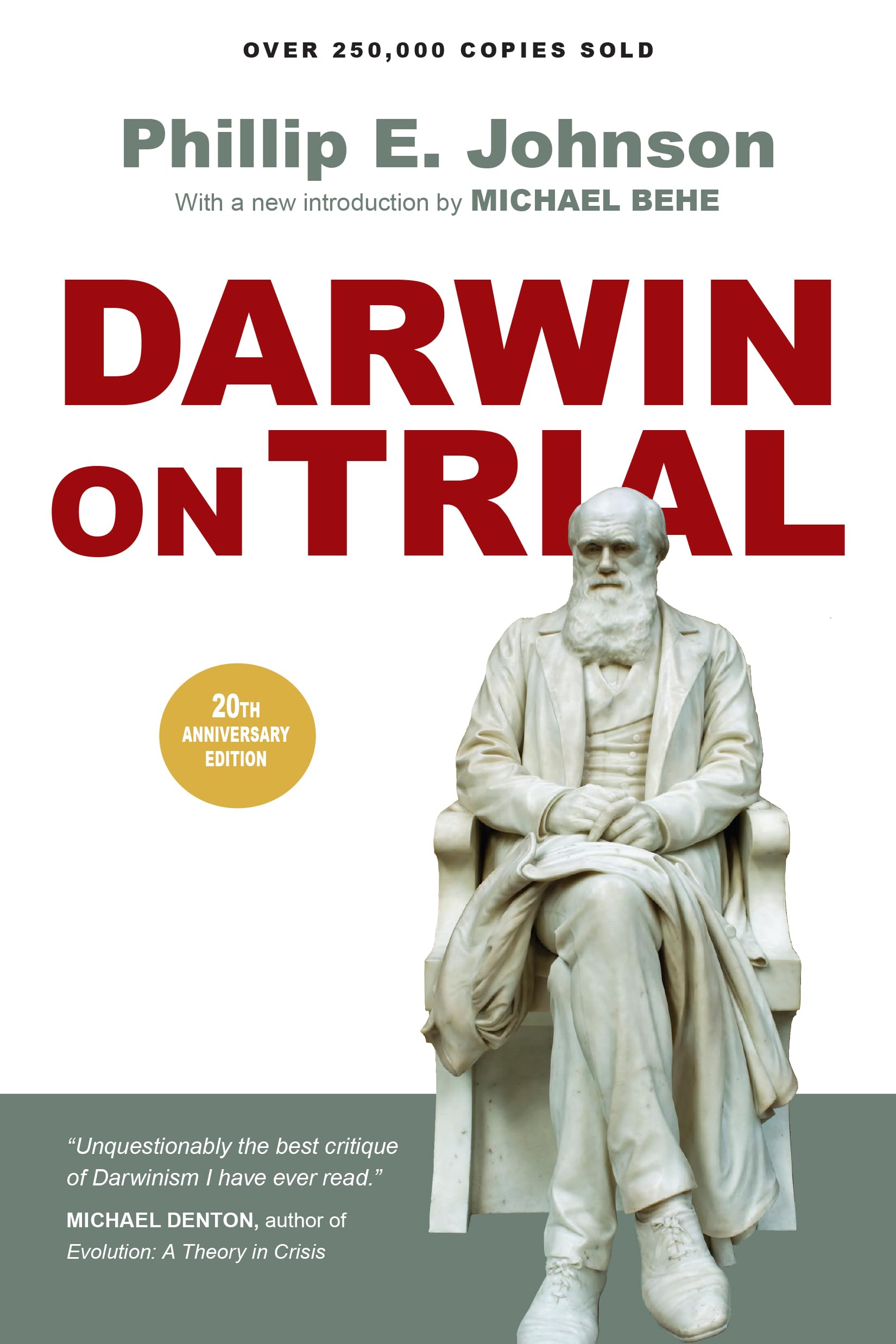
Originally published in 1992, Philip Johnson's Darwin on Trail examines the state of contemporary evolutionary thought - Neo-Darwinian Theory (NDT). The author approaches the subject with a critical eye, discussing many of the evidential challenges facing NDT as well as highlighting its underlying philosophical assumptions. For those new to this subject, Johnson is a long time Berkley law professor and well-known critic of Darwinism. I offer the following thoughts for potential readers.For anyone interested in evolutionary theory and its cultural ramifications this is an important and powerful book. Indeed, the force of Johnson's work is hard to overstate - the numerous strongly worded reviews on this site are themselves a testament to its significance. Given NDT's theological implications(either an atheistic creation story or a threat to Biblical literalists) Johnson's work often evokes a strong emotional response.Although Denton's "Evolution: A Theory in Crisis" is an important work with regard NDT criticism (Johnson himself credits it for drawing him to the issue), Darwin on Trail is in many ways the starting point for the current evolution debate. From a stylistic perspective the book is generally of a high standard - well argued and erudite. In fact Johnson's capacity as a thinker and communicator appears to have intensified the criticism his ideas have received. Despite the many ad hominum attacks against Johnson is hard to dismiss him. People have who have interacted with Johnson are often struck by his intellect and his charm. From a personal perspective, despite my initial reservations, I was tremendously impressed by Johnson when I saw him debate Will Provine (granted Provine is not that capable). In that encounter Johnson came across as the more open minded, tolerant and credible participant - I do not think my perspective was unique.Throughout the book Johnson highlights many of the now well-known challenges to NDT; lack of fossil evidence, mathematical improbability, etc. In doing so, Johnson argues that though NDT is possible there is in fact limited evidence to support the more grandiose claims of its proponents. Johnson readily admits that NDT is the best purely materialistic theory of human origins currently available. I share Johnson view that NDT is an elegant theory, the appeal of which is attested to by its quick adoption and enduring support. That said, however, Johnson makes a compelling case that NDT may not be correct.Despite the strength of his evidentiary case against NDT, perhaps Johnson's most valuable contribution is his discussion of the philosophical assumptions associated with Darwinism. Many proponents of NDT are metaphysical naturalists and therefore "believe" the theory to be a largely self-evident truth. This a priori belief in a theory can focus efforts on the search for confirming data rather than approaching the issue more objectively. This approach is not specific to evolutionists - Johnson makes good use of Thomas Kuhn's view scientific paradigms in this regard. The author also does a nice job of discussing Popper falsification criterion with regard to NDT. In this latter respect it seems difficult to envision any naturalist evidence that would count again Darwinism for some of its supporters.From my perspective Johnson deserves recognition for his courage in challenging scientific orthodoxy - regardless of whether he is ultimately proven right or wrong. It is important that ideas remain open to criticism and do not become sacred dogma. If NDT is valid this current challenge should be welcomed as an opportunity to articulate the theory's merits. If it doesn't stand up to criticism, however, it should be relegated to history (along with other fictional entities such as the ether) with little sentimentality.Overall it is an outstanding book that has, and continues to have, a significant impact. I highly recommend it. For readers seeking to delve further into this subject there are a plethora of good books available. Writers such as Behe, Dawkins, Dembski, Gould and Miller amongst others are worth a read.
Trustpilot
1 month ago
2 days ago