
DOWNLOAD THE APP


Customer Services
Copyright © 2025 Desertcart Holdings Limited
DOWNLOAD THE APP
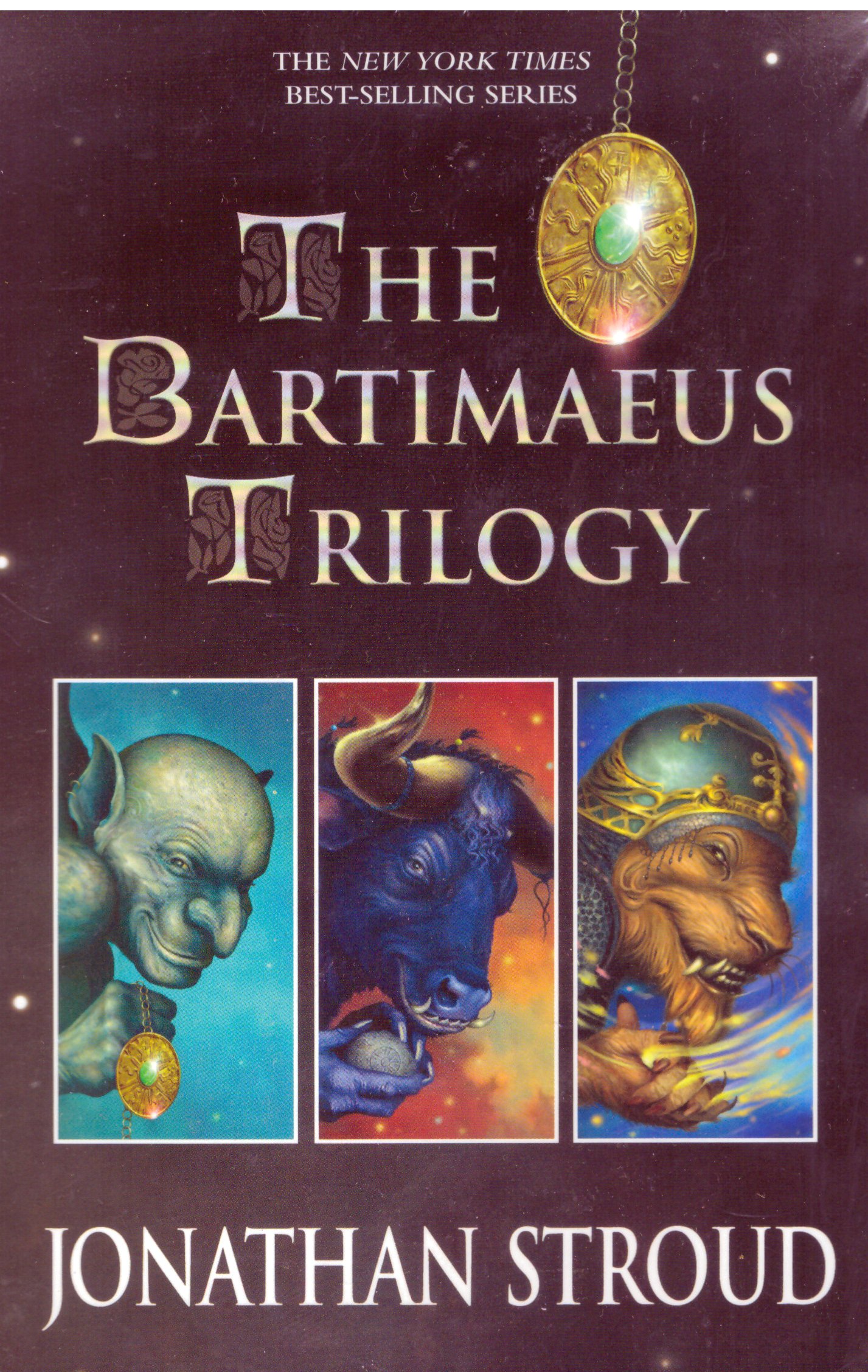
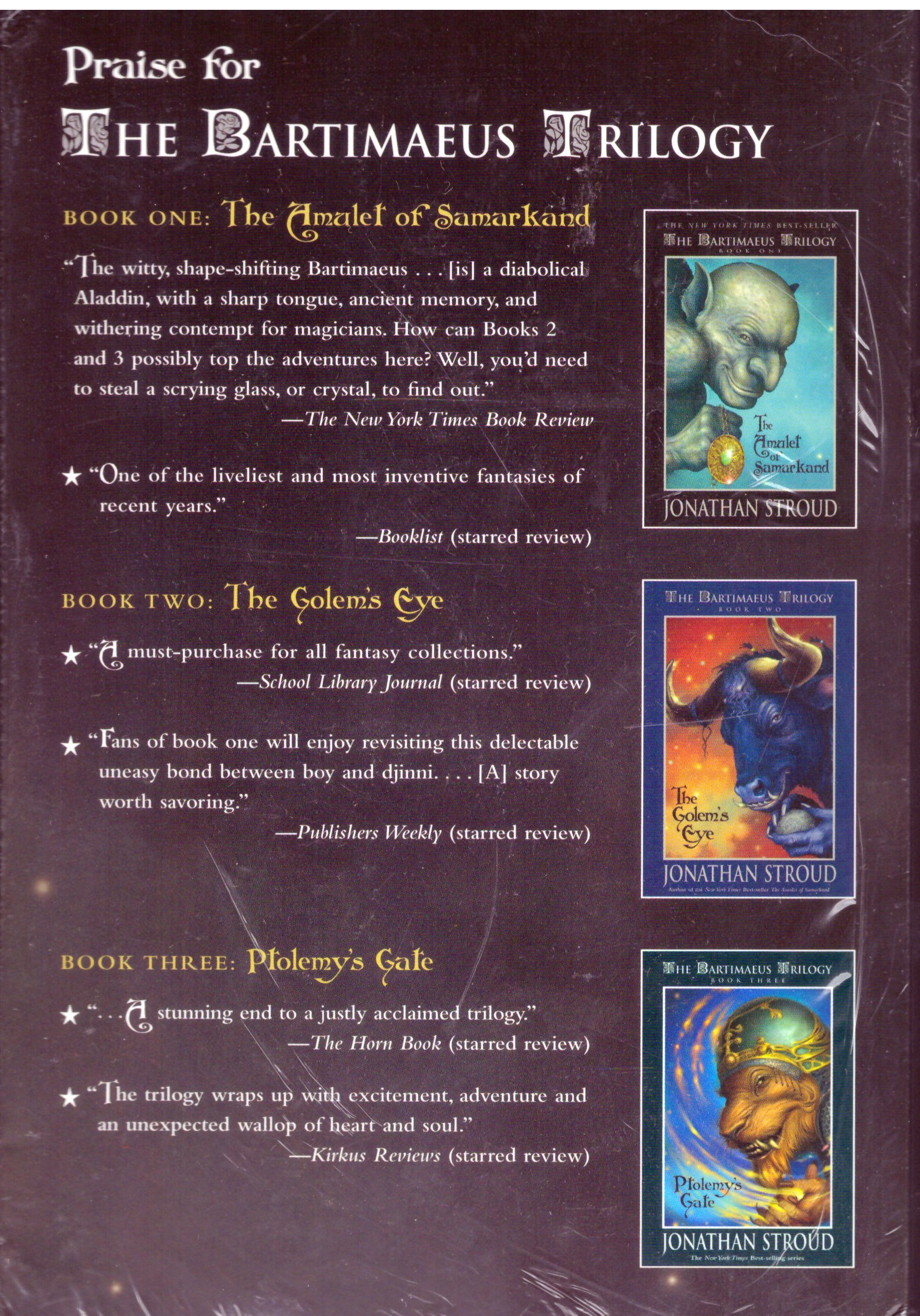


Full description not available
M**C
Wonderful Set!
The Bartimaeus Trilogy is one of the best series I have ever read. I was so sad that it finished with three books. It is so well-written and the characters are so well developed... There is unbelievable wit and great plots. I read this set last year sometime, but since it is one of my favorites I wanted to add a review on here.I can't believe some people call this a Harry Potter rip off. The main character is a magician- this one thing in common does NOT make a book a rip off! This especially is true when the young magician is Nathaniel- raised in a completely different atmosphere as Mr. Potter... with a personality that is on the other side of the spectrum. I DO recommend this book to people who do (and do not) like Harry Potter, Lord of the Rings and other fantasy books such as these.Bartimaeus is the main character and he is a djinni that is 5000 years old. The djinni's in Stroud's world are the slaves of magicians. (Magicians aren't actually powerful- they're demanding things from the djinni that makes them seem to have the power.) The djinni must perform these tasks or they are punished by the wizards and one of the worst forms of punishment is never sending them back to The Other Place from where they are summoned. Because the djinni aren't really from our place, they can shift into almost any shape/disguise.Now Nathaniel, our young 12 year old magician, is very gifted, naive, bitter and power hungry. To begin the first book, "The Amulet of Samarkand," he is the assistant of a crappy magician Arthur Underwood. Arthur treats Nathaniel horridly. He puts up with it though, mostly because Arthur's wife and one of his tutors helps him through it. This all changes when Simon Lovelace completely humiliates Nathaniel and Arthur is too cowardly to help or even stand up for him. Now he isn't just bitter, he is FURIOUS...With all his anger he throws himself into some pretty outrageous goals that seem impossible for a magician as young as he. He wants to summon a powerful middle-ranking djinni to avenge himself. But our amazing djinni, Bartimaeus, is not as docile as Nathaniel had hoped. He is totally hilarious- and REALLY sarcastic. (He narrates, mostly... and leaves us footnotes that really make the book what it is.) Nate eventually avenges himself by attempting to steal the Amulet of Samarkand from Simon Lovelace, his new enemy.In book 2, "The Golem's Eye, Nathaniel (now using his formal wizarding name John Mandrake) has to summon Bartimaeus once again. It is two years later and Nate has risen fast in the government. Nate is put in charge of hunting the source of some disastrous attacks that are devastating the wizarding community. The Prime Minister seems to think the Resistance is the source, but not everyone is so sure. (The Resistance is a team of commoners that rebel against the magicians' unfair government.) While Nate is going about his work, we have Kitty Jones, a leader of the Resistance, searching out magical weapons to use against the magicians' government... They're looking to overthrow them and regain control of London. We get a deeper look into the character of Kitty Jones. We figure out she is immune to magic.Book 3, "Ptolemy's Gate," is THE BEST in the trilogy and is set three years after the previous book. I think that makes Nathaniel 17 years old and one of the most influential magicians in the British cabinet for the Prime Minister. He has tons of djinni as slaves at this point and doesn't treat any of them well, including Bartimaeus. Nate has a lot of problems- the resistance is getting stronger and the foreign war is getting worse. he has also been over using and abusing all his djinni to the point where Bartimaeus almost dies. In an act that surprises Nathaniel and the djinni- he sends Bartimaeus back to the Other Place temporarily to regain his strength. Ah, is Nathaniel's heart not completely black coal just yet?We learn tons about Bartimaeus's past in this book- these are my favorite parts. He served a 14 year old boy named Ptolemy in the past who was very intrigued by The Other Place. Ptolemy wanted to end the slavery of the djinni and was very kind to Bartimaeus. Ptolemy was also the only human to travel to The Other Side and come back to write about his experiences.Kitty has also been very busy in the 3rd book. She studies magic nonstop and has made the decision to try something that has never ever been done by anyone non-magical before.The awesome fates of Kitty, Bartimaeus and Nathaniel are intertwined more than ever... and the government finally begins to crumble like it should. All hopes of magicians and commoners alike lie in the hands of Bartimaeus, Nathaniel and Kitty. The climax is intense and you will find yourself lost in the scene holding your breath until the ending.Without giving away any spoilers, that's all I can say ;] The ending was super emotional for me, I think anyone who gets really into this series will find themselves grabbing a tissue by the end of this book.Overall this series is intense, thrilling and amazingly written. The plots, dialogue and characters blew me away. I can't stop recommending this trilogy. I could read it a million times. I want Bartimaeus to be MY best friend. I have got to pick up some of Stroud's other work.
T**Y
Funny and dark
Let me start by saying (since the review form asks if I'm over 13!) that I'm an adult who loves children's and YA fantasy. My all-time favorites include Lloyd Alexander, Susan Cooper, John Christopher, Madeleine L'Engle... Jonathan Stroud may very well join the list if he consistently writes this well. Bartimaeus is a rather dark story with something of an anti-hero, but filled with humor ranging from broad, almost raunchy, to slyly subtle. In spite of the underlying thread of grimness, I kept finding myself laughing out loud, especially during the chapters narrated by Bartimaeus. Stroud uses the alternating point of view style that seems so ubiquitous these days; first person for the djinn Bartimaeus, third for the young magician Nicholas. I happen to like this method in and of itself, but, while it probably annoys some readers (a matter of personal taste) the two POVs do serve a valid rhetorical purpose in underscoring certain personal qualities of the respective characters.The anti-hero is another popular trend that seems to be making its way more and more from adult to children's literature. It's nothing new, of course - there have been less-than-savory protagonists for centuries, often in some great novels. I'm a huge fan of authors like G.R.R. Martin and Joe Abercrombie who, as many of you probably know, somehow manage to sympathetically portray characters ranging from stone-cold killers to cynical torturers. Note to parents: as Stroud's books are intended for minors, they avoid the more heinous, adult-themed brutality found in much of today's "realist fantasy", of course. Still, there are some pretty dark moments, and both Nicholas and Bartimaeus illustrate the duality of our nature. Their relationship is one of resentful dependence: mutual hate and need at once. Nicholas is remote, calculating and cold, yet naive and vulnerable, too. Bartimaeus is irreverent, sarcastic and often blood-thirsty, but, although a demon, is more immediately accessible in many ways. He has a wonderful sense of humor, a surprising amount of empathy for others - even, on occasion, for humans, and a very real sense of justice and fairness. The boy's development (or lack thereof, perhaps? I'm not telling!) is the ostensible theme of the trilogy, but Bartimaeus is marvelous (and outrageously funny!) in his alternating roles of servant, mentor and foil to Nicholas.
T**R
swashbuckling djinni
Demons are very wicked and will hurt you if they can. So Nathaniel, the magician-in-training, was taught and so he believes.Bartimaeus would argue on three points. First, he is not a demon. The term is insulting. He is a djinni. A noble, ancient and powerful entity.Second, he is not wicked--he only wants to go home to his own dimension where his essence doesn't ache from the physical restrictions of this world and where he won't be forced into slavery under threat of torture. The magicians who summon, bind, and control him are the wicked ones.Third, he isn't particularly interested in hurting Nathaniel. What would that achieve? No. He wants to kill him.But in the meantime, he'll settle for irritating the boy, while he follows orders in his own joyous, romping, destructive, cavalier style.*Steal from powerful government magicians? Check.Spy on the same in all imaginable shapes and guises? You've got it.Keep Nathaniel alive? . . . why of course. With gusto.Keep his comments to himself? . . . no. That one's not going to happen.Save England? Honestly, having seen countless civilizations with far greater panache than this one crumble to dust, he can rouse little interest in the matter.Oh, all right if you insist.*Be sure to read the footnotes. Try not to laugh too loudly.
Trustpilot
1 month ago
3 weeks ago