Some deliveries may take a little longer than usual due to regional shipping conditions.

DOWNLOAD THE APP


Customer Services
Copyright © 2025 Desertcart Holdings Limited
DOWNLOAD THE APP
Full description not available
C**M
Fascinating and easy to read
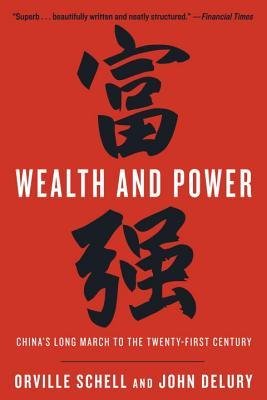
How does one begin to write the history of a country and manage to contain it all in one volume? I would daresay a task is impossible; especially for a country that has been in existence for thousands of years. Truth be told, this book is not an actual history of China, yet this isn’t really the authors’ intentions. The purpose of this book is to show how a once isolated, maligned country could rise from the depths of humiliation and subjugation and become, arguably, the most prosperous nation of the 21st century. To tell this story accurately, a fair amount of history needs to be told, though. What is China’s past? What were the seeds that allowed them to grow? And most importantly, who were the key figures that planted these seeds?This book does a splendid job of telling the history of China (starting around the 1850s during the Opium Wars) through the eyes of some of the keenest minds and instigators within the country. This really is a magnificent way of telling a story without allowing the reader to become immersed with too much minutiae and daily comings and goings that can weigh one down. Each chapter in this magnificent work serves as a sort of ‘Cliff’s Notes’ version of a period in the history of China, telling about the key events that would continue to shape the country. Since the focus of each chapter is also on a key player, we’re exposed to many of the normalcies and behaviors of the population as well. The authors do such a magnificent job, that I was tempted to read a complete biography on each key figure from each chapter.So roughly 170 years of history is told, and only about the last 25 could be looked at as marginally successful. China, from about 1850 through about 1980, is looked at as backwards, unsophisticated, and a far cry from a world power. What makes this book fascinating is the key insiders within the country realize this as well. They know the worldview of China isn’t positive nor powerful, and they realize that changes must be made. And these changes are slow. Boy are they slow. In fact, you have to admire the patience and perseverance of many of these nineteenth and early twentieth century figures . They’re convinced they’re contributing to the future success of China, but know that the changes being implemented are no guarantee for success, and they know that if these changes are successful, they won’t see results any time soon. In other words, they know that the changes won’t happen until long after they’ve been dead and buried. Is this a trait unique to those indigenous to Far-Eastern culture? As an American, I have to believe so to a point. I can’t imagine many in my country trying to radically change the direction of the country without some sort of instant gratification.When China is ravished by neighboring Japan during World War 2, a present-day resident probably couldn’t help thinking that all of the changes so far were for naught. Especially when the turmoil gives rise to the bloodthirsty despot Mao Zedong. Mao manages to ravage his homeland by starving and killing the masses as he believes it will somehow encourage and inspire proletariat unification that will allow his homeland to finally rise through the ashes. What’s a bit scary is that the authors suggest that Mao might have, in a strange way, succeeded at his goal. Most on the outside looking in, however, would conclude that the price that was paid was far too high. Although this book devotes two chapters to Mao (most other key figures only get one), there’s not a terrible amount of detail focusing on the atrocities of his regime during his so-called “Great Leap Forward”. We’re not exposed to the mass starvation, executions, and brutality of his regime. Oh sure, we read that it happened, but we’re not really allowed a front row seat.It’s after Mao’s depth that this book (and China itself) becomes the most interesting. Deng Xiaoping, Mao’s “successor” also gets an additional chapter devoted to him and the particular time in history, and I thought the chapters devoted to Deng were the most fascinating of the entire book. Deng, like Russia’s Nikita Khrushchev, realizes that he’s succeeding a bloodthirsty dictator, and humanitarian changes must be made to achieve China’s overall goal. Like Khrushchev, though, Deng doesn’t go nearly far enough. It was during his reign when the infamous Tiananmen Square incident took place in 1989. Deng’s most arduous goal for his country is for economic strength and not necessarily human rights. So although the country rises in economic power globally within the next few decades, the notion of ‘equality for everyone’ takes a significant backseat.In fact, the focus on economics as opposed to humanitarianism seems to be the focus of the last chapter or two of this book. The authors seem to stress to us that China has made significant strides financially, yet they still have quite a ways to go if they want to be looked at as ‘equals’ among the more philanthropic nations. The authors even hypothesize that China’s sprouting growth towards wealth and power might, in fact, be short lived if humanitarian changes remain slow and infrequent. This leads the reader to admire China’s economic growth, but there’s far too many warts for one to become impressed overall. Ironically the words in this book’s title “Wealth and Power” are looked at favorably from a monetary, hedonistic perspective, but those who know history know that these two words don’t come close to equaling success from a moralistic perspective. This is crucial that the reader doesn’t miss this.I loved this book. This is one of those rare books that I’m sure I’ll one day re-read. It was incredibly easy to understand and assimilate. It also taught so many valuable lessons of human nature of the past, present, and even the future. This book is a great starting point for those who might not follow current events closely yet have recently noticed that China seems to be in the headlines an awful lot. This book does a magnificent job of telling you the how and the why.
A**N
History of China from the Opium Wars conveyed through politics of key intellectuals and officials
Wealth and Power takes a new and interesting approach to give a history of China over the last century and a half. It is divided into chapters on key scholars and policy makers in China in which each chapter discusses the context and subsequent history of those individuals. Through the book the reader is given a history of China as well as an account of the progression of thought and how and why it evolved. It contextualizes issues of today and shows where they originated. The book has a great flow that takes the reader from the great humiliation of the Opium Wars to where China is today in the world, the issues it has overcome and the issues it still struggles with. Much material is embedded in Wealth and Power and it is extremely readable and interesting. I will try to give a quick overview of the people and history covered.The book is split into 15 chapters, for the most part each chapter covers 1 individual though Mao and Deng Xiaoping both take two chapters to cover. It starts with the Opium Wars where China's first "humiliation" at the hands of foreign powers began. The authors first discuss Wei Yuan who was a scholar in the early 1800s. It first introduces the concept of Wealth and Power and introduces Wei Yuan who they see as introducing ideas from the Legalist period of China to be more pragmatic about goals of governance for china compared to Confucian ideals. Through the Opium Wars the prioritizing of becoming more wealthy and powerful relative to following outdated bureaucratic process became an aspect of Wei Yuan's thinking and sets the stage for the subsequent chapters and returning to the concept of Wealth and Power. The author's move to Feng Guifen, a contemporary of Wei who spent more time among Europeans. The authors weave the characters together and relates the questions of each scholar together. Feng advocated learning from the barbarians. The authors move on to Empress Dowager Cixi an infamous character based off fanciful accounts of her behavior. The authors describe the power politics of the day but also discuss the philosophy of the decisions of the empress given the circumstances. Not so much a reformist the authors describe some aspects of her forward thinking about China's needs but she is used as a critical character in China's early modern history. The authors discuss Liang Qichao and the late 19th and early 20th centuries. The authors describe how criticisms of the Chinese system were growing and a recognition of the lack of progress of China becoming more abundant in science and technology. The authors note the growing sense of nationalism and desire to re-steer china back to its former glories. The author's move on to Sun Yat-Sen and the father of non-imperial China. It gives his history and that of the country 100 years ago. The chapter focuses on Sun Yat-Sen's global travels and pursuit of sympathetic Chinese to the failure of the nation and it discusses his 3 principles the country needed to follow namely - Nationalism, the rights of the People and the livelihood of the people. The authors move on to Chen Duxiu who was one of the founders of the Communist party. The authors document the turbulent times between the first and the second world war as Russia moved from Lenin to Stalin. It discusses the philosophical choices politicians had to consider given the conditions. The authors discuss the publishing's of Chen Duxiu in New Youth where he called for individuality, forward thinking, self defending, global and pragmatic. He saw the need to have a final stage of scientific thought and democratic rule, but a leninist means of achieving that end with a firm party. They then discuss Chian Kai-Shek, a key historic character. They discuss him as a military leader and politician and detail the cooperation and aggression of the nationalists and communists as a function of whether China's occupation. The authors move on to the two most influential political actors of the last century, Mao and Deng Xiaoping. They discuss early Mao and post political consolidation Mao, the Great Leapforward as well as the Cultural revolution. The turbulence of the times leads in to a discussion of Deng and his history of ascent followed by descent followed by ascent. The history gives a sense of why Deng focused on results rather than philosophy and how the years preceding his heading the party gave rise to his political and economic philosophy. The most important reforms for the recent growth of China were from Deng's vision of what was needed to prosper. We move on to the modern era first with Zhu Rongji who continued in Deng's footsteps and we end the book with Liu Xiaobo who is included to note that despite the economic success the democratic deficit within China remains.The authors tying together all of these characters does a remarkable job of making sense of China's history and national concerns. It shows how the nationalism that tied together so many of the political scholars in China for the last 150 years has helped get China to where it is by adopting economic ideas and foreign technology. The authors discuss how Mao's era might have been the reason why China was able to shed its Confucian ideological past and embrace a blank slate to try new experiments from. No doubt this was a painful way to achieve that blank slate and one always has to wonder if there were other less savage ways to have gotten it, but the issue is well posed. The author's discuss the future issues China will have to face and use Liu Xiaobo as an example of someone who might be looked on in history as setting the stage for the next intellectual shift- to a more democratic norm. The authors are careful to note that a nimble party might defy historical political evolution but the lack of democracy in China is resurfacing as a concern in a substantial way and civil unrest is increasing reminding us of Tienanmen Square. There is a lot of material in this and one gets a history of modern China as well as the politics that got us here.
M**N
thumbs up
great
M**0
Beautifully written, erudite and thought-provoking.
A brilliant history of the intellectual and cultural origins of China rise from national humiliations to world first economy.The book leave little hope for a democratic China.
J**S
Very good book
Last 150 years through different characters, their mindsets and ordeal to shape China from a feudal to a communist country
M**N
Writings from those that influenced the course of history, presented in a clear way.
Excellent summary and overview for gaining a broad and comprehensive insight of the historical development of Chinese politics, culture, economy, research and development and zeitgeist in the last 200-400 years.
B**N
Great overview, left me wanting more
Excellent overview of China from the start of the 19th Century until now. I actually wish it was a little longer as the author just touches on some topics I find very interesting and left me wanting to read up more about on my own.
J**O
Very useful
This is a very useful essay to better understand the roots of the Chinese diplomacy, easy to read and very interesting
Trustpilot
2 weeks ago
3 days ago