Buy anything from 5,000+ international stores. One checkout price. No surprise fees. Join 2M+ shoppers on Desertcart.
Desertcart purchases this item on your behalf and handles shipping, customs, and support to Denmark.
โก Fix it fast, fix it smart โ soldering without the burn!
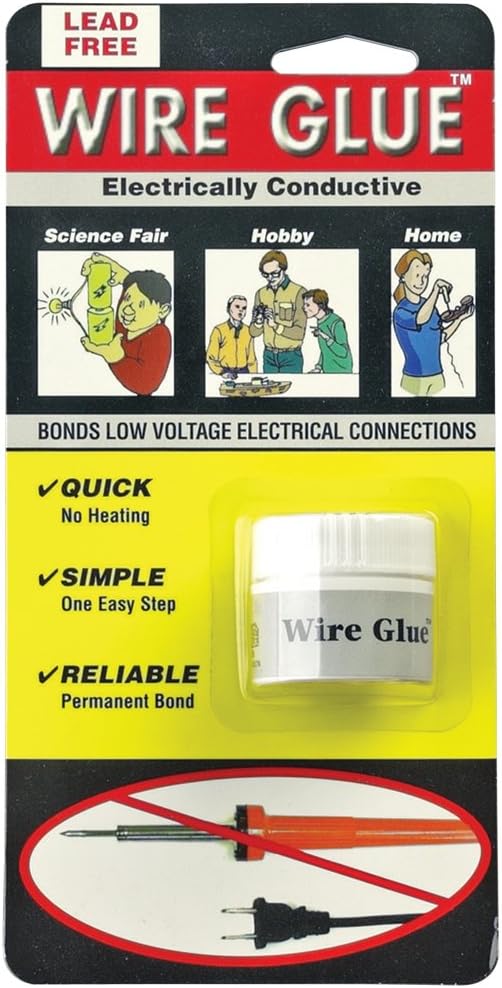
Electrically Conductive Wire Glue is a 9ml jar of high-viscosity liquid adhesive that creates permanent, low voltage AC/DC conductive bonds without heat. It cures fully in 12 hours, making it ideal for quick electrical repairs, especially in tight or outdoor spaces where soldering irons are impractical. Compact, eco-friendly, and easy to apply with simple tools like a toothpick, itโs trusted for durable, weather-resistant fixes in professional and DIY settings.
| ASIN | B000Z9H7ZW |
| Best Sellers Rank | #12,936 in Industrial & Scientific ( See Top 100 in Industrial & Scientific ) #34 in Soldering Irons |
| Brand | American Science & Surplus |
| Brand Name | American Science & Surplus |
| Color | Clear |
| Compatible Material | Wood |
| Container Type | Jar |
| Customer Reviews | 3.8 out of 5 stars 1,755 Reviews |
| Full Cure Time | 12 Hours |
| Item Form | Liquid |
| Item Package Quantity | 1 |
| Item Weight | 0.8 Ounces |
| Manufacturer | American Science & Surplus |
| Material | wood |
| Material Type | wood |
| Model | 03WIREGLUE |
| Number of Pieces | 1 |
| Other Special Features of the Product | Eco Friendly |
| Part Number | 400 |
| Special Feature | Eco Friendly |
| Specific Uses For Product | Electrical Repairs, Electrical Work |
| UPC | 831195001004 |
| Viscosity Level | Medium to High |
| Volume | 9 Milliliters |
| Water Resistance Level | Not Water Resistant |
J**P
Worked great on low voltage outdoor lighting.
I have a group of 6, 12V outdoor lighting group of lights that enhance our front gardens around our house. On one of the light connections, one of the two wires pulled out of the plastic housing (the electrical connection was down a small hole in the plastic housing. The wire had just pulled out exposing the metal strands of wire. When I pushed the wire back into the hole, the light lit up again, but the wire would not stay inside of the hole. I knew it needed to be soldered....somehow, but with no exposure to the connecting point inside of the plastic housing it was impossible. After a bit of googling and YouTubing, I found this product which was highly recommended. I searched on Amazon, found it, ordered it, it came quickly. I put some of the wire glue on the wires and dropped a bunch down the hole, jammed the wire into the hole (the light came on), I held the wires in place for a few minutes, and after a few months of various weather (warm, wet, cold, etc) the light still works. Great product!
D**N
Very conductive
I'm using this product to glue a magnet onto a 21700 battery to extend the length of a third-party battery so it fits properly in my Fenix flashlight. The wire glue doesn't bond the magnet and battery that well, so I added a little bit of clear non-expensive gorilla glue and mixed it with the wire glue. This combination works extremely well. It is also very conductive.
A**R
Much needed tool.. Does NOT work as advertised. Not conductive
This is perfect for the ones that cannot solder effectively. I use it for replacing rechargeable batteries that are soldered to the compartment. The only negative is that you need to use a stronger glue afterwards since the glue part of this items is weak. Too bad there's not much of a choice out there Unfortunately, I placed this review too quickly. The only reason the initial test worked was because the metal contacts were touching. When this conductive glue is in between the contacts, there's no conductivity, therefor, no voltage. This is false advertisement!! I will be returning.
A**G
Stir thoroughly!
It should be noted that this is not a replacement for a short length of wire, such as completing a circuit path. It is important to stir thoroughly, making sure to break up any blobs of material at the bottom of the container. The use of this conductive liquid is to coat joined conductors to substitute for soldering them. In that use, the product works well, as there is contact with a lot of the mechanically joined surfaces. Trying to create a pathway with this product results in that pathway having thousands of ohms of resistance per inch. I created a โtapโ at 50k of a 100k potentiometer to use in an antique radio. I used a fine wire running from the โtapโ I created to the edge of the carbon plate of the potentiometer. I used the product to cover the wire and where it was positioned on the edge of the carbon plate to create a very close, covered contact with the two surfaces. Since this was a volume control, any resistance was negligible. The bottom line is making a good, clean mechanical connection first, between the conductors before coating with this product. I will find more uses for this product.
B**1
It could work...
I got this for a small project that I was having problems soldering. It's VERY runny which is bad for me because my project has solder points fairly close to each other. So I'm having some trouble with controlling where it's going and when trying to tape off the other solder points to prevent the glue from going on them I'm having issues with it not staying stuck to the board or wire when I remove the tape even if I score the tape around the solder point and have applied two to three decent coats of the glue. Quick tests show that it does "work", but I'm going to have to play around with it to see if I can find out how to thicken it up and still be functional. If the pack had thicking instructions on it, since I'm sure there are some projects that it being runny would be better, I'd like it alot more... As it is now, even if you follow the instructions and apply it with a toothpick it's still pretty messy.
E**E
This worked for me!
I know the reviews are all over the place and I bought this over a year ago. I got a guitar pedal from an amazon return auction (Nellis) and it didn't work when you plugged it in. You shook it and something was bouncing inside. I was going to return it to the auction but would have cost more in gas than the couple $ I paid, so I took it apart. There was a top of a node that broke off? You could see where it was suppose to be and my wife glued it on. Works, gave it to my son in law. Yesterday put new pickups in an old Fender Mustang. I let it set for 2 hours, put super glue over that (per instructions on the box) let it set additional 2 hours. I could NOT get the pickguard back on to save my life. Ended up 2 hours later bending screws for it to go in but I was pulling and tugging for 2 hours! I'll be darn! Thought it would have broke!
D**R
Worked in my application
I needed to attach an inductive switch to a brass lamp base. Hot solder would have discolored the lamp base, so I resorted to this. After thorough stirring with a toothpick and abrading the surfaces to be attached, I applied this grey gloop to both surfaces. Attachment was not quick or easy as this is not tacky. So I used a clamp to hold the pieces together. Leaks of glue onto the clamp surface caused the joint to fail when the clamp was removed after overnight drying. Repeat. This time with cling film over clamp head. Messy but it worked. Treating it like a cement is what it takes.
R**N
Not a glue but is a paint
I bought this "glue" to attach spade connectors to each end of a battery. The spade was a male connector (basically a flat strip). The product is the consistency of paint not glue. there was no tacky to it, so the tab needed to be clamped in place until it dried. After 24 hours the paint was dry, but it had no strength. When I tested it, the tab fell off, so I cleaned it and reattached it. After the 24 hours I super glued it as recommended in the instructions. After that dried, I checked and there was no continuity across the connection. Thinking there was an issue, I pulled it apart again with very little effort. This time not only did I need to clean off the paint, but also the super glue. After several more tries varying the pressure of the clamp to attempt a spot that would have metal to metal contact around the paint and still be somewhat stronger bond, I decided that there was a tradeoff. I was either going to have a structural bond or an electric bond but not both. It would seem that this product may work on a circuit board where there is a good physical contact but no need for strength
Trustpilot
1 day ago
5 days ago