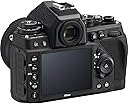
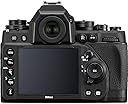
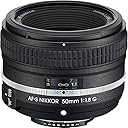
📷 Own the moment with classic style and modern precision.
The Nikon Df is a uniquely stylish full-frame DSLR combining a 16.2MP FX-format CMOS sensor with Nikon’s flagship EXPEED 3 processor. It features a fast 5.5 fps continuous shooting rate, a sophisticated 39-point autofocus system with 9 cross-type sensors, and a rugged yet lightweight magnesium alloy body. Designed for professionals and enthusiasts who crave tactile control, it revives classic mechanical dials for shutter speed, ISO, and exposure compensation. Compatible with all Nikon F-mount lenses, including vintage glass, and supports wireless photo sharing via an optional adapter, the Df blends timeless design with cutting-edge imaging technology.
| ASIN | B00GD1KBLI |
| Aperture modes | F1.8 |
| Are Batteries Included | Yes |
| Aspect Ratio | 4:3 |
| Auto Focus Technology | Center, Continuous, Contrast Detection, Face Detection, Live View, Multi-area, Phase Detection, Selective single-point, Single, Tracking |
| Autofocus | Yes |
| Autofocus Points | 39 |
| Best Sellers Rank | #405,105 in Electronics ( See Top 100 in Electronics ) #639 in DSLR Cameras |
| Bit Depth | 12 Bit |
| Brand | Nikon |
| Built-In Media | AN-DC9 Strap, BF-1B Body Cap, BS-1 Accessory Shoe Cover, C-E6 USB Cable, CL-1013 Lens Pouch, DK-17 Eyepiece, DK-26 Eyepiece Cap, Df FX-format Digital SLR Kit with AF-S NIKKOR 50mm f/1.8G Special Edition Lens (Black), EN-EL14a Rechargeable Li-ion Battery, HB-47 Bayonet Lens Hood, LC-58 Snap-on Front Lens Cap, LF-4 Rear Lens Cap, MH-24 Battery Charger, NikonView NX2 CD ROM |
| Camera Flash | no flash |
| Camera Lens | AF-S NIKKOR 50mm f/1.8G Fixed Special Edition Lens |
| Color | Black |
| Compatible Devices | Wi-Fi enabled devices (with adapter), Computers, External storage devices via USB |
| Compatible Flash Memory Type | SDHC, SDXC |
| Compatible Mountings | Nikon F (FX) |
| Connectivity Technology | Wi-Fi |
| Continuous Shooting | 5.5 |
| Customer Reviews | 4.2 out of 5 stars 59 Reviews |
| Digital-Still | Yes |
| Display Fixture Type | Fixed |
| Display Maximum Resolution | 960 x 640 |
| Display Resolution Maximum | 921000 |
| Display Type | LCD |
| Dots Per Screen | 921000 dots |
| Effective Still Resolution | 16 MP |
| Expanded ISO Minimum | 50 |
| Exposure Control | Aperture Priority, Automatic, Manual, Shutter Priority |
| File Format | JPEG (EXIF 2.3), RAW (NEF), TIFF |
| Flash Memory Bus Interface Type | SD |
| Flash Memory Type | SD/SDHC/SDXC card |
| Flash Memory Video Speed Class | 10 |
| Flash Modes | Auto, On, Off, Slow Synch |
| Flash Sync Speed | 1/250 sec |
| Focal Length Description | 50 Mm |
| Focus Features | Nikon Multi-CAM 4800 w/TTL phase detection |
| Focus Mode | Manual Focus (MF) |
| Focus Type | Automatic with Manual |
| Form Factor | Mid-size SLR |
| Generation | 1 |
| HDMI Type | Type C Mini HDMI |
| Hardware Interface | AV Port |
| Has Color Screen | Yes |
| Image Capture Type | Stills |
| Image Stabilization | No |
| Image stabilization | No |
| Item Weight | 1.68 Pounds |
| JPEG Quality Level | Fine |
| Lens Type | Interchangeable |
| Manufacturer | Nikon |
| Manufacturer Part Number | 1527 |
| Maximum Aperture | 16 f |
| Maximum Focal Length | 50 Millimeters |
| Maximum Shutter Speed | 1/4000 Seconds |
| Metering Methods | Multi, Center-weighted, Spot |
| Minimum Focal Length | 50 Millimeters |
| Minimum Shutter Speed | 30 seconds |
| Model Name | Nikon Df |
| Model Number | 1527 |
| Model Series | Df |
| Movie Mode | No |
| Night vision | No |
| Optical Zoom | 1 x |
| Photo Filter Size | 58 Millimeters |
| Photo Filter Thread Size | 58 Millimeters |
| Photo Sensor Resolution | 16.2 MP |
| Photo Sensor Size | Full Frame (35mm) |
| Photo Sensor Technology | CMOS |
| Remote Included | No |
| Screen Size | 3.2 Inches |
| Self Timer | 10 Seconds |
| Sensor Type | CMOS |
| Shooting Modes | Aperture Priority, Automatic, Manual, Shutter Priority |
| Skill Level | Professional |
| Special Feature | Classic Mechanical Operation System and Lens Compatibility |
| Specific Uses For Product | Photography |
| Supported File Format | JPEG (EXIF 2.3), RAW (NEF), TIFF |
| Supported Image Format | JPEG, RAW (NEF), TIFF |
| Total Still Resolution | 16.2 MP |
| Total USB 2.0 Ports | 1 |
| Total USB Ports | 1 |
| UPC | 018208015276 |
| Video Resolution | 1080p |
| Viewfinder | Optical |
| Viewfinder Magnification | 0.70x |
| White Balance Settings | Auto |
| Wireless Technology | Optional, via WU-1a wireless mobile adapter |
| Write Speed | 5.5 fps |
| Zoom | No Zoom |
F**R
The iPhone of DSLRs
To me, it's like an iPhone. You either love it, or you hate it, but either way, you are aware it is seen as overpriced. If you hate it, it's overpriced. If you love it, that premium is more worth it. Not the most advanced phone/camera, not the most customizable, but it just works well. No fuss, no frills. I really like this camera. I've been shooting Nikon since I had a Nikon EM. I've owned several of their APS-C models, most recently the 7000. I've used the 3200 and 5300 recently. I currently own a D800 and a Fujix100. Annoying things... 1. Wish it had a wider spread of AF points. Not necessarily 51pt, just a wider spread. The 31 pt system was first used on a dx camera. 2. Wish it had the option for a battery grip 3. Wish that right sided strap lug was not in the way! 4. Wish the on and off switch had a notch instead of just being a dial. 5. Wish it had focus peaking in live view. 6. It can't trigger CLS without sb800 or SB700/910 or third party trigger. 7. Ergonomics-see below. 8. Doesn't focus down to light as low as -2 EV, and no AF assist light!!! Sucks for such a great low-light sensor!!! For me, 6- 8 are the biggest issues. But none of this is a deal breaker. #8 is the worst though...It is solved with a flash though, but then see #6 So how does it compare to the d800? Handling D800 wins big time. I like how the d800 feels in my hand. I like the grip. I like the position of the shutter release button. I have no problem with the menus what so ever. I really don't need all those analog dials. I like how the d800 feels with a fast prime. I can hold the entire camera and shoot it comfortably with one hand. Holding the Df with a large prime and trying to shoot it with one hand feels off balance and awkward. YOu really have to use two hands. You need to grip the camera with the right hand a specific way to avoid that lug and you have to support a heavy prime with the left hand. I imagine the Df won't balance well with a big zoom. I hope Nikon introduces new F2 primes. I'd love to have a 35mm f2 AF-S! Auto-Focus- D800 wins again... don't have an issue with the 39 AF points vs 51 of the d800, i just wish they were spread out over the image a bit more. Not a new complaint. I do think it doesn't focus as fast in low light compared to the d800. But that's not a surprise as I think the d800 focuses down to -2EV (night) and the Df is -1. It feels a bit more hesitant in the dark, which sort of sucks because the sensor is so great for low light. Reminds of how my D7000 used to hesitate. I will say that I do not have to use AFFT on any of my lenses with Df. All my lenses have needed adjustment on my d800. Build- Tie. both are magnesium and weather sealed. Sensor- Tie. each one has their strength. Battery life- Df, but i really wish it took the D800 batteries as i have 3 already. WB- Does not lean towards green like the d800. looks better to me. ANYWAY. blah blah blah. I'm sure you can read online, i think you'll find my opinion is no different than others who have compared the two. How does it compare to my x100? apples and oranges. you can't compare an aps-c mirrorless vs a full frame...I think both cameras have their purpose. I will keep my x100 as it is so discreet. What i love about the x100 is the quiet shutter and the focus peaking. I think if i'm casually going out with friends during the day, the fuji will be my first choice. If i'm going out with a group of people or to a function and the lighting will be decent and focusing not challenging, I'll take the fuji. It's small, not pretentious, and takes very nice images. Why am i keeping it? It's really a great camera despite the negatives I've stated. after 1000 shots, it really is trouble free. As mentioned, it does what it is supposed to without any fuss or frills. Sure it's expensive, but based on absolute dollar number, it's cheaper than a leica, a d4, and some other FX cameras. I think if you are looking for a first Nikon FX camera, get the 610 and save your money for glass. You can buy Nikon D610 24.3 MP CMOS FX-Format Digital SLR Camera (Body Only) , Nikon 85mm f/1.8G AF-S NIKKOR Lens for Nikon Digital SLR Cameras , and Nikon 28mm f/1.8G AF-S NIKKOR lens for a smidge more than Nikon 1528 Df 16.2 MP CMOS FX-Format Digital SLR Camera with AF-S NIKKOR 50mm f/1.8G Special Edition Lens SLR Camera with 3.2-Inch LCD (Silver) . Or even better, buy a Nikon d600 , send it in to nikon claiming "oil spots" and hopefully they'll switch out the shutter for the 610 shutter. Only get the Df if you have Fx glass. If you don't have Fx glass, again by the d610/600. This is my family cam. This is the camera i will take with me when i go out with family and close friends. I really want nikon to make a new 35f2 G Part of me thinks that "Df" means "DSLR Finale". as this should be nikon's last DSLR as they currently make them. They need to move towards a real "fusion" camera with an OVF/EVF with focus peaking and an AF system similar to Nikon 1. *****UPDATE 12/27/2013***** Just wanted to address some of the common complaints I've heard. "It doesn't have SS of 1/8000" -Honestly? who needs 1/8000? I understand if you want to shoot your 1.4 glass wide open during broad daylight, but chances are broad daylight is harsh light and the picture would look horrible because harsh shadows. the BETTER (for a non-pro without big strobes) way to shoot wide open during daylight is with an ND filter that allows you to shoot 1.4 with a SS of 1/250, or whatever your flash works at best and use a flash. Sure you can do auto-FP sync at 1/8000 for fill, but the flash is so weak at that shutter speed. "AF struggles a bit compared to 51 point of the D800/e and D4." Yes it does on the outer focus points. Best results for me have been back button focusing and using the center point and recomposing. Not ideal, but gives me the best results. "no autofocus assist lamp" -I always turned mine off because it's annoying for my shooting needs. If its that dark and you need the bright white AF lamp, your subjects will squint and react negatively to bright "in your face" light. When it's that dark, i use the AF assist lamp on my flash. I will say though, as much as i like the Df, using it has shown me how much camera the D800 is for the money. I'm starting to think that the Df is not expensive for what it is. I think the D800 is a bargain for what it is. *****************UPDATE 1/26/2014******************** Have not used my Fujix100 or D800 in over a month. I've even thought about selling them. The Df really works for me. So far no issues at all. No lock up. no hanging, no focus issues with any of my lenses. Battery last 500+ (I've never tried to see how much i can shoot)
D**C
No Regrets !!
I've had the camera for about a month, and I am really loving it. One major reason I chose this camera vs the competition is the superior low light ability. Image quality at high ISO is stunning, even better than I was expecting. Altogether, image quality in any situation is impeccable. It has a very small form factor for a full frame DSLR. It is lighter than it looks like it should be, but still feels solid. With the 50mm kit lens attached it is a very light weight combo, indeed. I have exclusively used mirrorless cameras over the last few years and don't mind carrying this around a bit, DF is heavier but not uncomfortably so. I like the look and the analog dials (opinions may differ). There has been a ton of criticism about this camera,. some valid , some unwarranted. I'll mention a few and my take on it FWIW: Bad ergonomics - It's a retro design. It has retro ergonomics. I don't think the point of this camera is to mount big heavy zoom lenses on it. With small primes it handles just fine IMHO. Bad AF - I'm a center focus and recompose type of shooter. If you need AF points all over the frame, get a different camera. I have found the af very quick and accurate with the kit lens (haven't tried any other AF lenses yet). However, Wish It could focus in even lower light. It goes to -1ev, for this camera with this sensor it should go lower. Oh well. Only one sd slot - Yeah, wish there were two, but there isn't. Manual focus sucks - I haven't had a problem, the AF confirmation dot is a big help. However, I haven't tried to focus any lens faster than f1.8. It is a shame Nikon didn't put a retro style focusing screen. bummer. Price - It's not cheap. But, if you want it, you can rationalize the cost. I'm sure there are many other complaints I haven't mentioned... So to end this thing, I love the camera. I like it for what it is and I'm not really concerned about what it isn't. No camera is perfect and it is always a matter of tradeoffs when choosing one. I don't have any regrets about this purchase. Cheers !
L**F
Pure Photography? More like a Pure Pain in the Butt.
If you're considering this camera, ask yourself some questions. First: "Will I ever need to use this camera one handed?" If you can picture yourself leaning out over a canyon, bracing yourself with one hand and snapping pictures straight down with the other, this is not the camera for you. "Will I ever need to change settings while my attention is elsewhere?" If you can picture yourself running with the bulls, changing f-stop and shutter speed on the fly for that perfectly motion-blurred composition, this is not the camera for you. "Will I ever want to focus on something on the side of the frame?" If you like to autofocus anywhere other than the very center of the frame, this is not the camera for you. "Will I ever want to take a video?" ...because you can't. If you ever want to make video with your new DSLR, this is not the camera for you. Just to be clear, this camera feels and looks cheap, has incredibly counter-intuitive controls, has video capabilities pointlessly locked out, and the range of the autofocus points leaves EVERYTHING to be desired. Now, if you're still reading and thinking, 'Hm. None of those things really apply to me.' Ask yourself if you: -Like loud clicky noises when you move dials. -Have two extra hands to depress lock studs and twist dials in order to modify settings while holding the camera up to your eye. -Believe that the best composition has the focal point in the center of the frame (or always focus manually). -Have nostalgic feelings toward a camera that you used in college, or during the Nixon administration, whichever came earlier. -Distrust suspicious newfangled technologies such as video recording. Or if you don't really want to take pictures, and just want a hipster-chic camera to show off to your friends, THIS IS THE CAMERA FOR YOU! If not, check out the D810. Thanks, that's all.
S**S
An Emotional Purchase Not a Logical One
From the logical standpoint, this camera is a D610 with a D4 sensor (the D4 sensor noticeably underperforms the D610 sensor) wrapped in a really nice light weight and weather sealed body. The body doesn't justify the $800 premium over a D600. So from a logical standpoint, at $3,000 the D800 is a far superior camera and at $2,000 the D610 is a far cheaper camera. But logic misses the point of this camera. This camera is about emotion. From that aspect this is a very nice camera. First, it looks old school so the vast majority of people are going to think it is some sort of film camera and dismiss it. This makes it quite the stealth camera and a fine conversation piece. The quite mode works nicely. It does not make the camera silent but it does reduce the shutter noise. The camera feels great in the hand, has quirky handling, and has outstanding IQ. That really is all you need to know to make an emotional purchasing decision. However, for completeness I will continue. The construction is good but it does mix and match plastic with metal unlike the all metal D800. The feel of the dials is very nice. Everything you need for shooting is available on the top of the camera in a very non-cluttered functional top plate. ISO and Exposure Comp are on the left and shutter speed, PSAM, and aperture are set on the right side. The Exposure Comp dial sits on top of the ISO dial which makes it a little tricky to find without looking. Also, for some reason it has a lock on it also so you have to press the lock and rotate the dial requiring a tricky press and rotate maneuver or 2 hands. This is a dial I use a lot so I am not thrilled about this. The ISO dial with its lock is even more of a pain. You need two hands to move it and it requires an awkward grip on the camera to reach it. Good thing you don't need it very often. If you do need frequently move it you will most likely go into the menus and switch on the Auto ISO feature. The PASM dial is also a quirky as you have to lift it up to turn it. I often miss S or A and hit either P or M. No you won't accidentally move to a different mode but that has never been a problem for me on any camera. The pull up dial is a solution to a problem which didn't exist and not a good solution at that. You can change the aperture on your D series lenses by the lens itself. However, the camera dos not come setup to do that. If you try, it will give you an FE error. To set this up you need to go into the menus. The design of the front aperture change dial is very poor. It is a vertical wheel that does not extend up past the top and it is small that com pined with the dampening makes it is a pain to change the aperture with the dial. The shutter speed is another interesting dial as it only has full stop differences. You can use the rear dial to fine tune the shutter speed after you have rotated to the top dial to get it in the ball park. Not really a practical solution for either M or S priority. Note this is an option you have to turn on in the menus. It is not automatically on. There is a place on the dial to put the top dial on 1/3 EV and then you change the shutter speed with the rear dial like any other modern DSLR. This is where I let the dial most of the time. I don't usually feel the need to put my reading glasses on to use most of my cameras. However, with this camera, all the fonts on top are very small and I have a very hard time reading them without glasses. If you are older than your mid 40s this is something to watch out for. So The top and front of the camera are very nice and retro looking. The back of the camera looks and works just like any other Nikon DSLR. So while the fact you can set your exposure values from the dials on top is very nice the manual dial handling on this camera is quirky and slow. I think you will find, like the much touted Fuji hybrid OVF/EVF which most people only used in EVF mode, you will end up setting the camera to be used in modern DSLR mode. This likelihood and the need to dive into the menus to accomplish some things breaks the nostalgic spell a little. Also, I find it odd there is no video but there is a picture retouch menu in the camera. Does any serious photographer actually post process their images in camera. I don't think so and I don't really see this as a retro feature either. It would have been very tough to post process film in the camera. Also, while the camera is smallish, the lenses are still full size. So if you pop on a 70-200 f/2.8 or 135 f/2, this is still going to be a rather large and heavy system to tote around. The viewfinder is a nice bright .7x OVF but I would have been more impress with the old school .86x. Also, there is no way to change out the focus screens. A bigger concern, however, is the lack of a second card slot. This is not a big deal for casual shooting but for event shooting having a back up is very nice. The IQ on this camera is outstanding. From DxOMark the D4 scores are as follows Color Depth 24.7 bits, Dynamic Range 13.1 and Low Light ISO 2965. So let compare that with the E-M1 that I also have. Color Depth, 23 bits, Dynamic Range 12.7 and Low Light ISO 757. So the IQ is better by 1.7 bits for Color Depth, .4 stop of dynamic range, and just under 2 stops of EV. This is what DxOMark have to say regarding the scores: A color sensitivity of 22bits is excellent, and differences below 1 bit are barely noticeable and A value of 12 EV is excellent, with differences below 0.5 EV usually not noticeable. In low light situations, the Df is clearly superior with a 2 stop advantage. However, for regular day to day good light shooting, the IQ is going to be pretty comparable between the 2. I will be putting up comparison photos on my website. The photos will be a comparison of the Nikon Df, Sony A7, Olympus E-M1 and Panasonic GM1. EXIF will be stripped. If you have some old non-AI lenses, this is the first body since the F5 which includes the feature to fold the indexing tab back and out of the way. Very few people will need this feature but if you do, this is the only digital body to feature this. I really like the way this camera looks and feels. However, the fact of the matter, is DSLMs offer a lot of nice features over DSLRs and I find myself rarely using my Nikon DSLRs. Did the Df rekindle the Nikon love affair for me? Does it make me want to put down my E-M1 and shoot the Df instead? My answer right now is I don't know. The E-M1 outguns the Df in a lot of aspects except IQ and the difference is not as apparent as many would like you to believe. However, while quirky, there is something emotionally satisfying shooting the Df. Pros 16mp Sensor (To some extent this is the successor to the D700) Light weight Smallish Great Style Conversation Piece Stealth camera 1400 Pictures from a small battery. Cons Price (If this camera had included the D800 guts (focus capabilities, shutter speed, shutter longevity, etc) with D4 sensor, it would have been a logical and emotional purchase) One Memory Card Slot!!! Manual controls are quirky and slow to use Poor 1/4000 max shutter speed Poor 1/200 flash sync speed Poor 39 point centrally crammed focus points Low light focusing not as good as the D800 or D7100 No video (I don't use this feature much but I don't see any reason to exclude it) Is this the right camera for you? To answer that you need to answer this question. How did the pros and cons section of this review make you feel. If your answer is you didn't bother reading the pros and cons because your heart just wants this camera, then it is probably the right camera for you. You can't logic this purchase out. If it speaks to you buy it. If it doesn't the D800 or D600 are probably better alternatives for you.
D**Y
Reluctantly, I returned it
Nikon has always been a bit more romantic than other large Japanese companies. They have repeatedly produced cameras which seem more about honoring their corporate history than revenue. In 2005 they made a limited production run of their SP rangefinder film camera from the 1950's; lovingly crafted in Japan and strictly for collectors. In 2004, after it was clear that film photography was over, they nevertheless lavished engineering development on the F6, the last ever Nikon film SLR. It is hard to believe they recovered their costs on this finely designed and precision built camera, whose production soon fell to fewer than 50 a month, worldwide. Making it was perhaps more a love letter to an SLR past than a business decision. So it may also be with the Nikon DF, designed half for function and half for nostalgia for Nikon's glory days of SLR. I probably perfectly fit the demographic Nikon had in mind; old enough to remember my Nikon F in the 1960's with fondness, and still with a shelf of Nikon lenses accumulated from that day to this. However, I am not in a position to spend $3,000 just for retro nostalgia. And while it's sweet that it can mount pre-AI lenses, I converted the last of mine 20 years ago. I bought the DF with the idea that if it turned out to work better for my type of photography, which is portraiture, I would sell my D600 to recover part of the cost. But after a few days of testing, I have decided to keep my D600 and return the DF. Here's why: The DF is undeniably cool. On paper it is only slightly smaller and lighter than the D600, but in hand it feels significantly more compact. As for the mechanical dials in place of menu items and plastic, they are precisely machined and satisfying to operate - but the only one I would actually use frequently is the ISO dial - I don't often find a need to set shutter speed independently. Although I do not care about video recording, the DF sacrificed two things I occasionally do need; an integrated flash and a wireless remote. Nikon omitted the internal flash in order to keep the classic 1970's sharp pentaprism housing, a decision I consider cosmetics over functionality. Also my D600 works with the tiny inexpensive ML-L3 remote but the DF requires an expensive and bulky electronics box to enable the same thing. Finally I was a bit disappointed that - at this price - Nikon did not put all their very best components into the DF. The shutter lag is short and snappy, but it is the same as the D600 - not quite as short and snappy as the D800 or D4 (or the D700, which actually had the shortest latency of any recent Nikon). Capturing the shot at the instant of pressing the trigger is a big part of portrait photography. It came down to the sensor for me. Using the 16 MP sensor from the D4, the DF seemed like a worthy successor to the D700 with its large pixels, fantastic low light sensitivity and brilliant colors. But it should be noted that the D4 itself is about to be upgraded with an improved sensor, so the DF will not even be state of the art in a few more months. I tested the DF sensor by comparing photo for photo with my D600 at ISO 6400. Results: Yes, the DF has lower noise and cleaner images at high ISO, and yes the images have a brilliant punch and saturation. But the differences are modest under typical usage circumstances, not night and day, and in the end were not sufficient justification to spend so much money. The Nikon DF is a bit of a style item, aesthetically appealing but differing from other Nikon DSLR only in handling preferences. Not being able to justify owning two full frame bodies, it doesn't offer new functionality that would lead me to replace my D600 and in fact loses some features I am accustomed to having. It reminds me of another extremely cool retro product from Japan, the Toyota FJ Cruiser, designed to look like a vintage J40 Land Cruiser from the 1950's. I loved the look, but when I drove it, the design proved impractical and I ended up with a less cool but more useful Honda truck.
T**T
1 memory card and parts falling off
I really wanted to like this camera. It is so retro and light. But I need more than a pretty face for my camera gear. The first thing that surprised me was one memory card slot. Yikes! Not having a backup memory card is like not backing up your computer. It is just begging for problems. When I shoot with a high end camera, I always shoot in both jpeg & raw. I use my jpeg as a backup in case anything goes wrong with the raw memory card. The next problem I had with the camera is the battery compartment door fell off, and kept falling off. Next, an employee brought me the eyepiece that had fallen off when I took off the cover. The only camera profile available with the converted files is Adobe Standard. I've never seen a DNG that only has one camera profile available. No portrait, or landscape. That is a huge limitation. Yes, it's cute, it's retro, it's light, but so is my plastic Diana+. This camera cost me almost $3,000 and I would put it in the toy category. That is way too much money for a toy. Thank goodness I didn't sell my Nikon D4 16.2 MP CMOS FX Digital SLR with Full 1080p HD Video (Body Only) , which yes, is heavy, but well made, has 2 memory card slots, several camera profiles for DNGs, and none of the pieces fall off.
G**N
Old school controls meets new school electronics!
**EDIT 12/3/2013 - Added weight comparison** Let me say as I do with all my camera reviews that I'm not a professional photographer but just a hobbyist who appreciates cameras and gadgets in general. As such much of my review will be more subjective rather than technical... Anyway, I have a D800e and an Olympus OM-D EM-5 for my dslr setup... I originally got the EM-5 to use as a smaller back up camera for use when I didn't want to lug around my D800e. Now that the DF came out, it kind of fills the same niche that my OM-D did BUT it does everything SO much better. I haven't had much time to play around with it but based off my first day with it I think I may sell all my OM-D gear and stick with this one so I can make use of all of my Nikon lenses. PROS: -------------------------------------------------- - Picture Quality - Subjectively I'd say that the picture quality is on par with my D800e for most situations. Of course, if I ever needed to crop out a ton the nod would go to the D800e but for 95% of my non-pro shooting the DF is superb and excellent in low light I should add. Also, for comparison, in my opinion the picture quality is much better than the OM-D (not that the OM-D is bad...). - Size and Weight - Smaller and lighter than the D800e and larger than the OM-D. For me it's the perfect balance of size/weight when paired with a smaller prime lens like the 50mm that it came with... I'll probably look at some of the older Nikon manual focus lenses now because those should pair nicely as well. - Handling - This is probably my favorite part about the camera. I own several digital cameras and each one has a different method for changing settings like ISO, aperture, and shutter speeds and almost all the other digital cameras require 2-3 button presses and fiddling around with a tiny joystick or wheel. With the DF, there is a physical dial for almost every major setting which is really nice so you don't have to remember how to access each one! - Huge selection of Nikon lenses available plus I already own several nice lenses that'll work nicely with this - Fast AF... not quite as fast as the D800 and not as many focus points but very quick and I rarely find myself using all of the focus points on the D800e anyway... It is noticeably faster than my OM-D but that's to be expected. When using auto-focus the DF only missed a few times in my testing with the kit 50mm. - Styling - I love the look of this camera, it's retro look is obviously inspired by all the new cameras coming out now like the X100 lineup and the OM-D. You can't go wrong with this IMHO. CONS: -------------------------------------------------- - No video mode - not deal breaker for me but may be for some - No pop up flash - I try not to use flashes anyway and I can always use a small flash mounted to the camera if needed - SD cards only - this one kind of hurts... it'd be nice to have CF and SD card slots so the CF could be primary and SD backup like the D800e - Balance may be a bit off with the larger Nikon lenses - best to stick with the lighter prime lenses if possible WEIGHT COMPARISON: -------------------------------------------------- I was curious to see the weight comparisons between the D800e, DF, and OM-D. In my weights I put the 50mm 1.8g on both the D800e and DF and for the OM-D E-M5 I put on an equivalent Panasonic Lumix G Micro 4/3 LEICA DG SUMMILUX 25mm f/1.4 Leica Aspherical Lens . This way I could get a weight comparison of each camera with a 50mm lens on each. Nikon D800e - 2lb 12.6 oz Nikon DF - 2lb 4 oz Olympus OM-D E-M5 - 1lb 11 oz Interestingly the weight differences between both the D800e to the DF and DF to OM-D E-M5 is around 8-9 oz per my kitchen scale. There aren't really any conclusions to draw from this but thought it may be useful for those of you that were looking at these models... CONCLUSION: -------------------------------------------------- I love the camera. It's expensive, yes, but for full frame, full controls, and the ability to natively use all my Nikon lenses it's worth it! If you have the money and have Nikon equipment already this is a camera that you should seriously consider. If you already have the 50mm 1.8g, though, I'd say skip the special edition and get the body only kit. The lenses are essentially the same with the only differences being the casing. Recommended for - people wanting to get another full frame Nikon camera as a backup or people wanting a full frame dslr with more/easier manual controls Not Recommended for - people making the first jump in to full frame (IMO the D800 or D800e would be a better value for your money) or people who need/want full frame video or high megapixels for cropping As I get more real world use with this camera I'll probably update my review since I've only had it for a day. In any case, I thought, I'd share my first impressions with you guys thus far...
B**R
It just feels 'Right' for me.... 5 Stars
What to say....Finally a DSLR that feels 'familiar' to these old hands that have been holding Nikkormats and Nikon F's, FE's and F2's since the early '70's. My Wife and I are both dedicated Nikon fans, having accumulated a 'collection' of Nikon bodies and Nikkor lenses over the years. This camera has so many features that appealed to me, but the most significant is that it has the ability to work with every Nikkor F-mount lens that we own, including a couple from the late 60's. As soon as I started reading about it, I pre-ordered, before it was released, and waited, and have used it since December of 2013. It is so meaningful and good in a very personal, familiar way, that I picked up a second black-body Df several months later. No Regrets. It has low light performance that surpasses every ability I had even dreamed of. My old shoulder stock and cable releases and soft shutter releases all fit the threaded shutter button. It is light and compact compared to many of the other modern DSLR's. It has superb ISO range and is easily adjusted on-the-fly (once you master all the settings available by the external knobs and dials). It is extremely configurable via the many menu options. Battery life is excellent. It seems 'tough' or durable. It has not failed me through over ten thousand or so shots. I could go on and on, but the truth is, I am still learning to use all of the capabilities this camera has. Don't want to get into it that much? Set the Program on "P", set your ISO to 'Auto' in the menu, and go take great photos immediately. There is, I admit, an 'emotional attachment' in play for me and this camera. The ability to use it, as an instrument or 'tool of art' is beyond words - It approaches most closely to a 'feeling' or 'expression of emotion' -- And So, it is hard to sum it all up it in words. My advice is to try one, if you can, before you purchase. It may not be for everyone, but it sure feels 'Right' for me. Five Stars!
Trustpilot
2 days ago
2 months ago