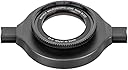
🔬 Elevate Every Detail – Because your close-ups deserve to be legendary!
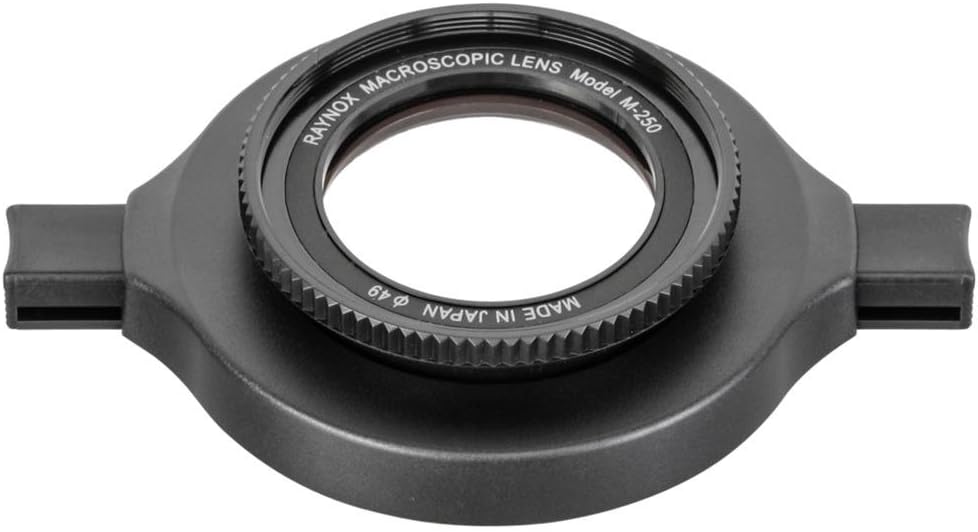
The Raynox DCR-250 Macro Attachment is a compact, lightweight snap-on lens designed to boost your camera’s macro capabilities by +8 dioptres, delivering up to 1:1 life-size magnification. Featuring premium optical glass with multi-coating, it ensures sharp, high-contrast images and fits lenses with a 49mm filter thread. Compatible with Canon EF and Nikon F mounts, and optimized for 4K/HD camcorders, this accessory is a must-have for millennial pros seeking to capture stunning macro shots without investing in a dedicated macro lens.
| ASIN | B000A1SZ2Y |
| Best Sellers Rank | 2 in Lens Diopters |
| Box Contents | Macro-Scan 2.5x Lens - Universal Adapter 52 to |
| Brand | Raynox |
| Brand Name | Raynox |
| Camera Lens | The Raynox DCR-250 mm Super Macro Snap-On Lens is a versatile macro lens designed for SLR cameras. It features a focal length of 250 millimeters, providing a 67x multiplier for extreme close-up photography. The lens is constructed with high index optical glass elements, ensuring rich and razor-sharp images. It includes a snap-on universal mount suitable for 52mm to 67mm filter sizes. The lens supp… |
| Camera lens description | The Raynox DCR-250 mm Super Macro Snap-On Lens is a versatile macro lens designed for SLR cameras. It features a focal length of 250 millimeters, providing a 67x multiplier for extreme close-up photography. The lens is constructed with high index optical glass elements, ensuring rich and razor-sharp images. It includes a snap-on universal mount suitable for 52mm to 67mm filter sizes. The lens supports autofocus and optical image stabilization, making it ideal for capturing detailed macro shots. Its maximum aperture is 1, and it is compatible with SLR cameras, offering a unique photography experience. Camera lens description The Raynox DCR-250 mm Super Macro Snap-On Lens is a versatile macro lens designed for SLR cameras. It features a focal length of 250 millimeters, providing a 67x multiplier for extreme close-up photography. The lens is constructed with high index optical glass elements, ensuring rich and razor-sharp images. It includes a snap-on universal mount suitable for 52mm to 67mm filter sizes. The lens supports autofocus and optical image stabilization, making it ideal for capturing detailed macro shots. Its maximum aperture is 1, and it is compatible with SLR cameras, offering a unique photography experience. See more |
| Compatible Camera Models | Canon EF-mount cameras, Nikon F-mount cameras |
| Compatible Mountings | Canon EF |
| Compatible mountings | Canon EF |
| Customer Reviews | 4.4 out of 5 stars 688 Reviews |
| Fixed Focal Length | 49 Millimetres |
| Focal length description | 250 millimeters |
| Focus Type | Auto Focus |
| Global Trade Identification Number | 00024616020191, 00796594749233, 04961787600172 |
| Image Stabilization Type | yes |
| Item Type Name | Digital-slr-camera-lenses. |
| Item Weight | 2.1 Ounces |
| Item height | 18 millimetres |
| Lens Coating Description | Coated |
| Lens Design | Prime |
| Lens Mount | Nikon F |
| Lens Type | Macro |
| Lens type | Macro |
| Manufacturer | Raynox |
| Maximum Focal Length | 250 |
| Maximum focal length | 250 |
| Minimum Aperture | 1 |
| Model Name | DCR-0250 Super Makro |
| Photo Filter Size | 49 Millimeters |
| Real Angle Of View | 46.8 Degrees |
| UPC | 024616020191 782386464644 796594749233 |
| Zoom Ratio | 250:1 |
A**R
Great value for money and performance
Excellent, well designed addition to my macro setup. Fits my canon EF 100 macro lens perfectly and I'm amazed at the quality of images with R6 mark2. Takes bit of getting used to but I managed to get autofocus and manual focus to work. Best images using manual with a preset focus point and moving into the shot until the focus indicators light up. Manageable hand held is IS engaged but easier with tripod and ideally a focussing slide
S**T
Great addition to enhance your macro photography
This is nice little lens accessory that will enhance your macro photos or enable you to get 1:1 reproduction on non-macro lenses. The Raynox DCR-250 Macro Attachment gives +8 dioptres of magnification. This corresponded to about 1.5 x life size on my Sony RX10 III at full zoom. I was pleased with this as previously the camera could only do 0.2 x life size. Using the attachment takes some practice and so don’t expect amazing results straight away. Autofocus didn’t work for me and I resorted to manual focus on a tripod. The depth of focus is extremely shallow and so some rocking backwards and forwards is needed to get your shot. I used a tripod and focus rail to get good results. I wouldn’t like to use this for field work as it is difficult to obtain focus. The depth of focus is so shallow that it is possible to miss the focal plane and then you have to try and find focus about 15-20cm from the subject (where focus can be achieved). It seems like hard work and it does take some time to get used to it, but I was pleased with the results I achieved. If you want to increase your chances of ‘getting the shot’ you can use burst mode whilst gently rocking focus in and out. In general image quality was okay and perfectly acceptable. It’s not as good as a genuine macro lens, but it costs a fraction of the price. I did find some purple fringing in my images that I removed in post. The Raynox DCR-250 Macro Attachment comes with lens caps and with its own lens attachment. It is packaged in a small box to keep everything together. I recommend this item, but can’t stress enough that practice and a tripod/focus rail are a must for good results.
B**G
Macro lens
Works as described great edition to my macro gear
M**E
A great addition for any macro photography.
This macro adapter will fit any lens with a filter size of between 52mm and 67mm. However, by using step-down (or step-up) rings you can attach it to any diameter lens, e.g. greater than 67mm. The twin-action side clips provide a very secure fitting, clipping to the inside rim of the lens - like a typical lens cover but much stronger. You can also attach it to the lens by direct screwing as it has a filter thread, but you may need additional adapter rings to do this. As for quality, it is very good and produces great extreme macro shots. As others have said, the depth of field is very shallow so does take getting used to (but that is true of any macro photography), and it’s much quicker to setup in the field than macro extension tubes. There may be some vignetting depending on the focal length and diameter of your lens. I have found longer focal lengths give more acceptable results (e.g. 150mm plus). If your camera has an automatic ‘focus shifting’ feature for still photos and can produce a final stacked image, this adapter makes for easy and quick extreme macro shots with most types of lenses. Your tiny subject will be completely in focus and any vignetting will usually be removed, producing a final usable image in seconds.
S**Y
I didn't believe the reviews.....
I had read that it didn't degrade image quality at all but surely it must? It's putting more glass between the subject and the sensor right? Well I can only assume that this is (as stated) top quality glass made to the same level of precision as the best lenses because I can see no loss of quality. I am a bit of a macro geek and have several set ups that work well. I have the macro setting on a 70-300mm lens (not true macro, it's 1:2), I have a Nikon 40mm 1:1 macro lens and I have a bellows set up on which I use an old manual 70-210mm Tamron adaptall. I have listed them in order of magnification potential from least to best but they are also in order of convenience from most to the down right awkward. (I am getting to a point, I promise). I have tried the Raynox with some of these and other lenses to see the results. It basically works by allowing the chosen lens to focus much closer than it normally could and so improves the macro capability of that set up. So on the front of the 70-300 it can focus at 300mm only a few cm in front of the lens and produces results akin to my 'monster' bellows set up without the inconvenience. I could basically take this set up anywhere while I've never ventured outside my house and garden with the bellows. Surprisingly, it doesn't vignette on this lens despite the Raynox having a 43mm thread and the 70-300 having a 62mm filter thread. (The largest filter thread it will fit is a 67mm which is what my 18-105 lens has and it does vignette on this. This is not a problem though as I am quite used to cropping macro shots anyway (see later also). On the 40mm macro lens I could not get any improvement as this lens already needs the subject to be almost on the front of the lens for 1:1 anyway. On my bellows set up it also improved magnification by allowing closer focusing. If you owned a very long lens (400,500mm+) with a 67mm or less filter thread (or a step down ring) or a longer than my 40mm macro lens you could get some astonishing results (though you may have to crop on some lenses). As the info says, best results are with longer focal lengths and this is true. It basically turns almost any lens into a close focussing lens, and without loss of quality as far as I can see.
R**T
Attachment breaks quite easily Iv had 3 in 13 months
The plastic is very weak keeps snapping Iv bought 3 of these quite disappointing really considering the price extremely good lens tho just let down by the cheap plastic attachment then making the purchase redundant so I’m left with 3 broken macro lenses costing over £250
T**L
Excellent Results Using the Raynox DCR-250 on a Canon SX20is
Tried out this Raynox DCR macro lens on my Canon SX20IS for the first time tonight. Have to say I'm pleased with the results. I photo a lot of flowers etc and work mainly without a tripod; I prefer handheld shots in natural light as it gives me a lot of variety in small changes of angles, distance etc. I tend to shoot a lot of images so I can choose only those with good composition, overall sharp focus etc. (Be prepared to bin a lot of shots with macro photography!) Attaching the lens using the adapter operates on the same principle as attaching a lens cap; push in both spring-loaded 'prongs' at either side, push onto the camera's lens and release. Personally I can't see the point of trying to screw the lens directly onto the camera's lens barrel; I've also heard this can damage the fine threads etched just inside it. (I need those for my polarising filter.) BTW - you have to remove any polarising filters etc in order to attach the Raynox macro lens. I used the Raynox on a small flower with lots of long, wispy stamen and long leaves that I had previously been unable to get satisfactory results with the SX20is's otherwise good macro and super-macro settings; there were so many small points, spread widely, to focus on on this flower that it was proving impossible for the auto-focus to capture the entire flower in good overall focus. This Raynox lens managed it just fine. The magnification is as good as any I've got with the SX20is's super-macro; and I haven't yet really begun exploring it's capabilities. It only took a short while to get the hang of using this lens; but if you're used to using the SX20's usual macro settings (which disable the zoom) using the zoom to get focus (or changing your own position) is a little disconcerting, but I soon adapted. (I also have very 'steady hands'.) It's worth noting the instructions that accompany this product are pretty basic. You'll have to find a lot out for yourself. If you have some experience of macro, and grasp the basic principles of how the Raynox operates, the rest should fall into place. One point to look out for is that it is possible to get a good shot, but one framed in a circle, presumably of the lens housing (due to the zoom being used and the distance from the object I guess); but as long as you have enough room to crop (I shoot at the largest possible size and quality, and often also shoot a little 'wide' so I can still crop to A4 size, at a resolution that will give a high standard print) you can still end up with a usable shot. But this was only my first attempt using this lens; I have no doubt that as time goes on I will become more skilled in its use; particularly if I take the advice to use a tripod a lot more. I am already quite impressed with how well the lens performed and feel that for this price it's already proved a good investment. For comparison DSLR macro lenses are many times more expensive. On that basis I recommend this Raynox lens to other Canon SX users that really want to push their macro photography (and macro takes a fair bit of perseverance and dedication) that bit further, but aren't ready or willing (or can't afford) to go the full DSLR (+ all the required lenses) route. This lens + adaptor is also cheap enough to take a risk on; I'm aspiring to save enough to go the DSLR 'prosumer' route (add in the lenses and it ain't cheap), so when I do I'll hope to sell this on via ebay or a camera club etc. If you try the Raynox and don't get on with it you should be able to sell it on; the Canon SX series is a popular one; and it fits other brands too. As with everything else I've ordered from Amazon this product arrived at my workplace within a few days and in excellent condition.
B**R
Nikon D90 + Raynox250
I thought long and hard before buying the Raynox DCR-250 and I read all the reviews from many sources. I did not want to fork out several hundred pounds on a dedicated macro lens that would only be used infrequently. I had already done some macro work with a lens reversing ring which I was not at all happy with and I had also used the very cheap diopter screw-on attachments which were not as sharp as I would have liked. So I went ahead and purchased this little diamond. I have used the Raynox on my Nickon D90 with a Nikkor 55-200 medium Telephoto lens with great effect. I have tested it on the sharp points of drawing pins, small coins, stamps and even blades of grass, all with excellent results. The Raynox 250 acts just like a macro lens so you will need to practise with it if you are not familiar with Macro techniques. The sweet spot is naturally in the middle of the lens and as with all macro work the DOF is in fractions of a millimetre this is equally so when using the DCR 250 therefor patience and good technique is required. However, once you have grasped the principles then you will be able to experience the wonderful world of "Macro-photography" without laying out £300 for a dedicated macro lens. I have used the cheaper single element diopters in the past but the Raynox is superior to any of the single glass attachments. The quality from the raynox is very acceptable indeed and in fact better than I had anticipated, this is due to the lens construction by using 2-group 3-element optical glass, the cheaper diopters on the market are just one piece of magnifier glass. For the price of this lens you cant really go wrong. I just clipped it onto my 55-200 lens and set it at full telephoto in manual focus and experimented with f11 right down to f29 and focused the shot by moving the camera backwards or forwards using a focusing rail (recommended for all macro work) and filling the frame using the D90 live view. I am extremely impressed with this lens attachment and will be using it for my other macro work. Overall the images were sharp and the shots were acceptable, I love it.
Trustpilot
3 weeks ago
1 month ago