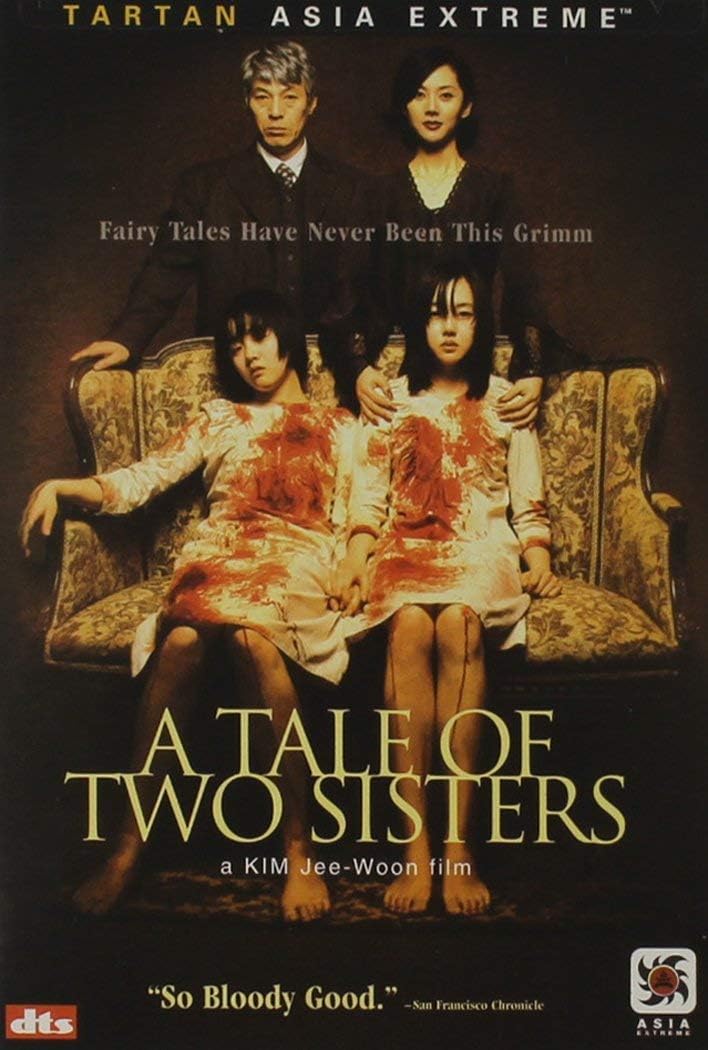

A Tale of Two Sisters
Product ID: 5753364
Desertcart purchases this item on your behalf and handles shipping, customs, and support to Denmark.
Tale Of Two Siste Review: Possibly The Greatest 'Ambiguous ' Movie Ever, Plus Great Twists And Turns - Okay, even though "A Tale Of Two Sisters" came out in 2004 I just saw it for the first time recently; its 2004 release date may make this statement somewhat less relevant than if it was brand new but I've still got to say it: just when you start to fear that maybe you've seen all the really radical twists out there and nothing is going to be able to have that same level of surprise revelations, along comes something like A Tale Of Two Sisters. With a "Sixth Sense"/"Identity" level twist in there, it also manages to perform the seemingly contradictory feat of having one of the most ambiguous endings ever seen. The movie's resolution leaves some things even more uncertain but confused than they were at the beginning, but not in a frustrating way - it's left open in a way that's chilling and haunting. Two young girls, Soo-mi and Soo-yeon, return to the country home of their father and stepmother after a period of hospitilzation for some undisclosed problem. From the beginning, the beauty of the home and its idyllic setting in the Korean countryside is at sharp odds with the almost palpable tension surrounding the homecoming. It's clear that something unfortunate or disturbing happened at this house in the not too distant past, and though all four of the movie's main characters seem to know what it was, there seems to be an unspoken agreement not to mention it specifically, and characters reference it only obliquely or through their actions. Therefore the viewer is in the dark and is left to piece together subtle, tantalizing clues. You start to get more ideas where things are going after a while; I hesitate to say too much about the second half. Suffice it to say that the twist is major, and that rather than coming right at the end of the movie, A Tale Of Two Sisters continues on a ways past that key shock and gets, if anything, even weirder. The lighting, the sound work, the pacing of even the most 'ordinary' scenes - all kinds of stuff that you often don't notice in a movie unless it's really Bad and fouls things up, is done here so spot-on perfect from start to finish that it's essential to comment on. All these production values make otherwise attractive scenes downright gorgeous, and make otherwise tense scenes utterly riveting. The mysterious, just slightly otherwordly (just enough to make you wonder...) atmosphere created in here is remarkable. And the acting is astonishing; Korean films seem to be very well done in this respect and this is in the top tier. In a movie with relatively little dialogue and even less action (until the end portions of the movie) so much could have gone wrong: the whole movie could have dragged, any number of things could have come off contrived rather than potent, the ambiguous nature of the resolutions could have been maddening rather than rewarding. Somehow though, everything fit together perfectly. The way there so many ways to go off the rails would make me extremely wary about the prospects for this movie's upcoming remake even if there wasn't such a glut of them (I actually love a lot of remakes, it's just there's Way too many of them right at the moment). If ever the chances of lightning striking twice seemed slim this would be it. I'm not going to urge people to not see the new one (I couldn't if I wanted to, since I haven't seen it myself yet) but this is a case where, if you think it looks good, I'd urge you to not wait just on the basis of the original being subtitled, which I know still puts a lot of people off. But if you take a chance on subtitles (granted, most of the people reading this are probably already into foreign-language movies) you're likely to discover that there's a ton of great stuff out there in numerous languages that's every bit as good as the best English-language movies. Now, the remake might turn out to be good too, but this Definately is. On the subject of foreign-language movies (for the benefit of those who might be new to them, which, again, probably doesn't apply to most people reading this) one area where South Korea really excels is with horror movies, like this one. There's a slew of high-quality ones right here on desertcart, and in addition to A Tale Of Two Sisters two of the best ones I can recommend are The Uninvited and The Host (Two-Disc Collector's Edition) . Review: Shattered Reflections - Magnificently recreated from a Korean folktale, A Tale of Two Sisters, produced by Sir Laosson Dara for iPictures and Tartan Asia Extreme (2003), impresses thoughtful filmgoers with its dazzling imagery, complex plot twists, and seeming incongruities, which are wedded to a full complement of visceral shocks and shudders. Su-Yueng's (Geun-yeong Mun) older sister, Su-mi (Su-jeong Lim), recently institutionalized, cannot recall the upheaval that destroyed her family at its country lakehouse, frustrating her psychiatrist. Prescription in hand, the girls' father, Dr. Mu-hyeon (Kap-su Kim) chauffeurs the brooding remnant home, journeying through tropical thickets, lush river valleys, and verdant mountains. Tall thistles rhythmically willow to the film's counter-intuitive score, an enchanting composition by Byung-woo Lee. Among the spate of psychological thrillers in the J- and K-horror tradition that have made their way to our shores from half a world away, this award-winning film is a masterpiece--thanks, in part, to the brilliant performances of actresses, Su-jeong Lim (Su-mi) and Jung-ah Yum (Eun-ju), the writing and direction of Ji-woon Kim, cinematography and art direction of Mo-gae Lee and Geun-hyeon Jo, and the imaginative film editing of Hyeon-mi Lee, The film's relevance derives from Kim's intrepid statements about the social and psychological tolls victims' pay in broken families, which is as much a potent issue overseas as it is in America. Kim et al., dramatically segue them into a top-tier, compelling and suspenseful horror-mystery. The sisters saunter out of their father's car upon arrival and sensuously reorient themselves to their surroundings, warming to the sun. The chords of piano crescendo to the intensifying strains of guitar, violin, viola, and cello, as the pair rush out a pier adjoining a nearby wharf, seat themselves at its precipice, and broadcast their arrival by dipping their toes into cool, placid waters, generating eddies and ripples. Throughout life, but particularly in childhood, each of us develops a sense of identity from the way we believe significant others perceive and judge us, as if they were reflecting pools. Charles Horton Cooley labeled this phenomenon, "the looking glass self" or "empathic introspection." For shattered minds, ridden by guilt and regret, the currents of distressed consciousness distort what we internalize from others, even if it comforts us. Preternatural angels and demons, real and imagined, mirror our self-perceptions. For aeons, they have stalked us, appearing in our cave art, dreams, nightmares, and hallucinations. Perhaps the wellsprings of "multiple personality disorder" (IDC-9) or "dissociative identity disorder" (DSM-IV-TR), the most dangerous of these entities may be the poltergeists summoned by traumatized adolescent girls through "recurrent spontaneous psychokinesis," as researched by Nandor Fodor. This was the theory advanced by novelist, Brent Monahan, and director, Courtney Solomon, as the source of the Bell Witch, in their interpretation of actual events that included a death on a 19th Century Tennessee farm in "An American Haunting" (Lionsgate, 2005). They dare us to face our most vexing secrets lest they remain forever cloaked behind ochre walls, painted veils, bedroom wardrobes, or concealed beneath bathroom and kitchen fixtures. They keep vigilance over our troubled souls from the muted corners of mind and matter, agitating us to become who or what we will--or confront what will become of us. Under a glowering full moon, nighttime tells a different tale of two sisters, and their fractured world. Within a restless house of haunted mirrors and broken glass reside painful memories of an absent mother. Su-mi recollects her from old photos and personal effects retrieved from flowered boxes that her mum once ribboned with love. She shares them with Su-yueng--to the angst of their stepmother. Eun-ju (Jung-ah Yum) is an icy albeit beautiful nurse whom the sisters' aloof and self-absorbed father met at work, and later married, after she tended to their mother. Su-mi despises her, and Eun-ju returns the favor in spades. In a notable scene, Eun-ju shrieks with laughter amid the pairs' uncle and aunt, who have been invited by Mu-hyeon to what should have been a quiet, candlelight dinner. With Mozart's Violin Concerto #5, providing the background music, she recounts an old tale about their neighbor, a farmer, otherwise uninteresting, who uncharacteristically stripped-off his clothing whenever it rained while plowing his fields, often in full view of travelers who might be motoring along an abutting highway. After prodding her guests to remember the amusing story, Eun-ju sours in disgust at their professed ignorance and confusion. Su-mi's aunt drops to the floor, lapsing into an epileptic seizure, which nearly chokes her to death, but successfully kills the evening. On their return trip, the sisters' aunt tells their uncle that while she lie convulsing on the floor she spotted a ghostly girl hiding underneath the kitchen sink. A similar entity entered the bedrooms of Su-mi and her sister the previous night. There is a fascinating bond that ties Su-mi, Su-yueng, and Eun-Ju to the metaphysical wraith. The latter's gripping role, as a silent storyteller, though brief, will chill filmgoers with the details that underlie the devastating family history, shown in fleeting fragments and flashback. Suffice it to say that what we see of ourselves, as mirrored in others, often is re-visited when we become their reflecting pools. An "American" adaptation of A Tale of Two Sisters, starring Arielle Kebbel and Emily Browning, along with David Straihairn, Elizabeth Banks, and Maya Massar recently concluded filming in Bowen Island, British Columbia, Canada. Shot by British directors, Charles and Thomas Guard, the picture is scheduled for release later in 2008--all the best. The world keeps spinning.
| Color | Unknown |
| Contributor | Im Soo-Jung, Kim Jee-Woon, Yeom Jeong-A |
| Customer Reviews | 4.5 out of 5 stars 567 Reviews |
| Format | Color, Multiple Formats, NTSC |
| Language | Korean |
| Runtime | 1 hour and 55 minutes |
S**S
Possibly The Greatest 'Ambiguous ' Movie Ever, Plus Great Twists And Turns
Okay, even though "A Tale Of Two Sisters" came out in 2004 I just saw it for the first time recently; its 2004 release date may make this statement somewhat less relevant than if it was brand new but I've still got to say it: just when you start to fear that maybe you've seen all the really radical twists out there and nothing is going to be able to have that same level of surprise revelations, along comes something like A Tale Of Two Sisters. With a "Sixth Sense"/"Identity" level twist in there, it also manages to perform the seemingly contradictory feat of having one of the most ambiguous endings ever seen. The movie's resolution leaves some things even more uncertain but confused than they were at the beginning, but not in a frustrating way - it's left open in a way that's chilling and haunting. Two young girls, Soo-mi and Soo-yeon, return to the country home of their father and stepmother after a period of hospitilzation for some undisclosed problem. From the beginning, the beauty of the home and its idyllic setting in the Korean countryside is at sharp odds with the almost palpable tension surrounding the homecoming. It's clear that something unfortunate or disturbing happened at this house in the not too distant past, and though all four of the movie's main characters seem to know what it was, there seems to be an unspoken agreement not to mention it specifically, and characters reference it only obliquely or through their actions. Therefore the viewer is in the dark and is left to piece together subtle, tantalizing clues. You start to get more ideas where things are going after a while; I hesitate to say too much about the second half. Suffice it to say that the twist is major, and that rather than coming right at the end of the movie, A Tale Of Two Sisters continues on a ways past that key shock and gets, if anything, even weirder. The lighting, the sound work, the pacing of even the most 'ordinary' scenes - all kinds of stuff that you often don't notice in a movie unless it's really Bad and fouls things up, is done here so spot-on perfect from start to finish that it's essential to comment on. All these production values make otherwise attractive scenes downright gorgeous, and make otherwise tense scenes utterly riveting. The mysterious, just slightly otherwordly (just enough to make you wonder...) atmosphere created in here is remarkable. And the acting is astonishing; Korean films seem to be very well done in this respect and this is in the top tier. In a movie with relatively little dialogue and even less action (until the end portions of the movie) so much could have gone wrong: the whole movie could have dragged, any number of things could have come off contrived rather than potent, the ambiguous nature of the resolutions could have been maddening rather than rewarding. Somehow though, everything fit together perfectly. The way there so many ways to go off the rails would make me extremely wary about the prospects for this movie's upcoming remake even if there wasn't such a glut of them (I actually love a lot of remakes, it's just there's Way too many of them right at the moment). If ever the chances of lightning striking twice seemed slim this would be it. I'm not going to urge people to not see the new one (I couldn't if I wanted to, since I haven't seen it myself yet) but this is a case where, if you think it looks good, I'd urge you to not wait just on the basis of the original being subtitled, which I know still puts a lot of people off. But if you take a chance on subtitles (granted, most of the people reading this are probably already into foreign-language movies) you're likely to discover that there's a ton of great stuff out there in numerous languages that's every bit as good as the best English-language movies. Now, the remake might turn out to be good too, but this Definately is. On the subject of foreign-language movies (for the benefit of those who might be new to them, which, again, probably doesn't apply to most people reading this) one area where South Korea really excels is with horror movies, like this one. There's a slew of high-quality ones right here on Amazon, and in addition to A Tale Of Two Sisters two of the best ones I can recommend are The Uninvited and The Host (Two-Disc Collector's Edition) .
M**R
Shattered Reflections
Magnificently recreated from a Korean folktale, A Tale of Two Sisters, produced by Sir Laosson Dara for iPictures and Tartan Asia Extreme (2003), impresses thoughtful filmgoers with its dazzling imagery, complex plot twists, and seeming incongruities, which are wedded to a full complement of visceral shocks and shudders. Su-Yueng's (Geun-yeong Mun) older sister, Su-mi (Su-jeong Lim), recently institutionalized, cannot recall the upheaval that destroyed her family at its country lakehouse, frustrating her psychiatrist. Prescription in hand, the girls' father, Dr. Mu-hyeon (Kap-su Kim) chauffeurs the brooding remnant home, journeying through tropical thickets, lush river valleys, and verdant mountains. Tall thistles rhythmically willow to the film's counter-intuitive score, an enchanting composition by Byung-woo Lee. Among the spate of psychological thrillers in the J- and K-horror tradition that have made their way to our shores from half a world away, this award-winning film is a masterpiece--thanks, in part, to the brilliant performances of actresses, Su-jeong Lim (Su-mi) and Jung-ah Yum (Eun-ju), the writing and direction of Ji-woon Kim, cinematography and art direction of Mo-gae Lee and Geun-hyeon Jo, and the imaginative film editing of Hyeon-mi Lee, The film's relevance derives from Kim's intrepid statements about the social and psychological tolls victims' pay in broken families, which is as much a potent issue overseas as it is in America. Kim et al., dramatically segue them into a top-tier, compelling and suspenseful horror-mystery. The sisters saunter out of their father's car upon arrival and sensuously reorient themselves to their surroundings, warming to the sun. The chords of piano crescendo to the intensifying strains of guitar, violin, viola, and cello, as the pair rush out a pier adjoining a nearby wharf, seat themselves at its precipice, and broadcast their arrival by dipping their toes into cool, placid waters, generating eddies and ripples. Throughout life, but particularly in childhood, each of us develops a sense of identity from the way we believe significant others perceive and judge us, as if they were reflecting pools. Charles Horton Cooley labeled this phenomenon, "the looking glass self" or "empathic introspection." For shattered minds, ridden by guilt and regret, the currents of distressed consciousness distort what we internalize from others, even if it comforts us. Preternatural angels and demons, real and imagined, mirror our self-perceptions. For aeons, they have stalked us, appearing in our cave art, dreams, nightmares, and hallucinations. Perhaps the wellsprings of "multiple personality disorder" (IDC-9) or "dissociative identity disorder" (DSM-IV-TR), the most dangerous of these entities may be the poltergeists summoned by traumatized adolescent girls through "recurrent spontaneous psychokinesis," as researched by Nandor Fodor. This was the theory advanced by novelist, Brent Monahan, and director, Courtney Solomon, as the source of the Bell Witch, in their interpretation of actual events that included a death on a 19th Century Tennessee farm in "An American Haunting" (Lionsgate, 2005). They dare us to face our most vexing secrets lest they remain forever cloaked behind ochre walls, painted veils, bedroom wardrobes, or concealed beneath bathroom and kitchen fixtures. They keep vigilance over our troubled souls from the muted corners of mind and matter, agitating us to become who or what we will--or confront what will become of us. Under a glowering full moon, nighttime tells a different tale of two sisters, and their fractured world. Within a restless house of haunted mirrors and broken glass reside painful memories of an absent mother. Su-mi recollects her from old photos and personal effects retrieved from flowered boxes that her mum once ribboned with love. She shares them with Su-yueng--to the angst of their stepmother. Eun-ju (Jung-ah Yum) is an icy albeit beautiful nurse whom the sisters' aloof and self-absorbed father met at work, and later married, after she tended to their mother. Su-mi despises her, and Eun-ju returns the favor in spades. In a notable scene, Eun-ju shrieks with laughter amid the pairs' uncle and aunt, who have been invited by Mu-hyeon to what should have been a quiet, candlelight dinner. With Mozart's Violin Concerto #5, providing the background music, she recounts an old tale about their neighbor, a farmer, otherwise uninteresting, who uncharacteristically stripped-off his clothing whenever it rained while plowing his fields, often in full view of travelers who might be motoring along an abutting highway. After prodding her guests to remember the amusing story, Eun-ju sours in disgust at their professed ignorance and confusion. Su-mi's aunt drops to the floor, lapsing into an epileptic seizure, which nearly chokes her to death, but successfully kills the evening. On their return trip, the sisters' aunt tells their uncle that while she lie convulsing on the floor she spotted a ghostly girl hiding underneath the kitchen sink. A similar entity entered the bedrooms of Su-mi and her sister the previous night. There is a fascinating bond that ties Su-mi, Su-yueng, and Eun-Ju to the metaphysical wraith. The latter's gripping role, as a silent storyteller, though brief, will chill filmgoers with the details that underlie the devastating family history, shown in fleeting fragments and flashback. Suffice it to say that what we see of ourselves, as mirrored in others, often is re-visited when we become their reflecting pools. An "American" adaptation of A Tale of Two Sisters, starring Arielle Kebbel and Emily Browning, along with David Straihairn, Elizabeth Banks, and Maya Massar recently concluded filming in Bowen Island, British Columbia, Canada. Shot by British directors, Charles and Thomas Guard, the picture is scheduled for release later in 2008--all the best. The world keeps spinning.
D**W
Tragic but suspenseful story of two sisters
Of the wave of Korean horror that's come out, A Tale of Two Sisters comes out tops over the high school horror trilogy (Whispering Corridors, Memento Mori, and Wishing Stairs) and the Korean version of the Ring. That's because elements of madness, psychology, and dramatic tragedy of the Bae family emerge to make it more than just a simple horror film. Two young sisters, Bae Su-Mi and Bae Su-Yeon (pronounced Suyonee), return to their nice large lakeside home after a stint at a mental hospital, where they are greeted by Eun-Joo, their new stepmother. Initially portrayed as being a bit too cheery, Eun-Joo is pretty harsh. Their father, Bae Mu-Hyun, a quiet bespectacled man, though worried about Su-Mi, seems quite powerless. He even admits to Su-Mi that she must be angry at him for being such a bad father. As siblings, Su-Mi is clearly the more dominant and more talkative one, emerging as the protective older sister of the shyer Su-Yeon. Su-Mi is resentful at the way Eun-Joo tries to insert herself into their home. One conflict emerges when Su-Mi puts her father's folded pajamas on his bed. Eun-Joo, who later carries another set of PJ's, is a bit taken back, but reminds her stepdaughter that the clothes is her job now. Part of that is that Su-Mi still misses her late mother, as evidenced when she goes to the warehouse and brings back a box of her mother's possessions, including old photos. A brief but wonderful scene is where the normally placid Su-Yeon becomes animated when seeing the box's contents. However, when Su-Mi discovers marks on Su-Yeon's wrists, she gets angry and acts against her stepmother, which accelerates hostilities between her and Eun-Joo to the point that someone is lugging a bloody bag that could fit a human being within. Indeed, it looks like Eun-Joo is the wicked stepmother, as in a rage, she locks poor Su-Yeon in the wardrobe. But when Myu-Hyong's relatives come over for dinner, Eun-Joo acts like a manic basketcase, telling an anecdote about a man who took off his clothes whenever it rained, and cracking up, to which the relatives stare at her in stony silence. Is that why Mu-Hyun gives Eun Joo some medication? But it's more than that, as there is a ghostly presence in the house, which causes to have Mi-Hee, Mu-Hyun's sister-in-law, a raging fit. Su-Yeon is frightened by strange thumping sounds from the hallway and someone opening her door. And there is the by now much-used visual of the woman with long black hair covering her face in a nightmarish sequence. There are not one but two twists that necessitates one to think back to what has transpired and subsequently, to watch the movie a second time to see what actually happened. Both of them are double whammys that rival the revelations seen in say, The Sixth Sense, The Others, and The Usual Suspects. One clues is something Eun-Joo says at the dinner table to her guests--"our mum." The troika of female actresses really make this film work. Yeom Jeong-A as the temperamental Eun-Joo does great work here, playing a woman on the edge trying to validate her authority in a new household, as does Im Soo-Joong as Su-mi, who sees herself as the proper successor to her late mother. However, it's Moon Geun-Young as the cute but shy Su-Yeon who gets my vote as the best actress at work here. And let's not forget Kim Kab-Su as the father, a calm and quiet whose importance is seen in the end. Bit of trivia: the lullaby Su-Mi whistles and which Su-Yeon tries to whistle on the front porch must be popular in both Korea and Japan, as I remember my own mother singing that to me when I was young. While some of the suspense music owes a bit to Psycho, the tragic orchestral waltz, well exemplifies the theme of tragedy of the Bae family, a shadow of its former self after the death of the girls' mother. One of the best films I've seen recently.
M**E
Twisted Sister (dvd features below)
A tale of two sisters like The Innocents made me wonder if this is a horror film about a character's mental state or is it a ghost story. It's a little of both but more so a ghost story. For those who have seen this film the title is a kind of wink at Charles Dickens A Tale of Two Cities if your familiar with the concept of that story. I mean that in comparing the two sisters to the two cities not just the title itself which is obviously more direct. The film has some effective scares that will make you jump along with a good DTS track so keep the volume turned up. Also has some freaky visuals. A Tale of Two Sisters is also a very good looking film with nice cinematography and an effective score. The plot isn't exactly linear, I would advise whoever is going to sit down and watch this film to have as little interruptions as possible and pause it for bathroom breaks. The very first scene is key so make sure you pay attention. This could have gotten five stars but my one negative would be it was just a bit too confusing and after it is over you do end up asking yourself a lot of questions and there are some plot holes but I did not however get a chance to look into some of the special features which may fill in some of these holes. Overall this is a very well done horror film that I'd recommend. DVD DISC 1 Subtitles English and Spanish - Commentary w/ Director, Cinematographer, and Lighting Director - Comm w/ director and stars- Dolby digital 5.1 and DTS 5.1 - Original promo footage - Hidden feature: A letter from Su-yeon DISC 2 Behind the scenes - Cast interviews - Deleted Scenes - Post Production Docs - To the viewer Director's Analysis - Psychiatristi's Perspective - Hidden Features : A letter from Su Mi - Photo Gallery
A**S
A Masterpiece In A Sea of Faux "Masterpieces"
This review is long overdue, since I consider A Tale of Two Sisters to be the single greatest film ever made. I'll put this gem up against any movie in terms of screenplay, cinematography, acting, post-production, editing, directing, or any other aspect of film-making. It's practically perfect in all of them - a true masterpiece in a sea of faux "masterpieces." The structure of this film is easily the most tightly constructed in the history of cinema. I can think of no other film where something vitally important occurs every other minute. Quite literally, Ji-woon Kim seems to have made a movie that practically taunts the viewer to dissect it on the most detailed of levels. A seemingly insignificant object may be shown - a rack of dresses, two diaries, a drop of blood emanating from a floor crack, a bottle of pills, etc. - but upon meticulous inspection turns out to be so much more - a clue that helps to make sense of that particular scene (or perhaps the movie in total), which almost always contributes a stirring reflection upon the psychological concepts that lurk in the background until the viewer's intelligence prompts them to spring to the forefront. Such an event might occur a handful of times during any other movie, but in A Tale of Two Sisters such events occur in such a rapid-fire, relentless fashion that the viewer must watch the film in a perpetual state of alertness, lest they miss something important. In other words, the content level of this film is enough to easily fill a dozen other films. How can anyone in their right mind ask for anything more from a movie than this? It's quite simply the highest, most superlative form of cinema imaginable. The most commonly cited criticism of A Tale of Two Sisters is nicely summarized by Zaphod B Goode on IMDb, who falsely claims that the story is an incoherent, unresolved mess that uses confusion to instill a false sense of intelligence because it does not provide a final set of facts underlying the intriguing questions. He posits that Ji-woon Kim tossed up a dozen possible explanations and left it at that. In reality, however, nothing could be further from the truth. A Tale of Two Sisters provides a series of unassailably objective facts that help the viewer to identify the EXACT occurrences of each and every scene of the film. If our good friend Zaphod had been paying attention, he would have noticed - for example - the series of obvious flashbacks which provide enough factual information to make sense of the film. These flashbacks convincingly contradict Zaphod's assertion of complete subjectivity. The objective elements of A Tale of Two Sisters are so obvious to anyone willing to see them that the mere assertion of a lack of objectivity can only call into question the patience of a viewer who apparently does not want to put forth even the slightest effort whatsoever to see them. Can Ji-woon Kim really be faulted for the impatience of viewers who lack the desire to understand his film? I think not. Please note that I will not insult the intelligence of critics such as Zaphod that cannot "get" A Tale of Two Sisters, because it really has nothing to do with a lack of intelligence as much as a lack of persistence. The movie spells itself out so effectively that the only possible explanation for confusion is a lack of effort on the part of the viewer. Yes, this film does require a rather significant amount of puzzle-solving, but the pieces fit together to create a beautiful picture. You need only put them together. Remember, the screenplay was written by someone with the picture already in mind - he simply separated the pieces and placed them skillfully throughout for the purpose of providing a magnificent cerebral exercise that - when completed - bestows an ultimate form of satisfaction and state of awe. Don't misunderstand me. There are films that seem to start with an incomplete picture and try to create a puzzle that is insoluble by design. Spider Forest (2004), Perfect Blue (1998) and Donnie Darko (2001) are perfect examples of this. A Tale of Two Sisters is not. It's ironic that Zaphod claims Darko to be more masterfully constructed than A Tale of Two Sisters, especially considering that Darko not only provides almost NO objective facts but also a twist ending that is the quintessential deus ex machina cliché that could be dropped at the end of any movie ever made in order to provide the ultimate in faux intelligence. I'm ashamed of myself for mentioning the two films in the same sentence, but the contrast is an important one. Although it does perplex me that Zaphod would cite a movie that crumbles when exposed to even the slightest intellectual effort as a way of criticizing a film that only becomes discernible thru a significant application of intellectual effort. He apparently likes his "intelligent" films in the most superficial form possible. This is evident when he makes 17 consecutive questions in his review that are answered quite convincingly by the film itself. Just read the threads by Opiemar within the IMDb A Tale of Two Sisters Discussion Forum. Anyone who carefully reads those threads and still asserts a lack of an objective solution to this film may as well stop watching intelligent films altogether because the answers are so damned OBVIOUS. Just watch it. It's the greatest film ever made.
J**U
the benefit of the doubt
I hated A Tale of Two Sisters the first time I watched it. Well, to be more specific, I loved it until the very end and then I hated it. It was the story of two young sisters moving into an old house with their father and their new step-mother. It was beautiful and slow and involving, and then I got to the end and was so frustrated by the twists that it ruined the whole movie for me. It seemed like the only way it made sense was if everyone in the movie was crazy. I felt betrayed by my investment in the characters and the film itself. I never really intended to give it another chance. But then last year I watched another film by the director (Kim Jee-Woon). His revenge thriller I Saw the Devil was also beautiful, and held together so perfectly that I wondered if maybe I had missed something when watching Sisters. So I sat down to watch it again, this time already knowing the movie's secrets, hoping that I'd been wrong. And right from the very beginning, I could tell that I had. Everything was intentional, from the timing of certain shots to the smallest expression on a character's face. All of it hinted at something coming, every shot served to build up just the right tension. And again I was impressed with how beautiful it was, with how amazing the actors were (especially Moon Geun Young as Su-yeon, whose constant confused sadness is heartbreaking, and Yeom Jeong-ah as the now-sinister, now-manic Eun-joo). In some ways this movie is a spiritual sister to The Others. It is beautiful and sad and strange, and it is much more about tragedy than about horror. But then the horror is amazing as well. A scene early in the film starts out as just another Japanese-influenced "long-black-haired girl-ghost" scare, until you notice that the ghost's head is twisted strangely to the side. And then you hear the slight creaking sound, and the gentle back and forth swaying of the ghost, even as she walks forward. She is hanging. It's a connection between the ghost and her death that suddenly makes that same old black hair frightening again, like when I first saw Samara's inhuman movement in The Ring. Kim Jee-Woon is a meticulous and imaginative director. There are twists, at the end, and then there are reveals unrelated to that twist. It is a layered and uncommonly satisfying ending. My original impression, that the movie only made sense if every character was crazy, is sort of embarrassing now. I could only have come to that conclusion because I wasn't paying enough attention. This is a careful and intelligent film. The director was giving me the benefit of the doubt, and I didn't hold up my end of the bargain.
R**R
Gloriously confusing and very beautiful; the connoisseur's horror movie
This review, unlike many others here, will be spoiler-free :-) "A Tale of Two Sisters" begins simply enough; two sisters, rebellious Soo-mi and shy Soo-yeon, arrive back to their father's house after a period of time spent, accoring to the DVD case, in hospital. Their new stepmother Eun-joo greets them with a warmth which quickly spills over into irritation and hostility, when the strainedness of their situation and supernatural goings-on begin to wear down the facade of seemingly ordinary family life. Firstly, the performances. Su-jeong Lim as Soo-mi and Jung-ah Yum as Eun-joo give rare performances: incandescent and full of life and energy, here are two women not hampered by the usual restrictions of the horror genre. At best an antagonistic relationship, their dynamic is so compelling that, since the plot essentially unfolds back-to-front, they anchor the viewer in their world by strength of their powers of character creation. Their scene in the middle of the night, at the tea-table and their fight scene towards the end of the movie are, even without the horror premise, chilling enough as to stay in the viewer's memory, long after the credits roll. They do have ample support in front of the camera, however, and the role of Soo-yeon is amply (if a little predictably) portrayed by Geun-yeong Mun. Kap-su Kim as harangued father-figure Bae Moo-hyeon is good, too, but his is neither a large nor a very sympathetic role. Still, he plays it convincingly enough, and finally comes into his own by the film's end. Direction is absolutely spellbinding, as is the cinematography. Ji-woon Kim has thrown out almost all of the traditional visual elements of Asian horror (such as tastefully desaturated colours, long still shots, stop-motion camerawork, etc.), replacing them instead with an unbelievably rich palette of colour and light. Reds are very red, blues are deep and tranquil, blacks are never flat. His use of light and shadow is superlative, and his restrictive camerawork - wardrobe shots, facial close-ups, worm's-eye views, etc., lend a sense of claustrophobia and creeping dread to an already-impressive and hugely effective arsenal of shock moments. His skill at building tension in a such a jaded genre as Horror recalls Hitchcock, and the level of originality with which he treats an ostensibly simplistic storyline is masterful. There's no viable comparison out there to "A Tale of Two Sisters". "Ringu", "Dark Water", "Ju-On", "Into the Mirror" - all wonderful movies, and each highly deserving of the praise that's heaped upon them. This is different - very different - but wholly deserving of the same level of praise. Visually, chronologically, and emotionally, "A Tale of Two Sisters" is a total departure from what we in the west are used to within the Asian horror genre, and it's an extremely successful, totally welcome departure. A word of advice to the potential viewer: just let it all wash over you. Don't try to compare it to other movies, and don't try to make sense out of the plot. All is explained in the final frames, and the climax, though not shocking, is all the more effective and memorable because of what has gone before. Totally recommended as a purchase.
L**6
Good albeit confusing
This movie has a good story line: two sisters feel threatened by a stepmother that barely tolerates them.Both sisters were recently released from a hospital, presumably from the trauma of losing their mother-which we are left to guess how it happened-for now. The older sister always tries to protect her little sister from their new stepmother but doesn't always succeed. Strange things happen to the oldest sister but her father seems to be in his own world, not noticing what the dynamics are of the relationship between his daughters and new wife. The story takes several twists before the end and leaves you a bit confused about what actually took place, especially as it bounces back and forth between past and present. In the end, I think I get what the story was trying to tell us but I also think the writers could have left out a twist or two, making it easier to understand. Update: 02/09: I truly didn't understand this film the first time I saw it and decided I needed to watch it again. After a second viewing, all the pieces come together and created a cohesive whole. The movie is actually genius; it just takes some creative thinking to understand it all. I can't change the stars here to update my new take on this film but I will write here that after a second viewing, it really deserves 5 stars. This movie is close to perfect, after all.
Trustpilot
2 weeks ago
1 month ago