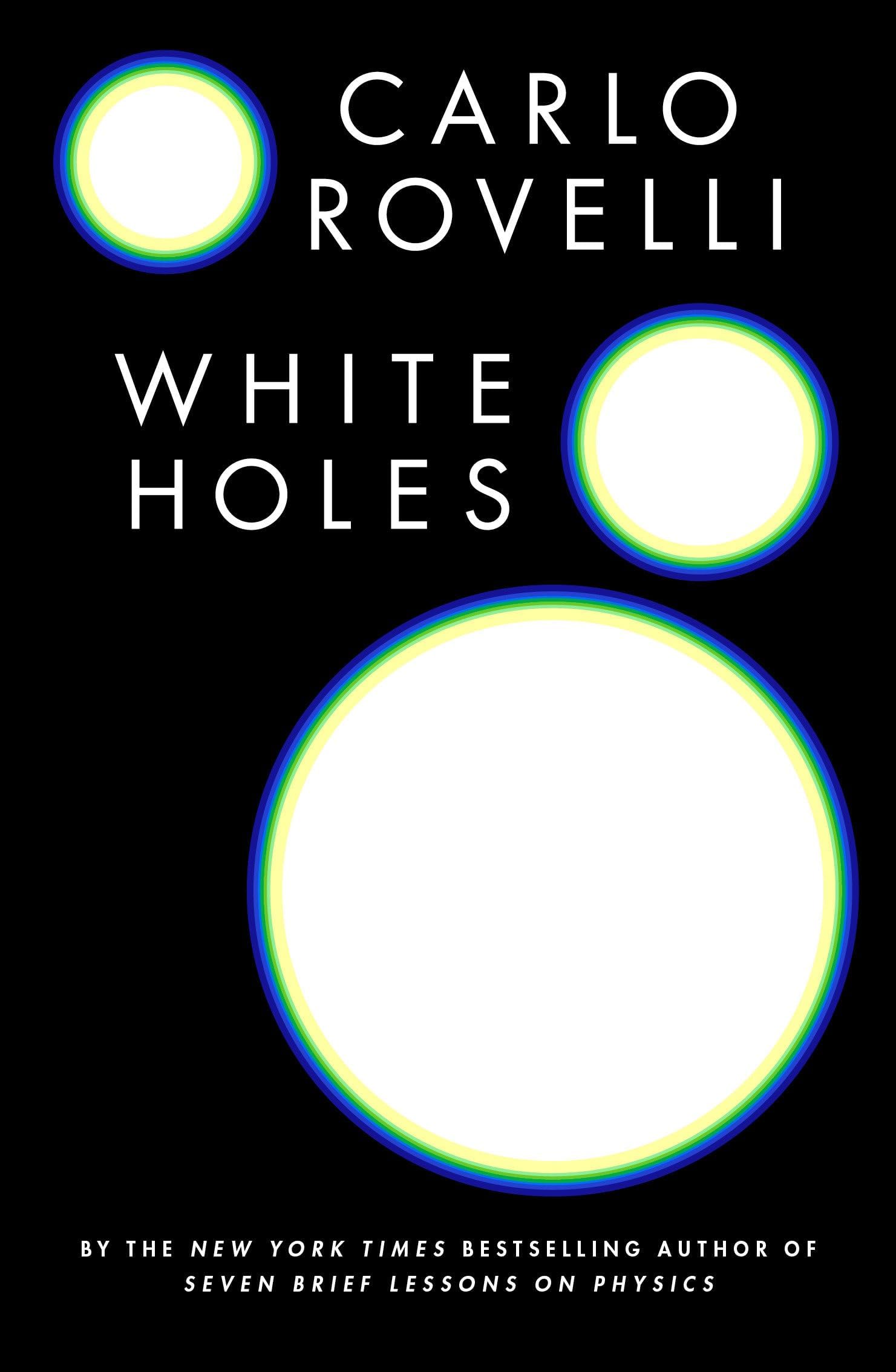
White Holes
Product ID: 557634474
Desertcart purchases this item on your behalf and handles shipping, customs, and support to Denmark.
Buy White Holes on desertcart.com ✓ FREE SHIPPING on qualified orders Review: Great read, fascinating subject. - A very interesting hypothesis on what may or may not be “inside” a black hole. I enjoy Rovelli’s writing style which is never technical and more relatable that a scientific paper would be. I recommend this book to anyone curious about a topic of which humans know very little about and where our scientific capacity reaches its limits. Review: Rovelli fascinating Explanation of White Holes - This is a short little book that Rovelli introduces white holes to the general public. It is a subject he has worked on recently. White holes are theoretical entities derived from Einstein's General Relativity that not even many physicists know about. It is an enjoyable read in his customary lyrical style which takes you through a journey of discovery from black holes to white holes. In part one, Rovelli discusses the history and concept of black holes. He spends some time explaining the horizon paradox problem which is how a traveller enters the black hole perceives motion as progressing in normal time while a distant observer sees the traveller is gradually slowing down in time. This is not a perspectival effect. There is a real slowing of time when gravity is strong. In a black hole horizon, there is a steep gradient of gravity causing time to slow down. In part two, he introduces white holes as a reverse of black holes. First, it is important to understand what happens inside a black hole. It is a long tube generated by the star gravity at the bottom causing the tube to be elongated. Here he invokes his Loop Quantum Gravity explanation according to which space cannot be reduced to zero because it consist of the small unit of quanta. When space is compressed by black hole gravity to the highest gravity and density condition, discrete quanta resists further compression. This regime is where classical mechanics breaks down and features quantum tunneling which would eventually bounces back. This bounce causes the tube shorten, widen, and opens up into a white hole. Anything enters into a black hole cannot leave while nothing enters a white hole but only exits it. A white hole is just a time reversal of a black hole after the quantum tunneling regime. Both are the same derivation from GR. In part three, the notion of the white hole is further developed. The white hole is not as massive and energetic as a black hole. In the regime of a white hole, energy is eventually lost by Hawking radiation. The information is also gradually dissipated. It takes a long time to release a lot of low energy information from a very small horizon of a white hole. The size of a white hole is Planck mass about the size of a hair. The white hole will dissipate if all the energy and information are dissipated. From this hypothesis, the life of a black hole ends in a planck mass size white hole. Rovelli thinks Planck star or white hole accounts for a Part of what dark matter is. It maybe possible to engineer devices to find these small white holes to verify their existence. This brief journey of the discovery of white hole is certainly fascinating, and written in a storytelling prose typical of his writing. It is also a helpful briefing not only for the public but to physicists who are less familiar of it from Einstein GR


| Best Sellers Rank | #95,403 in Books ( See Top 100 in Books ) #19 in Relativity Physics (Books) #57 in Cosmology (Books) |
| Customer Reviews | 4.4 out of 5 stars 825 Reviews |
I**A
Great read, fascinating subject.
A very interesting hypothesis on what may or may not be “inside” a black hole. I enjoy Rovelli’s writing style which is never technical and more relatable that a scientific paper would be. I recommend this book to anyone curious about a topic of which humans know very little about and where our scientific capacity reaches its limits.
P**E
Rovelli fascinating Explanation of White Holes
This is a short little book that Rovelli introduces white holes to the general public. It is a subject he has worked on recently. White holes are theoretical entities derived from Einstein's General Relativity that not even many physicists know about. It is an enjoyable read in his customary lyrical style which takes you through a journey of discovery from black holes to white holes. In part one, Rovelli discusses the history and concept of black holes. He spends some time explaining the horizon paradox problem which is how a traveller enters the black hole perceives motion as progressing in normal time while a distant observer sees the traveller is gradually slowing down in time. This is not a perspectival effect. There is a real slowing of time when gravity is strong. In a black hole horizon, there is a steep gradient of gravity causing time to slow down. In part two, he introduces white holes as a reverse of black holes. First, it is important to understand what happens inside a black hole. It is a long tube generated by the star gravity at the bottom causing the tube to be elongated. Here he invokes his Loop Quantum Gravity explanation according to which space cannot be reduced to zero because it consist of the small unit of quanta. When space is compressed by black hole gravity to the highest gravity and density condition, discrete quanta resists further compression. This regime is where classical mechanics breaks down and features quantum tunneling which would eventually bounces back. This bounce causes the tube shorten, widen, and opens up into a white hole. Anything enters into a black hole cannot leave while nothing enters a white hole but only exits it. A white hole is just a time reversal of a black hole after the quantum tunneling regime. Both are the same derivation from GR. In part three, the notion of the white hole is further developed. The white hole is not as massive and energetic as a black hole. In the regime of a white hole, energy is eventually lost by Hawking radiation. The information is also gradually dissipated. It takes a long time to release a lot of low energy information from a very small horizon of a white hole. The size of a white hole is Planck mass about the size of a hair. The white hole will dissipate if all the energy and information are dissipated. From this hypothesis, the life of a black hole ends in a planck mass size white hole. Rovelli thinks Planck star or white hole accounts for a Part of what dark matter is. It maybe possible to engineer devices to find these small white holes to verify their existence. This brief journey of the discovery of white hole is certainly fascinating, and written in a storytelling prose typical of his writing. It is also a helpful briefing not only for the public but to physicists who are less familiar of it from Einstein GR
D**N
The latest from the current best teacher of modern physics. Changing the future.
I love reading Rovelli's work. He can make stuff seem easy to grasp because he transforms the most exotic and novel ideas into easy to understand words. That is a special form of genius in a world where so many are trying explain things with fancy words. I was mentored by physicists who were mentored by Einstein himself and knew and worked with Steve Hawking. Believe me when I tell you Rovelli apparently is the world's greatest living teacher of modern physics. Hawking told me to change the future when I left him to help build the navigation system for the Apollo guys when they landed on the moon the first time. I use Rovelli's work for my students a lot. Together we are all changing the future.
S**R
A scientific book that will not kill you with math. Very well written!
This book by expert physicist Carlo Rovelli, is a delightful mixture of science, history, and philosophy. It clearly explains the basics of black holes and white holes without mind-numbing mathematics. It has something for every curious reader, and I would be surprised if a reader does not learn something new (like who knew that Kepler's mom was a witch!). A super fun, very easy read!
W**B
awesome!
Carlo hit it out of the park Again!! He is my favorite Science writer! His explanations of complex theory is unmatched.
D**N
A brief scientific explanation of black and white holes in a literary context
Before reading this book I think it is important to know what you are looking for. Rovelli in places gives clear if concise explanations of black holes and their relation to white holes. It is an interesting interpretation of black holes. But interspersed with the explanations are many literary quotations, most of them from Dante. And something I found disruptive (but which other readers may not) is that inside many chapters he spends from a paragraph to over a page talking about his writing process, his history writing the book, his personal reflections on scientific thinking, or his thoughts on the human condition. These are set off by the fact that in these sections he suddenly stops using capital letters at the beginning of sentences or with the pronoun “I.” (When I first ran into this, I thought they were typos on a large scale – they are not.) I found this amalgamation of science, literary citations, and e.e. cummings style unhelpful and distracting and at times irritating. However, if you are looking for a brief explanation of white holes and do not mind (or would appreciate) Rovelli’s style, the book is a useful introduction to the concept.
P**U
납기 필수
책 구매 망설임 없이 구매 했습니다
J**.
Brief yet detailed and easy to understand
It’s a short book, but it contains a lot of information which the author seamlessly weaves with allegory and easy to understand images and examples. I am not a physicist but I was able to comprehend everything in this book, and walk away with a better appreciation for the universe. Definitely worth a read.
Trustpilot
1 day ago
3 weeks ago