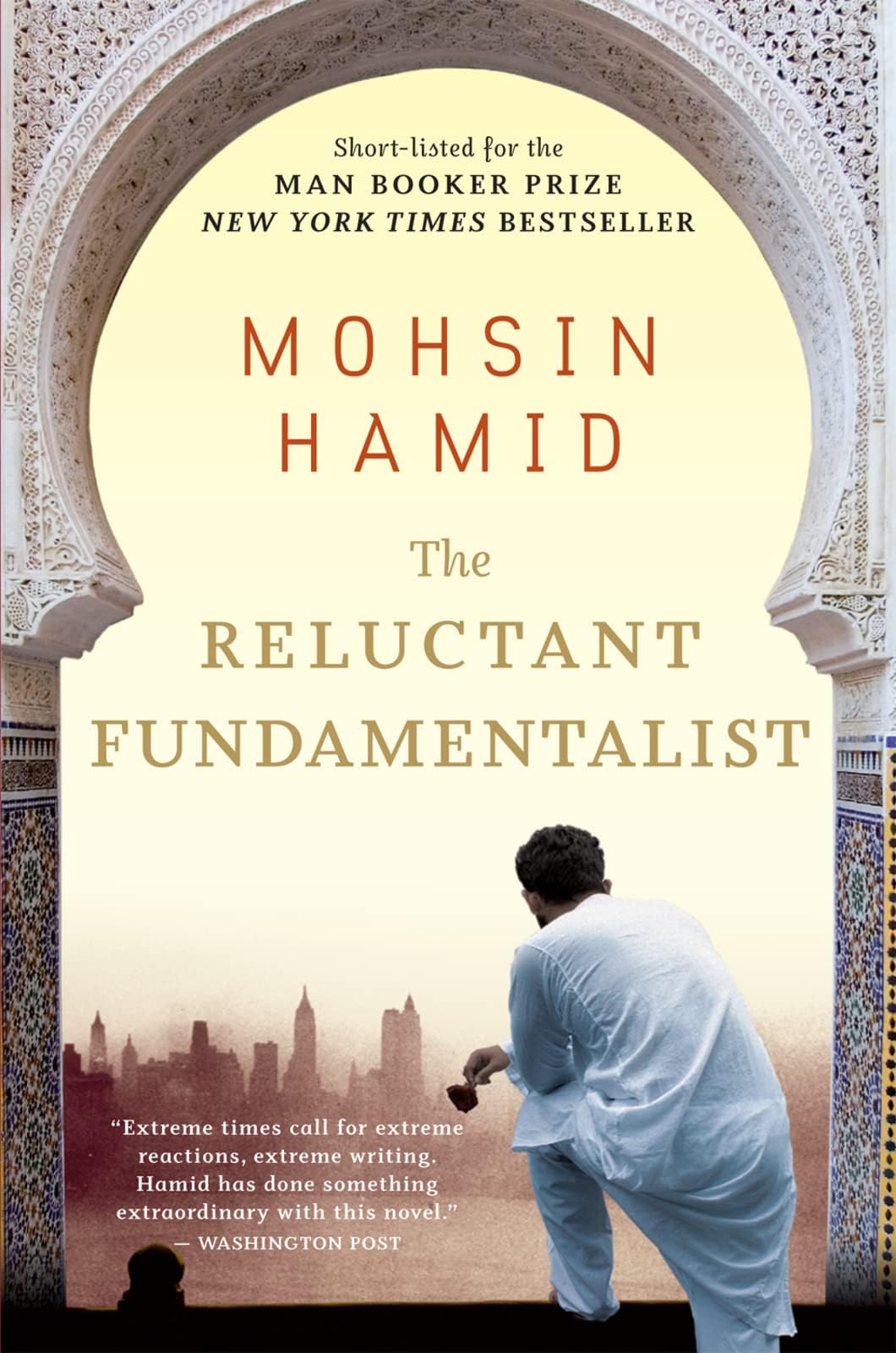
The Reluctant Fundamentalist: A Man Booker Prize-Shortlisted Literary Novel of Love, Identity, and the American Dream
Product ID: 4772092
Buy anything from 5,000+ international stores. One checkout price. No surprise fees. Join 2M+ shoppers on Desertcart.
Desertcart purchases this item on your behalf and handles shipping, customs, and support to Denmark.
The Reluctant Fundamentalist: A Man Booker Prize-Shortlisted Literary Novel of Love, Identity, and the American Dream [Hamid, Mohsin] on desertcart.com. *FREE* shipping on qualifying offers. The Reluctant Fundamentalist: A Man Booker Prize-Shortlisted Literary Novel of Love, Identity, and the American Dream Review: Excellent, Unusual Work Of Fiction. - SECTIONS MISSING IN AUDIOBOOK - This is a very well written work of fiction by a Pakistani novelist. The story starts with an extremely intelligent and well educated Pakistani speaking to an American. The setting is Pakistan. The protagonist describes, from his view, his experiences in America and of Americans. The protagonist was working in America, for an American Company, before and after Sep. 11, 2001. I fear saying much more about content as I have no desire to diminish one's reading experience. The novel has a semi autobiographical aspect to it. The protagonist is a Pakistani was educated at Princeton. Mohsin Hamid, the author, is a Pakistani educated at Princeton. I feel I have not read enough author's from Asia and intend to correct that. The novel itself is both unusual to my experience and very well written. There is suspense that slowly builds that I felt was the product of superior writing skills. I read this book on Kindle while listening to the audiobook simultaneously. The narrator of the audiobook is Satya Bhabha. Up until the last few of Chapter 3 the audiobook was a perfect reproduction of this excellent novel. Mr. Bhabha's narration has been excellent and has added to the reading experience. However a significant part of the end of Chapter 3 is completely missing. It is an important part of the story and if one only listens to the audiobook one will miss it, I think without knowing it. It is approximately the last five paragraphs. One can still comprehend the story, if one only listens to the audiobook, but the reading experience is altered, and not for the better. Similarly, the last two paragraphs of Chapter 9 are missing. The narration of this chapter ends at the end of a paragraph. Once again, I believe if one only listens to the audiobook, one will not be able to detect this. Once again, the story does not become incomprehensible, but is, I think, diminished. I paid very little more for the Kindle and audiobook combination than I would have for just the audiobook and I am glad I did so. Thank You... Review: Complex and Original Landscape of the Mind - Reading a NY Times best-seller initially attracted my interest. It was a complex read from the first page. The bombing of the Twin Towers leaves a Pakistani native bereft, longing for cohesion among family and friends, while laboring through a prestigious "sanitary" job in white collar NYC. Among native friends he was accepted as an equal in his class; in America he was fundamentally an outcast due to his native Muslim/Pakistani roots, his non-standard physical bearing, and his personal peculiarities. Princeton educated but lonely and far removed from his roots (family, friends, peers), he was essentially challenged to remain open-hearted and emotionally alive in the USA. To achieve personal self-mastery outside of these familial parameters (in his mind) is to die a thousand deaths due to disenchantment with the whole game of modern life. His heart begins to change in subtle ways. The drama is acute at the end. A real-page-turner. My visceral reaction is that there is much more to the end game of this short story, and it is never quite resolved/finished. Explanations are wanting. I found myself craving a real discussion afterwards to further open up the beauty, depth, and love I found in this very well-written 1st person (semi-autobiographical?) expose. There is also a motion picture of the same title. I look forward to watching it soon.


| Best Sellers Rank | #20,778 in Books ( See Top 100 in Books ) #38 in Discrimination & Racism #485 in Psychological Fiction (Books) #1,412 in Literary Fiction (Books) |
| Customer Reviews | 4.2 out of 5 stars 6,734 Reviews |
F**Y
Excellent, Unusual Work Of Fiction. - SECTIONS MISSING IN AUDIOBOOK
This is a very well written work of fiction by a Pakistani novelist. The story starts with an extremely intelligent and well educated Pakistani speaking to an American. The setting is Pakistan. The protagonist describes, from his view, his experiences in America and of Americans. The protagonist was working in America, for an American Company, before and after Sep. 11, 2001. I fear saying much more about content as I have no desire to diminish one's reading experience. The novel has a semi autobiographical aspect to it. The protagonist is a Pakistani was educated at Princeton. Mohsin Hamid, the author, is a Pakistani educated at Princeton. I feel I have not read enough author's from Asia and intend to correct that. The novel itself is both unusual to my experience and very well written. There is suspense that slowly builds that I felt was the product of superior writing skills. I read this book on Kindle while listening to the audiobook simultaneously. The narrator of the audiobook is Satya Bhabha. Up until the last few of Chapter 3 the audiobook was a perfect reproduction of this excellent novel. Mr. Bhabha's narration has been excellent and has added to the reading experience. However a significant part of the end of Chapter 3 is completely missing. It is an important part of the story and if one only listens to the audiobook one will miss it, I think without knowing it. It is approximately the last five paragraphs. One can still comprehend the story, if one only listens to the audiobook, but the reading experience is altered, and not for the better. Similarly, the last two paragraphs of Chapter 9 are missing. The narration of this chapter ends at the end of a paragraph. Once again, I believe if one only listens to the audiobook, one will not be able to detect this. Once again, the story does not become incomprehensible, but is, I think, diminished. I paid very little more for the Kindle and audiobook combination than I would have for just the audiobook and I am glad I did so. Thank You...
A**A
Complex and Original Landscape of the Mind
Reading a NY Times best-seller initially attracted my interest. It was a complex read from the first page. The bombing of the Twin Towers leaves a Pakistani native bereft, longing for cohesion among family and friends, while laboring through a prestigious "sanitary" job in white collar NYC. Among native friends he was accepted as an equal in his class; in America he was fundamentally an outcast due to his native Muslim/Pakistani roots, his non-standard physical bearing, and his personal peculiarities. Princeton educated but lonely and far removed from his roots (family, friends, peers), he was essentially challenged to remain open-hearted and emotionally alive in the USA. To achieve personal self-mastery outside of these familial parameters (in his mind) is to die a thousand deaths due to disenchantment with the whole game of modern life. His heart begins to change in subtle ways. The drama is acute at the end. A real-page-turner. My visceral reaction is that there is much more to the end game of this short story, and it is never quite resolved/finished. Explanations are wanting. I found myself craving a real discussion afterwards to further open up the beauty, depth, and love I found in this very well-written 1st person (semi-autobiographical?) expose. There is also a motion picture of the same title. I look forward to watching it soon.
D**9
A thriller with intelligence, this book will surprise you.
This is an outstanding, creatively imagined story which manages to give many of us non-Islamic folks a glimpse into what being Islamic in the U.S. must have been like after 9/11. The story takes place in Pakistan (Lahore) as Changez, once a successful immigrant in the U.S., relates his story to an unnamed American. From a privileged, but poor family, Changez manages to get into Princeton and graduate with honors. He lands a highly sought after and highly paid position with a New York "valuation" firm which tells companies what they are worth. He loves New York, falls in love with an American woman, and has more money than he ever anticipated. But after Sept. 11Changez not only finds himself being viewed differently, but begins to view himself differently as well. He suddenly decides to grow a beard which draws even more attention to himself and begins to question his role in the U.S. In the meantime, his relationship with the woman he loves changes for reasons not related to Sept. 11, but also makes him question some essential questions. While the unnamed and unheard American in the cafe could be a mere foil, Hamid manages to create an interesting character we know only through the eyes of Changez. The American's own visit to Pakistan is questionable and Changez works hard to assure the man of his safety. By the end of the novel you are surprised to find yourself in a page-turning, suspense-filled plot (and I'm not giving away any endings). Hamid's narrative is tight and well controlled. At times I questioned the strange romantic relationship, but at the end of the novel we see that it serves to show us another side of the U.S. and Changez's relationship to it. It also teaches about Changez as a person, although we can see how he may appear distant to others. His work at the "valuation" firm is a high stakes position in which his answers determine the fate of others. When this begins to bother him he is encouraged to separate himself from the results since anyone could produce them -- it is nothing personal and he does not make the decisions. But Changez recognizes his role in the process. It is this role which we build out upon as Changez begins to see the role he plays in other areas of his life. What he recognizes is that passivity is not an option. To use the existentialist formula, "not to choose is to choose." In other words, he moves from passivity to action which seems to surprise many, including himself. But is he really changing or simply becoming for himself? That is up to the reader to decide. Regardless of the answer, Hamid's book is essential reading for anyone seeking to understand more of what is happening in the world today. There are no simple answers, but there is insight.
R**S
A three-star thriller
I suspect there will be two different categories of readers attracted to this book: those who have heard it is a good thriller and those who have heard it is a novel of literary merit...those approaching it as a thriller will be more satisfied, but it does not quite make it in either category, at least for me. "The Reluctant Fundamentalist" tells the story of a Pakistani named Changez as he narrates his life story to an American in a cafe in Lahore, post 9-11. There were some aspects of the novel that I liked... Changez, has a firm and consistent tone throughout, and his love interest, Erica, is believable, at least at first. While the prose is well-crafted (Changez adopts a somewhat archaic and formal tone to the American stranger) the claims for the beauty of the language in other reviews seem somewhat overblown. There are some tricks played with the reader, based mainly on our assumptions about the characters, but I did not find this very clever. It heightens the suspense, but rather in the fashion of a movie where the fright device suddenly jumps out at the viewer. But in a purportedly realistic novel, one likes to have the details right or credibility suffers. The business setting, Changez's job as a "valuation analyist" at an American hot-shot "valuation firm," just did not seem credible to me...such jobs, mainly done by investment banks or consultants, would not be assigned to a 22-year-old fresh out of undergrad Princeton. Although the author has reportedly worked as a financial consultant in New York, the work setting did not convince. Changez's firm would not send a team of 5 or 6 to Manila for three months to "value" a local CD manufacturer...I mean, what were they doing, counting the paperclips? We are also told that it is up to Changez to devise his own "valuation model," a strangely ad hoc and imprecise approach melded to the unbelievably precise. Perhaps the author is trying to make some sort of point about Changez's character, in that he has aspects of the precise and vague in his personality, but if so, it didn't work for me and just detracted from credibility, important in a thriller. Without giving away any essential plot developments, Changez's later "change" I found rather forced and inexplicable. A-type personalities who get into Princeton just don't act this way, and that also detracted from his girlfriend Ericka's believability, who similarly went to Princeton. Changez seems always to be graded and judged, at Princeton, and at the firm, yet there seems little questioning of the validity of this system. Is he just a grade-grubbing bourgeois striving to climb into the upper ranks of the plutocracy or does he see this more cynically? The tension does build as the narration proceeds, but there are continual nagging questions about credibility that slowly add up throughout but thr reader is always aware of authorial manipulation throughout. There is little discussion of issues of religion, class or race and that too detracted from the credibility of the novel's resolution. But the author deserves credit for his handling of this theme, identity problems of a Pakistani in post 9-11 America, but I wish he had set it in a background with which he may have had more familiarity. Right now, this is long-listed for the Booker Prize. Of others on the list, I have read only Ian McEwan's "On Chesil Beach" a stronger novel, at least in terms of the prose, but it is not McEwan at his best. I also read several Booker-eligible novels that never made the list but should have(particularly John Burnside's "The Devil's Footprints")... there are stronger candidates on the Booker list than "The Reluctant Fundamentalist" and the list itself seems very weak this year. But if one is after a decent short thriller to occupy oneself for a few hours, this may serve the purpose.
M**A
with great prospects for the future
The style chosen by the writer is effective in that it creates a kind of mystery and is involved in an atmosphere of suspense and makes the reader to read further.This atmosphere is created by the fact that the write chose to narrate the story in the form of a monologue or it could be said a dialogue but in which the words of the other interlocutor are always heard through the narrator. From my point of view, this is a story of a man trapped between two worlds between the world where he has his roots and the adopted country. He chose to go back to his roots even though it meant going back to deprivation as opposed to a life of comfort, with great prospects for the future. He remained true to his past, to his origins. Was the choice a result of the disappointment with love or of the guilt he felt knowing that while he enjoyed the things money can buy, his parents and other relatives were deprived of the essentials?
K**E
Shattering!
I did not know what to expect when I began this book but it grabbed my attention from the first page and didn't let up until the last--and what a last page it was. I can honestly say, NOTHING was what I expected. The main character, Changez, is a young Pakistani from a family that was once affluent but is now in decline. He receives a scholarship to Princeton where he graduates with all A's at the top of his class. He is promptly recruited by a top corporate valuations company, and in no time, is living a life he could not have imagined. He has a great job, a beautiful American girlfriend, and a non-stop social life. He is tall, handsome, well-dressed and well-liked. His boss takes him under his wing and it seems his future will be a brilliant one. And then the World Trade Center is attacked and Changez world view shifts. I was quite startled by the author's naked openness about his feelings in this story. Changez is in the Philippines on business when the Towers are attacked and his first reaction is one of happiness. He is ashamed of himself for feeling that way and immediately regrets the loss of life but, at the same time, cannot help but approve of the symbolism. Yet, he is well-aware that America has given him so much--why would he feel the way he did? Slowly Changez slips into decline--a decline that even he does not understand. He is deeply conflicted and divided inside between his gratitude to a country that has given him so much and the land of his birth that he feels loyal to. During a business trip to Chile he begins to fall apart and, while visiting the home of poet Pablo Neruda, he makes a terrible decision. This was not an easy book to read at times but the deep conflict and confusion Changez experiences is gripping. The author takes no shortcuts and avoids the trite and expected. The end was shattering. I am very glad to have read this book but believe it is not for everyone.
N**A
It's All About Perspective
I picked up The Reluctant Fundamentalist and could not put it down. It is a pleasure to read with language as appealing as the message is disturbing. Hamid studied under Joyce Carol Oates, and it shows. The book is a first person narrative by a brilliant, thoughtful and careful Pakistani young man about his experiences leaving Princeton, becoming a Wall Street analyst, and living through the a world changed by America's reaction to the events of 9-11. The book is a work of fiction and not an autobiography, but from the author's background, I would guess that some of the protagonist's insights have come from the author's experience. As the book points out, Pakistan is the world's sixth largest country by population, and American interest in Pakistan has waxed and waned depending on other global American interests. From the protagonist's point of view, the lives of those living in Pakistan have no meaning to Americans except as collateral damage. As an example of his belief he points out that America failed to intervene to protect Pakistan from Indian aggression as the United States was engaging in the run up to the invasion of Iraq. American papers did report and continue to report about tension between India and Pakistan. Until reading this book, however, I, blindly, failed to empathize with the ordinary Pakistani who was just as traumatized by the potential of a nuclear exchange with India as were residents of lower Manhattan by the attacks on the Twin Towers. Moreover, the disruptions to the normal life of people living in Pakistan: officers billeted in homes, freeways being closed to allow the airforce to practice emergency take offs and landings, and gun emplacements near summer homes, may be even greater than the airport lines the average American has had to endure. In this age of globalization, many foreigners come to America and learn how we think. Their compatriots in their home countries learn only how we act. This book provides a valuable insights about how others may perceive us and may help to remove the blinders of our natural national narcissism and give readers an idea how we may be perceived by others, and why.
M**C
Interesting topic, makes you think about how one thing can spin others in a different direction.
This was an interesting book. I actually think it needs a couple of reads to get the story straight in your mind (its a short story). It is a narrative between an American journalist in Pakistan and a Pakistani who comes to America to study at Princeton and graduates top of his class. He ends up with a much sought after position at a very prestigious financial firm in NYC as a "valuator"; looking at the fundamentals to make necessary decisions. Basically, he goes into financially troubled businesses to figure out a way to financially stabilize the company no matter what the consequences to the owners or their employees. Then the tragedy of 9/11 happens and his family is soon facing instability at home. Its an intriguing story with a twist at the end. I also saw the movie which depicted differently the relationship with the American he is sitting with in Pakistan as well as with his American love interest. The movie made this relationship with those characters very different, whereas in the book you really didn't know who he was talking to, that was part of the intrigue. Read the book, watch the movie, read the book again.
Trustpilot
5 days ago
3 weeks ago