
Buy anything from 5,000+ international stores. One checkout price. No surprise fees. Join 2M+ shoppers on Desertcart.
Desertcart purchases this item on your behalf and handles shipping, customs, and support to Denmark.
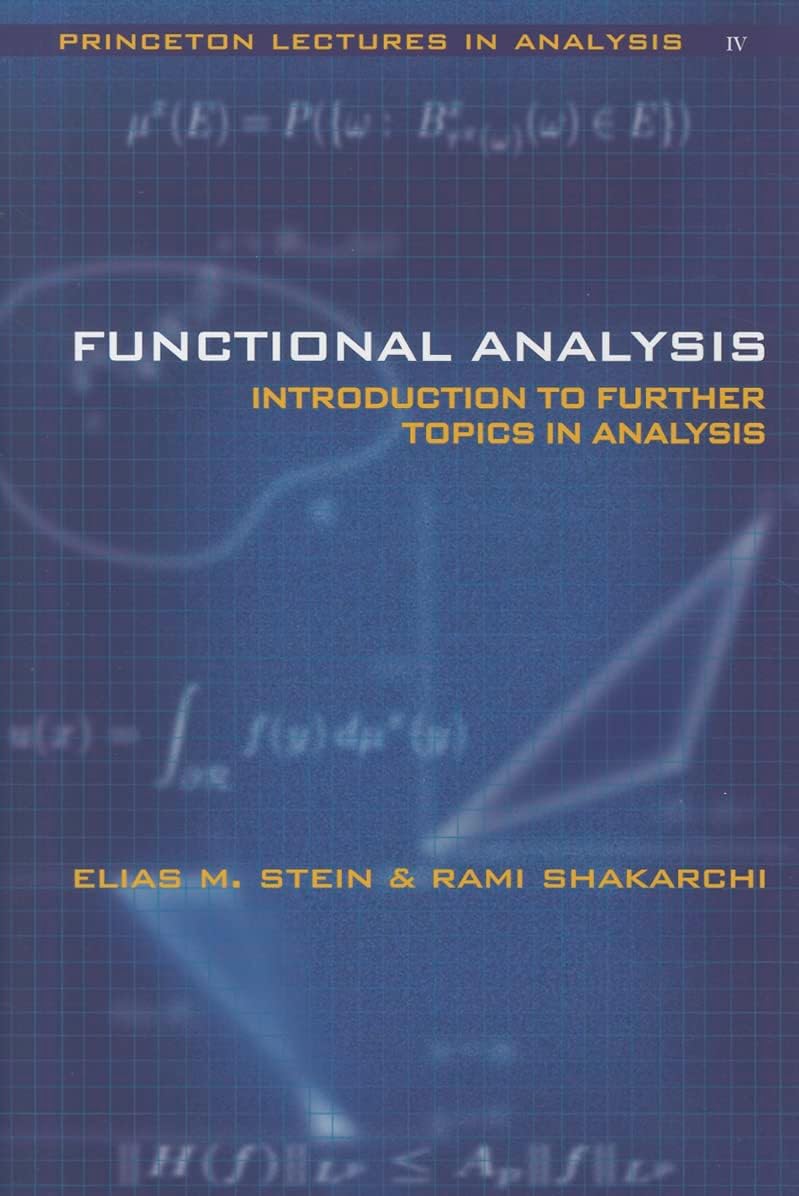
Buy Functional Analysis: Introduction to Further Topics in Analysis by Stein, Elias M., Shakarchi, Rami online on desertcart.ae at best prices. ✓ Fast and free shipping ✓ free returns ✓ cash on delivery available on eligible purchase. Review: Livro em excelentes condições Review: Book was dirty with dust and glue residue on the cover. Page edges dirty; will require sandpaper grinding. Very poor experience.
| Best Sellers Rank | #173,234 in Books ( See Top 100 in Books ) #123 in Mathematical Analysis #432 in Pure Mathematics #461 in Geography |
| Customer reviews | 4.7 4.7 out of 5 stars (33) |
| Dimensions | 16.51 x 3.18 x 24.13 cm |
| Edition | Illustrated |
| ISBN-10 | 0691113874 |
| ISBN-13 | 978-0691113876 |
| Item weight | 482 g |
| Language | English |
| Print length | 448 pages |
| Publication date | 11 September 2011 |
| Publisher | Princeton University Press |
L**S
Livro em excelentes condições
B**.
Book was dirty with dust and glue residue on the cover. Page edges dirty; will require sandpaper grinding. Very poor experience.
序**)
This is one of the references of my paper "An Elementary Existence and Smoothness of the Navier-Stokes Equations: Elementary Weak Solutions" and "A proof of the Hartog's phenomenon". The locally solvability of the partial differential oparators with constant coefficients, Hartog's phenomenon are written.
P**M
Functional analysis is the fourth and final book in Elias Stein's and Rami Shakarchi'sPrinceton lectures in analysis. Elias Stein is a world authority on harmonic analysis and it is not surprising therefore that the first book in the series was on Fourier analysis. The second and third books covered complex and real analysis. He is also a winner of the prestigious Wolf Prize which is granted, at least in part, for excellence in communication of mathematical ideas: "For his contributions to classical and Euclidean Fourier analysis and for his exceptional impact on a new generation of analysts through his eloquent teaching and writing." These books were based on lectures given at Princeton and therefore reflect the standard of mathematics teaching at Princeton, but more importantly they reflect what Stein wanted to do by bringing together a life time of knowledge and insights concerning Fourier theory. My understanding (which comes from someone within the functional analysis "mafia") is that Professor Stein really wanted to set a benchmark for doing Fourier series and functional analysis properly and that has informed the way he has approached these four books. The synthesis of ideas is excellent and even though I learned Fourier theory from a very able man, I was always hankering for the bigger deal - the broader connections. At the top level of mathematics the "helicopter" view is actually the hardest thing to do - just think of Littlewood's three principles: (a) every measurable set is nearly a finite sum of intervals; (b) every absolutely integrable function is nearly continuous; and (c) every pointwise convergent sequence of functions is nearly uniformly convergent. These three simple principles are but the tip of a massive analytical iceberg. It is clear that there is a real passion for Fourier series and its tantalising applications which are extraordinarily diverse. When Fourier initially developed the seemingly outrageous theory in the early part of the 19th century, little did he know the astonishing applications that his theory would have. The sheer generality of Fourier series has in turn generated extremely subtle issues which have exercised the minds of some great mathematicians over the years. You cannot properly understand Fourier theory until you really appreciate the subtlety of the convergence issues that it poses. Stein's series of books are all about really deeply understanding why the theory works as well as it does. Because these books are written for a mathematically sophisticated undergraduate audience they are in my view not really suitable for a struggling student. They are not suitable for an electrical engineering student, say, who just wants to know how to bang out Fourier or Laplace transforms. This is not the audience for these books. They are in fact like a complex French meal that requires a suitably chosen white or red wine to complement the overall meal. Indeed, I sometimes take one of the four volumes down to Bondi Beach to watch the waves and reflect on the depth of the material which is reinforced by the numerous exercises and problems. The exposition is very clear and the proofs are easy to follow (assuming the reader has the requisite background knowledge). There is an enormous amount of material in the exercise and problems which really amplify and reinforce the material in the text. There are some quite difficult problems but there are many hints which take you sequentially through the solution and in my experience these hints do indeed lead you systematically to the full solution. That is not to say that you don't have to do a lot of work to get there. In fact I have published detailed solutions to some of his exercises and problems. The volume on functional analysis is actually quite different to other "classical texts" dealing with functional analysis. For instance Rudin's textbook on functional analysis has quite a different emphasis to Stein's introduction to the subject. Stein devotes a whole chapter to applications of the Baire category theory while Rudin devotes a page. Stein does this because it provides some insights into establishing the existence of a continuous but nowhere differentiable function as well as the existence of a continuous function with Fourier series diverging a point. Thus what he is doing is providing a much more holistic and integrated approach to the subject than occurs in other approaches which are much more narrowly focused. In terms of overall feel I think he is closest in philosophical approach to Frigyes Riesz whose book "Functional Analysis" (with Bela Sz.-Nagy) is so different to the more modern books. Riesz in fact "talks" through some proofs without elaborate algebra. Stein covers the applications of functional analysis to probability theory and the vehicle he uses is Rademacher functions which enables a quick derivation of the square root law for sums of Bernoulli trials. This leads into a chapter on Brownian motion which starts with a quotation from Joe Doob which says in part that "Norbert Wiener..was so unfamiliar with the standard probability techniques even at elementary levels that his methods were so clumsily indirect that some of his own doctoral students did not realize that his Brownian motion process had independent increments". Those of us who have attempted hacking through Doob's impenetrable books will appreciate the irony in this quotation. Having said that Stein's approach to the construction of Brownian motion is different to the approaches taken by the finance world writers. He develops Brownian motion in the context of solving Dirichlet's problem generally. This is what you would expect from an expert in harmonic analysis. There is a very useful chapter oscillatory integrals in Fourier analysis which develops the theory behind averaging operators and curvature. The book also contains all the other "usual suspects" of functional analysis - Banach spaces, LP spaces, Hardy spaces and so on. Because this is the last book in the series it is worth going back on reviewing the scope of what has been achieved. When you do this, you appreciate what a superb job has been done in bringing the whole sprawling area together. A lifetime of work has been reflected in these books and any student who can do every single problem and exercise would indeed be destined for great things.
R**I
Es un libro completisimo y con demostraciones sumamente rigurosas y detalladas, aun así es didáctico, ....NO es un libro para principiantes, requiere una formación matemática bastante solida....pero quien quiera profundizar en este tema, este es uno de los mejores libros que he leído , escrito por un matemático de nivel superlativo Elias Stein.
Trustpilot
1 month ago
3 days ago