Buy anything from 5,000+ international stores. One checkout price. No surprise fees. Join 2M+ shoppers on Desertcart.
Desertcart purchases this item on your behalf and handles shipping, customs, and support to Denmark.
⚙️ Unlock precision and versatility—engineer your future with every waveform!
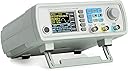
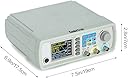
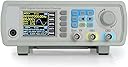
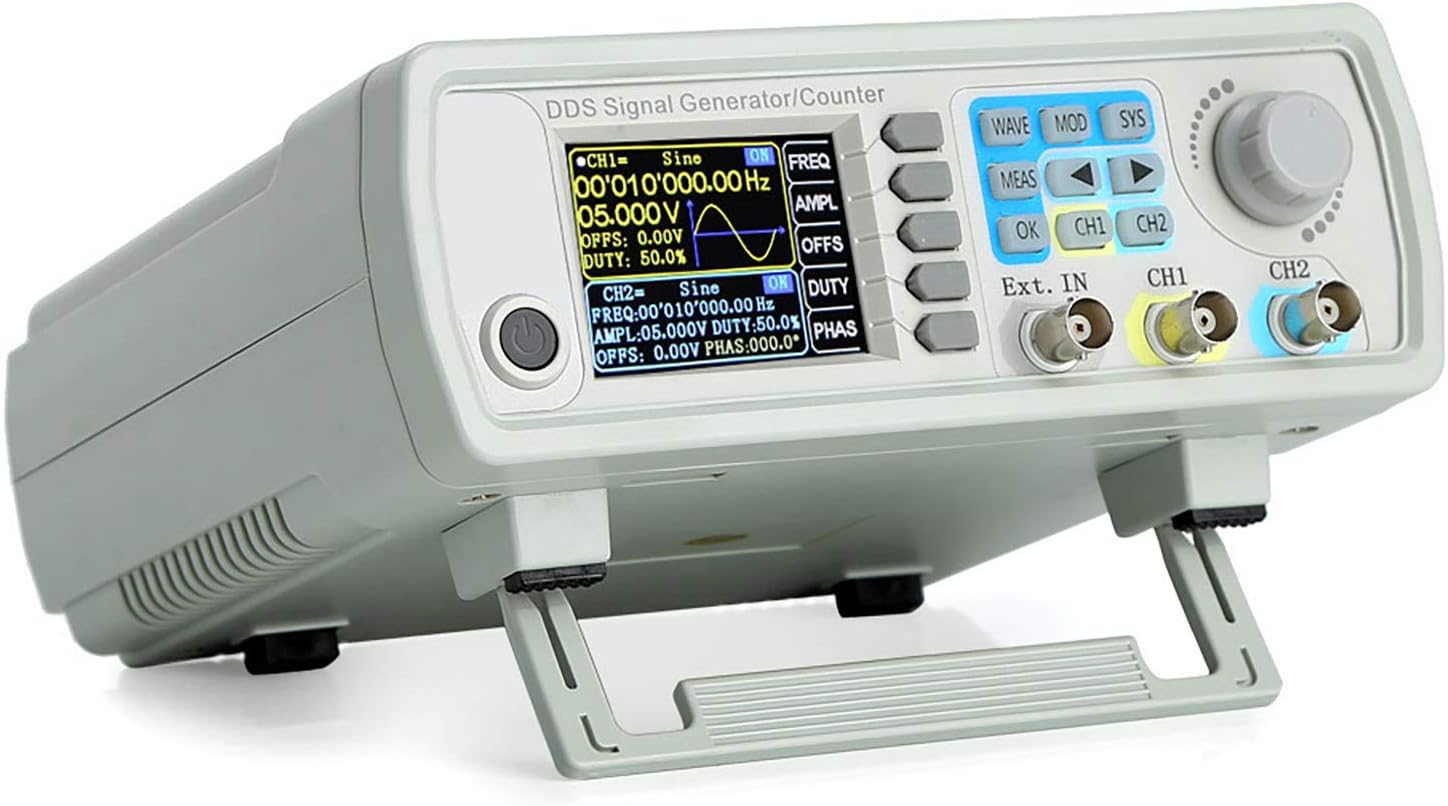
The Koolertron Upgraded 15MHz DDS Signal Generator is a high-precision dual-channel arbitrary waveform generator featuring a 15MHz sine wave output, 200MSa/s sampling rate, and 99 memory slots for user settings. Designed with FPGA and high-speed MCU technology, it offers stable, low-distortion signals across 60+ waveform types, including advanced sweep and modulation functions. Ideal for engineers, labs, and educators seeking professional-grade signal generation with flexible measurement and storage capabilities.


| Customer Reviews | 4.4 out of 5 stars 471 Reviews |
W**E
Great functionality for the price
This is a great audio generator for the money. It's stable, has a clean output, tons of features and it's really easy to use. The screen is well lit, and it only takes a short time to learn the UI. I work on audio gear, and it's got everything that I need. The stability is good enough for my wow/flutter test, and the multifrequency waveform is perfect to troubleshoot filters. Everything works like it should. The only negative would be the thing is so light, you have to have a hand on top when you push a button or you'll push it off the shelf. Tie it down some way, or just learn to hold it while you use the buttons. I'm very happy with mine.
T**6
Excellent value
I bought this to generate audio-frequency signals for testing amplifiers, signal adapters, etc. It took a little trial-and-error to figure out some of the controls, but in the end the unit worked flawlessly for my needs and is easy to operate. The documentation is not very extensive, but if you know something about test equipment you'll figure it out. The unit is fairly compact and lightweight (almost too light – weighs practically nothing). The construction is not super-rugged, but for everyday use in a home or office it's fine. I can't speak to the more advanced capabilities (e.g., the PC interface) because I haven't used them yet, but the basics are great. I wish all my equipment worked this well.
A**R
May need some work
I have only used this for about 2 hours so don't consider this a complete review. First the bad: The BNC jacks or cables are defective but mostly usable. Just breathing on where the cables connect to the machine creates horrible noise visible on an oscilloscope even when the channel is turned off. Some weights on the cables to keep them still is a kludgy fix. The cable is also very stiff compared to oscilloscope cables. Finding the sweet spot where the signal is clear and uninterrupted reminds me of the old days of doing reception ballet with old TV sets. I'm not yet 100% certain, but the voltage might randomly jump up and down slightly ( a few mV @ 1V) when going from one frequency to another. The 2nd channel has the same noise problem. The display for it is small and hard to see. But may be a good tradeoff so that the 1st channel is easier to see on the smallish screen. The good: The user interface is very intuitive. I didn't need the manual to figure out how to change frequency, amplitude, waveform, or do sweeps. It is actually the best I've seen on electronics test equipment. It boots up quickly. Just eyeballing it, but it seems reasonably accurate. They went to great pains to keep the price down. Other: It is very lightweight because the plastic case is mostly full of air. It is powered by low voltage from a wallwart(ugh), but that means it could easily be made battery powered and portable. There is plenty of room in the case to add a battery pack. Its brain appears to be made by Lattice Semiconductor, I can't see exactly which chip but I assume it is an FPGA. There is a place for a 6(?) pin header on the mainboard, and a 5(?) pin header on the front panel interior which may be handy for hacking it. There are also 4 very small, cellphone antenna like sockets on the mainboard, likely for testing, but which could possibly find other uses. Except for screwing up the cables (or sockets) manufacturing, I'd say this is a good value for price. It is probably good enough for hobbyists getting their electronics feet wet, high school students, and curious characters. Obviously it isn't intended for advanced hobbyists, scientists or electronics engineers, or those who just like the feel of high quality. Although I fall into one of the former categories, I wish I had spent 3x more for a something like a Rigol. I think I would feel differently if they had just gone the extra meter and spent a few more cents on the connectors and added rubber feet for grip so that I wouldn't feel like the magic smoke will puff out of it soon and to help me trust it a bit more as far as accuracy and that that horrendous noise won't damage delicate components.
J**N
Great product for the price
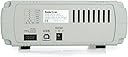
I'm very satisfied. I found the user interface for basic functions to be relatively intuitive. Signals seemed stable up to 10MHz (I have the 15MHz model). Above that, square waves had overshoot/ringing but could very well be the leads/termination impedance to my scope. My only (minor) criticisms: I would like to see detailed documentation for using the extension connector at the rear of the unit. TTL in/out is pretty obvious and seem to work well. I'm not sure about the receive/transmit pins. I could not find a place to buy the cable and had to make one. Like others have commented, the alligator clip boots/insulators are very smooth and slippery - inside and out. So much so that compressing the clips causes them to slip out of my fingers, or the insulator slides back exposing the metal resulting in potential shorting when used in tight spaces. I will try to roughen them up or replace the boots.
S**L
Very good
Edited review: regarding the duty, I realized that there was specifically a pulse wave which is affected, and that the square wave is not. This was confusing since duty is selectable for all waves, but it does work. I also took this into the lab today and compared it to lab quality generators. I’m creating very low voltage, low frequency signals on this thing (10 Hz at 0.1V) and attenuating it down to about 200uV. This thing is a beast and does that no problem, even slightly better than some of the lab grade equipment we have. Do your own tests, but for my purposes this exceeds my expectations. I still have not tried creating software defined arbitrary waves, but if that works reliably I’d give this 6 stars if it was possible. Original Review: I’m using this for very low frequency, low voltage stuff (10Hz @ 0.1V) and it does a pretty good and reliable job. So far the only thing that doesn’t work is the duty. Adjusting it still results in a fully symmetrical wave. I also haven’t tried uploading arbitrary waveforms yet, but watched a YouTube video that tracked down the required software and it seemed a bit annoying to set up. So far it’s been a productive instrument, but unfortunate that I didn’t get a feature I paid for.
R**.
Excellent performance for the price. Drawback... no number keys on the keyboard.
I used my new oscilloscope to view the various output waveforms (sine, square, sawtooth etc.). They looked good on the scope, and the scope indicated that the peak-to-peak output voltage was the same as the level that I had set the generator up for. It looked to be right on the marks. You can see the digital-to-analog conversion steps in the waveform, but they were not excessive, and that is expected with a digitally synthesized generator. They were not a problem for what I needed, and will likely never be a problem for my purposes. If you will be using this to test harmonic distortion of a high-end audio amplifier, you should probably use a much more expensive generator that uses more data bits. Also, I was using a digital scope, so some of that waveform stepping (quantization) was due to the scope itself. I placed a 50 ohm load resistor across the output terminals, and the p-p voltage dropped to 1/2 of what it was without the resistor. This is just what should happen with a generator that has a 50 ohm output impedance. It is light-weight (feels almost like a cheap toy), which made it easy to carry to a job site. I simply needed to generate a consistent modulating tone for testing a piece of radio equipment. It served my purpose very well.
M**H
Not so good for arbitrary waveforms
As others attest, this is quite a versatile and surprisingly good unit for the money. However, if you are looking to generate arbitrary waveforms, you might want to look elsewhere. To begin with, the CD that I received with this unit totally lacked the software required to connect a PC to the unit and run the JDS Signal Generator Control Panel software, which also includes the arbitrary waveform program. If you read the reviews and questions, you’ll see that I’m not the only one who’s had this problem. I had to dig to find out that you can download the missing software from http://amazonfiles.s3.amazonaws.com/DDS.rar . This software allows you to control the Koolerton unit from your PC and to generate and upload arbitrary waveforms. The instruction that come with the software package are sketchy and lacking sufficiently detailed step-by-step instructions for dealing with the multiple .exe files in multiple folders in the installation package. Once you figure that out, you have to just play with the software to fully understand it since there are no detailed operating instructions. For arbitrary waveforms you’d be a lot better off with an upgrade to a more capable unit with better software with detailed instructions and good support (the Siglent units are what I chose, other better signal generators are also available).
J**M
I am surprised in a good way about how well this works
I am amazed constantly over how far electronics have come. This little generator is rock solid. It is accurate and within specs. It is so light that I had to attach rubber feet to the bottom to stop it from skittering around. It has a lot of memory slots available to store settings and arbritrary waveforms. Whatever you store in position zero is what it uses at boot. It is powered by a 5VDC wall wart so there is no internal power supply. I come from the day when devices that could only do half what this does and they weighed several pounds, had to warm up and even then drifted to no small degree. Let me cut this short and say that if you need a signal generator and don't want to pay for lab grade precision you may never need this thing is worth a try. It comes with decent cables, a booklet that is enough to get started, and a disk with the programs you need if you want to craft your own arbitrary waves or what not.
Trustpilot
3 weeks ago
1 month ago