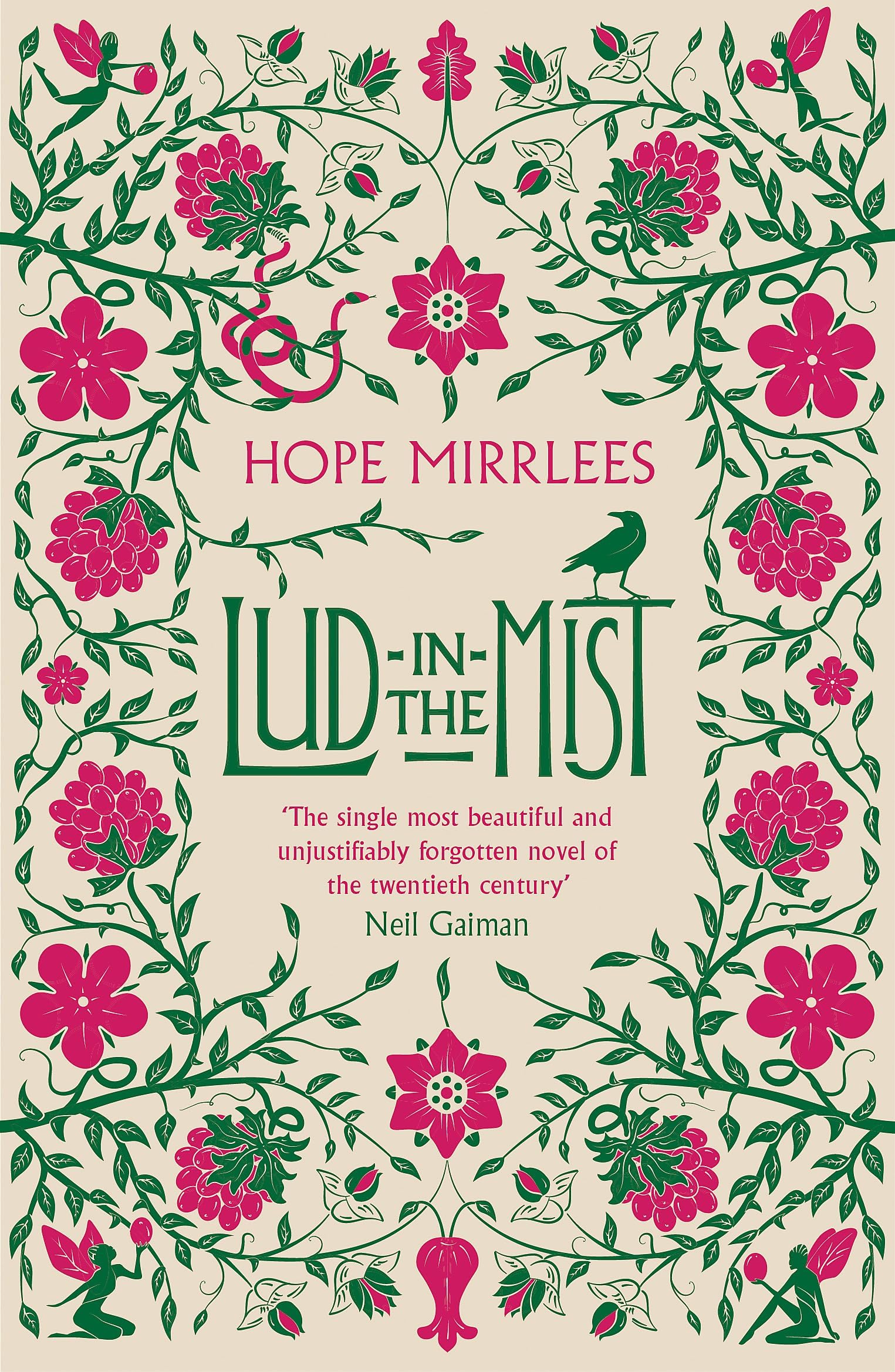
LUD-IN-THE-MIST
Product ID: 402300404
Desertcart purchases this item on your behalf and handles shipping, customs, and support to Denmark.
A true classic - and the 'single most beautiful...and unjustifiably forgotten novel of the twentieth century' Neil Gaiman Lud-in-the-Mist is a prosperous country town situated where two rivers meet: the Dawl and the Dapple. The Dapple springs from the land of Faerie, and is a great trial to Lud, which rejects anything 'other', preferring to believe only in what is known, what is solid. Nathaniel Chanticleer, a dreamy, melancholy man, is deliberately ignoring a vital part of his own past; a secret he refuses even to acknowledge. But with the disappearance of his daughter, and a long-overdue desire to protect his son, he realises Lud is changing - and something must be done. Review: Brilliant. - I don't think I'm well-read enough to review this book -- as is the case with many British writers of that period, Mirrlees is far better classically educated than I am, and I'm sure I missed quite a few of her references. However, I now firmly agree with Neil Gaiman that this is "the single most beautiful, solid, unearthly, and unjustifiably forgotten novel of the twentieth century" so I felt I should attempt to review it here in the hopes that I get a few more people to seek it out. This is most distinctly not the sort of fantasy novel that would be able to get published today. Tolkien's Shire feels strongly influenced by Mirrlees' Lud, but it's not the Shire that so many fantasy writers and publishers have taken as their model, it's all that pesky questing and evil-battling. There are no epic quests in this novel, and there is definitely nothing as comforting as a black-and-white delineation of good and bad. Instead, Lud-in-the-Mist is somehow at the confluence of high fantasy rooted strongly rooted in folktale and a political thriller. It is written in a surprisingly straightforward, earthy style that nonetheless has plenty of room for some of the most beguiling and delightful descriptive passages I've ever read. It uses broad comedy side by side with the melancholy and the bittersweet. It can be read as a parable of class struggle, or as an endorsement of mind-altering drugs (keep in mind that it was published in 1926, so I highly doubt that this was what Mirrlees intended). It is most certainly about balancing the mundane and the miraculous (paraphrasing Gaiman's introduction), which perhaps explains how it came to be all these things at once. There are quite a few elements that turned people off (judging from the reviews I've seen online) but every single one of them worked for me: yes, the first third or so was highly episodic; yes, Nathaniel Chanticleer seems a bit of a bumbling fool at first, and isn't exactly likable; yes, it is very British, and quite old, so everyone reads white (though the women come off quite a bit better than in most of the fantasy written by men at the time) and as I mentioned above there are plenty of classical references. If your reading diet is entirely post-Tolkien fantasy, this novel will come as a bit of a shock to the senses. But if you actually enjoyed some of those classics they forced on you in school (things like Gulliver's Travels (Penguin Classics) , for instance, whether you read the satire or not) and want some fantasy with both a brain and a heart, this is absolutely the book for you. Review: Great read - Love this book. Thoroughly enjoyed it. A great fairy story for adults which I love.
| Best Sellers Rank | #174,622 in Books ( See Top 100 in Books ) #1,436 in Fantasy Anthologies #1,465 in Military Fantasy (Books) #1,782 in Paranormal Fantasy (Books) |
| Customer Reviews | 4.3 out of 5 stars 525 Reviews |
P**S
Brilliant.
I don't think I'm well-read enough to review this book -- as is the case with many British writers of that period, Mirrlees is far better classically educated than I am, and I'm sure I missed quite a few of her references. However, I now firmly agree with Neil Gaiman that this is "the single most beautiful, solid, unearthly, and unjustifiably forgotten novel of the twentieth century" so I felt I should attempt to review it here in the hopes that I get a few more people to seek it out. This is most distinctly not the sort of fantasy novel that would be able to get published today. Tolkien's Shire feels strongly influenced by Mirrlees' Lud, but it's not the Shire that so many fantasy writers and publishers have taken as their model, it's all that pesky questing and evil-battling. There are no epic quests in this novel, and there is definitely nothing as comforting as a black-and-white delineation of good and bad. Instead, Lud-in-the-Mist is somehow at the confluence of high fantasy rooted strongly rooted in folktale and a political thriller. It is written in a surprisingly straightforward, earthy style that nonetheless has plenty of room for some of the most beguiling and delightful descriptive passages I've ever read. It uses broad comedy side by side with the melancholy and the bittersweet. It can be read as a parable of class struggle, or as an endorsement of mind-altering drugs (keep in mind that it was published in 1926, so I highly doubt that this was what Mirrlees intended). It is most certainly about balancing the mundane and the miraculous (paraphrasing Gaiman's introduction), which perhaps explains how it came to be all these things at once. There are quite a few elements that turned people off (judging from the reviews I've seen online) but every single one of them worked for me: yes, the first third or so was highly episodic; yes, Nathaniel Chanticleer seems a bit of a bumbling fool at first, and isn't exactly likable; yes, it is very British, and quite old, so everyone reads white (though the women come off quite a bit better than in most of the fantasy written by men at the time) and as I mentioned above there are plenty of classical references. If your reading diet is entirely post-Tolkien fantasy, this novel will come as a bit of a shock to the senses. But if you actually enjoyed some of those classics they forced on you in school (things like Gulliver's Travels (Penguin Classics) , for instance, whether you read the satire or not) and want some fantasy with both a brain and a heart, this is absolutely the book for you.
B**T
Great read
Love this book. Thoroughly enjoyed it. A great fairy story for adults which I love.
G**I
Not very interesting
Wonder what all the hype is about . Language very pleasant to read, about half through and getting bored.
S**I
Gaiman sold it to me
I bought this book because it was recommended by Neil Gaiman. Not everything Neil recommends is for people who like his work, but this is ok.
R**N
I don't normally like "fantasy"...
I don't normally like "fantasy", but this was so well done I enjoyed it a lot. The last 10% of the book suddenyl flagged, but then it picked up.
Trustpilot
1 month ago
1 month ago