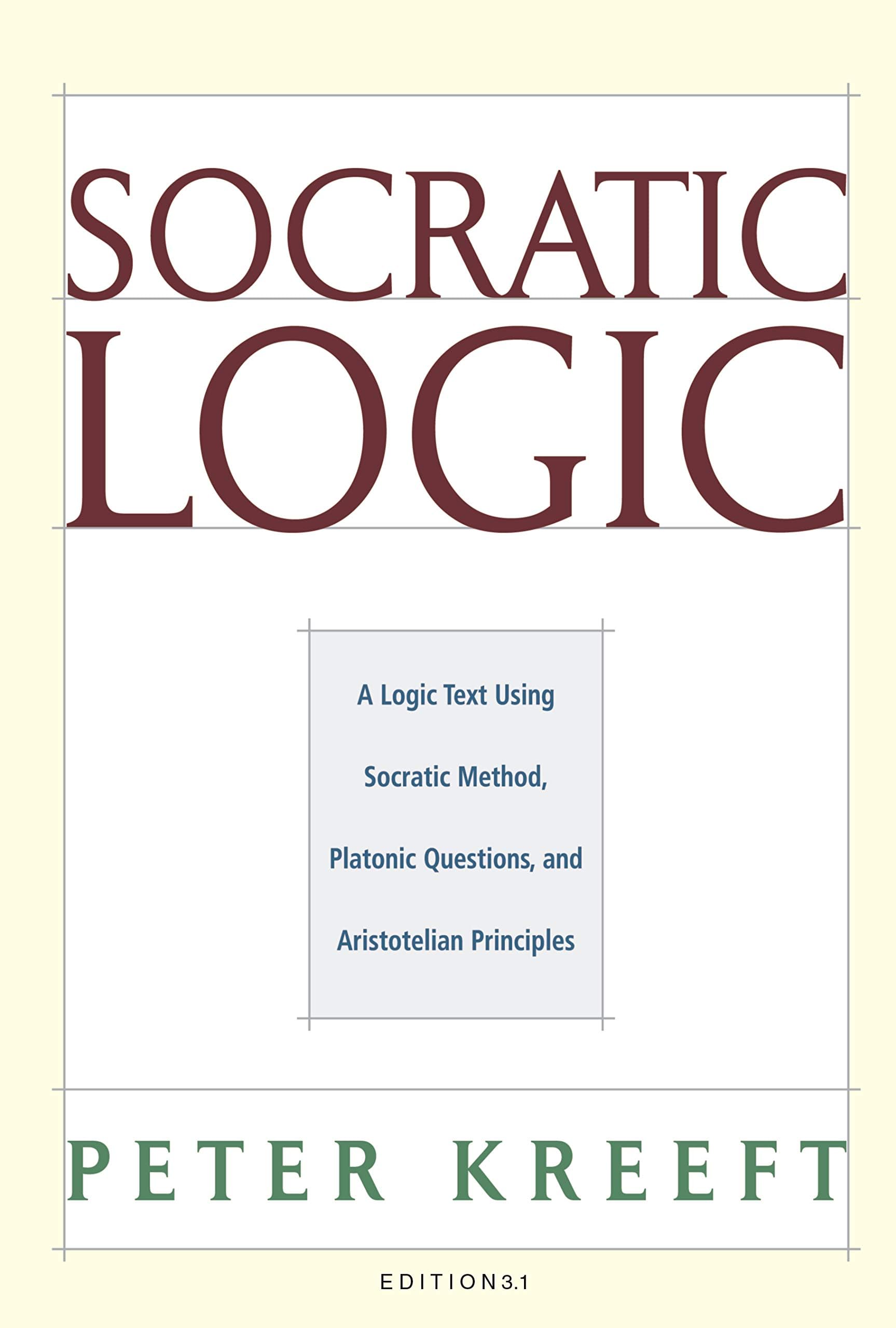
Socratic Logic: A Logic Text using Socratic Method, Platonic Questions, and Aristotelian Principles, Edition 3.1
Product ID: 3866191
Buy anything from 5,000+ international stores. One checkout price. No surprise fees. Join 2M+ shoppers on Desertcart.
Desertcart purchases this item on your behalf and handles shipping, customs, and support to Denmark.
This new and revised edition of Peter Kreeft’s Socratic Logic is updated, adding new exercises and more complete examples, all with Kreeft’s characteristic clarity and wit. Since its introduction in the spring of 2004, Socratic Logic has proven to be a different type of logic text: (1) This is the only complete system of classical Aristotelian logic in print. The “old logic” is still the natural logic of the four language arts (reading, writing, speaking, and listening). Symbolic, or “mathematical,” logic is not for the humanities. (How often have you heard someone argue in symbolic logic?) (2) This book is simple and user-friendly. It is highly interactive, with a plethora of exercises and a light, engaging style. (3) It is practical. It is designed for do-it-yourselfers as well as classrooms. It emphasizes topics in proportion to probable student use: e.g., interpreting ordinary language, not only analyzing but also constructing effective arguments, smoking out hidden assumptions, making “argument maps,” and using Socratic method in various circumstances. (4) It is philosophical. Its exercises expose students to many classical quotations, and additional chapters introduce philosophical issues in a Socratic manner and from a commonsense, realistic point of view. It prepares students for reading Great Books rather than Dick and Jane, and models Socrates as the beginner’s ideal teacher and philosopher. Review: Kreeft vs. Copi - At the core of any work, especially something so foundational a topic as logic, lies a particular web of beliefs and principles that the authors bring to the table. In the average logic course, you're likely to encounter either Irving Copi's or Patrick Hurley's textbook, and both are quite good; I've used both of them, and I especially enjoy Irving Copi's book, as he was a talented student who had the privilege of studying under the illustrious Bertrand Russell, and his talent in and passion for clear reasoning in the pursuit of truth comes through nicely. Still, one thing is missing from these two that can, in turn, be found in Kreeft's text on logic, and that is a justification for his approach to the subject over and against others. Kreeft champions a classical approach to logic, which is by no means a deficient one, contrary to any of Wittgenstein's infamous remarks, and this sort of full disclosure and justification isn't quite something one will get from other texts, as far as I'm aware. The mere acknowledgement of the disjunction between the modern approach to logic and classical one is what makes this book worth studying, especially serving a corrective, supplemental, or dialectical role in relation to Copi or Hurley. In addition to the dialectical value of this book, there are a few quality-of-life advantages that this book has over, say, Copi et al. For example, Kreeft's incisive wit and wry prose are welcome antidotes to their more blithe and dull counterparts found in standard textbooks. It also covers the same foundational building blocks that are standard in a logic course, so you're not going to be surprised per se by material found in Copi or Hurley if you solely read Kreeft as your introduction to logic, but I do recommend it as a companion to Copi's text in logic for a more holistic approach to study. Review: The Key to Clear Thinking - As a layperson who has somewhat of an interest in philosophy and logic, I honestly don't feel like I need any other book. This book is perfect for the amount of depth that I want to get into the subject. It's not too much and not too little. I like that the author stresses the importance of classical logic over modern symbolic logic. I think if I dove straight into symbolic logic, I would've quickly lost interest in the subject.
| Best Sellers Rank | #45,546 in Books ( See Top 100 in Books ) #1 in Logic (Books) #26 in Philosophy of Logic & Language |
| Customer Reviews | 4.7 out of 5 stars 330 Reviews |
W**.
Kreeft vs. Copi
At the core of any work, especially something so foundational a topic as logic, lies a particular web of beliefs and principles that the authors bring to the table. In the average logic course, you're likely to encounter either Irving Copi's or Patrick Hurley's textbook, and both are quite good; I've used both of them, and I especially enjoy Irving Copi's book, as he was a talented student who had the privilege of studying under the illustrious Bertrand Russell, and his talent in and passion for clear reasoning in the pursuit of truth comes through nicely. Still, one thing is missing from these two that can, in turn, be found in Kreeft's text on logic, and that is a justification for his approach to the subject over and against others. Kreeft champions a classical approach to logic, which is by no means a deficient one, contrary to any of Wittgenstein's infamous remarks, and this sort of full disclosure and justification isn't quite something one will get from other texts, as far as I'm aware. The mere acknowledgement of the disjunction between the modern approach to logic and classical one is what makes this book worth studying, especially serving a corrective, supplemental, or dialectical role in relation to Copi or Hurley. In addition to the dialectical value of this book, there are a few quality-of-life advantages that this book has over, say, Copi et al. For example, Kreeft's incisive wit and wry prose are welcome antidotes to their more blithe and dull counterparts found in standard textbooks. It also covers the same foundational building blocks that are standard in a logic course, so you're not going to be surprised per se by material found in Copi or Hurley if you solely read Kreeft as your introduction to logic, but I do recommend it as a companion to Copi's text in logic for a more holistic approach to study.
A**X
The Key to Clear Thinking
As a layperson who has somewhat of an interest in philosophy and logic, I honestly don't feel like I need any other book. This book is perfect for the amount of depth that I want to get into the subject. It's not too much and not too little. I like that the author stresses the importance of classical logic over modern symbolic logic. I think if I dove straight into symbolic logic, I would've quickly lost interest in the subject.
T**K
Like Drinking from a Cool Mountain Stream
Decades may pass before this book is recognized for what it is: the most straightforward, honest, and philosophically illuminating logic text in print. It is hard to fathom how rare and useful it is for a man as well-read as Kreeft, and as orthodox, to sift through most historical and modern logic texts for us, and to present all the classic features of logic, and the salient departures from the classic approach to logic. Moreover he does this in one highly accessible, lively, readable volume. This book is even clear (and fun) enough to avoid intimidating an interested middle or high school student. It takes a uniquely dedicated and selfless teacher to 'condescend' as charitably as Kreeft does here- this book is bursting with palpable, intellectual energy on even simple topics, and overflowing with helpful examples on more difficult ones. This book ought to be also a standard, near-required text for Catholic and Christian colleges. It may be some time before that happens, but it will happen, because it needs to.
A**T
Excellent Introduction; Overdone Rhetoric
Pros: 1. Kreeft's book is perhaps the most excellent introduction to logic (esp. Aristotelian) around. 2. It is generally easy to read. 3. It has abundant exercises and examples. Cons: 1. Kreeft misunderstands so-called modern logic, confusing it with metaphysics. Any model of modern symbolic logic that is more advanced than simply propositional logic is just as serviceable with realist metaphysical backing as Aristotelian logic is. After awhile, the comments get annoying, and they tend to get worse in quality as the book goes on. There's an article in "First Things" that responds to Kreeft briefly and decisively on the matter, with excellent questions. For example: if Aristotelian logic is necessarily realist rather than nominalist, how did the nominalists in the 1300s get along just fine using it? 2. Some of his exercises are...bad. As in, they don't actually test what the topic is. Most of them are fine, but somewhere around 5% of them seem more oriented towards Kreeft making criticisms of people/positions he disagrees with, instead of actually being on the topic. 3. Inflated self-importance. While the best introductory text, Kreeft is not the only modern text which discusses Aristotelian logic (of course, this in part depends on just how recent a text has to be). Further, he has a far-reduced scope of primary sources. No non-Catholic thinkers in Aristotelian logic are referenced, which misses out on a huge amount of the Aristotelian tradition. That said, Kreeft really is one of the only Aristotelian logic texts around to actually include copious examples and exercises, dealing with ordinary language. While at times one of the more frustrating parts of the book, it is also definitely the most helpful and distinctive part of the book too. Until a better book of Aristotelian logic, which is less rhetorical, emerges: this is the best modern introduction to logical thinking for the contemporary student (whether high school or college, or later). I highly recommend its use.
J**N
Great book.. ignore the bad reviews
Unbelievable book (in a good way). I think it should be known that the author is a fervent believer of Christianity, which is why some reviews of the book are not so friendly towards the author. However, I could care less about PC culture and instead would rather focus on the wisdom and knowledge contained in this book. I’m writing this review long after reading as I revisited the book to buy for a friend and saw some unpleasant reviews. I have read the book multiple times and was easily able to ignore the authors “Christian personal philosophy.” I think people have become so sensitive that a book full of great teachings with a couple of anti PC moments has mangled their experience with the entire book. I’d imagine you found this book to learn, it will absolutely help you do so. (Something the bad reviews even admit to themselves! 1 star because it’s not PC enough? Cmon now)
T**I
Good overview, can be a bit different in implementation
Asking questions to guide learning is very effective for getting people to develop critical thinking skills. I have tried teaching with and without socratic logic and implementation is different at the individual, small group, and class scale. I find it most effective when getting people to identify where they have made a mistake without pointing it out to them. This way they form the understanding themselves rather than me just giving them the answer. Some students complain about me not giving them the answers, but I am there to teach and help them learn and sometimes that is not the most effective method.
L**Y
Best logic text for regular people.
This book will help you understand why social media arguing is (often times) worthless. If you understand Socratic logic, you can dismantle bad ideas quickly and effectively without appealing to emotions over sound reason. Want to understand how to hold your ground beyond emotional reasons? This book is for you! Also, the answers in the back of the book allow you to learn on your own OR with others. Cannot say enough good things about this book.
P**G
You will not find another like it.
Dr. Kreeft is an amazing logician, philosopher and theologian. His work is wonderfully inspiring and insightful. This book, which collects the wisdom of Socratic logic and re-presents it to a modern reader, is indispensable if you want to be better able to understand your thoughts, determine what is true, valid and good, and understand how we can arrive at conclusions.
T**A
It replaced the lenses through which I see and understand the world
It took me 1-2 months to read through it completely. I find myself re-reading it just to get another appreciation for the details I might have missed. I will only say: difficult read at first but worth it. The rest is left to be discovered.
A**M
Just begin reading seems interesting topic and write
Nice
F**O
It's an excellent book not just rich in logic...
Probably this author is a one of kind masters of our era to base this book on such extraordinary authors and books, you can se that he can clearly understand and master the subject, it also has some beautiful insights about general philosophy that make this book one of the best and TOP of the ones you can buy. God bless friends...
J**N
Yes, O Socrates!
I really, really like this book. It's an easy-to-read but thoroughgoing presentation of syllogistic (or 'Aristotelian', or 'category', or 'term') logic, the logic devised by Aristotle and taught at universities till some time in the last century. Syllogistic logic shows how to combine pairs of premises, each of which is a 'categorical' subject-predicate proposition of one of four types - All S are P Some S is P No S is P Some S is not P - so as to yield a valid conclusion, one that can't be false so long as the premises are true. Syllogistic logic has long been dropped from university courses in favour of predicate logic, a mathematised discipline that translates propositions into a completely symbolic language, so that a simple-looking syllogism such as All men are mortal and Socrates is a man, so Socrates is mortal is transmogrified into something like ∀x(Px → Qx), ∀x(Qx → Rx) : ∀x(Px → Rx) From the off and throughout Kreeft makes his case that syllogistic logic, though not as versatile as predicate logic, is more useful, since we're more likely to use it: the handful of types of proposition, and types of argument, it treats are easier to understand, to remember and to apply in real life than the upside-down As and backwards Es of its modern rival. And he's very persuasive: thinking in syllogisms comes more naturally than thinking in symbols, and in a real-life conversation the rules laid down by Aristotle spring to mind more readily than all the intricacies of quantifiers, variables, relations and whatnot. There's useful non-syllogistic stuff too: an in-depth chapter on informal fallacies, and a great section on the importance of defining terms with the Aristotelian tools of species and genus. There are memorable examples throughout. The book deals with all the basics of syllogistic logic that appear in (very) traditional textbooks: the square of opposition, the distinction between contrariety and contradiction, the immediate inferences (for example, from 'All As are B' we may without further ado infer 'All not-Bs are not-A'), such fallacies as illicit major, illicit minor and undistributed middle, and more exotic arguments such as sorites, epicheiremas and the rest. Students of modern propositional logic (which Kreeft conflates with predicate logic) will recognise its outlines in the chapter on compound syllogisms. There's a sensible treatment of the alleged problem of existential import, and a good chapter on inductive logic that runs through Mill's methods. I say the book's distinctive strength, however, is its blatant Catholicism. The Scholastics developed syllogistic logic to a very high degree, especially in uncovering its metaphysical foundations, and over the years seminaries and other institutions have preserved this inheritance. Kreeft - an unapologetic Catholic apologist - makes full use of it. He discusses and explains the three acts of the mind, Aristotle's categories, the predicables, and even the Tree of Porphyry - things that haven't appeared in a logic book for many years. He also gives a full-blooded defence of realism about universals, the correspondence theory of truth, and what he calls 'epistemological realism' - the view that we really can know things about the 'outside' world. I have a few low-level gripes. Malapropisms aren't the same as amphibolies. The Goclenian sorites is more complicated than Kreeft says. Also, despite being in its '3.1' edition, the book still has a fair few typos, and not much of an index. But none of this matters. If I could change one thing, I would greatly expand the section on the medieval 'Barbara Celarent' mnemonic for valid syllogisms. The intricacies of this mnemonic - how the vowels stand for types of proposition, and some of the consonants for the logical operations to transform one syllogism into another - are among the great beauties of syllogistic logic. I've gone on far too long. This is a great book, the best logic textbook I know, and I wish it had been written years before it was!
M**I
Socratic Logic
Very good book
Trustpilot
1 month ago
4 days ago