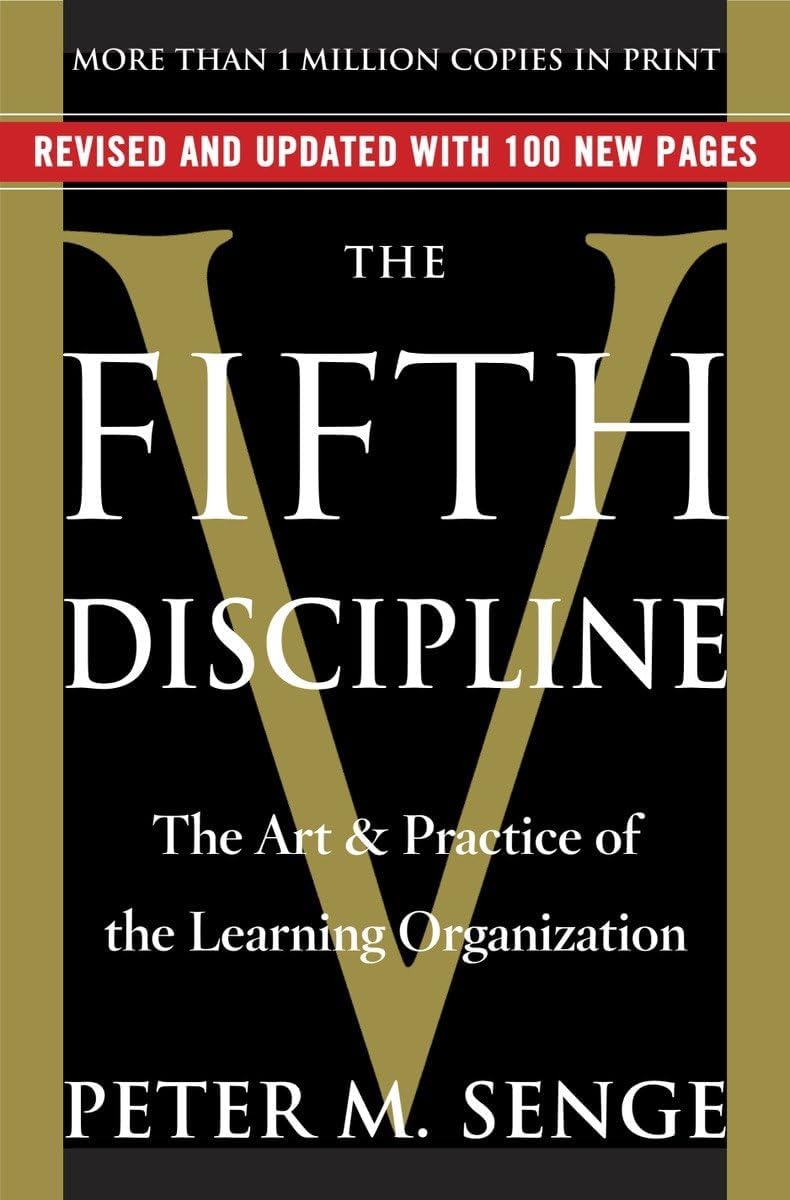
The Fifth Discipline: The Art & Practice of The Learning Organization
Product ID: 3671027
Buy anything from 5,000+ international stores. One checkout price. No surprise fees. Join 2M+ shoppers on Desertcart.
Desertcart purchases this item on your behalf and handles shipping, customs, and support to Denmark.
MORE THAN ONE MILLION COPIES IN PRINT • “One of the seminal management books of the past seventy-five years.”— Harvard Business Review This revised edition of the bestselling classic is based on fifteen years of experience in putting Peter Senge’s ideas into practice. As Senge makes clear, in the long run the only sustainable competitive advantage is your organization’s ability to learn faster than the competition. The leadership stories demonstrate the many ways that the core ideas of the Fifth Discipline, many of which seemed radical when first published, have become deeply integrated into people’s ways of seeing the world and their managerial practices. Senge describes how companies can rid themselves of the learning blocks that threaten their productivity and success by adopting the strategies of learning organizations, in which new and expansive patterns of thinking are nurtured, collective aspiration is set free, and people are continually learning how to create the results they truly desire. Mastering the disciplines Senge outlines in the book will: • Reignite the spark of genuine learning driven by people focused on what truly matters to them • Bridge teamwork into macrocreativity • Free you of confining assumptions and mindsets • Teach you to see the forest and the trees • End the struggle between work and personal time This updated edition contains more than one hundred pages of new material based on interviews with dozens of practitioners at companies such as BP, Unilever, Intel, Ford, HP, and Saudi Aramco and organizations such as Roca, Oxfam, and The World Bank. Review: Great Book - "The Fifth Discipline: The Art and Practice of the Learning Organization" by Peter M. Senge was a book assigned to me for my Quality Control class and I have to say that this book has great concepts of improving your business through learning organization. Within the learning organization Senge points out five disciplines; Personal Mastery, Mental Models, Shared Vision, Team Learning and Systems Thinking being the fifth discipline. Peter M Senge believes that a learning organization must achieve all five disciplines in order to better improve the organization. Senge also mentions five organizational disabilities that prevent a company from being successful. Peter Senge does a great job in deeply explaining all five disciplines. One thing I really like about this book is how Senge offers real life scenario to help him get his point across. One scenario that really got my interest was the Beer Game scenario. It's a pretty long scenario but well worth it to understand Senge's point that systems are interdependent of each. Meaning that systems will similarly think in qualitative terms. A key factor I got from this scenario is that we must break the way that systems independently think of their own decisions. The organization must think as a whole and must keep in mind how their decisions affect the rest of the system. Overall this book is a little complicated to understand at moments but contains very interesting concepts of improving an organization. In my opinion, this book is written for individuals in a managerial type position that have the power in greatly influencing their business decisions. I recommend this book to any individual in any industry that wants to better their organization. Review: Fantastic Book - Fantastic book. A bit intellectual, yet solid in rationale and recommendation. Every learning leader, CLO, and CHRO should read this book!


| Best Sellers Rank | #11,572 in Books ( See Top 100 in Books ) #9 in Business & Organizational Learning #63 in Business Management (Books) #106 in Leadership & Motivation |
| Customer Reviews | 4.6 out of 5 stars 2,542 Reviews |
C**S
Great Book
"The Fifth Discipline: The Art and Practice of the Learning Organization" by Peter M. Senge was a book assigned to me for my Quality Control class and I have to say that this book has great concepts of improving your business through learning organization. Within the learning organization Senge points out five disciplines; Personal Mastery, Mental Models, Shared Vision, Team Learning and Systems Thinking being the fifth discipline. Peter M Senge believes that a learning organization must achieve all five disciplines in order to better improve the organization. Senge also mentions five organizational disabilities that prevent a company from being successful. Peter Senge does a great job in deeply explaining all five disciplines. One thing I really like about this book is how Senge offers real life scenario to help him get his point across. One scenario that really got my interest was the Beer Game scenario. It's a pretty long scenario but well worth it to understand Senge's point that systems are interdependent of each. Meaning that systems will similarly think in qualitative terms. A key factor I got from this scenario is that we must break the way that systems independently think of their own decisions. The organization must think as a whole and must keep in mind how their decisions affect the rest of the system. Overall this book is a little complicated to understand at moments but contains very interesting concepts of improving an organization. In my opinion, this book is written for individuals in a managerial type position that have the power in greatly influencing their business decisions. I recommend this book to any individual in any industry that wants to better their organization.
P**G
Fantastic Book
Fantastic book. A bit intellectual, yet solid in rationale and recommendation. Every learning leader, CLO, and CHRO should read this book!
F**J
My Notes from The Fifth Discipline
The Fifth Discipline: The Art & Practice of the Learning Organization written by Peter Senge in 1990 has some great viewpoints for upper and middle managers to learn from. The book may seem to apply its learning philosophy for large size companies but is valid for a company of any size. Senge’s views of the learning organization are broken down into five disciplines; they are: personal mastery, mental models, team learning, building shared vision, and systems thinking. In chapter 2, Senge explains the seven deficiencies of a learning organization which he calls the “seven learning disabilities”. I don’t know why but the “parable of the boiling frog” stands out in my mind the most; that of letting threats gradually sneak up on or your system. Or being complacency or too comfortable where you can’t react in time because it’s too late. Senge does a good job of giving the reader a visual with his illustrations and examples. On page 89 he mentions of how the temperature controls adjustments can overshoot the target and exceed the desired limits. A simple time delay between adjustments can help stabilize the process from overshooting the opposite limits. I’ve seen this on systems that monitor the relative humidity when storms blow in and change the dew point. Also, when my spouse comes home from work and adjusts the thermostat as low as it can go thinking the A/C unit will cool down faster. By the time I get home the house is freezing…. Senge’s point is that sometimes delays to a process are sometimes necessary while other delays, like in the “beer game” orders, may be a burden and create an issue. The beer game was in chapter 3 is a great example of how material flows from the brewery, through the distributor, and then to the retailer for sale to the consumers. The process is a little redundant and maybe a little long winded but is important for the readers or managers to understand how easily things can go wrong. My initial thought was the book was written in 1990 and now that we have the internet with B2B software, it could resolve the communication breakdown between the three parties and have material flow closer to JIT process. This would help the reaction time as sales increase or decrease. Senge references the beer game throughout his book and mentions the game was first developed in the 1960’s as a demonstration at MIT’s Sloan School of Management. The “7 Disabilities” of an organization relate to the “11 Laws of an Organization” in chapter 4. The seven disabilities can be conquered by the disciplines of the eleven laws of an organization. What I thought reading through the beer game was somewhat difficult but was nothing compared to the agonizing chapters of 6 and 7. Chapter 8 was refreshing that deals with “Personal Mastery”. I guess the part I enjoyed was the “Personal Vision” where I can evaluate my own visions and not just my goals. It clarifies the vision and what it takes to achieve being a “personal mastery”. It mentions to fill in the gap between my vision and reality; the “gap” is the energy of making my vision a reality. One thing Senge mentions is that “organizations learn only through individuals who learn. Individual learning does not guarantee organizational learning. But without it no organizational learning occurs”. Leadership, vision, and disciplines all play a part in creating a learning organization. These are just some of my notes that I made for myself and almost gave the book only three stars for the long drawn out sections. Other than that it is a good book and one to highlight and tag notes inside and keep on your shelf. That is just my take on it - hope my notes help.
C**T
Great book.
Great book. Great concepts.
C**.
A must read for those who want to know more about how to make an influence your workplace, your community and in your own life.
The purpose of the Fifth Discipline is to turn corporations into learning organizations and to create learning environments for those that take part in these corporations. The author explains what the 5 disciplines are and describes the 7 learning disabilities that each of us will encounter and how to overcome them. The first discipline is personal mastery. By achieving this discipline we are able to see the results that matter most to us. The second discipline involves overcoming mental models. Mental models are ideas that are essentially ingrained into the way we think. The third discipline is building a shared vision. A shared vision is a common and genuine goal where people want to learn because they want to. The fourth discipline is team learning. Team learning is being able to enter a dialogue where ideas are shared openly and everyone is thinking together, not just a single person providing ideas and the rest of the group agrees as to not create conflict. The fifth discipline is systems thinking, the bonding agent meant to bring all the other disciplines together. This discipline is where people discover how they create their reality and how the can change it. We are then given an in depth description of the 5th discipline, systems thinking. Systems thinking is the idea that we are all part of a larger system, it wants us to view ourselves as part of nature and not just an observer separate from every other living thing. The author wants us to understand that our problems aren’t caused by some external source but instead caused by our own actions and our inability to find the root cause of our problems. He shows us how to identify naturally reoccurring patterns in nature, how people normally react to these patterns, and how to counteract the negative effects of these patterns by teaching us how to attain leverage on each type of pattern. Based on the lessons taught in this book I feel that these disciplines can be used in making effective changes in not only the workplace environment but in my community and in my personal life.
T**F
Must for any manager
In this book Peter Senge discuss how to become a learning organization. Learning organizations are organizations that facilitate individual learning and continuous improvement. To illustrate his many concepts, Senge provides simple to understand examples and real world situations. By reading this book you can better adapt to change, become more innovative, and remain competitive. This book is mainly geared toward managers but its idea can be applied to anyone at any level. The main ideas that this book goes over are: 1.Personal Mastery is the continuous motivation to personal growth and learning. Organizations need individual growth and learning to grow and learn. 2.Share Vision is the building of deep common caring for the vision. Organizations not only need a common vision but one that individuals deeply care about and can unite behind. 3.Mental Models is challenging deeply held internal assumptions. Organizations need to constantly surface, challenge, and improve old familiar assumptions. 4.Team Learning is the sharing of individual learning. Organizations need this to allow its employees to grow quicker. 5.System Thinking is the viewing of the world as a complex system where everything is connected to each other. Organizations need to view themselves as part of a system and how their actions affect the system.
A**R
he explains his insights on how we can break these cycles from a traditional linear way of thinking to systems thinking which ev
Although it is somewhat evident that this book is a bit older and lacking some modern day examples, “The Fifth Disciple” by Peter Senge captures concepts of how to create a learning organization. Senge masterfully explains how people are stuck in a traditional way of thought and how it affects our decision making in business practices. The book also features a simulation experiment done with MIT students called, “The Beer Game.” The game results from show a repeated pattern of the points Senge is making about how we think similarly in terms of individuality and how it creates cycles in which we fail. From there, he explains his insights on how we can break these cycles from a traditional linear way of thinking to systems thinking which eventually ties in to create a better learning organization. As an engineering major, I felt this book did a very good job in tying a lot of concepts together that is practical in the major. The book also does a good job of highlighting where systems thinking is also practical in improving broader things like family, teams and organizations along with businesses. This book is definitely worth the read for anybody as it applies to everyday interactions. For anybody with management and business control positions, this book will definitely enlighten you on the benefits of operating under a learning organization especially if working in a supply chain industry.
M**B
Dense yet compelling, overly restrictive clipping limits on Kindle
For Kindle Users: The clipping limits on the kindle edition of this book are so restrictive that you cannot use the sharing function on the Kindle at all. I love to tweet my comments on highlighted text through my Kindle. Its one of the best Kindle features in my opinion. However, this book appears to have clipping limits so restrictive that I could not tweet even once. Too bad, neither Amazon nor Crown Business Publishing will get the free advertising that comes from the tweets related to this book. For everyone else: The book, while dense and in some places longer than it has to be, was well written explaining a topic that is not intuitive. Systems thinking might have been a better subtitle, though, as that seems to be the primary focus of the book.
社**ー
マネジメントの基本を深く考えた内容
初版も大きな衝撃があったが、初版に新たに実践的な手法を書き加えた改訂版。2006年に出版されたときから大きな話題になった。 ドラッカー亡き後、経営学の中心にあって、「学習する組織」あるいは「組織学習」という理念で、人間が組織を創り、その人間が志。自分への謙虚さ、対話、チーム学習、固定概念の打破等で5つのDiscipline(日本語「稽古」に近いかも知れない)を修得すること説いている。翻訳も出たが、著者の精神を読み取るために是非原書で読んで欲しい1冊である。 低迷している日本経済を建て直すヒントがこの本にあるようだ。
K**T
Excellent - beyond what I expected
I ordered this book for a Masters level program I'm taking. I'm pleased this is one of my textbooks, as I will use it forever more! Great content.
S**C
Good quality
Good book
G**D
A classic book
A classic book which lays the foundation for building learning organisations and knowledge management.
C**N
Ótima leitura para quem busca entender o diferencial de empresas do futuro.
O livro fala de disciplinas que as empresas precisam dominar para serem bem sucedidas. Dentre as disciplinas a quinta disciplina o autor destaca como sendo a principal e que não é muito presente nos dias de hoje. Recomendo a leitura.
Trustpilot
1 month ago
1 week ago