


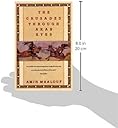
The Crusades Through Arab Eyes (Saqi Essentials)
Desertcart purchases this item on your behalf and handles shipping, customs, and support to Denmark.
Description
🌟 Unlock the untold story of the Crusades — see history through a new lens!
- HIGHLY ACCLAIMED - Top-ranked military strategy and history book with 4.6-star rating from 846 readers.
- MULTICULTURAL INSIGHT - Gain a rare, nuanced understanding beyond Western narratives shaping modern perspectives.
- DIVE DEEP INTO HISTORY - Explore the Crusades through authentic Arab chronicles and eyewitness accounts.
- MASTERFUL STORYTELLING - Amin Maalouf’s erudite and poignant prose brings complex historical events vividly to life.
- THOUGHT PROVOKING SCHOLARSHIP - Challenge conventional views with a groundbreaking multicultural retelling.
The Crusades Through Arab Eyes by Amin Maalouf is a 293-page paperback that retells the Crusades from the perspective of contemporary Arab chronicles and participants. This masterful work offers a rare multicultural viewpoint, challenging traditional Western narratives and illuminating the historical forces shaping Arab and Islamic consciousness today. Highly rated and ranked among top military strategy and history books, it’s essential reading for anyone seeking a deeper, more inclusive understanding of this pivotal era.

Specifications
| Dimensions | 5.1 x 0.67 x 7.9 inches |
| Isbn 10 | 0805208984 |
| Isbn 13 | 978-0805208986 |
| Item Weight | 2.31 pounds |
| Language | English |
| Part Of Series | Saqi Essentials |
| Print Length | 320 pages |
| Publication Date | April 29, 1989 |
| Publisher | Schocken |
Reviews
User
Highly Recommend
Great read and very informative; must put book down within chapters to digest all the information. Does jump around timeline (back and forth) as well as around the different areas (Baghdad to Tyre, back to Baghdad earlier in timeline, back to western Syria with mixture of timelines, etc) within each chapter and within each 100-yr segment. But very informative; helps me understand modern middle east much better. Two useful maps but I did use an atlas as well. Highly recommend for historical as well as social and religious values education.
User
An Amazing History
This book presents the history of the crusades from the viewpoint of the Arabs and other peoples of the middle east. On reading this book, what one realizes is the brutality of the experience. While it is expected that war will bring with it brutality, it is surprising to read of this brutality being dealt out in the name of Christianity, not only on Muslims but also on other Christians.One of the most shocking incidents in one of the initial battles of the crusades is when a poorly supplied and starving Christian army storms a Muslim city and proceeds to boiling men and roast children and begin devouring them to ward of their hunger. This incident is backed up by Christian sources as well. You can imagine that such display of violence would scar a region for centuries.I really recommend reading this book in order to get an idea what people in the middle east are thinking in these troubled times. While those of us in the west may have forgotten what happened during the crusades, it is something which people in the region think about constantly, and their view of western actions in the region are colored by this experience. By reading this book, you may have a chance to change your perspective and see things through the eyes of others. In addition, this is perhaps one of the most well-written histories I've read in a while. The style is not academic, so anyone will find this an easy read and will get caught up in the story.This is a must-read.
User
Fresh writing and a compelling account of the Crusades from the Arab perspective
Everyone knows that the Middles Ages were barbarous times, but the Europeans come out of this account looking like downright savages. Don't get me wrong, the Arabs aren't presented as the ideal people of earth in the book, but their "Christian"-invader counterparts from Europe come off as filthy, greedy, opportunistic and brutal which, truth finally be told, they were. Maalouf even supplies a few recorded accounts of crusader cannibalism, where the enemy is cooked and eaten. Along with that are several Arab exchanges of heads in boxes. Gruesome.Maalouf has done his due diligence here. He starts with the state of the Arab world before the first Crusade, indicating the fractured state of the area and how one kingdom would not necessarily come to the aid of another. Everything takes off from there, with an account of all the Crusades, the Saladin, etc. If you've played Age of Empires 2: Age of Kings, seen Kingdom of Heaven: The Making of the Ridley Scott Epic (Newmarket Pictorial Moviebook) and read The Civilization of the Middle Ages: A Completely Revised and Expanded Edition of Medieval History, then you'll be fully prepared for Maalouf to round out the story of the Crusades. And the author does it all without any sort of bias towards one side or the other.Concise, educational and entertaining all at the same time.
User
A very interesting book
When I picked this book up I figured it would be an all out hate attack against the West and would prop up the East as being saintly. I was surprised though, because it was very little of that at all. In fact, most of the book revolved around the problems between the Arab emirs and sultans. It seems as though there political problems have not changed for hundreds of years, heck, it seems as though they were more screwed up than the Crusaders'.Obviously there was some bias. Whenever the Crusaders won the Muslims "fought valiantly" and whenever the Muslims won the Crusaders were "crushed." But, do realize that this is an arab's perspective and a fanatic christian would probably do a similar turn.It doesn't give a real concise history of the crusades because it seems that from the Arab's perspective, there isn't a numbering of crusades, rather, a constant threat of invasion. So, you would have to have a little knowledge of the crusades before reading this book so that one could distinguish between the 1st and 3rd crusade for instance.I did like how it went into a bit of detail on Reynald de Chatillon, the merciless hater of Muslims who doesn't seem to get a whole lot of mention in any of Western accounts of the Crusades that I have mentioned, but even then there were some discontinuities, for I had though the 3rd crusade was started with his attacking a caravan with one of Saladin's wives, yet Maaloof only makes not of an attack on a caravan.But, the author is fair and in the final piece, seems a bit reluctant to admit that while the Muslim east expended its energies to relieve the land of the "Franj" it in the same token lost much of what it made it a civilized land, in effect, passing their civilization onto the Franj in exchange, ironically, for the backwardness and religious fanaticism that was used to describe the first Frankish invaders in 1097.Overall, I recommend this to anyone who has some idea of the crusades and wants a different outlook. Its an easy read, not weighed down by too many facts though for the Western reader, the Arabic names seem to get confusing at times.
User
Better than game of thrones
Your jaw will be on the floor the entire time you're reading this book. It disposes of the dry expository style of most works of medieval history and instead takes on the narrative style of a novel. The unexpected twists of fate, spycraft, betrayals, assassinations, battlefield ingenuity, and unlikely alliances that make up the various kingdoms and city-states of the Middle East are laid out in a way where you'll genuinely get invested in these "characters" of history. You'll find yourself holding out hope that this time they'll stop the mysterious Frankish hordes, or rooting for Damascus over Aleppo or Acre over Jerusalem, only to suddenly have that hope smashed against the wall by marauding Turkish prince or a hashish-smoking Assassin from Iran.At the same time, Maalouf keeps his story completely based in hard research into *Arabic* primary sources of the time period, which is something only a tiny minority of the foremost "experts" on Middle Eastern history today ever even bother with. He maintains his credibility as a historian yet shows incredible prowess as a storywriter, seamlessly citing inline while encouraging the reader to be skeptical where appropriate. Writers like Ibn al-Athir become characters in and of themselves, contextualized into their own time periods and priorities as writers. Eurocentricity never once makes an appearance, keeping true to the title of the book by keeping you as informed or in-the-dark about the Europe of this period as the Muslims were then. Maalouf doesn't fall into a single racist trope about fanatical Muslims or anachronistic ideas of ethno-religious identity, ever the easy escape of the lazy Middle East expert. He does the hard work of showing you with hard fact the precise political motivations of every little prince of every little city, painting a beautiful picture of the region and time period that will leave you wishing for a TV adaptation of his work.
User
Masterful and Perceptive
There is only one thing that made this a difficult read: the phonetic transliteration of Arabic names is lousy in the Kindle edition. Otherwise,Maalouf is masterful, superbly narrative and poignant as he alludes to the long and deep wounds of The Crusades upon Arab peoples and upon the perception of persecution that often accompanies fanatical mindsets in both East and West. Maalouf is erudite and cogent as he lays out the chronology of the convoluted and intrigue-laden events over a three or four hundred year period. He also demonstrates the fragility of peace and order in The Holy Land during this time period. This book is a rare gem as most texts I have read as an historian have been the Turkish, Western European and the Greek perspectives (my languages are Turkish, Latin and Greek). Uniquely, Maalouf demonstrates the intricacies of the tapestry of cultures present from India to Egypt to show us that there was no monolith of cultures on either side.I often read several historical books from differing perspectives simultaneously, as it tends to deepen my understanding of events. I recommend reading Robert Payne’s THE DREAM AND THE TOMB along side this book for a beautifully written and researched Western perspective of the eight crusades and the end of Christian occupation.
User
A must-have for a complete look at the Crusades.
Oddly, I purchased this book some time ago but only read it over these past two weeks-a shame because it is a wonderful book and one that has expanded my understanding of all that happened during the centuries of the Crusades.Maalouf's nicely condensed book is a joy to read with many passages from medieval Arab chroniclers and an ability to, for the most part, thread his [and our] way through mightily complex Near Eastern dynastic histories. I say for the most part because, particularly in Part Three, he gets mired in that political dynastic swamp alluded to previously. Fortunately he uses that historical patchy ground to launch into a discussion of the rise and dominance Saladin in this political morass.Maalouf, because he is writing from a broader perspective than most Western Crusade historians, has illuminated the Near Eastern stage at the time clearer than the histories that I have read during these past years. It's strange reading the Crusade histories from this other perspective because it is like looking at a picture that you thought was familiar to you only to discover that you've been looking through a kaleidoscope and it is a little unsettling.A person studies the Crusades through Western histories and their organization usually follows each Crusade from People's through Louis' Afracan debacles; Maalouf however, never mentions these separate crusades-in fact you read of Conrad's drowning death as an event that caused the collapse of a huge band of reinforcements coming to strengthen the seige of Acre. So these separate crusades that we in the West look upon as normal historiography are passed simply as new bands of reinforcements for events already taking place.If I can criticize Maalouf, and I'm wary of doing so, I would say that for this reader he failed to present a comprehensive picture of all that was taking place in the Near East; rather he gives the reader extraordinarily detailed accounts of the details of dynastic history among a myriad of conflicting city states nominally under an umbrella government but in reality acting totally alone and for their own interests. And this is why the Crusades had any success at all-not western religious valor but eastern disunity.Maalouf has written a great book and it has my highest recommendation.
User
Amin Maalouf must be read by anyone and everyone
The Occident lives in a mindset where the Occident is the standard of all things, and anyone or anything that diverts from it is immediately classified as something other than “normal” or “natural”. When this authors proposed to write the history of the crusades - several decades ago - from the point of view of the normally described as enemies or impious or heretics or enemies of the faith, he broke through centuries of remarkable scholarship and what I must call a pacific and I disturbed understanding of the world by the Occident. This author has, however, produced such an amazing work that decades later he became one of the most important members of the Académie Française of the French language, which is no small achievement at all. All of this is to say that great works in History and Literature necessarily have to make us think and rethink a thousand times what we consider the normal and given understanding of the world. If nothing else, Amin Maalpuf has achieved this rare and remarkable status and his work is a must for any person who wants to really understand the world from a multicultural perspective.
User
excellent, well-written and an easy read
excellent, well-written and an easy read. I've read several books on the topic of the crusades and this one provides an insightful and unique perspective
User
Shocking
Very painful to read. Shows the sad history of the Muslims and how they fell into utter chaos
User
history
Really good read. Great perspective to see how this period mapped out through the eyes of the islamic inhabitants from squabbling petty rulers to the religious groups and the ordinary people. Seen through their eyes no one expected the invasions to be successful and so bloody and how the people despaired of their leaders to mount a defense and drive the crusaders back into the sea. As the story progresses we see how champions eventually emerged and were able to focus and turn the tide. We also see how the invaders eventually succumbed to the same intrigues and power struggles as their rival Islamic enemies.
User
Estupendo!
Un libro necesario hoy en dia para comprender mas el mundo arabe. Ademas se lee muy fácilmente y con un ritmo frenético. Lo recomiendo mucho
User
Enlightening
The author has done an extraordinary amount of research to bring together this historic book essential for anyone wondering why we are where we are in relations between “middle eastern” and “western” cultures. Or more accurately between Christian and Muslim countries, especially those with radical Christians and radical Muslims. Interestingly the Israelis are considered crusaders by some. The Prologue gives an insight, if not picked up when reading each chapter, about the effects of the Crusades on current world politics; why did the Arab world decline in areas of human development such as science, philosophy, education, literature and the western world take over and become more civilised cultures (to some extent).
Common Questions
Trustpilot