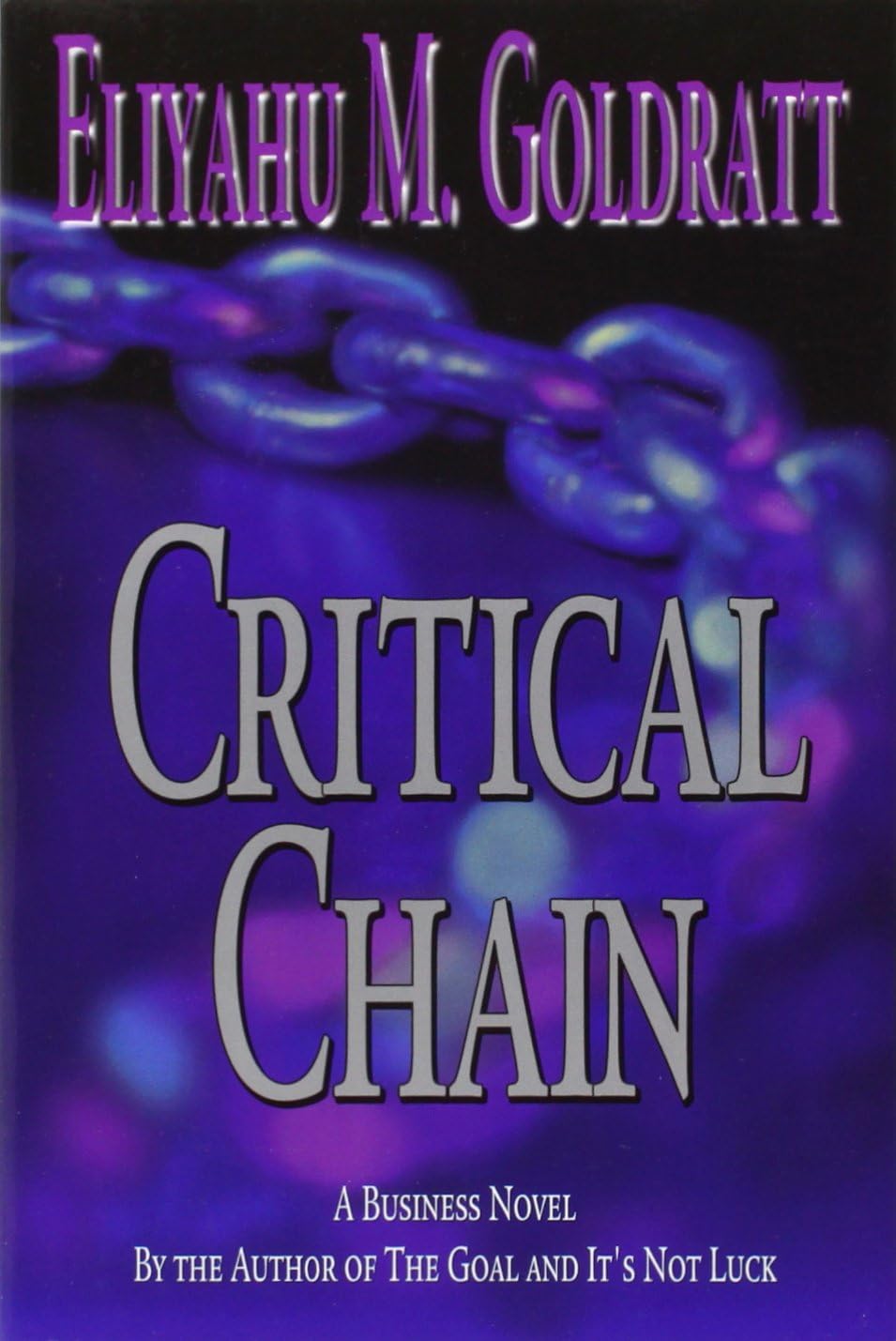
Critical Chain
Product ID: 3573962
Buy anything from 5,000+ international stores. One checkout price. No surprise fees. Join 2M+ shoppers on Desertcart.
Desertcart purchases this item on your behalf and handles shipping, customs, and support to Denmark.
Following the worldwide success of his bestseller THE GOAL, Dr. Eliyahu Goldratt wrote CRITICAL CHAIN to introduce his groundbreaking approach to managing projects. In this compelling business novel, Professor Silver and his students explore ways to deliver projects on time, within budget, and without compromising the original scope. They learn how to plan single projects better, overcome the shortcomings of forecasts by managing buffers, and lay the foundation for improving project flow. Goldratt continued to analyze project delays in countless implementations over the next couple of decades. His revelations were genuinely eye-opening. Often, the leading causes for missing deadlines are not unexpected delays but hidden elements in how we manage our projects—elements that are essentially obstacles to project flow. His rules for successfully managing any multi-project environment were meant to be the subject of his next book; however, he didn’t have the chance to complete it. In honor of his legacy and to advance his insights, his daughter, Dr. Efrat Goldratt-Ashlag, wrote the book GOLDRATT'S RULES OF FLOW for him. Review: Several Moderate "AHA"s Make This Book Valuable - Eli Goldratt continues his application of Theory of Constraints (TOC) to various business processes by focusing on project management with this latest business novella. TOC is a method of creating ongoing improvement in operational processes, as well as a general management philosophy. Goldratt introduced this theory to world in his best-selling book THE GOAL, where he applied the principles to a manufacturing setting. In CRITICAL CHAIN, Goldratt builds upon the teachings found in THE GOAL. He quickly describes of constructs of TOC, while spending more time addressing some specific phenomenon of project management versus process management. This is where the "Aha"s come into play. Goldratt's characters debate and learn why projects often run overdue and over budget, or finish with less completed than originally specified. The characters debate critical path vs. non-critical path tasks, early vs. late start, resource conflicts, safety buffers in each task, negotiating with subcontractors and suppliers, as well as the erroneous progress accounting/measurement techniques that give everyone a false sense of progress toward completion. Each of these topics were useful in challenging the conventional wisdom of project management. Each presented some new techniques for managing projects more aggressively. In my job, I indirectly manage a large number of construction project managers, and this was useful in understanding some of the reasons we struggle to deliver on time and on budget. For those of you looking for the same enlightenment that you probably derived from THE GOAL, you will be mildly disappointed. For those of you who have not yet read THE GOAL, I highly recommend reading it, because it will provide the foundation material (TOC) in much more depth and clarity. For me, TOC completes the loop of operational concepts that I have pondered over my career, namely how to improve processes and improve overall organizational productivity, while eliminating "fire fighting" and bottlenecks in production. CRITICAL CHAIN furthers the progress of this thinking relative to a project vs. a process environment. Review: Great Book on Theory of Constraints and Critical Chain - This is the book to start with on Critical Chain (i.e. Critical Path with resource considerations). Eliyahu Goldratt was one of the founders in this field and this book is the logical starting point for learning about Critical Chain project management. This is written like a novel so you can easily finish the book within a few hours if you are a normal reader. The concepts seem to be easier to grasp since they are repeated within the pages a few times and that most ideas are backed up by examples with projects examples from people in the book Pros: Easy read since it is written like a Novel Critical Chain is an interesting project management style Well though out and well executed with good examples. Cons: Critical Chain is shown as the ultimate savior to projects, even though there are issues that this method contains Sometimes we spend a lot of time reading the story without any business insights Overall this is great books and a good starting point for Critical Chain Managment
| Best Sellers Rank | #56,155 in Books ( See Top 100 in Books ) #354 in Business Management (Books) |
| Customer Reviews | 4.5 out of 5 stars 1,224 Reviews |
K**R
Several Moderate "AHA"s Make This Book Valuable
Eli Goldratt continues his application of Theory of Constraints (TOC) to various business processes by focusing on project management with this latest business novella. TOC is a method of creating ongoing improvement in operational processes, as well as a general management philosophy. Goldratt introduced this theory to world in his best-selling book THE GOAL, where he applied the principles to a manufacturing setting. In CRITICAL CHAIN, Goldratt builds upon the teachings found in THE GOAL. He quickly describes of constructs of TOC, while spending more time addressing some specific phenomenon of project management versus process management. This is where the "Aha"s come into play. Goldratt's characters debate and learn why projects often run overdue and over budget, or finish with less completed than originally specified. The characters debate critical path vs. non-critical path tasks, early vs. late start, resource conflicts, safety buffers in each task, negotiating with subcontractors and suppliers, as well as the erroneous progress accounting/measurement techniques that give everyone a false sense of progress toward completion. Each of these topics were useful in challenging the conventional wisdom of project management. Each presented some new techniques for managing projects more aggressively. In my job, I indirectly manage a large number of construction project managers, and this was useful in understanding some of the reasons we struggle to deliver on time and on budget. For those of you looking for the same enlightenment that you probably derived from THE GOAL, you will be mildly disappointed. For those of you who have not yet read THE GOAL, I highly recommend reading it, because it will provide the foundation material (TOC) in much more depth and clarity. For me, TOC completes the loop of operational concepts that I have pondered over my career, namely how to improve processes and improve overall organizational productivity, while eliminating "fire fighting" and bottlenecks in production. CRITICAL CHAIN furthers the progress of this thinking relative to a project vs. a process environment.
C**.
Great Book on Theory of Constraints and Critical Chain
This is the book to start with on Critical Chain (i.e. Critical Path with resource considerations). Eliyahu Goldratt was one of the founders in this field and this book is the logical starting point for learning about Critical Chain project management. This is written like a novel so you can easily finish the book within a few hours if you are a normal reader. The concepts seem to be easier to grasp since they are repeated within the pages a few times and that most ideas are backed up by examples with projects examples from people in the book Pros: Easy read since it is written like a Novel Critical Chain is an interesting project management style Well though out and well executed with good examples. Cons: Critical Chain is shown as the ultimate savior to projects, even though there are issues that this method contains Sometimes we spend a lot of time reading the story without any business insights Overall this is great books and a good starting point for Critical Chain Managment
K**R
New ideas in project management
This book is actually fiction, although it intended to be used as a instructional manual for implementing a new approach to project management. As a project manager I think the book is very practical and I think his approach would work very well for many projects. However, the theory that Goldratt proposes goes against all of the other commonly used project management tools (Gantt, Critical Path, PERT) that are based on timelines and milestones. The book is written from a common-sense approach (in contrast to the approach used by textbooks) and some of the problems it addresses are: 1. Projects often run over budget but rarely finish under budget 2. Multitasking is actually detrimental to projects 3. Constraints arrise when multiple projects use the same resources 4. The true cost of a project (which Goldratt says is much higher than most think) 5. Negotiations with subcontractors used on a project 6. Net Present Value and payback period are inadequate measurements for the cost of a project Don't be discouraged if you don't understand any of the typical project management jargon. Goldratt does a great job of introducing each concept and describing the basic, underlying concepts. The technical concepts are explained in question-answer form that would be similar to attending a seminar. Lastly, Goldratt uses two types of projects (product development and construction) as examples in this book. However, the concepts and his approach could be applicable to many different types of projects. In my opinion, the determining factor for applicability of Goldratt's approach is the structure of the organization and not the type of project; the less burocratic, the more applicable.
P**T
Understand what bottlenecks really do
What the great consultants can do that others cannot is provide a perspective that makes application and understanding simpler -- not more complicated. Goldratt's writing style, since my first exposure to his work in "The Goal" is of a remarkably clear-thinking view that is delivered in the form of very readable novels. We have all heard of "bottlenecks" and all have a clear idea of what that means -- but Goldratt made a science of the study of bottlenecks in our professional lives. As he expanded his views of the implications of bottlenecks we could find ourselves managing differently. As an example, we have all experienced the "all-hands" speech that explained we were behind in our work and we all needed to work harder to get back on track. What Goldratt taught us is that there is only one bottleneck at any given time, and that is the point that should receive focused management attention, not everyone in the organization. In a manufacturing facility, speeding everyone up means making excess inventory that cannot be used until the bottleneck catches up. It's a small thing with very relevant implications for managers.
K**M
Logical and easy read
Im a very unconventional PM and don't like to fit my projects always into the PMP box. I use alot of hybrids, so I found this a great easy read (if you can get past the " writing style" as other reviews suggest) which it can be thought provoking. While reading this book I took time to stop and think about how it relates to my current projects and found it offered some good logical take aways.
M**C
Critical chain
Everything you ever wanted to know about critical chain but we're afraid to ask.
B**E
Business Novel on ToC for Traditional Project Management
Critical Chain is another of the well-known Goldratt business novels related to Theory of Constraints. This one is ToC applied to traditional project management. ToC-wise itself there isn't much news. The new thing is the application of critical chain thinking to project management. I found the new parts somewhat disappointing as it assumed that one person has a fixed amount of skill and didn't seem to be open for the possibility of cross-functional teams. That was kinda a big bummer on the book for me, even though the story was pretty good. The mentor in the story is Rick Silver, who is a lecturer at a university on the eMBA program. One difference in structure of this business novel compared to many others is that the mentor is still figuring things out himself and he doesn't have all the answers. He wants to understand it all and discover something so that he can get tenure at the university. He gives a class on project management, and decides to focus on the real problems that people have. He discovers that projects have tasks that are sequenced and that each task is estimated with a buffer. The buffer is filled up (due to the scheduling) when it is estimated and thus adding a small buffer to every task will cause the total buffer to be small. Thus critical chain focuses on removing these small task buffers and put them at the end instead, to avoid the problem of many small buffers being eaten. Rick Silver helps his class in the eMBA through this thinking process and they try it out in their projects. Of course, it works and then... well I'll need to leave something for the reader still :) Eli Goldratt is a good author, so the story is nice and easy to follow. It keeps the reader engaged and it is an excellent way to explain the concepts of ToC and critical chain planning. For story, I'd give it a 4 or 5 stars. However, I was uncomfortable with the content and some of the ideas. It doesn't really discuss breaking constraints a lot, especially not breaking skill constraints through learning and teaming. But instead, it accepts all the supposed constraints and calculates buffers around them. Also, it doesn't really talk a lot about changes or about the fact that the tasks planned might not be the reality. All of that, made critical chain planning an interesting idea, but didn't trigger any wow moments and left me with more questions. These project assumptions and missing topics caused me to dislike the book at times, and thus I'll leave it with 3 stars. Not really recommended unless you are in very traditional projects with true constraints or you are a Goldratt fan.
H**S
Some book grow on you ...
I had to read this book while studying in the late 90th. I read it again in 2007 and unfortunately it had no big impact on me. My recent reading of it was like a "hit in the face" (you are right I am probably slow). It helps to explain lots of issues of sub-optimization and waste of energy. As well, it shows that we often do not measure performance in the way we should. Now, I think that this is a "must read" for every manager. In the last month, it reoriented my thinking about performance, even though I still think that this type of "story telling" should be abolished.
M**A
Great resource on Critical Chain Project Management
I am first time reading a book from this author. I loved the book. You get to learn a concept like Theory of Constraints or Critical Chain Project Management. But, you don't feel like it's boring content on a text book. I loved the story and how real life project management challenges are presented one at a time. You get absorbed into the story and travel along the project management challenges as they unravel. A great book for any one who is involved in project management or production.
C**E
Il est possible de faire des applications dans une grande variété de domaines. Incroyable et vrai!
Excellent livre. Je l'utilise pour concilier mon travail avec les devoirs de mes deux enfants et je commence à constater des résultats très satisfaisantes.
J**R
La Chaine critique est un ouvrage que tout Manager de projet devrait lire au moins un fois
Critical chain est l'ouvrage de référence de la Chaîne Critique, il s'appuie sur la théorie des contraintes et de l'ouvrage "The Goal" du Même auteur, Eliyahu Goldratt. Comment faire plus avec moins de ressources du Lean avant l'heure...
M**L
Fatto bene per capire il concetto di critical chain
Il libro è fatto veramente bene, al di la della storia che può piacere o non piacere, porta il lettore per mano attraverso i concetti sviluppati da Goldratt. Io l'ho trovato una lettura veramente interessante
E**T
Muy Recomendable
Es una historia con aplicación real para la administración de proyectos, me lo recomendaron y fue una buena decisión su compra.
Trustpilot
1 month ago
1 month ago