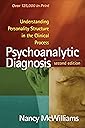
Psychoanalytic Diagnosis: Understanding Personality Structure in the Clinical Process
Product ID: 3437165
Desertcart purchases this item on your behalf and handles shipping, customs, and support to Denmark.
This acclaimed clinical guide and widely adopted text has filled a key need in the field since its original publication. Nancy McWilliams makes psychoanalytic personality theory and its implications for practice accessible to practitioners of all levels of experience. She explains major character types and demonstrates specific ways that understanding the patient's individual personality structure can influence the therapist's focus and style of intervention. Guidelines are provided for developing a systematic yet flexible diagnostic formulation and using it to inform treatment. Highly readable, the book features a wealth of illustrative clinical examples. New to This Edition *Reflects the ongoing development of the author's approach over nearly two decades. *Incorporates important advances in attachment theory, neuroscience, and the study of trauma. *Coverage of the contemporary relational movement in psychoanalysis. Winner--Canadian Psychological Association's Goethe Award for Psychoanalytic and Psychodynamic Scholarship Review: The Best Book for Learning How Diagnosis can Help You Treat Better - I know some people will reject this book because "Psychoanalytic" is in the title. Others will reject this book because "Diagnosis" is in the title. However, this essential text is highly useful to all practitioners of any theoretical orientation if they can get past the negative stereotyping. The term "Diagnosis" as used in this book is in line with the original definition of the word that is derived from Greek- meaning a distinguishing, to perceive, to know thoroughly. The second part of the book title explains that the point of diagnosing is to know how to help. McWilliams clarifies that, "The main object of this book is to enhance practice..." and that is what this book does extremely well. Nancy McWilliams never looses the person to the diagnosis. "Once I have a good feel for the person, the work is going well, I stop thinking diagnostically and simply immerse myself in the unique relationship that unfolds between me and the client...one can throw away the book and savor individual uniqueness." Her writing style is much like she describes her therapy sessions. She points out the necessity at times, to judiciously self-disclose. Her personal sharing gives the text a soul and you feel you are with a warm and wise teacher. For example when discussing the value of psychoanalysis, McWilliams discloses, "I share this opinion, having benefited all my adult life from a good early classical analysis." Let me share with you an example of her eloquent style that pervades this text: "When any label obscures more than illuminates, practitioners are better off discarding it and relying on common sense and human decency, like the lost sailor who throws away the useless navigational chart and prefers to orient by a few familiar stars." It is writing such as this, which makes this text enjoyable, as it is enlightening. McWilliams' taxonomy is fundamentally based on just two Axes. The first dimension conceptualizes a person's degree of developmental grow or personality organization (neurotic-normal level, borderline level and psychotic level). McWilliams assesses the neurotic, borderline, and psychotic levels of personality structure in terms of favorite defenses, level of identity integration, adequacy of reality testing, the capacity to observe one's pathology, nature or one's primary conflict, and transference and countertransference. She explains that "borderline" is not a distinct personality disorder as introduced by DSM III, but an over-all level of severity. It is a stable instability between the border of neurotic and psychotic ranges, characterized by a lack of identity integration and reliance on primitive defenses without the overall loss of reality testing that is seen with people at the psychotic level. The second axis identifies the type of character or personality patterns (psychopathic, narcissistic, paranoid, depressive, schizoid, etc.). She explains that though this two-axis model is oversimplified, it is useful in synthesizing and streamlining diagnostics for newcomers. McWilliams first looks at how the levels of personality organization are important in the therapeutic process. She states the neurotically organized person is like the boiling pot with the lid on too tight making it the therapist's job to let some steam escape (uncovering-expressive work). However, the psychotically vulnerable individual's pot is boiling over, and it is the therapist's job to turn down the heat and get the lid back on (supportive work). I strongly recommend this recent edition of Psychoanalytic Diagnosis: Understanding Personality Structure in the Clinical Process as a required text for doctoral and post-doctoral students to help them understand and treat patients. Review: A must for every clinician! - I listened to the Audible version of this title and am very thankful for McWilliams putting this information together in a cohesive and accessible text. Psychoanalytic diagnosis is nearly foreign to modern practice, and so much more in depth than what we are taught in graduate school to become clinicians. The book's strengths are in its ability to explain dense concepts in a way that is easy to understand for people new to thinking psychodynamically. Defense mechanisms are covered in the first half, and the rest of the book details various character types and what to expect with working with each kind. I found the distinction between primitive and mature defense mechanisms particularly useful. Another strength is that this book will help you understand why some interventions will work wonderfully with some clients and not at all with others. I found the narration to be pleasant with this title. I think to really understand this concept, it would be useful to purchase a print copy and read the chapter again after listening to it. There is a lot of information to absorb in this text and it may take several reads to start to know the character types.
| Best Sellers Rank | #626,770 in Books ( See Top 100 in Books ) #6 in Medical Psychoanalysis #10 in Popular Psychology Psychoanalysis #11 in Psychiatry (Books) |
| Customer Reviews | 4.8 out of 5 stars 640 Reviews |
R**.
The Best Book for Learning How Diagnosis can Help You Treat Better
I know some people will reject this book because "Psychoanalytic" is in the title. Others will reject this book because "Diagnosis" is in the title. However, this essential text is highly useful to all practitioners of any theoretical orientation if they can get past the negative stereotyping. The term "Diagnosis" as used in this book is in line with the original definition of the word that is derived from Greek- meaning a distinguishing, to perceive, to know thoroughly. The second part of the book title explains that the point of diagnosing is to know how to help. McWilliams clarifies that, "The main object of this book is to enhance practice..." and that is what this book does extremely well. Nancy McWilliams never looses the person to the diagnosis. "Once I have a good feel for the person, the work is going well, I stop thinking diagnostically and simply immerse myself in the unique relationship that unfolds between me and the client...one can throw away the book and savor individual uniqueness." Her writing style is much like she describes her therapy sessions. She points out the necessity at times, to judiciously self-disclose. Her personal sharing gives the text a soul and you feel you are with a warm and wise teacher. For example when discussing the value of psychoanalysis, McWilliams discloses, "I share this opinion, having benefited all my adult life from a good early classical analysis." Let me share with you an example of her eloquent style that pervades this text: "When any label obscures more than illuminates, practitioners are better off discarding it and relying on common sense and human decency, like the lost sailor who throws away the useless navigational chart and prefers to orient by a few familiar stars." It is writing such as this, which makes this text enjoyable, as it is enlightening. McWilliams' taxonomy is fundamentally based on just two Axes. The first dimension conceptualizes a person's degree of developmental grow or personality organization (neurotic-normal level, borderline level and psychotic level). McWilliams assesses the neurotic, borderline, and psychotic levels of personality structure in terms of favorite defenses, level of identity integration, adequacy of reality testing, the capacity to observe one's pathology, nature or one's primary conflict, and transference and countertransference. She explains that "borderline" is not a distinct personality disorder as introduced by DSM III, but an over-all level of severity. It is a stable instability between the border of neurotic and psychotic ranges, characterized by a lack of identity integration and reliance on primitive defenses without the overall loss of reality testing that is seen with people at the psychotic level. The second axis identifies the type of character or personality patterns (psychopathic, narcissistic, paranoid, depressive, schizoid, etc.). She explains that though this two-axis model is oversimplified, it is useful in synthesizing and streamlining diagnostics for newcomers. McWilliams first looks at how the levels of personality organization are important in the therapeutic process. She states the neurotically organized person is like the boiling pot with the lid on too tight making it the therapist's job to let some steam escape (uncovering-expressive work). However, the psychotically vulnerable individual's pot is boiling over, and it is the therapist's job to turn down the heat and get the lid back on (supportive work). I strongly recommend this recent edition of Psychoanalytic Diagnosis: Understanding Personality Structure in the Clinical Process as a required text for doctoral and post-doctoral students to help them understand and treat patients.
J**Y
A must for every clinician!
I listened to the Audible version of this title and am very thankful for McWilliams putting this information together in a cohesive and accessible text. Psychoanalytic diagnosis is nearly foreign to modern practice, and so much more in depth than what we are taught in graduate school to become clinicians. The book's strengths are in its ability to explain dense concepts in a way that is easy to understand for people new to thinking psychodynamically. Defense mechanisms are covered in the first half, and the rest of the book details various character types and what to expect with working with each kind. I found the distinction between primitive and mature defense mechanisms particularly useful. Another strength is that this book will help you understand why some interventions will work wonderfully with some clients and not at all with others. I found the narration to be pleasant with this title. I think to really understand this concept, it would be useful to purchase a print copy and read the chapter again after listening to it. There is a lot of information to absorb in this text and it may take several reads to start to know the character types.
V**A
Extremely informative
Excellent overview of personality types, mostly focused on the pathologies associated with them. The introduction is an invaluable guide to key strains of psychoanalytic thought. The book is a bit academic, yes, but this is to some extent necessary to explain the subject matter in precise terms. It's written for therapists, but I'd recommend it to anyone who has done read some pop psychology and wants to go deeper.
W**F
Psychoanalystic Diagnosis by Dr. McWilliams
I am thoroughly enjoying this book that I am studying for a doctoral course in clinical psychology. Dr. McWilliams begins by explaining why analysts or clinicians diagnosis and then proceeds to developmental levels of personality organization. She writes descriptively and with clarity, which makes it easy to understand. She explains the fundamental Freudian principles well. She provides an understandable and clinical review of Object Relations and Ego Psychology, which is very helpful, then provides a comprehensive description of defenses, which I found fascinating. I am studying the last half of this book on the types of character organization and I know that I will be grateful for the knowledge she imparts to me as I have been from the beginning of the book.
A**P
Brilliant & Humane
This is an excellent resource because Dr. McWilliams knows how to place diagnostics within a socio-cultural framework and can therefore provide a more thorough and insightful analysis of personality disorders, those who diagnose them and those who suffer from them. She is not one of those clinicians who attempts to detach in a pseudo-scientific manner, but rather constantly reminds the reader of the DYNAMICS between therapist and patient. I have read various books on these issues, and some authors known as experts in the field (Kernberg, Millon) are tedious to read because of their jargon. They have much in common with the DSM which takes a "cold," clinical approach by listing symptoms. McWilliams provides a great deal of insight by contextualizing these issues; J. Reid Meloy is also excellent. Highly recommended: one of the most accessible, comprehensive and scholarly books I have read on the challenging and fascinating subject of personality disorders.
A**R
Five Stars
Fan-friggin-tastic. Read it
R**A
Insightful book on a scholars level
A hard read at first although Very informative.
L**.
Great read!
This was my favorite text last semester. I absolutely loved this book. It gives a very thorough understanding of personality disorders and what causes some people to behave the way that they do. You would have a much better understanding of the personality disorders and how to counsel certain groups of people as opposed to others. I love how the book gives information on what to look for in certain personality types and then how to counsel certain personality types and what might work and what might not work. It gives a much more in depth understanding of the different personality disorders than the DSM.
J**E
Careerchanging
Beeinflusst und strukturiert mein gesamtes Denken und therapeutisches Handeln seitdem ich es gelesen habe.
I**)
Interesting, informative & inspirational.
Although the nomenclature is at an intermediate - advanced level, the information is laid out quite well and can be understood with relative ease. Ms. McWilliams Psychoanalitcal Diagnosis takes a most direct, yet humanistic approach to psychoanalysis and the pursuit of psychiatry at large. A must read for any practitioners, but as well a good source for a cultivating a more in-depth knowledge base! Portable size (not full textbook size), well bound, removable jacket/sleeve.
L**S
Formidable
Ce livre offre un récapitulatif de différentes visions psychanalytiques (et au-delà), une vision à la fois très poussée théoriquement et très humaine de la psychopathologie. Un vrai régal.
K**.
Kitap hasarlı bir şekilde geldi. Dört yıldızı kitaba verdim Amazon’a değil!
Kitap hasarlı bir şekilde geldi. Kargolanma sürecine hiç özenilmemiş. Benim için hayal kırıklığı oldu.
P**A
Perfect!!!
Ótimo livro e leitura fácil!!!É muito claro e objetivo! Excelente para psiquiatras em formação e psiquiatras que desejam um livro de consulta rápida!
Trustpilot
2 months ago
1 week ago