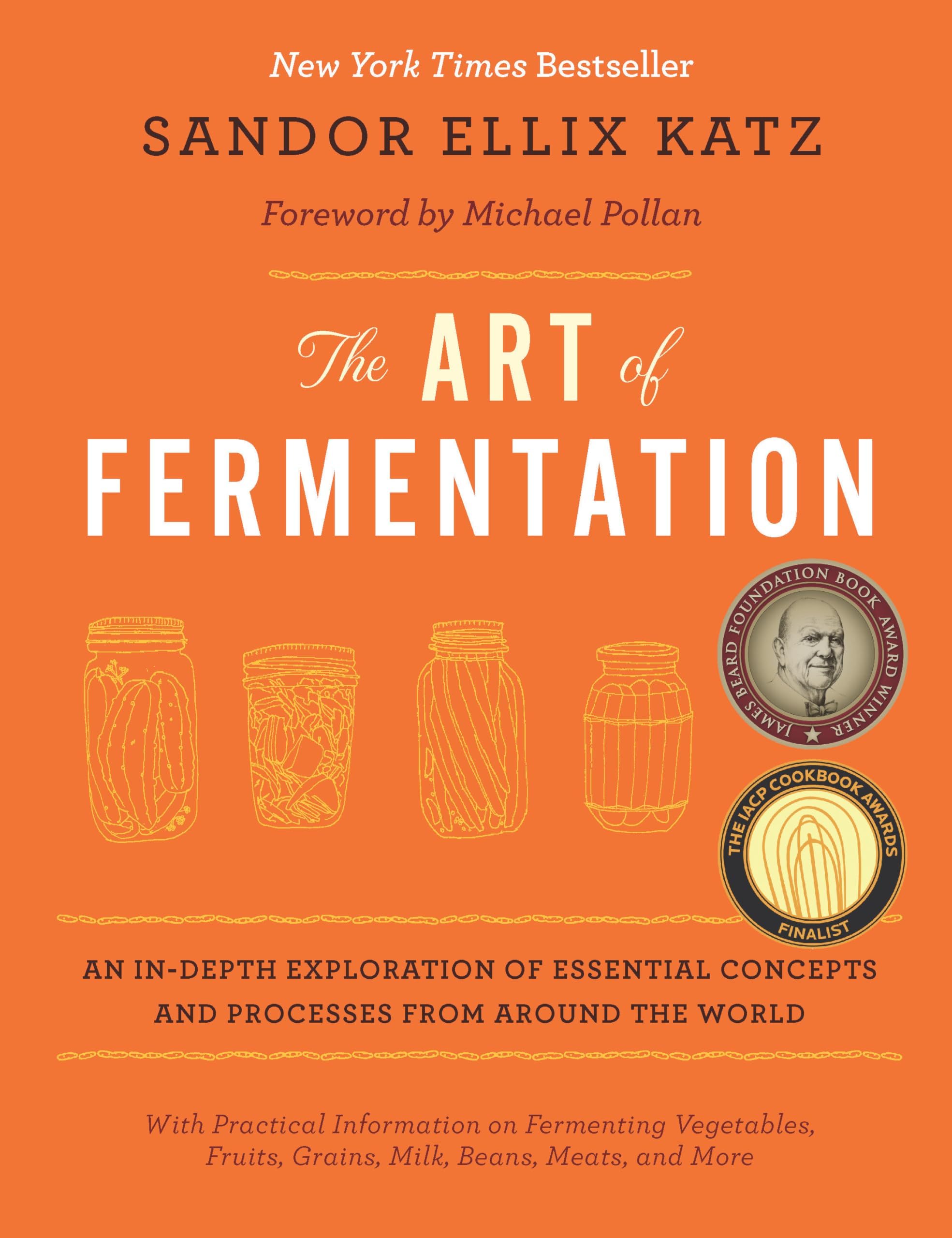
THE ART OF FERMENTATION
Product ID: 323480
🏆James Beard Award-winning fermentation bible
📚500+ pages of expert fermentation wisdom
🥒Covers 20+ fermentation recipes from veggies to meats
Desertcart purchases this item on your behalf and handles shipping, customs, and support to Denmark.
🥒 Transform your kitchen into a fermentation lab — don’t miss the cult classic everyone’s raving about!
The Art of Fermentation is the definitive 500+ page guide by expert Sandor Katz, offering practical, safe, and creative fermentation techniques for vegetables, dairy, meats, and alcoholic beverages. Celebrated by The New York Times and awarded by the James Beard Foundation, this bestseller empowers both beginners and pros to master fermentation with confidence and flair.


| Best Sellers Rank | #9,719 in Books ( See Top 100 in Books ) #5 in Vegetarian Cooking #7 in Food Science (Books) #11 in Canning & Preserving (Books) |
| Customer Reviews | 4.7 out of 5 stars 3,195 Reviews |
B**S
Introduction To Post-Pasteurianism
First off: this book is beautiful. Hardcover, with a series of full-color plates 1/3rd and 2/3rds through. For only twice the price of a flimsy paperback, you're investing in five hundred solidly-constructed pages that will last. And a good thing, because this book is destined to be a classic. You don't need to have read Katz' other work, Wild Fermentation: The Flavor, Nutrition, and Craft of Live-Culture Foods , to understand, appreciate, and use this book - it stands alone. If you already own Wild Fermentation, don't be put off by the duplication of some recipes in the Table of Contents. Yes, sauerkraut, kimchi, and pickles are in here, but every section is greatly expanded with much more information and many more references. (Ever thought of using a layer of cooking oil as an airlock? Neither had I, but I'm going to try it!) Speaking of references... the Resources, Glossary, and Works Cited chapters could keep you busy for a few years. And yes: you will use this book. As Michael Pollan states in the well-written foreword, this is not one of those cookbooks you buy for the nice pictures and keep on your coffee table. This is a project manual. Fermentation is something you have to experience to understand, and Katz give you absolutely everything you need to get started. The first 67 pages are devoted entirely to the beginner, focusing not on specific recipes but on answering the inevitable questions: "WHY would I want to ferment food? is it safe? what equipment and general expertise do I need?" Again from Pollan: "Katz writes about the transformative power of fermentation with such infectious enthusiasm that he makes you want to try things just to see what happens." This is so true. Even if you don't initially intend to, many of these 'recipes' are so simple and unintimidating (hard apple cider, mead, sauerkraut and its derivatives, sourdough) that it's hard to resist the urge to pick up a box of Mason jars and some fresh produce the next time you're at the grocery store. Many of us are experimenters at heart, and fermentation is the perfect mix of art and science to tap into this nature and inspire all kinds of crazy projects. Already the neighborhood King of Kraut? I guarantee that this book will still have something for you. Chapter 12 - "Fermenting Meat, Fish, and Eggs" isn't enough? Turn to Chapter 13, for a short but serious discussion of what it takes to turn a fermentation hobby into a small business. Notes about scaleup, HACCP plans, and licensing are cool to read about, though I have no plans to open a tempeh factory anytime soon. Or how about Chapter 14 - "Non-Food Applications of Fermentation"? Again, I don't live on a farm, but it is neat to read about compost, silage, and bioremediation. (Surprise: Katz doesn't buy into corn ethanol biofuels) While this is by no means a biology textbook, the scientific content is much improved over Wild Fermentation. Chapter 1 - "Fermentation as a Coevolutionary Force" is, in general, accurate and well-referenced. Katz is not a formally-trained scientist, but he does not shy away from technical details when they are helpful for understanding, and he shows respect for the scientific method and its results. See, for instance, his discussion of 'homofermentative' and 'heterofermentative' organisms in vegetable fermentation (pg 96), or of commercial starter cultures (pg 132). If you subsist on white bread and margarine and bleach your cutting boards after every use, fermentation may not be the hobby for you. The first time I skimmed some strangely-textured yeast off of a crock of fermenting beets, I have to admit I was a little skeptical what those beets would look like when I pulled them out (they were absolutely delicious). While some of my more imaginative fermentation adventures have yielded delicious results, a few have been downright terrible (yep, ate them anyway!). If you don't see any issue with carving a bit of mold off some cheese or a piece of fruit instead of throwing it out, then you probably have what it takes. Many (most?) of the poor reviews on Wild Fermentation are from people taking issue with Katz' lifestyle or philosophies. Many of his philosophical discussions in this book are backed up with hard science and references, so even those who found Wild Fermentation to be overbearing may find this new book to be more palatable. If you have some problem with the fact that Katz has HIV (he states this outright in the new book, and includes a sidebar about how fermented foods may be helpful but they are not a disease cure), do the rest of us a favor and keep it to yourself. I've been experimenting with fermentation for about a year, relying mostly on Wild Fermentation and a substantial collection of online resources. I've only had this book for a week, and I've already had tons of fun and learned a lot. When I'm finished with my read-through, this book will definitely be making its rounds among my friends. A great reference and a worthwhile investment - highly recommended.
G**I
This is not JUST a cookbook
This was my first book on fermentation, and it remains my favorite. What I love most is the way it teaches you the why and the how behind the processes. This is not just a cookbook; it is a book of history, anthropology, sociology, and even poetry. It reveals the human and deeply real side of food and fermentation. If you want a book that makes you feel at home while teaching you how to ferment, this is it.
A**R
Best Book on Fermentation Currently Available
Fermentation was frankly something I had little to no experience or interest in until a few years ago....even then it was a slow progression. For health reasons (we're not getting any younger) we started taking an active interest in food - both the quality of the food and the preparation practices. The more we learned, the more we started cooking, baking and making our own food. Bread was perhaps one of the very first things we took the time to make from scratch and soon the bread baking became a weekly tradition. Fresh baked bread is so delicious, warm and comforting. Of course, that led to grinding our own flour and since bread is so much like beer - my spouse began experimenting with home brewed beer and wine and even soda. It wasn't long before something always seemed to be brewing in the kitchen and at least one of us, was quickly becoming a fermentation fan. Over those few years, our diet, shopping habits, food choices and preparation methods changed fairly radically from what we had thought was a decent diet to an all organic, homemade diet with local produce when possible. It was during that time I started hearing more and more about the benefits of fermentation of other foods - but frankly, not having grown up around anything remotely related to food preparation, I had no idea what was/wasn't fermented. In fact, I thought pickles were always made with vinegar and canned - I had no idea they were fermented. Ditto for sauerkrout or oodles of other items. Somewhere along the line, I came across Sandor's first book on fermentation and purchased it. It was NOT love at first sight...in fact, after the first read, I thought it sounded horrible (rotted food?!) and set it aside for at least another year. Then by chance, I happened to taste some REAL pickles..then fermented salsa and several other things that just knocked my socks off. I pulled that book out and decided to give it a try. Low and behold, it worked like a charm! Soon I was buying big fermentation pots and since then we have become regular consumers of fermented products made a home. I then bought the book and video set and several other books on fermentation...in fact, by this point, I probably own most of the major books about fermentation. So, when this came up as an advanced order option, I purchased it right away although I wasn't sure what to expect. It was delivered early and right from the start, it is obvious this book is MUCH larger than previous books. It provides a exemplary overview of fermentation from both a historical perspective as well as current uses around the globe. The information expands upon the understanding of fermentation in a dramatic way. It's both interesting and informative. Without a doubt, it's one of the best books I've read on the subject and I've read a LOT of them! Now, if you are just wanting an introduction to fermentation with a few quick and easy recipes' and examples, the older books by Katz are probably still your best choice. On the other hand, if you are a person that likes to understand a topic in depth when starting something new, this may be more to your liking. Existing fermentation fans will ABSOLUTELY want to purchase this new book for the expanded knowledge, information and insight. It will not disappoint! May your beer always bubble, your bread always rise - Your pickles always pucker and your crock never demise! Happy fermenting folks!
K**S
The Bible of Fermentation
I just received this yesterday, but already have a lot of information and experience with fermentation. But, this book exceeds my expectations. I didn't expect it to cover wine and mead, include recipes from fermented drinks to vegetables and fruit to meat, and it even talks about the diffeent kinds of fermentations crocks as well as offering recipes and sage advice. I haven't even scratched the surface of this book! If you want to ferment - whether for simple culinary use or for health, this is the book you need to get started. This is a substantial book, so don't waste your money buying an assortment of books until you discover this one.
D**R
Great Resource for Vegetable and Grain Fermented Products
I have used Sandor Katz's Wild Fermentations for several years and his latest book is a greatly expanded book on the same topics with largely the same enthusiastic experimental approach to the subject. I would not recommend either book for anyone interested in fermented milk or cheese information as The Art of Fermentation contains only 30 pages on yogurts, fermented milks and cheesemaking in total. I was hoping Sandor would have indulged us with more information on brined cheeses as they are the cheese world's version of pickles and brined feta style cheeses are still rather a scarce topic for most home cheese makers. Sandor has also elected to not focus on bread making or baking as the book has only 15 pages devoted to breads including pancakes and Indian dosas and idli's with only the briefest mention on the topic of Ethiopian sourdough Teff grain based Injeera, even though Idaho grows a significant amount of the Teff grain for consumption by the Ethiopian community here in the USA . I was also surprised to find nothing on the very diverse topic of homemade Indian Achar and Pachadi making traditions and the diversity of fermented Indian pickles is very large. I love the Achars I find at some Indian restaurants and they are all housemade products with no recipe available in my Indian cookbooks. Only a brief mention is made of chili based fermented sriracha sauces. The book shines on the subject of indigenous wild fermentations involving any and all combinations of vegetables, grains, fish and even red meat. Mr. Katz does not waste space with traditional recipe lists or even exact measurements of spices or salt levels, instead telling us to go forth and multiply our own pickles and drinks. This is both the enthusiastic positive approach likely to create more home pickle fanatics and the Achilles' heal of his writing style. Sandor doesn't use a broad range of descriptive words to describe fermented results and he does appear to have a much more tolerant acceptance of the result of his experimental approach. In other words, he is willing to eat and drink just about everything he ferments at home. If a home cheese maker attempts a blue veined cheese or even a plain yogurt at home, the commercial version already consumed (for instance a Maytag Blue cheese or commercial Yoplait yogurt) is likely to strongly influence her expectations of the desired outcome. Same with a Korean radish Kimchi or a salted fish or preserved shrimp purchase at an Asian market. I would think most of us would want to have tried some version or another of these products before attempting to re-create it at home. If the result is unpleasant or not worth the energy and time to make it at home, do we make changes to the recipe or just give up after the first failure? But for many of the fermented products described between these 500 pages, we may not have a reference point to guide us in the desired outcome and Sandor does not build a language of descriptive flavor and taste to help guide us towards a successful outcome. His discussion of Kosher Dill pickle softness is very helpful and has been a problem for some of my homemade pickles but not others. Perhaps that is because he has not succeeded in making the products uniform from batch to batch (I know I haven't) but I would prefer a more culinary approach to this subject with more profiles presented to compare one version and style versus another. That is also the charm in his hands-on approach and is perhaps inevitable with using native microflora present on the surface of many foods to ferment them. In any case, his microscopic world of friendly bugs is just waiting to help us enrich our hand made prickles and bubbly grain and fruit drinks. I highly recommend this text to anyone with a willingness to explore foods and tastes that may be foreign at first sip and bite. It contains a wealth of information and ideas that may require further investigation before success is acheived but it is the most complete reference on this topic designed for a general reader with a strong ethnology bent and interest in indigenous cultures!
F**H
This Book is AMAZING!
This book has got to be the most important book written for survival, living sustainable, and giving a finger to the powers that be that have brainwashed generations of people now to be afraid of food preservation -- therefore being dependent on industry to feed us and keep our food safe. This book goes beyond teaching you how to live a healthy life using simple fermentation methods since the beginning of mankind - without saying directly, it is a revolution for people to take their power back from companies and food regulators who have been trying to scare us into thinking we need all their fancy science and equipment in order to survive and not poison ourselves. When in fact, we have been poisoned by the lack of variety in bacteria that our guts have evolved to need. (Co-evolved.) --- I think its wild that a book about fermenting foods can involve so much passion, but i feel reading this book is empowering. After having read a few months back a Book about CANNING food, which literally scared the hec out of me and made me never want to Can a single food due to the many scientific factors and high rates of food poisoning from it -- i had felt depressed about how I would be able to store all the food from my gardens beyond just shoving things in a food cellar. Fermentation is the food poisoning FREE, time tested over human history answer to food storage and preservation -- or at least elongating that process while giving our guts the bacteria they long for. With this kind of knowledge, those with and without a garden can extend their food so much further, so much healthier, and for SO much cheaper then the food industry would ever want you to re-learn. I am thankful that Sandor has written this resource which is so needed! His dedication to explore this way of eating will change the health of countless people who learn the art of fermentation. I know it has already changed my life, because having celiac disease these ferments are the first thing to have effected my digestive tract in a positive way in 12 years! - Right now I am starting my 3rd bath of kraut, i have 8 types of fruit vinegars, fruity kombucha, saurrubben and fermenting cashew nut "cheese". Working my way through all types of ferments, and can't wait to get the the even wilder ones!
J**X
Everything You Ever Wanted to Know About Fermented Foods.
I got hooked on the process of fermentation of vegetable materials while making a couple of batches of Old time Deli Dill pickles. Though my methods were rough around the edge. The end product was fantastic. Then I discovered other treats like carrots, hot sauce, onions, and sauerkraut. No other book seemed to fit my desire to learn more about the technical aspects of fermentation like this one did. I approached this book with some caution because it covered so much territory. I was so impressed by this book that I also purchased the author's other book ' Wild Fermentation '. ' The Art of Fermentation ' is an overview of virtually all fermentation processes known to man. Mr. Katz certainly knows his subject well and obviously did extensive research in the course of developing his knowledge of fermentation. He also mentions his failures and stumbles along the way. Although this book won the James Beard award and was a finalist in the IACP cookbook award . It is by no means a cookbook in the true sense of the word. It is a veritable textbook on the process of fermentation with a wealth of general information on the subject. The book begins with a detailed discussion of the biology of fermentation and continues with a discussion of everything from fermented beverages to various fermented foods from various cultures and ethnic groups. It also includes very good discussions on yogurt, cheeses, and meats. With the advice in this book you can develop your own recipes and techniques that fit your working environment. I highly recommend this book and compliment Mr. Katz on his efforts. This book is destined to become a classic on the subject of fermentation.
A**A
Feeds my nerd impulses
Love this book! The subject of fermentation brings out my inner nerd, and this book feeds that impulse! When I got it, I literally sat down and started reading it cover-to-cover, as if it were a novel rather than a cookbook. This is not a book of recipes. Rather, it's a book about the methodologies and practices and principles of fermentation. I definitely appreciate the references to how fermentation is practiced around the world in obscure cultures. As a librarian and nerd, I also appreciate how he cites his sources constantly, so that I am able to do further reading if so desired. By far, my favorite thing is that this book enables me to go and experiment with the plethora of suggestions he provides. Again, this is NOT a book for people who like to follow recipes step-by-step. Rather, it's for the experimental cook/diy-er, who invariably modifies every recipe she uses. By far, the best section in this book is the section on "kraut-chi" (love the use of this word). There are many suggestions and variations, and I felt very inspired and motivated after reading this section. I wish the section on kefir was larger, but Katz wisely alludes several times to Dom's kefir site, which is THE online authority on kefir. Something I've been struggling with is finding use for whey (the result of making kefir-cheese), and this book brings up many suggestions. I haven't yet had the impulse to make my own beer or wine, but after reading this, I am tempted to make fruit sodas using whey and venturing into fruit fermentation and maybe even making a cider or vinegar.
K**R
Good overview of different fermentation techniques
Very good book, read it from cover to cover!
G**E
Poor book quality
Pretty sure the information inside the book are very good but the quality of the book itself it's pretty poor. Just open it and it's already coming apart
T**M
Could be better
More a book on personal experiences than a step by step guide/explanation of fermentation proces. Could be better.
S**E
Fantastic read!
Devoured this book and thoroughly enjoyed it! My copy is a little battered and worn now because it’s seen many a mishap. I’ve yet to successfully ferment anything (my sourkraut wasn’t chopped finely enough and bubbles over turning my counter a lovely blue/purple colour!) but it’s so worth the read. I shall continue to persevere and one day I will make all the beautiful fermented foods and beverages! Long live the art of fermentation, long live a healthy gut microbiome!
H**O
Buen producto
Muy buen contenido
Trustpilot
1 month ago
3 days ago