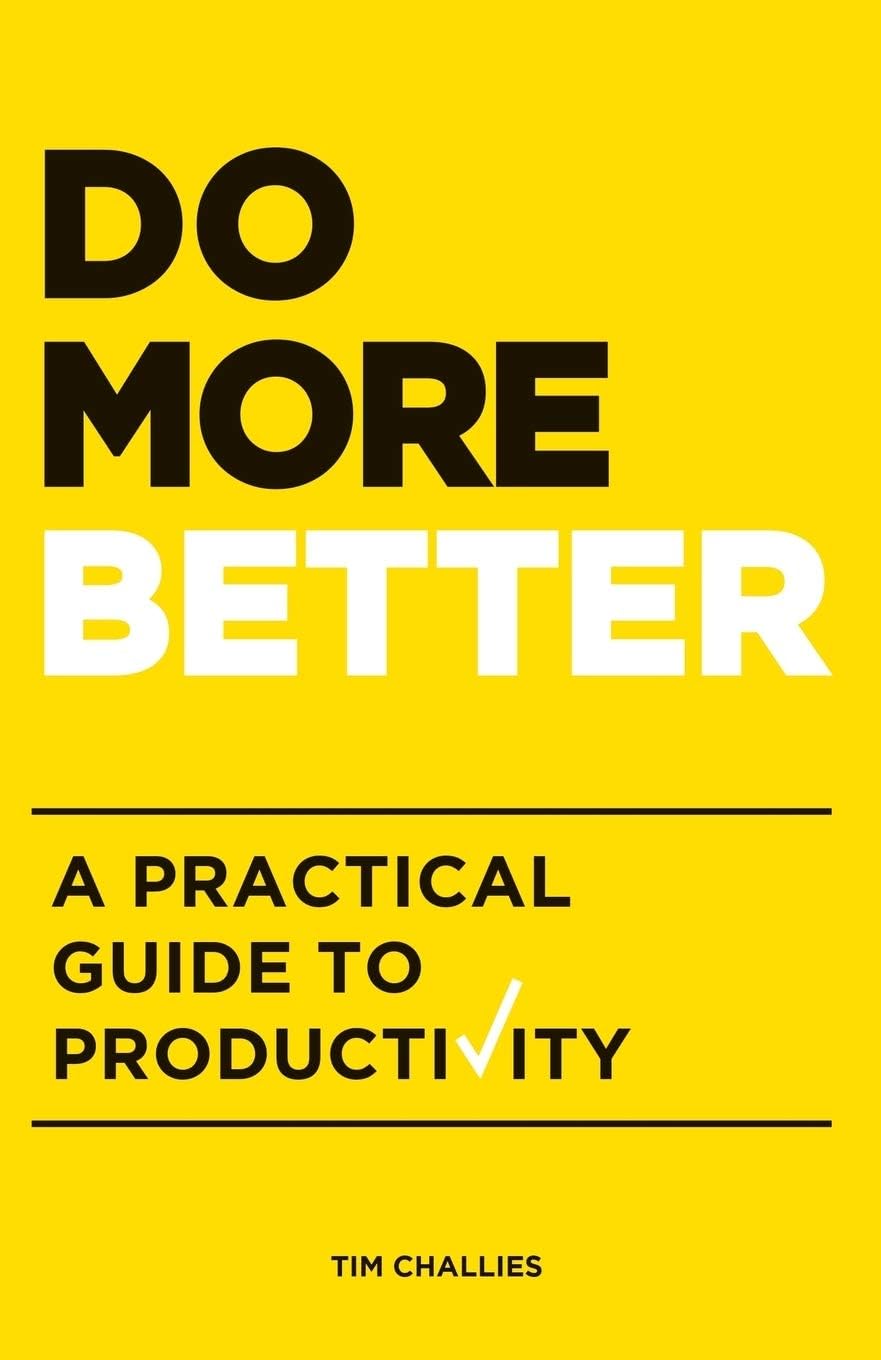
Do More Better: A Practical Guide to Productivity
Product ID: 20979368
Buy anything from 5,000+ international stores. One checkout price. No surprise fees. Join 2M+ shoppers on Desertcart.
Desertcart purchases this item on your behalf and handles shipping, customs, and support to Denmark.
Don’t try to do it all: Do more good. Better I am no productivity guru. I am a writer, a church leader, a husband, and a father with many responsibilities and with new tasks coming at me all the time. I wrote this short, fast-paced, practical guide to productivity to share what I have learned about getting things done in today’s digital world. Whether you are a student or a professional, a work-from-home dad or a stay-at-home mom, it will help you learn to structure your life to do the most good to the glory of God. In Do More Better, you will learn: Common obstacles to productivity The great purpose behind productivity 3 essential tools for getting things done The power of daily and weekly routines And much more, including bonus material on taming your email and 20 tips I have learned along the way. It really is possible to live a calm and orderly life, sure of your responsibilities and confident in your progress. You can do more better. And I would love to help you get there. -Tim Challies Review: A great book to help you do more--better! - I want to do more—better. Don’t you? The problem, however, is that my ambition often leaves me feeling like King Solomon described in Psalm 127: with vanity-ach. Rising early, going to bed late, eating the bread of anxious toil—it’s no way to live. Solomon writes, in contrast to this, God “gives to his beloved sleep” (v. 2). And it’s here that Tim Challies begins Do More Better: A Practical Guide to Productivity, with the encouragement that if a man as busy as King Solomon could figure out how to live a productive but not anxious life then by the grace of God, so can you. For those who don’t know, Challies is a husband, father, pastor, author, and has about a half dozen other important roles, such as co-founder of a publishing company (Cruciform Press) and host of a very popular Christian blog (Challies.com). And when I say “popular,” that’s an understatement. His blog had just under 16 million pageviews in 2015. For comparison, mine had less than 16 thousand. Yet for all this, Challies maintains that he’s no productivity guru. That’s okay by me, though. He’s certainly a practitioner, and his aim in Do More Better, as he writes, is to “open up [his] life and to let you in a little bit” (7). In other words, Do More Better is decidedly not a bloated textbook of source material with footnotes. Rather, as the subtitle says, it’s a practical (and we might add “personal”) guide to productivity. Do More Better has ten short chapters, and begins by stressing the importance of knowing your purpose; you can’t be truly productive without it. Then, Challies talks about how to find your particular purpose and mission, that is, how to find the sphere of responsibility that God has called you to be productive in. The book concludes by exploring tools for collecting your tasks, planning your calendar, and gathering your information. There are two bonus chapters, one on taming your emails and another with 20 tips for increasing your productivity. What is Productivity? Let’s talk for a moment about definitions. Challies defines productivity in this way: Effectively stewarding your gifts, talents, time, energy, and enthusiasm for the good of others and the glory of God. When defined in this way, Challies underscores that productivity is first a theological issue. Thus, productivity is not merely a good thing that Type-A personalities kick-start in the early morning hours. Rather, because productivity is about “stewarding your gifts . . . for the good of others and the glory of God,” then to be unproductive is a sin of omission that must be forgiven and forsaken. In short, every Christian, not just go-getters, must strive for productivity. Drop and Give Me 20 Speaking of striving, be aware that Challies isn’t writing to simply relay information. Get ready to work. To see what I’m talking about, consider how the opening paragraph to Chapter 4 ends: “And that means you are ready for your next assignment” (35). Assignment? Wait—what? The assignment he’s talking about is related to identifying your specific purpose and mission, and the responsibilities associated with it. He’ll metaphorically hold your hand through the process, of course, but in this way Challies is more personal trainer than author. Just as it will do an athlete little good to know the proper form on squats (inhale on the way down, exhale on the way up; flat back; eyes up; and keep your knees from extending beyond your toes—by the way), so it will do the reader little good to burn through this short book without application. Remember, it’s not receiving good coaching that matters. It’s good coaching followed that matters. And by way of encouragement, I can say that I was helped as I completed the assignments. Small Book, Big Strengths There are many things I appreciated about Do More Better. Here are a few of them. First, I appreciated the simplicity. For example, if you have ever found yourself staring at a “To do list,” remember, you can only do four things with each task: delete it, do it, defer it, or delegate it (p. 59). Second, I loved the bonus chapters, especially the one on taming your email. My approach to my inbox didn’t seem so silly until Challies proposed this: “Imagine if you treated your actual, physical mailbox like you treat your email” (p. 109). If every time you received a letter or piece of junk mail you just peaked at it and stuffed it back in the mailbox, the result would be both humorous and sad. Finally, my favorite aspect was the distinctively Christian approach to productivity. For example, note this comment about delegating tasks to others. Most productivity gurus will encourage you to be as selfish as you need to be, to get rid of anything that doesn’t interest or excite you. But as a Christian you can do things that do not perfectly fit your mission but still do them out of love for God and with a desire to glorify him. (p. 42) Here, as throughout, the book is in stark relief to a selfish, secular approach to productivity. Every aspect of our lives, including our productivity, is to be bounded by godliness. For, what profit is it to us if we achieve massive levels of productivity without glorifying God? Any attainment in God-dishonoring productivity is like running the race backwards—really, really, really fast. Ultimately, you won’t win; instead, you’re productively running in the wrong direction. If there had been more space, I would have liked to see a little more discussion of Sabbath and contentment. God has appointed limits to our productivity, limits for our good. Also, more critique of the idols of achievement would have further highlighted a distinctively Christian view. The book, however, is purposefully short. I appreciated this, and I think you will too. I highly recommend Do More Better. It will help you discover God’s purposes for your life and move productively towards them. Review: Productivity Coach, Not a Guru - My dad has a saying that we six kids heard a thousand times while growing up, “There’s a place for everything, and everything should be in its place.” When he said this, it was usually in relation to the hand tools being put back in the correct drawer or snow shovels being hung on the proper hook. The principle was simple and, when followed, was an essential ingredient to peaceful living in a well-ordered home. Tim Challies has a version of that same principle, which he applies to life management: “a home for everything, and like goes with like.” In other words, there needs to be a place for everything that floats around our brains related to the carrying out of the responsibilities and opportunities associated with God’s calling for our lives, and life is well-ordered and most productive when all similar stuff is in its proper place. The day it was released, I ordered it. Why? 1. A week never goes by in which I don’t wish I had been more productive; I regularly wish there were more hours in a day. 2. The book is short (120 pages), and I’m a slow reader. 3. Tim Challies is a productive guy, a brother in Christ whom I wanted to learn from. 4. Other productivity books in my library provided limited help to me, personally. I needed a coach to show me how to do it. Do More Better is not a book to read. It is a book to work—to apply—it is a working book. While the first two chapters lay out a brief, biblical philosophy for productivity, each chapter that follows contains action steps, which I considered to be mandatory for myself. And I’m very glad I did. I suggest you take 5-7 days to work the book. Here’s what I did. • The day after the book arrived in my mailbox, I read the first chapter and printed and filled out its corresponding worksheet. Day 2: I reviewed the worksheet and took it deeper. • Days 3 and 4: I read and worked through the mission statement assignment (something I’m ashamed to say that I’ve never done before). As a result, there are some things I’m not going to do anymore, some I will do less, and some more. The first two chapters are essential if you sense it is time to recalibrate your life, to evaluate what you are doing in light of your God-given responsibilities, gifting, and calling. I would discourage you from skipping these chapters. Slow down, pause, do this. It will be necessary for lasting progress. • Days 5 and 6: I read the more practical section of the book and worked through every action step exactly as Tim coached me. • Day 7: I followed through on my first daily Coram Deo review. I will not pretend, this was not easy. But, as of today, I’ve worked the system and completed daily reviews three times, and I’m loving it. The beauty of the system is in its simplicity. What I love the most about Do More Better is that Tim does not set out to become another productivity guru. Instead, he is a coach—and a good one. Too many productivity/time-management books have left me feeling like I had to copy the author’s elaborate life habits down to specifics in order to succeed. The problem with that approach is that no two of us are wired by God completely the same, and no two human lives are identical in their responsibilities and calling. This book never made me feel like other books have. Instead, Tim walked me through his life management habits—giving me enough specific examples to see how the system works—but not so many that I would be tempted to try to become just like him. I needed someone to hold my hand, so to speak, and walk me through setting up the three basic tools that I will continue to customize to suit my life the best. Tim did that. For the first time, I'm actually beginning to feel like I can get a handle on things and have a system that works. I have much further to go (there are app videos to watch and more features to learn), and will continue to tweak as I go. I’ve already signed up for Tim’s 10 Days of Productivity so I can get a better grip on my new tools, and recommend you do the same. But, first, get the book and work the book, as far as you are able to on your own. You will not regret it. It is the best little book on life management in my library.
| Best Sellers Rank | #62,418 in Books ( See Top 100 in Books ) #31 in Christian Business & Professional Growth #37 in Christian Stewardship (Books) #524 in Christian Personal Growth |
| Customer Reviews | 4.6 out of 5 stars 1,586 Reviews |
B**K
A great book to help you do more--better!
I want to do more—better. Don’t you? The problem, however, is that my ambition often leaves me feeling like King Solomon described in Psalm 127: with vanity-ach. Rising early, going to bed late, eating the bread of anxious toil—it’s no way to live. Solomon writes, in contrast to this, God “gives to his beloved sleep” (v. 2). And it’s here that Tim Challies begins Do More Better: A Practical Guide to Productivity, with the encouragement that if a man as busy as King Solomon could figure out how to live a productive but not anxious life then by the grace of God, so can you. For those who don’t know, Challies is a husband, father, pastor, author, and has about a half dozen other important roles, such as co-founder of a publishing company (Cruciform Press) and host of a very popular Christian blog (Challies.com). And when I say “popular,” that’s an understatement. His blog had just under 16 million pageviews in 2015. For comparison, mine had less than 16 thousand. Yet for all this, Challies maintains that he’s no productivity guru. That’s okay by me, though. He’s certainly a practitioner, and his aim in Do More Better, as he writes, is to “open up [his] life and to let you in a little bit” (7). In other words, Do More Better is decidedly not a bloated textbook of source material with footnotes. Rather, as the subtitle says, it’s a practical (and we might add “personal”) guide to productivity. Do More Better has ten short chapters, and begins by stressing the importance of knowing your purpose; you can’t be truly productive without it. Then, Challies talks about how to find your particular purpose and mission, that is, how to find the sphere of responsibility that God has called you to be productive in. The book concludes by exploring tools for collecting your tasks, planning your calendar, and gathering your information. There are two bonus chapters, one on taming your emails and another with 20 tips for increasing your productivity. What is Productivity? Let’s talk for a moment about definitions. Challies defines productivity in this way: Effectively stewarding your gifts, talents, time, energy, and enthusiasm for the good of others and the glory of God. When defined in this way, Challies underscores that productivity is first a theological issue. Thus, productivity is not merely a good thing that Type-A personalities kick-start in the early morning hours. Rather, because productivity is about “stewarding your gifts . . . for the good of others and the glory of God,” then to be unproductive is a sin of omission that must be forgiven and forsaken. In short, every Christian, not just go-getters, must strive for productivity. Drop and Give Me 20 Speaking of striving, be aware that Challies isn’t writing to simply relay information. Get ready to work. To see what I’m talking about, consider how the opening paragraph to Chapter 4 ends: “And that means you are ready for your next assignment” (35). Assignment? Wait—what? The assignment he’s talking about is related to identifying your specific purpose and mission, and the responsibilities associated with it. He’ll metaphorically hold your hand through the process, of course, but in this way Challies is more personal trainer than author. Just as it will do an athlete little good to know the proper form on squats (inhale on the way down, exhale on the way up; flat back; eyes up; and keep your knees from extending beyond your toes—by the way), so it will do the reader little good to burn through this short book without application. Remember, it’s not receiving good coaching that matters. It’s good coaching followed that matters. And by way of encouragement, I can say that I was helped as I completed the assignments. Small Book, Big Strengths There are many things I appreciated about Do More Better. Here are a few of them. First, I appreciated the simplicity. For example, if you have ever found yourself staring at a “To do list,” remember, you can only do four things with each task: delete it, do it, defer it, or delegate it (p. 59). Second, I loved the bonus chapters, especially the one on taming your email. My approach to my inbox didn’t seem so silly until Challies proposed this: “Imagine if you treated your actual, physical mailbox like you treat your email” (p. 109). If every time you received a letter or piece of junk mail you just peaked at it and stuffed it back in the mailbox, the result would be both humorous and sad. Finally, my favorite aspect was the distinctively Christian approach to productivity. For example, note this comment about delegating tasks to others. Most productivity gurus will encourage you to be as selfish as you need to be, to get rid of anything that doesn’t interest or excite you. But as a Christian you can do things that do not perfectly fit your mission but still do them out of love for God and with a desire to glorify him. (p. 42) Here, as throughout, the book is in stark relief to a selfish, secular approach to productivity. Every aspect of our lives, including our productivity, is to be bounded by godliness. For, what profit is it to us if we achieve massive levels of productivity without glorifying God? Any attainment in God-dishonoring productivity is like running the race backwards—really, really, really fast. Ultimately, you won’t win; instead, you’re productively running in the wrong direction. If there had been more space, I would have liked to see a little more discussion of Sabbath and contentment. God has appointed limits to our productivity, limits for our good. Also, more critique of the idols of achievement would have further highlighted a distinctively Christian view. The book, however, is purposefully short. I appreciated this, and I think you will too. I highly recommend Do More Better. It will help you discover God’s purposes for your life and move productively towards them.
P**S
Productivity Coach, Not a Guru
My dad has a saying that we six kids heard a thousand times while growing up, “There’s a place for everything, and everything should be in its place.” When he said this, it was usually in relation to the hand tools being put back in the correct drawer or snow shovels being hung on the proper hook. The principle was simple and, when followed, was an essential ingredient to peaceful living in a well-ordered home. Tim Challies has a version of that same principle, which he applies to life management: “a home for everything, and like goes with like.” In other words, there needs to be a place for everything that floats around our brains related to the carrying out of the responsibilities and opportunities associated with God’s calling for our lives, and life is well-ordered and most productive when all similar stuff is in its proper place. The day it was released, I ordered it. Why? 1. A week never goes by in which I don’t wish I had been more productive; I regularly wish there were more hours in a day. 2. The book is short (120 pages), and I’m a slow reader. 3. Tim Challies is a productive guy, a brother in Christ whom I wanted to learn from. 4. Other productivity books in my library provided limited help to me, personally. I needed a coach to show me how to do it. Do More Better is not a book to read. It is a book to work—to apply—it is a working book. While the first two chapters lay out a brief, biblical philosophy for productivity, each chapter that follows contains action steps, which I considered to be mandatory for myself. And I’m very glad I did. I suggest you take 5-7 days to work the book. Here’s what I did. • The day after the book arrived in my mailbox, I read the first chapter and printed and filled out its corresponding worksheet. Day 2: I reviewed the worksheet and took it deeper. • Days 3 and 4: I read and worked through the mission statement assignment (something I’m ashamed to say that I’ve never done before). As a result, there are some things I’m not going to do anymore, some I will do less, and some more. The first two chapters are essential if you sense it is time to recalibrate your life, to evaluate what you are doing in light of your God-given responsibilities, gifting, and calling. I would discourage you from skipping these chapters. Slow down, pause, do this. It will be necessary for lasting progress. • Days 5 and 6: I read the more practical section of the book and worked through every action step exactly as Tim coached me. • Day 7: I followed through on my first daily Coram Deo review. I will not pretend, this was not easy. But, as of today, I’ve worked the system and completed daily reviews three times, and I’m loving it. The beauty of the system is in its simplicity. What I love the most about Do More Better is that Tim does not set out to become another productivity guru. Instead, he is a coach—and a good one. Too many productivity/time-management books have left me feeling like I had to copy the author’s elaborate life habits down to specifics in order to succeed. The problem with that approach is that no two of us are wired by God completely the same, and no two human lives are identical in their responsibilities and calling. This book never made me feel like other books have. Instead, Tim walked me through his life management habits—giving me enough specific examples to see how the system works—but not so many that I would be tempted to try to become just like him. I needed someone to hold my hand, so to speak, and walk me through setting up the three basic tools that I will continue to customize to suit my life the best. Tim did that. For the first time, I'm actually beginning to feel like I can get a handle on things and have a system that works. I have much further to go (there are app videos to watch and more features to learn), and will continue to tweak as I go. I’ve already signed up for Tim’s 10 Days of Productivity so I can get a better grip on my new tools, and recommend you do the same. But, first, get the book and work the book, as far as you are able to on your own. You will not regret it. It is the best little book on life management in my library.
T**N
A Christian Perspective on Productivity
“How are you doing?” “I am doing well but keeping busy.” This is a typical response in our fast-pace culture. Sadly, we can tend to pride ourselves in our busyness, believing we are productive when we may not be. If busyness does not equate to productivity, how can we know if we are being productive? Thanks to Tim Challies and Cruciform Press, we now have an answer. In his book, Do More Better Challies gives us a concise and practical guide to a Christian understanding of productivity. The greatest contribution this book gives to the reader is its certain Christian understanding of productivity. Throughout the book, the Christian perspective is represented in two specific ways: the practice of stewardship and the purpose of the productivity. The two elements show up in the definition of productivity as “effectively stewarding your gifts, talents, time, energy, and enthusiasm for the good of others and the glory of God” (Challies 16). Stewardship permeates every area of life and calls us to faithfulness in our responsibilities (Challies 29). As one who studies the importance of biblical stewardship, I greatly appreciate this. Likewise, I am grateful for Challies’ emphasis on the purpose of productivity: for the good of others and the glory of God (Challies 26, 39, 78, 91). Too often, productivity seeks the narrow view of improving one’s own life for one’s own sake. For the Christian, they must understand they exist for something more. Challies points us to what that “something more” is. A second commendation for Do More Better is the importance for organization. The book guides the reader to write mission statements for each area of responsibility and to be willing to say “no” to items and tasks which do not fit within those missions (Challies 40). Throughout the book, “a home for everything, and like goes with like” is repeated, stressing organization. Along with the idea of organization are priorities (Challies 92-93). Both organization and priorities are essential to a productive life. For these two reasons (and many more), I wholeheartedly recommend Do More Better by Tim Challies to any Christian who seeks to live a productive and fruitful life. That said, there are three qualifiers for the reader. First, the content of the book encourages technology-driven productivity. If you are not planning on using technology for task management, scheduling, and information, this book will not benefit you as greatly. Secondly, if you plan to read this book but not apply it to your life, you are wasting your time. This book again and again implores you to apply what you are reading to your own context. Third, and lastly, this guide to productivity requires commitment and maintenance daily and weekly. If you are comfortable using technology, planning on applying the content, and are willing to persevere, be sure to purchase your copy of Do More Better by Tim Challies. I received a PDF copy of this book for free from Cruciform Press in exchange for this review. I was not required to write a positive review, but an honest review. The opinions I have expressed are my own and are my honest review of the book.
E**.
8 reasons why Do More Better will help bring peace, order, and improved productivity to your life.
Do More Better may not be for everyone, but for a Christian seeking not just productivity, but a clear theological foundation for why productivity matters, this book is for you. Here are 8 reasons why: 1. It’s theological. Before jumping into tools and systems, Do More Better delves into the theological underpinnings that justify our pursuit of productivity. Our purpose is to glorify God by doing good to others which drives our desire to be more effective. 2. It’s practical. Although the book opens with the necessary theological grounds for productivity, it quickly turns practical. Each section ends with an action item that prompts you to take a step toward organizing your system. Downloadable worksheets are available to guide you to think through your areas of responsibility and the tasks associated with each area. Challies describes how to use each tool and outlines a workflow to maximize your productivity. 3. It’s mission-minded. Do More Better doesn’t merely provide a framework for accomplishing the most with your day, it explores the reason behind the work. If you follow the system, you will define your major areas of responsibility and create a mission statement for each. This discovery will help you design the system to match your life, calling, and goals. 4. It’s simple. Unlike so many productivity tools, Do More Better is simple, straightforward, and succinct. I spent two hours in a local deli reorganizing my Evernote and configuring Todoist using Challies’ method. In only two hours, I had a functional system to tweak and expand. 5. It’s clarifying. As you work through the system, you’ll clarify what you are doing with your time and why. You will likely find tasks you can eliminate or delegate. You will also discover tasks that will improve your entire day. Do More Better will help you determine when to say, “Yes” and when to say, “No” to requests of your time. 6. It’s cross-disciplinary. The tools provided in this book will work for everyone who desires to be more effective. Stay-at-home moms, working moms, managers, ministers, entrepreneurs, and executives will all benefit from applying these concepts. 7. It’s digital. Challies implements his system with three ubiquitous digital tools: Evernote, Todoist, and Google Calendar. He defines the role of each tool and provides a framework for their maximum efficiency. He explains what do to then goes a step further to describe how to do it, leaving no gap between the theoretical and practical. If you use a computer and have a smartphone, this system will simplify your life. 8. It’s maintainable. Challies says, “You have probably noticed that there is nothing in this world that coasts toward order. There is nothing on all this sinful planet that, when left on its own, gets more orderly.” In response to this reality, Do More Better recommends daily and weekly tasks to keep your system in good working order. The daily tasks help you quickly assess your day and only take a few minutes to complete. Weekly maintenance takes a bit longer but is essential to keep the system in good working order. By completing my daily tasks in the morning, my day is more focused and peaceful.
Z**K
Years later, still a profoundly helpful guide to productivity to the glory of God
I began using Challies' Do More Better system in 2019. It's seven years later. Productivity books come and go, but this one remains as relevant and helpful as ever. It's exactly what a believer in Jesus should want out of a productivity book - theologically sharp, simple to implement, and immediately impactful on your working life. Strongly recommend.
C**N
Instant Productivity! Just Add Water - And a Few Free Apps...
Working from home sounds like the greatest thing ever when you don’t work from home. And don’t get me wrong, it is great. There’s nothing like waking up and walking down two flights of stairs (in your PJS no less) to get to the office. I especially appreciate it because I know what it’s like to drive an hour to work. I’m not complaining. But working from home isn’t all sunshine and unicorns. And it isn’t for everyone. People who work from home have to be self-motivated. They have to be able to manage their time well. They need to have priorities. They need a plan. Unfortunately, none of that describes me. I’m an easy-going, take-it-as-it-comes, wait-until-the-last minute kind of guy. You may know someone like me. Or, you may be someone like me. Now, this doesn’t mean that I don’t like the idea of productivity. I love the idea. I’ve just never been any good at turning the idea into anything other than an idea. Until now. Tim Challies has written the perfect book for people like me. If you make your own schedule (whether you work from home or not) and feel like you could be more productive, don’t waste your time reading this review. Just buy the book. Don’t waste your time reading what I have to say. Instead, just start reading the book. You can thank me later. Now, for those of you that aren’t fully convinced, let me explain what makes this book so good… One of the things I love about this book – and you may completely disagree with me here – is the fact that Challies grounds his ideas in a biblical theology of productivity. If you aren’t a Christian, you may be turned off by this fact but I’d encourage you to take the time to listen (the book isn’t all that long anyway). According to Challies, “productivity is not what will bring purpose to your life, but what will enable you to excel in living out your existing purpose.” And what is our purpose? According to scripture, it’s to glorify God through good works. Challies examines this idea and, in so doing, reminds the reader that we are not our productivity. Whether I get 2 things done today, or 200 things, I still bear God’s image. My identity is not so bound up in what I do that I have to become a workaholic in order to truly be human. With that said, what I do does matter. I just need to have the right perspective. As Jesus said, “For what does it profit a man to gain the whole world, and forfeit his soul?” (Mark 8:36). And whether you’re a Christian or not, this truth is helpful. Life isn’t about putting checkmarks in boxes. It’s about doing the most good. When we approach productivity from this perspective, it’s freeing. We don't have to look at it as a chore – a list of things to ‘get done.’ Instead, we’re free to focus on building something – a better family, a better career, a better life. Challies’ perspective reminds me of John Wesley’s encouragement to “do all the good you can. By all the means you can. In all the ways you can. In all the places you can. At all the times you can. To all the people you can. As long as ever you can.” But does it work? As I’ve already said, I’m not a very productive person. If I’m left alone, entropy sets in. And entropy usually looks like a combination of Facebook, YouTube, and news websites. But Challies is so specific and his instructions are so simple that productivity becomes natural – even for someone like me. And the system works. Or, it has been working for the past couple of weeks. And that’s really something for me. Normally, I find something new, do it for three days, and promptly return to my old ways. Old habits, as they say, die hard. But Challies' system makes sense. And it’s easy. And the only necessary tools are free to anyone with an e-mail account and internet access. There’s no need to buy expensive planners or file folders. Challies’ whole system can be done with three apps: Google Calendar, ToDoist, and Evernote (I added Trello to my own personal mix of productivity apps for certain information). Basically, this book brings the old adage ‘a place for everything and everything in its place’ to bear on how we work. Google Calendar is for events. ToDoist is for tasks. Evernote is for information. But Challies doesn’t just say “download these apps and use them.” That would make for a very short book. Instead, he guides you through the process of setting these apps up for maximum efficiency and of maintaining the system in the long term. One review I read described Challies as a ‘shepherd’ of productivity. I couldn’t agree more. Reading this book is like sitting down with a close friend – a friend who has discovered the secret to being productive – and letting him explain his methods. And his methods work. As I’ve already made clear (at least twice), I’m one of the least productive people I know when left to my own devices. But I’m genuinely getting more done now than I ever have in the past. I’m writing sermons earlier, praying more often, and reading scripture with greater intensity. And I don’t say all that to brag on myself. Hardly! I say it because I want you to know that if you’ve ever struggled with being productive, there is an answer. And its name is 'Do More Better.' Now stop reading this and go buy it. P.S. - Definitely read the chapter on e-mail. It's so worth it.
R**R
as I was thinking through my goals and the things I would like to do differently
Going into this year, as I was thinking through my goals and the things I would like to do differently, I was hit with my need to be better organized. I tried to take some time and review my systems, or the places where I needed to establish systems of some kind, not just to do MORE or to be MORE efficient, but to do BETTER. Like many of you (I'm assuming) I find myself often not only with a to-do list that is overcrowded, but with many to-do lists that are overcrowded and spread out all over the place. I find that because all the information about all obligations and responsibilities and all the things is floating around in there somewhere, I spend more energy worrying that I'm forgetting something than I spend on taking care of the things I need to do. Not to mention I am a creative person, and I can't tell you how many ideas or have thought out projects go in and out of my head before I can devote any real time to them. All of this contributes to my putting Do More Better on my reading list for this year. I love how the book starts out with laying a groundwork theology of work. Why do we work? Why does our work matter? Why should we strive to steward our time better? It was a refreshing and helpful reminder that organization and having helpful systems put in place really does come back to a stewardship issue. We are commissioned to do good work, and anything that enables us to carry that out in a healthy and fruitful way is an opportunity for us to give glory and honor to our God. Moving on from there, there were a couple chapters I found particularly clarifying that addressed putting your personal mission to words and defining your personal responsibilities. Having these down on paper is so helpful in knowing how to prioritize your time and energy, what to say no to, and what new things to pursue. Throughout the rest of the book, Challies walks us through his personal systems. He narrows it down to three tools: a task management tool, a scheduling tool, and an information tool. He shares personal recommendations for each of these (all accessible online) and walks you through how to set them up and get the most out of them. Everything is free and very simple to set up and get going. I had previously used some of these things but he shared in-depth about how to use them better, and how to set all three up so that they work together for you. I found this book helpful in many ways but I probably wont be using the system he outlines fully. Some of it just is not practical for me, or I have found other ways to stay on top of those certain things. There are parts that I skimmed because it got really detailed and I wanted to get the general idea before I committed to following all the steps. The things that I didn't find useful I believe are most due to the fact that I'm not in the place where I need to have such a structured system. However, as I am hoping to press into some new projects and new work opportunities in the near future, I can see how I may return and pick up the things laid out here. Overall, I would recommend this book to anyone feeling overwhelmed with responsibilities and tasks even if you don't end up picking up and following the systems and tools for yourself because the chapters at the beginning and end are a good overview and encouragement towards doing more better.
K**D
Valuable book
I liked this book. I would recommend it to friends but not without explanation. It seems like it would work best for a man in his 40's who is math minded, results driven, and technologically savvy.The information is somewhat personality driven and circumstance driven, but in fairness to the author he explained in the beginning that the way he would teach the material would be to explain how he does it in his own life. I think that's a sensible approach but not applicable to the widest of audiences. That being said, I gained much from reading this book. Here are my take aways: I loved Tim Challies' theological approach to productivity. I enjoyed the way he had the reader stop and apply the material throughout the book.This was done in small, manageable chunks that allowed you to layer the information and use it quickly. I appreciated how he taught his readership how to divide up their areas of life and write a mission statement for each area. He provided focus before he taught the "how tos". And for weeks after reading the book (multiple times now), I continue to repeat to myself: "A home for everything." and "Like goes with like". Repetition works! Where I started to get bogged down was when it came to learning how to use a scheduling tool and a task management tool and an information keeping tool. I felt like I had several tasks added to my life on my way to productivity. For those less math minded and less technologically savvy, I would recommend taking these chapters (5,6,7,8) slow. Digest them, work through them. Try it instead of giving up. Finally, I think the book is worth reading for the bonus chapters alone (Tame Your Email and 20 Tips to Increase Your Productivity). The author's word picture about how most people use email was brilliant and crystal clear. Again, I recommend reading this book. I dare you to walk away from it without at least one thing you can apply to life everyday.
I**M
Life changing book
I read this a year ago in a moment of my life in which I was drowning in work and ministry. I've been following Tim Challies ministry for a while and when I found out that he had written a book about God glorifying productivity I didn't think twice to buy it. It drastically changed the way I go through my day and how I prioritize my work, I used to be behind schedule most of the time and now it's the opposite. I'd dare to say that understandig, that the use of my time also glorifies God and using the tips that are in this book, I increased my productivity three-fold.
A**R
My life has changed (no exaggeration)
I really enjoyed every moment of reading this book. It's only short, but if you take the time to actually implement what is described in it as you go, then you will find it takes longer. The biggest benefit to my life is the task management tool described in the book. It has literally revolutionised the way I do things. I get more things done in less time simply by not having to constantly recall what it is that I have to do. Also that guilty, nagging feeling that I've forgotten something no longer exists! I know where to find everything now! Thanks, Tim, for writing this book. It ministered to me in a way the Christian books usually don't. Bless you.
R**T
Transformative
I purchased this book in May 2022. In those 3.5 years it has delivered, and some, on enabling me to do more better. The system Challies proposes has helped me to order every aspect of my life so that nothing is missed or forgotten. I have recommended this book to countless friends. 100% recommend to all, especially those who aim for "making the best use of the time, because the days are evil" (Eph 5:16)
D**Y
Sehr praktisch und Lebensverändernd
Tim Challies gibt sehr viele, reiche und praktische Tipps, die dein Leben organisierter gestalten und aus diesem Grund produktiv macht. Allerdings geht er eher auf ein produktives Leben ein, welches großen Nutzen an digitalen Medien macht. Obwohl altmodische Menschen auch vom Buch profitieren, ist es besser für digitale Nutzer geeignet.
P**N
Perfecto
Es muy muy útil, lo recomiendo totalmente. Te guía de manera muy práctica, lo compre hace un par de años y ahora en día sigo usando sus métodos.
Trustpilot
3 days ago
1 month ago