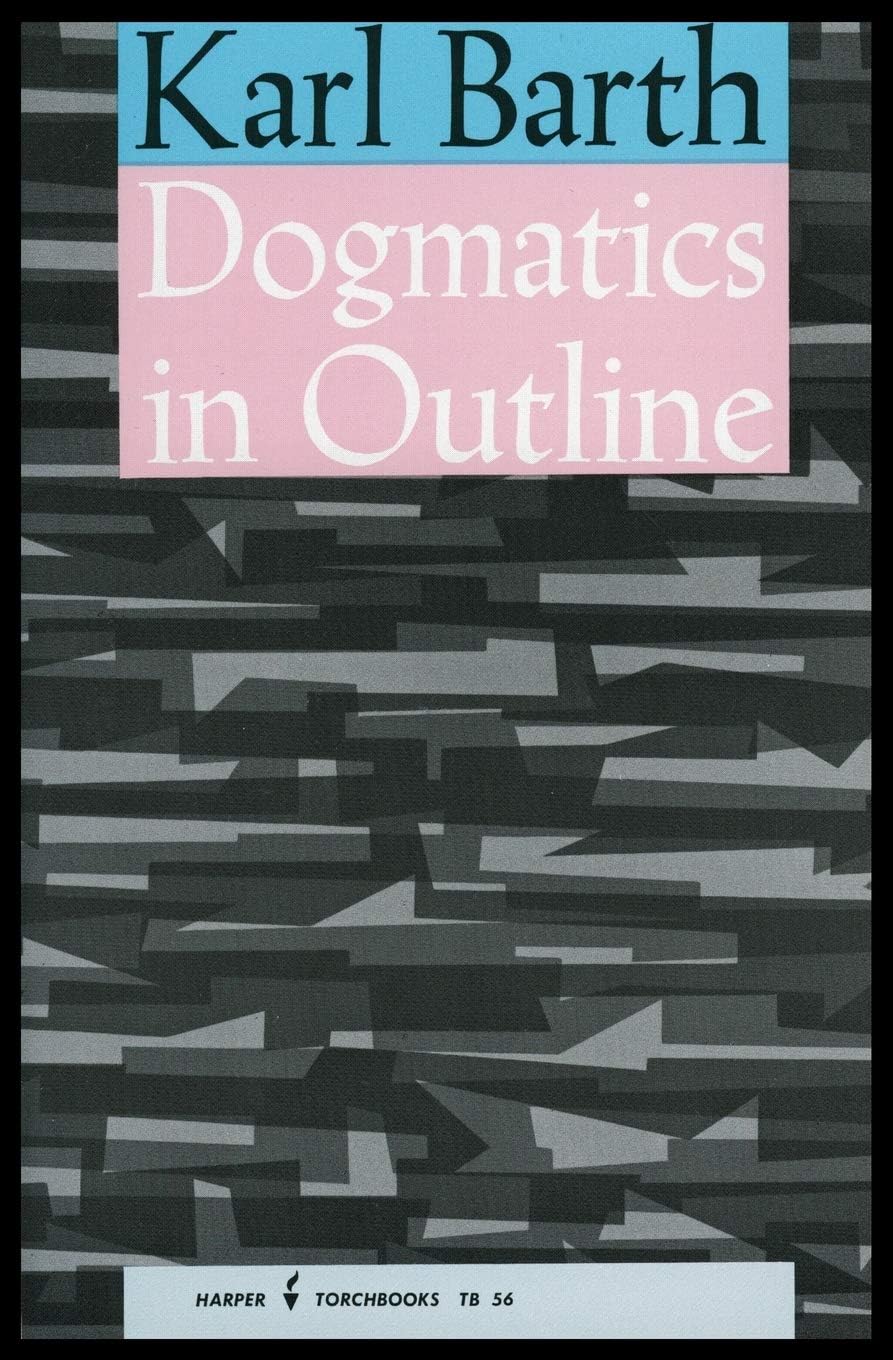
Dogmatics in Outline: Essential Christian Theology from the Twentieth Century's Greatest Theologian
Product ID: 19773624
Buy anything from 5,000+ international stores. One checkout price. No surprise fees. Join 2M+ shoppers on Desertcart.
Desertcart purchases this item on your behalf and handles shipping, customs, and support to Denmark.
Dogmatics in Outline: Essential Christian Theology from the Twentieth Century's Greatest Theologian [Barth, Karl] on desertcart.com. *FREE* shipping on qualifying offers. Dogmatics in Outline: Essential Christian Theology from the Twentieth Century's Greatest Theologian Review: Helpful, Slim Introduction - Author: Karl Barth Publisher: Harper & Row Publishing Reading Level: Moderate Pages: 155 "Where the life of the church is exhausted in self-serving, it smacks of death." (146) Karl Barth's Dogmatics in Outline is a summary of the Apostle's Creed from 1946. Barth calls them "merely an outline of the multi-volume Dogmatik" (6). This is to sell them short. Anyone who can state, as Barth did of the concluding lectures, that "now they are published, I notice their weak points and will not grumble at any reviewer who brings them to my attention" (8) deserves to be read as one who is critical of all words — including their own. Dogmatics in Outline is not without fault. Nor will any reader walk away without disagreements (apparently even Barth). Yet still, Barth is a masterful guide through the Apostle's Creed from the Reformed tradition providing insights and thoughts that the modern church needs to hear. His usage of the Heidelberg Catechism throughout his exposition provides great historical light and reveals that many of his insights are not novel. Yet, he would still call these lectures "a document of our time" (8). Though the setting is formal, Barth's teaching is quite straightforward. While a general knowledge of the Apostle's Creed will help a reader, Barth expounds upon the creed without any presuppositions. In many cases, his challenges to liberal theology remind of modern problems the church still faces. Any Christian seeking an introduction — or refresher — on Karl Barth will benefit from the reading of Dogmatics in Outline. "Where God's grace is rejected, man rushes into his own mischief." (106) Review: Another voice in the chorus - I finally finished this book, my first by Barth - it took me months to read this short (155 pages) series of lectures delivered to a group of dedicated students at Kurfürsten Schloss in Bonn in 1959. Despite the fact that each section is at most about five pages, Barth is deceptively easy to read and thus I spent a great deal of time poring over what had been transcribed in each lecture. He seemingly wastes no words, hardly repeats himself and is almost never recorded delivering anything but the highest level of discourse. Many do not write as clearly as Barth spoke extemporaneously. In particular, the three chapters on the structure of faith (Faith as Trust, Faith as Knowledge, and Faith as Confession) are particularly useful. The contrast between faith as trust and as knowledge was and is still difficult for me to totally understand in the context of this discussion. If reading the chapter on trust, one might accuse Barth (as some have) of fideism, but then taken as a pill with the chapter on knowledge, the waters are muddied. Knowledge rightly understood, knowledge as wisdom or Sophia rather that Scientia, Barth argues, is the sort of Christian knowledge that is related to faith (and encompasses the entire existence of man). Finally the church's job, in faith, is to confess its faith. It must proclaim, even in `unedifying language' familiar to those `out there'. Christian faith does not happen in a 'snail's shell' or in a comfortable dualism. Confession is not a weak thing that happens weekly in a church service, but in our every involvement outside of life Barth calls the Christian to confess in love, in ways that `Mr. Everyman' can understand. To paraphrase St. Francis, spread the Gospel, and use words only if necessary. By far the most moving chapter is on the coming judgment of Christ. Judgment never seems to be a fun topic, but in this case Barth points us to Christ as the one who will create order and restore what has been destroyed. (The particular university was apparently in near ruins in the post-war landscape, perhaps making this a particularly poignant point for many students as well as Barth himself). At judgment all tears will be wiped away. It won't be a question of our faith or lack of faith - but it will be the point where "it is finished" comes into full view. Christ has done his work on earth, which holds for all, Christian and non-Christian alike. An amazing lecture that truly challenges any sort of knee-jerk reaction against Christ the Judge. This was for me a book to savor and delight in, and it is one that I shall revisit again and again throughout my life.
| Best Sellers Rank | #121,375 in Books ( See Top 100 in Books ) #182 in Christian Systematic Theology (Books) #262 in Christology (Books) #272 in Religious Philosophy (Books) |
| Customer Reviews | 4.4 4.4 out of 5 stars (204) |
| Dimensions | 5.31 x 0.36 x 8 inches |
| Edition | 34731st |
| ISBN-10 | 006130056X |
| ISBN-13 | 978-0061300561 |
| Item Weight | 2.31 pounds |
| Language | English |
| Print length | 155 pages |
| Publication date | September 2, 1959 |
| Publisher | Harper Perennial |
A**Y
Helpful, Slim Introduction
Author: Karl Barth Publisher: Harper & Row Publishing Reading Level: Moderate Pages: 155 "Where the life of the church is exhausted in self-serving, it smacks of death." (146) Karl Barth's Dogmatics in Outline is a summary of the Apostle's Creed from 1946. Barth calls them "merely an outline of the multi-volume Dogmatik" (6). This is to sell them short. Anyone who can state, as Barth did of the concluding lectures, that "now they are published, I notice their weak points and will not grumble at any reviewer who brings them to my attention" (8) deserves to be read as one who is critical of all words — including their own. Dogmatics in Outline is not without fault. Nor will any reader walk away without disagreements (apparently even Barth). Yet still, Barth is a masterful guide through the Apostle's Creed from the Reformed tradition providing insights and thoughts that the modern church needs to hear. His usage of the Heidelberg Catechism throughout his exposition provides great historical light and reveals that many of his insights are not novel. Yet, he would still call these lectures "a document of our time" (8). Though the setting is formal, Barth's teaching is quite straightforward. While a general knowledge of the Apostle's Creed will help a reader, Barth expounds upon the creed without any presuppositions. In many cases, his challenges to liberal theology remind of modern problems the church still faces. Any Christian seeking an introduction — or refresher — on Karl Barth will benefit from the reading of Dogmatics in Outline. "Where God's grace is rejected, man rushes into his own mischief." (106)
C**E
Another voice in the chorus
I finally finished this book, my first by Barth - it took me months to read this short (155 pages) series of lectures delivered to a group of dedicated students at Kurfürsten Schloss in Bonn in 1959. Despite the fact that each section is at most about five pages, Barth is deceptively easy to read and thus I spent a great deal of time poring over what had been transcribed in each lecture. He seemingly wastes no words, hardly repeats himself and is almost never recorded delivering anything but the highest level of discourse. Many do not write as clearly as Barth spoke extemporaneously. In particular, the three chapters on the structure of faith (Faith as Trust, Faith as Knowledge, and Faith as Confession) are particularly useful. The contrast between faith as trust and as knowledge was and is still difficult for me to totally understand in the context of this discussion. If reading the chapter on trust, one might accuse Barth (as some have) of fideism, but then taken as a pill with the chapter on knowledge, the waters are muddied. Knowledge rightly understood, knowledge as wisdom or Sophia rather that Scientia, Barth argues, is the sort of Christian knowledge that is related to faith (and encompasses the entire existence of man). Finally the church's job, in faith, is to confess its faith. It must proclaim, even in `unedifying language' familiar to those `out there'. Christian faith does not happen in a 'snail's shell' or in a comfortable dualism. Confession is not a weak thing that happens weekly in a church service, but in our every involvement outside of life Barth calls the Christian to confess in love, in ways that `Mr. Everyman' can understand. To paraphrase St. Francis, spread the Gospel, and use words only if necessary. By far the most moving chapter is on the coming judgment of Christ. Judgment never seems to be a fun topic, but in this case Barth points us to Christ as the one who will create order and restore what has been destroyed. (The particular university was apparently in near ruins in the post-war landscape, perhaps making this a particularly poignant point for many students as well as Barth himself). At judgment all tears will be wiped away. It won't be a question of our faith or lack of faith - but it will be the point where "it is finished" comes into full view. Christ has done his work on earth, which holds for all, Christian and non-Christian alike. An amazing lecture that truly challenges any sort of knee-jerk reaction against Christ the Judge. This was for me a book to savor and delight in, and it is one that I shall revisit again and again throughout my life.
W**Y
Dim text
Text in the delivered book is quite light, making the text somewhat difficult to read.
A**H
Great Introduction to Barth
This is an excellent short and (relatively) accessible work by Barth. Delivered as a lecture in the year just after WWII, Barth is speaking to students about the basic doctrines of the Christian faith. His combativeness, intellect, and humor are on display here in a book full of vivid metaphors and surprising turns of thought. If you want to read Barth himself but don't want to tackle the Church Dogmatics yet, this is a great choice.
J**F
Accessible and academic
This is something like 13 volumes of Barth’s work translated from German and distilled to outline form. What a find! A well-supported academic tome with fantastic application to a modern walk with Christ.
M**N
Content superb , print is terrible
Received for Christmas, up on my request. From what I have read content is +++. Excited to read this. However, the print is --- very poor. It seems the publisher ran a photocopy of a previous book on an old printer, bound it and published it. It is hard to read. Contrast is poor. It is a shame.
G**R
Good summary of Karl Barth Church Dogmatics using Apsotles' Creed
If you want a nice summary of the basic themes of Church Dogmatics, this is it. I have read the entire Church Dogmatics, and this book provides many of the key positions we find there. It does not replace the reading of Church Dogmatics, but for those who have no interest in going that far with Barth, this is a good place to be. It is a set of lectures Barth offered, without notes, in Germany soon after World War II. It is an exposition of the Apostles' Creed. It provides some good insight into the direction Barth was headed had he completed Church Dogmatics.
P**R
Beware this edition. Almost unreadable print
Barth's book is wonderful. But you couldn't find that out with this edition. The pages are light gray, not white. And the print is dark gray, not black. Almost unreadable.
H**H
Barth es un teólogo que no a todos agrada, pero es excelente y te obliga a revisar lo que crees y lo que piensas que habías entendido.
R**N
The print is so feint I cannot read it and this was on the second book too. I don't want it. I would like a refund please. I am having trouble trying to return the second defective copy.
提**ん
難解な英語ですが、必読書です。ドイツ語が読めない場合は、頑張るべきです!私も頑張りました!紙の本でも購入しました。
S**S
Anyone who ever looks at theology these days cannot help but notice the shadows of certain figures looming large over them. Arguably, fewer of these are more prominent than Karl Barth. His Church Dogmatics is often cited as one of the greatest works of 20th century theology. It is, however, extremely long and, I might add, rather expensive. So in order to attempt to get to grips with Barth's theology, I have had his Dogmatics in Outline on my radar for some time. In this book, which is comprised of transcripts of lectures he gave in Germany, just after the Second World War, he condenses his magnum opus into a little over 140 pages, going through the Apostles' Creed, phrase by phrase. Before he begins in earnest, though he gives us an outline of his plan, as well as some very useful discussions on the nature of faith. One must not think, though, that because the book is short that it is straightforward. It's very dense, particularly the early chapters. I think I could re-read the first 30 pages over and over again, get something new out of them every time and yet still not fully grasp the breadth of the vision that Barth was expounding. As he moves on to look at the various bits of the Apostles' Creed, it does become a bit more accessible. Though that may be because I had, by that time, adjusted my reading to suit the cadences present in the text. In many ways, it is particularly hard for me to summarise what Barth's theology is, because what became clear is how much of an influence he has been on the leaders of the churches I have been a part of. That is, I view my own beliefs as being fairly orthodox and there is very little in this book that is vastly different from the teaching I have largely grown up within baptist, pentecostal and other nonconformist churches. It was then merely a very well-articulated series of sermons in the same vein that I have listened to in each of the last 4 decades. As I was reading through it, I found myself wondering if his theology was the pinnacle of `pre-critical' thinking. Though there are plenty of theologians before him who have had similar views (I think here of the likes of Augustine, Aquinas, Luther & Calvin), Barth was a contemporary of Bultmann, who is one of the others whose shadow across modern theology cannot be ignored. The other figure I thought of was A.W. Tozer. Though the latter was not as theologically astute as Barth, I sensed a similarity in their approach to, and view of, the bible. Interestingly, though, Barth does not go so far as to make any sort of claim to inerrancy, but he does insist on the bible being front and centre of how we understand the christian faith. Though Bultmann is barely alluded to, there is a distinct air of defiance against Bultmann's school of thinking. For my part, though I would lean towards Barth's point of view, I would pay more attention to biblical criticism than is evidenced here. Barth warns at the outset that this is meant to be a careful look at what the church should be and be for from the perspective of those who are part of the church. It's not a book I would recommend to a non-christian, that's not the target audience. But for anyone wanting to read a book of pretty solid theology, then this is an excellent place to start.
M**D
I have just started to read this book to help me understand Barth's straight and forthright biblical teaching. When one mention's the name Barth these days you get a negative response why I'm not sure. Barth's teaching helped the church in the West to discover hope and stability through a difficult period in its history.
Trustpilot
1 month ago
2 weeks ago