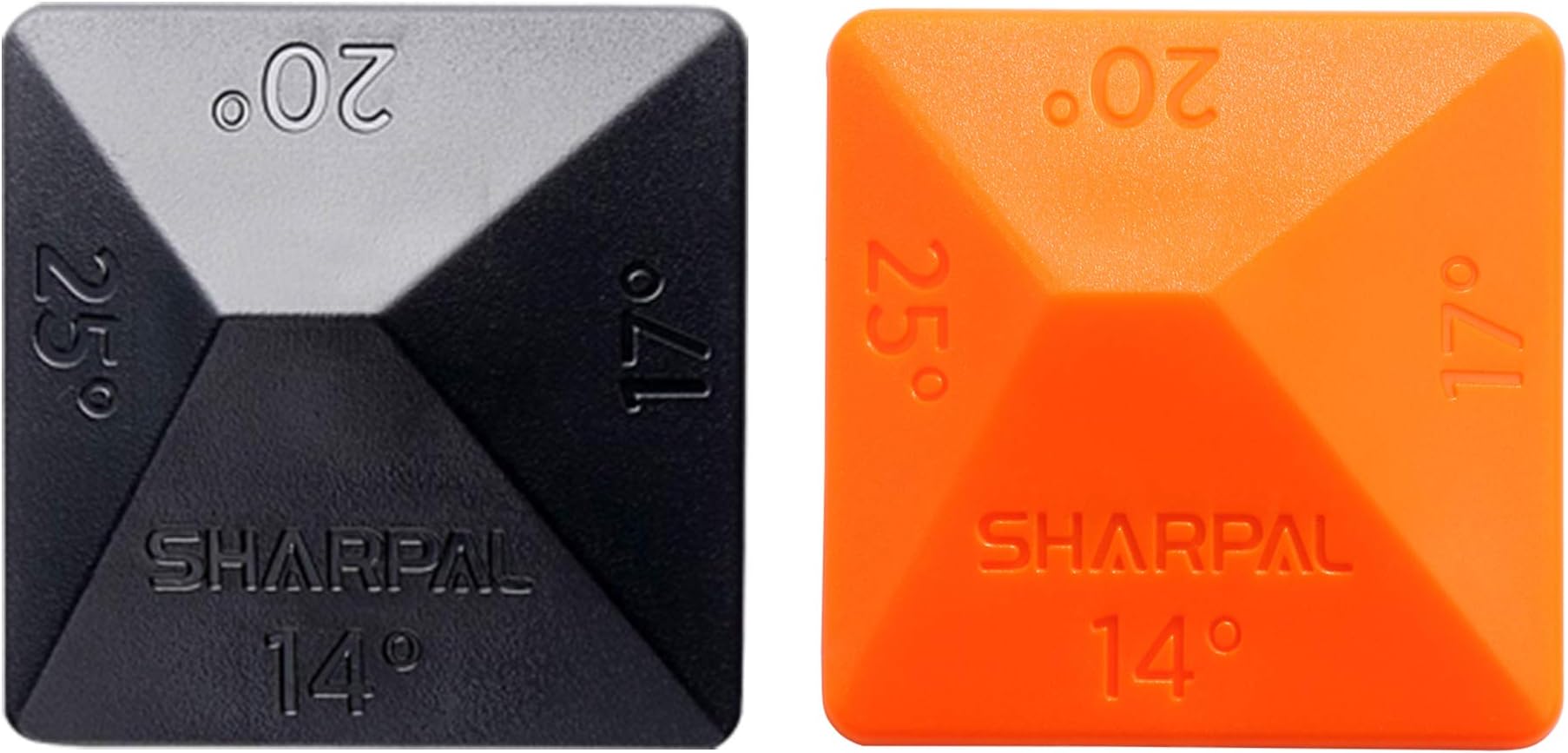
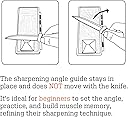
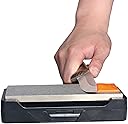
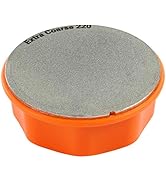
The two guides included in the Sharpal 196N package are excellent tools for finding the correct angle to use when sharpening a knife on a diamond plate or a sharpening stone. Even an experienced sharpener sometimes needs a guide. The orange pyramid guide has an embedded magnet that will allow the guide to attach and stay put on most diamond sharpening plates (also called whetstones). My pictures show the orange guide on a Sharpal 162N diamond whetstone. (Note that the 162N whetstone comes with the orange guide included.) However, many brands of diamond coated whetstones have the diamonds embedded in a layer on a steel plate, so the orange guide should work just fine with them. To use the orange guide, select the angle you want for the knife, then put the guide on the diamond whetstone with that angle facing the long side of the whetstone. Diamond whetstones can be used to sharpen a knife by putting the knife on the stone at the selected angle, then maintaining that angle while moving the knife in a "slicing" motion across the whetstone, as though you were trying to slice off the diamond coating. The amount of pressure on the whetstone is four pounds or less. If you have a kitchen scale, you can get a feel for how much force is equal to four pounds. (Believe me, it isn't much.) When in doubt, use less force and go across the stone more times. Do about 8-10 strokes on one side, then flip the knife over and do 8-10 strokes on the other edge. Most people will use the same hand for both sides of the knife, which means you would relocate the orange guide to the other end of the whetstone. Some ambidextrous folks can simply switch hands to sharpen the other edge of the knife. My photo shows 20° selected for use. Most western knives would use a 20° angle. Use a 14° angle for most Japanese-style knives (Shun, MAC, Tojiro, Dalstrong, etc.). The 17° guide might be more appropriate for a Global. If unsure, consult the description for the particular knife at the manufacturer's website or wherever the knife was purchased. Check to see if there is an Amazon description, too. The 25° angle is appropriate for cleavers and some chef knives. This larger angle will not get the edge as sharp as a narrower angle, but the edge will be more difficult to roll over, if you are using a lot of force during your cutting activities. The black guide is shown on a 3000 grit Pride Abrasive water stone. It has a rubbery bottom that helps prevent the guide from slipping on the stone. Most water stones require you to pull the edge across the stone by having the top of the knife moving forward and the sharp edge trailing behind. In other words, you are dragging the edge away from the stone surface, not trying to slice off the top of the water stone - many brands of water stones are soft enough that you actually would cut into the stone. So, to use the black guide, you need to put the knife on the desired angle and observe how the knife looks relative to the stone. Then you lift the knife off the guide while maintaining that angle, put the knife on the stone and dragging the edge across the stone. I realize that this description may not adequately explain the process, so I suggest that you watch some online videos. You can search for videos by Peter Nowlan that I watched when I first began sharpening. Peter does not use angle guides, but you can learn the basic techniques and incorporate the angle guide into your own process.