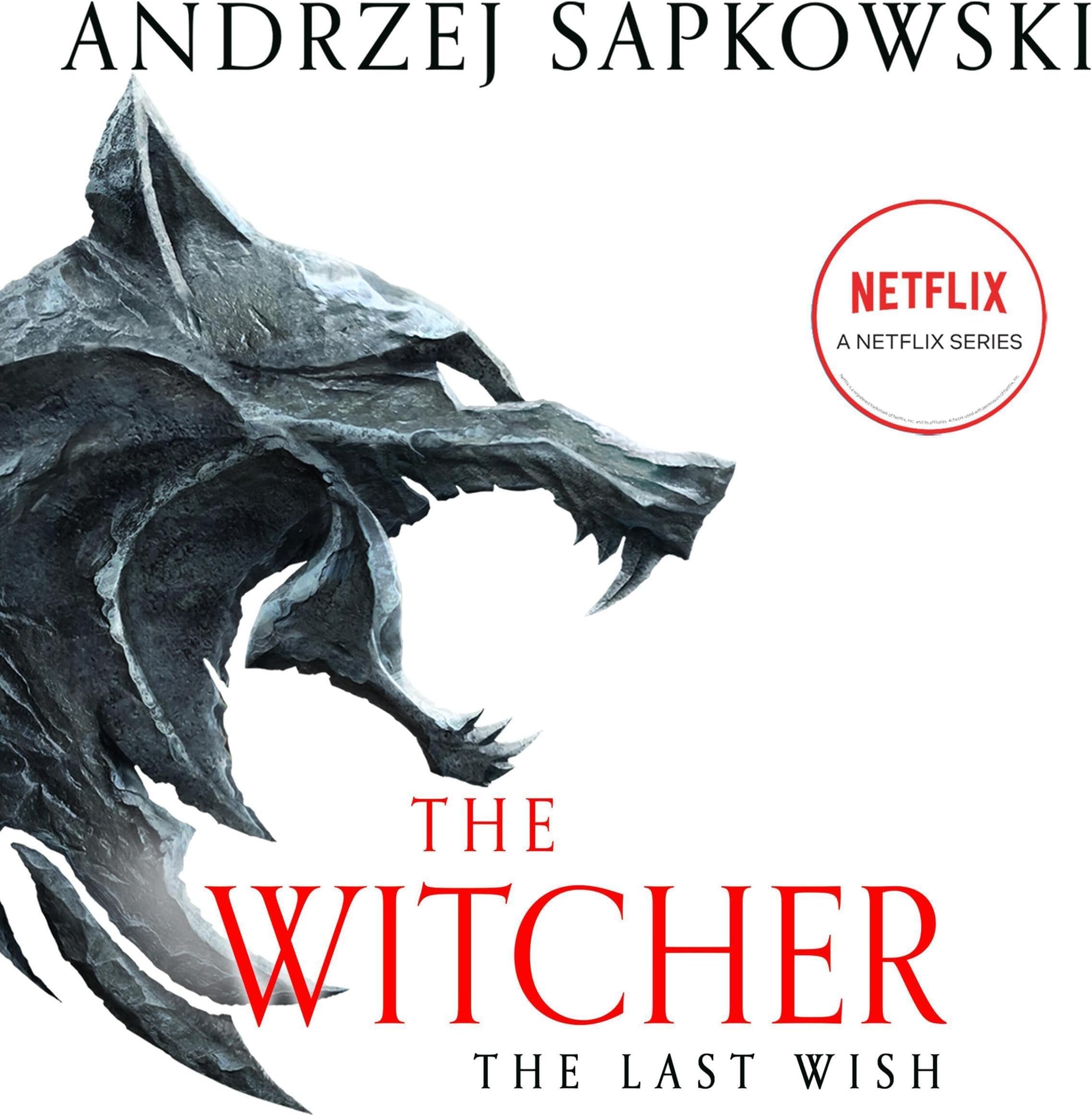
The Last Wish: Introducing the Witcher
Product ID: 14543746
Geralt the Witcher—revered and hated—holds the line against the monsters plaguing humanity in this collection of adventures, the first chapter in Andrzej Sapkowski’s groundbreaking epic fantasy series that inspired the hit Netflix show and the blockbuster video games. ★ The New York Times bestselling series ★ Over Fifteen Million Copies Sold Worldwide ★ World Fantasy Award Winning Author ★ David Gemmell Legend Award Winning Author ★ Named One of the Greatest Book Series of All Time by Forbes Geralt is a Witcher, a man whose magic powers, enhanced by long training and a mysterious elixir, have made him a brilliant fighter and a merciless hunter. Yet he is no ordinary killer. His sole purpose: to destroy the monsters that plague the world. But not everything monstrous-looking is evil and not everything fair is good . . . and in every fairy tale there is a grain of truth. Witcher collections The Last Wish Sword of Destiny Witcher novels Blood of Elves The Time of Contempt Baptism of Fire The Tower of Swallows Lady of the Lake Season of Storms Crossroads of Ravens Hussite Trilogy The Tower of Fools Warriors of God Translated from original Polish by Danusia Stok Review: A rich fantasy series with a world full of moral and political ambiguities like in our own - There was a video game called "The Witcher" that was fun and thought provoking. I didn't play through "The Witcher 2," but I saw the trailer for "The Witcher 3" and my interest was rekindled. I decided to read the books that the video games were based on. They were great! They are about Geralt of Rivia, a witcher (mutant monster fighter) in a European folklore fantasy setting. It was interesting reading the books after playing the video games. "The Last Wish" is a collection of short stories contained within a frame narrative, and the first story is about Geralt curing a striga's curse. This story was also shown at the start of the video game. The video game's representation of that event matches the short story play by play. Similarly, the quote from the "Witcher 3" trailer is taken, almost verbatim, from another short story. In general, the video game felt very faithful to the books. The setting, the tone, the character, and the philosophical issues were all similar to those seen in the books. The character of Geralt is wonderful, and the game does him justice. That is to say, if you liked the video games, I highly recommend the books. The books, however, are better than the video games. The setting is analogous to our own. The moral dilemmas that the books raise are meaningful ones that people grapple with all the time. The protagonist is noble, if damaged, and the storytelling is great. Before I extol the virtues of the books, however, I will say that the writing style is not my favorite. Sapkowski leaves a lot unsaid. It sometimes isn't clear when the book is transitioning from a short story to a frame narrative, for instance. This also means that dialogue also contains a lot of implicit actions. I am used to a writing style where dialogue has exposition interspersed, so I expect a conversation to happen in a mostly synchronous manner without much time passing between one person talking and another, but Sapkowski often has a significant passage of time. That's not to say that it's unclear -- I can usually figure out what was done based on the dialogue, but it does often take some rereading. Geralt also likes to leave things unsaid (while he does have long monologues, he just as often makes his point with no words or few words), so this could also be a perverse instance of the medium matching the message. Now the virtues. While the setting is European folklore inspired fantasy, I think that it matches our setting more closely than a lot of books set either in our world or a world very close to ours. In Sapkowski's world, humans invaded a continent inhabited by many other sentient species and conquered them (and most of those sentient species had done the same thing a few millenia past). Now, there are attempts at a tentative peace. Witchers themselves come from an older age when monsters were rampant and threatened survival. Now, more often than not, the threat is not some stark monster, but human greed with a benevolent mask. Cities provide protection from natural threats, but people don't know how to deal with the intercultural exchange that comes from living with many other different people or with the anonymity that comes from living with many other people in general. Centralized power has helped the sciences and arts flourish, but it has also led to corruption and war, and despite growing resources, many people still are poor. The world is bigger than most people know, and most people aren't experts in the world around them, so most people have a hard time separating myths from reality. A person has to work to make money to live, and a person also has to comport themselves so that they can sleep at night. That's a pretty good description of Earth in the twenty first century. Europe exploited or colonized much of the world (and many of the people that it conquered were simply the conquerors on a more local scale), but the world is now attempting a tentative peace. We still carry the legacy of an age where we had to fight for mere survival (witness, for example, the popularity of guns) even though the struggles we face today are things like neocolonialism. A country that was founded on the notion of freedom and immigration has become nativist and struggles with pluralism. People, lost in the crowd, fall through the cracks, so children get left behind, and mentally ill people become homeless. Most people in the most prosperous nation on Earth don't think that the government is working well, and it has been at war for 214 years since 1776. With knowledge all around us, it's hard to tell myth from reality. And we have to make money to live and live so that we can sleep at night. But how? Most of our age old wisdom is what got us into this mess! Who do we treat with compassion, how do we identify monsters, and what do we do when we find one? One of the reasons that I like the books better than the video game is that the books feature moral dilemmas more strongly. One of the first short stories, "The Lesser Evil," features two parties trying to convince Geralt to help them against the other. His response to both: "Evil is evil... Lesser, greater, middling... Proportions are negotiated, boundaries blurred... if I'm to choose between one evil and another, then I prefer not to choose at all." While most of the time in the video games is spent killing monsters, most of the time in the books is spent musing about philosophy, politics, and why Geralt refuses to kill things that most see as monsters. People invent many monsters, according to Geralt, because then "they seem less monstrous themselves." Some of the moral dilemmas are confusing. In one story, Geralt kills a group of people who are preparing to massacre a village, and he feels guilty about it because he might have been able to avoid anyone dying. In another story, Geralt kills a group of thugs (rather than disabling them, which would have been easy), but never indicates that he felt remorse. This isn't an issue of ambiguity, but rather a lack of attention to some issues. His stance on most issues, like pluralism, is fairly consistent at least. Sapkowski also uses framed narratives to great effect. In framed stories, we often read of Geralt saying that he can't do something because of the Witchers' code, but in a framing story, he says, "I have at times hidden behind a code. People like that. Those who follow a code are often respected and held in high esteem. But no one's ever compiled a witcher's code. I invented mine. Just like that. And keep to it. Always -- Not always." Geralt is tormented, and framed narratives allow him introspection. All in all, "The Last Wish" is great, and I'm happy to keep reading more books in the series! Note that "The Last Wish" is the first book, and the next book is "The Sword of Destiny," which is only available as a fan translation, and not "The Blood of Elves." Review: I found a few things to appreciate even though I am not really into short stories - I help moderate a discussion board about fantasy books and some of the people there just raved about this series, so I decided to check it out. I am kind of ambivalent about the book after having finished it. I think part of my problem is that I am just not into books of short stories. They can't seem to keep my attention. There is no hurrying through my evening tasks or shirking house cleaning to pick up the book again to see what happens next. I think I just prefer longer, more connected narratives. There are hints of something else going on in this book, but it sort of feels like a disjointed series of continuing adventures. If you are more of a fan of short stories than I am, you will probably not have this hang up. (Sometimes, the number of stars I give a book is reflective of how quickly or how slowly I finish it. I let this one sit for a couple of weeks halfway through.) The other thing is, this reads a lot like other sword and sorcery novels and stories I've read (which is honestly not many, mostly some Elric of Melnibone books -- it doesn't help that the protagonists share certain characteristics of physical appearance). I appreciate the place of sword and sorcery in the overall scope of fantasy literature, but it is not really my cup of tea. It is not something I reach for often. The pace, the magic, the creatures, the battles, the sidekick (Geralt of Rivia's Dandilion and Elric's Moonglum are not exactly the same, but one immediately reminds me of the other due to their places next to the heroes) -- they are all present. There were definitely some things I liked. It is interesting to see a voice in fantasy who is not from the Anglo-Saxon world. (It seems like most of the authors I read are from the US, Canada, the UK, Ireland, Australia, or New Zealand.) The author is still European and you get that sort of flavor running through the stories. This book is heavily influenced by European folk and fairy tails and mythology. (I would not call it a copy or even an adaptation. I just feel like some elements are borrowed and adapted to fit.) These influences make the reader assume things about the setting that help to fill in the details of the world without beating you over the head with them (and without infodumping). I do like that, and I think it is necessary, because you can't really develop a world deeply in a short story format. But by triggering the use of shortcuts in the reader (we've all read fantasy with small villages, sorcerers, bards, evil creatures, etc.), the setting is developed. It is hard to assess the writing since this is translated into English. Certainly I could understand everything that was going on, so on that level, the translation worked. There was a quality to the writing in this book that reminded me of the few other translated works of fantasy fiction I've read (by Sergey and Marina Dyachenko, for example). I don't know if that is a result of how translators work or because of the natural cadence of Slavic languages, but I find it really well-suited to telling a story with folk tale/fairy tale influences. I am definitely going to continue the series though, and here's why. First, through dropped hints here and there, we are getting a tantalizing peek at what was done to make the protagonist of these stories, Geralt of Rivia, into a "witcher" (basically a non-sorcerer with some magical abilities and good fighting abilities who goes around freeing townspeople from disruptive magical creatures and the like). I love mysteries like this and they will draw me in every time. I will put up with short stories just so I can find those little clues about the past. Second, I am curious to see how Geralt's adventures would translate to a full-length novel. I think the potential is definitely there. Third, I really like the social undercurrents surrounding witchers. People can be quite prejudiced against Geralt -- until they need help from him. Geralt is not always treated nicely and yet he maintains a strong moral code throughout. He is loyal to his friends and does try to avoid trouble (though it sometimes finds him anyway). I am curious about how the social undercurrents contributed to the decline of witchers as a profession (it seems there are few or none left, aside from Geralt). After writing this and thinking for awhile, I've decided to go with 3.5 stars (which I rounded up to 4 for my rating). I decided that although short stories and sword and sorcery are really not my things, I did like the author's approach to world building and structuring society, I love the mystery surrounding Geralt's past, and I thought the language worked well with the sort of story that was being told. Those are not things I often find myself remarking upon in other books, so the author clearly did several things right here, and those deserve to be acknowledged.
S**G
A rich fantasy series with a world full of moral and political ambiguities like in our own
There was a video game called "The Witcher" that was fun and thought provoking. I didn't play through "The Witcher 2," but I saw the trailer for "The Witcher 3" and my interest was rekindled. I decided to read the books that the video games were based on. They were great! They are about Geralt of Rivia, a witcher (mutant monster fighter) in a European folklore fantasy setting. It was interesting reading the books after playing the video games. "The Last Wish" is a collection of short stories contained within a frame narrative, and the first story is about Geralt curing a striga's curse. This story was also shown at the start of the video game. The video game's representation of that event matches the short story play by play. Similarly, the quote from the "Witcher 3" trailer is taken, almost verbatim, from another short story. In general, the video game felt very faithful to the books. The setting, the tone, the character, and the philosophical issues were all similar to those seen in the books. The character of Geralt is wonderful, and the game does him justice. That is to say, if you liked the video games, I highly recommend the books. The books, however, are better than the video games. The setting is analogous to our own. The moral dilemmas that the books raise are meaningful ones that people grapple with all the time. The protagonist is noble, if damaged, and the storytelling is great. Before I extol the virtues of the books, however, I will say that the writing style is not my favorite. Sapkowski leaves a lot unsaid. It sometimes isn't clear when the book is transitioning from a short story to a frame narrative, for instance. This also means that dialogue also contains a lot of implicit actions. I am used to a writing style where dialogue has exposition interspersed, so I expect a conversation to happen in a mostly synchronous manner without much time passing between one person talking and another, but Sapkowski often has a significant passage of time. That's not to say that it's unclear -- I can usually figure out what was done based on the dialogue, but it does often take some rereading. Geralt also likes to leave things unsaid (while he does have long monologues, he just as often makes his point with no words or few words), so this could also be a perverse instance of the medium matching the message. Now the virtues. While the setting is European folklore inspired fantasy, I think that it matches our setting more closely than a lot of books set either in our world or a world very close to ours. In Sapkowski's world, humans invaded a continent inhabited by many other sentient species and conquered them (and most of those sentient species had done the same thing a few millenia past). Now, there are attempts at a tentative peace. Witchers themselves come from an older age when monsters were rampant and threatened survival. Now, more often than not, the threat is not some stark monster, but human greed with a benevolent mask. Cities provide protection from natural threats, but people don't know how to deal with the intercultural exchange that comes from living with many other different people or with the anonymity that comes from living with many other people in general. Centralized power has helped the sciences and arts flourish, but it has also led to corruption and war, and despite growing resources, many people still are poor. The world is bigger than most people know, and most people aren't experts in the world around them, so most people have a hard time separating myths from reality. A person has to work to make money to live, and a person also has to comport themselves so that they can sleep at night. That's a pretty good description of Earth in the twenty first century. Europe exploited or colonized much of the world (and many of the people that it conquered were simply the conquerors on a more local scale), but the world is now attempting a tentative peace. We still carry the legacy of an age where we had to fight for mere survival (witness, for example, the popularity of guns) even though the struggles we face today are things like neocolonialism. A country that was founded on the notion of freedom and immigration has become nativist and struggles with pluralism. People, lost in the crowd, fall through the cracks, so children get left behind, and mentally ill people become homeless. Most people in the most prosperous nation on Earth don't think that the government is working well, and it has been at war for 214 years since 1776. With knowledge all around us, it's hard to tell myth from reality. And we have to make money to live and live so that we can sleep at night. But how? Most of our age old wisdom is what got us into this mess! Who do we treat with compassion, how do we identify monsters, and what do we do when we find one? One of the reasons that I like the books better than the video game is that the books feature moral dilemmas more strongly. One of the first short stories, "The Lesser Evil," features two parties trying to convince Geralt to help them against the other. His response to both: "Evil is evil... Lesser, greater, middling... Proportions are negotiated, boundaries blurred... if I'm to choose between one evil and another, then I prefer not to choose at all." While most of the time in the video games is spent killing monsters, most of the time in the books is spent musing about philosophy, politics, and why Geralt refuses to kill things that most see as monsters. People invent many monsters, according to Geralt, because then "they seem less monstrous themselves." Some of the moral dilemmas are confusing. In one story, Geralt kills a group of people who are preparing to massacre a village, and he feels guilty about it because he might have been able to avoid anyone dying. In another story, Geralt kills a group of thugs (rather than disabling them, which would have been easy), but never indicates that he felt remorse. This isn't an issue of ambiguity, but rather a lack of attention to some issues. His stance on most issues, like pluralism, is fairly consistent at least. Sapkowski also uses framed narratives to great effect. In framed stories, we often read of Geralt saying that he can't do something because of the Witchers' code, but in a framing story, he says, "I have at times hidden behind a code. People like that. Those who follow a code are often respected and held in high esteem. But no one's ever compiled a witcher's code. I invented mine. Just like that. And keep to it. Always -- Not always." Geralt is tormented, and framed narratives allow him introspection. All in all, "The Last Wish" is great, and I'm happy to keep reading more books in the series! Note that "The Last Wish" is the first book, and the next book is "The Sword of Destiny," which is only available as a fan translation, and not "The Blood of Elves."
S**O
I found a few things to appreciate even though I am not really into short stories
I help moderate a discussion board about fantasy books and some of the people there just raved about this series, so I decided to check it out. I am kind of ambivalent about the book after having finished it. I think part of my problem is that I am just not into books of short stories. They can't seem to keep my attention. There is no hurrying through my evening tasks or shirking house cleaning to pick up the book again to see what happens next. I think I just prefer longer, more connected narratives. There are hints of something else going on in this book, but it sort of feels like a disjointed series of continuing adventures. If you are more of a fan of short stories than I am, you will probably not have this hang up. (Sometimes, the number of stars I give a book is reflective of how quickly or how slowly I finish it. I let this one sit for a couple of weeks halfway through.) The other thing is, this reads a lot like other sword and sorcery novels and stories I've read (which is honestly not many, mostly some Elric of Melnibone books -- it doesn't help that the protagonists share certain characteristics of physical appearance). I appreciate the place of sword and sorcery in the overall scope of fantasy literature, but it is not really my cup of tea. It is not something I reach for often. The pace, the magic, the creatures, the battles, the sidekick (Geralt of Rivia's Dandilion and Elric's Moonglum are not exactly the same, but one immediately reminds me of the other due to their places next to the heroes) -- they are all present. There were definitely some things I liked. It is interesting to see a voice in fantasy who is not from the Anglo-Saxon world. (It seems like most of the authors I read are from the US, Canada, the UK, Ireland, Australia, or New Zealand.) The author is still European and you get that sort of flavor running through the stories. This book is heavily influenced by European folk and fairy tails and mythology. (I would not call it a copy or even an adaptation. I just feel like some elements are borrowed and adapted to fit.) These influences make the reader assume things about the setting that help to fill in the details of the world without beating you over the head with them (and without infodumping). I do like that, and I think it is necessary, because you can't really develop a world deeply in a short story format. But by triggering the use of shortcuts in the reader (we've all read fantasy with small villages, sorcerers, bards, evil creatures, etc.), the setting is developed. It is hard to assess the writing since this is translated into English. Certainly I could understand everything that was going on, so on that level, the translation worked. There was a quality to the writing in this book that reminded me of the few other translated works of fantasy fiction I've read (by Sergey and Marina Dyachenko, for example). I don't know if that is a result of how translators work or because of the natural cadence of Slavic languages, but I find it really well-suited to telling a story with folk tale/fairy tale influences. I am definitely going to continue the series though, and here's why. First, through dropped hints here and there, we are getting a tantalizing peek at what was done to make the protagonist of these stories, Geralt of Rivia, into a "witcher" (basically a non-sorcerer with some magical abilities and good fighting abilities who goes around freeing townspeople from disruptive magical creatures and the like). I love mysteries like this and they will draw me in every time. I will put up with short stories just so I can find those little clues about the past. Second, I am curious to see how Geralt's adventures would translate to a full-length novel. I think the potential is definitely there. Third, I really like the social undercurrents surrounding witchers. People can be quite prejudiced against Geralt -- until they need help from him. Geralt is not always treated nicely and yet he maintains a strong moral code throughout. He is loyal to his friends and does try to avoid trouble (though it sometimes finds him anyway). I am curious about how the social undercurrents contributed to the decline of witchers as a profession (it seems there are few or none left, aside from Geralt). After writing this and thinking for awhile, I've decided to go with 3.5 stars (which I rounded up to 4 for my rating). I decided that although short stories and sword and sorcery are really not my things, I did like the author's approach to world building and structuring society, I love the mystery surrounding Geralt's past, and I thought the language worked well with the sort of story that was being told. Those are not things I often find myself remarking upon in other books, so the author clearly did several things right here, and those deserve to be acknowledged.
B**D
Introducing Geralt of Rivia, the White Wolf.
2019-11-13: (5 star) It's been one day longer than three years to the day since I last read this. I just noticed that. Totally unintentional, but kind of funny nonetheless. Anyhow, I'm back in the world of the Witcher for my second read. The impending TV show from Netflix had me all hyped up and I decided to revisit this collection, and read the next as well if I ended up enjoyed it more. Which I did. A lot more, actually. I don't know why that is. Probably it was just a mood thing, which is so often the case with entertainment, but I also think that reading it the first time around while simultaneously playing the video game (The Witcher 3) was a mistake. You'd think it would actually be a good idea, but the games and the books don't share continuity. The games are set further down the timeline than the books, and are their own story which doesn't infringe upon the story line in the books. So I think that essentially following two different stories at once about the same characters threw me off. I really enjoyed this collection this time around though, and settled on 5 stars after deeming more of the stories as being worthy of 5 stars than 4. The Last Wish is a collection of six short stories surrounding The Witcher, Geralt of Rivia, and they are intersected by a frame story (entitled The Voice of Reason) that follows Geralt's time with his friend Nenneke at Melitele's Temple. Geralt, while outwardly appearing to be a vicious, dangerous, and ill-tempered man--well, more than appearing, he is those things--is also a thoughtful, inquisitive man, with a complicated past; often of good humor. Each of these six stories offers us a view at who The Witcher is, where he comes from, and the manner of man he is. The world is changing. And these days, for a man whose job it is to hunt monsters for pay, it is a tough pill to swallow that humans are often capable of as much monstrosity as the monsters themselves. Maybe even more so. I am going to list out the six stories below, and say a bit about each of them. THE WITCHER: In which Geralt is called upon to deal with a striga at the palace of Foltest, king of Temeria. An excellent introduction story. A GRAIN OF TRUTH: In which Geralt is welcomed into the house of Nivellen, a most interesting host. But as Geralt soon learns, Nivellen does not live alone. This story is in my top three, and I felt like it did a great job of showcasing Sapkowski's writing chops. The man is very descriptive at times, and sets a nice scene. The translation did not bother me so much this time around either, for whatever reason. THE LESSER EVIL: In which Geralt visits the town of Blaviken (a name of some infamy for Witcher fans) and battles with choices, and, well, lesser evils. One of the most important stories of the collection when it comes to characterization of our White Wolf, and definitely in my top three. A QUESTION OF PRICE: In which Geralt is invited by Queen Calanthe of Cintra to the banquet of her daughter Pavetta on her fifteenth birthday. This story rounds out my top three, and very well may be my favorite of the bunch. But you know, as I type this, my top three is less certain. Because the next story is darn good too. THE EDGE OF THE WORLD: In which Geralt is traveling with Dandelion near the supposed edge of the world, the end of civilization, and struggling to find work, when a man tells them of a devil making mischief on his property. This story also serves as our first look at the elves, the Aen Seidhe. THE LAST WISH: In which Geralt and Dandelion (let's be honest, mostly Dandelion) accidentally unleash a Djinn after a fishing mishap. This story serves as our introduction to Yennefer of Vergerberg, and Triss Merigold is also briefly mentioned. And that's it. There you have it. A really nice collection of stories to introduce Geralt of Rivia, The White Wolf. '“Evil is evil, Stregobor,” said the witcher seriously as he got up. “Lesser, greater, middling, it’s all the same. Proportions are negotiated, boundaries blurred. I’m not a pious hermit. I haven’t done only good in my life. But if I’m to choose between one evil and another, then I prefer not to choose at all."' 2016-11-12: (3 star) I decided to pick this up because I've just started playing 'The Witcher 3', and thought it would be interesting to play and read simultaneously, regardless of the separation of plot. I'm glad I did, this was a fun read. It is a series of short stories following Geralt of Rivia, a Witcher - monster slayer for hire. I think that this book actually suffered from my reading it directly after The First Law trilogy, which I enjoyed immensely. It didn't quite live up to the hype I'd built up from that series. That and I feel that the translation (this series was originally written in Polish) is a little clunky here and there. All in all, its a short, fun read and I'll continue the series somewhere down the line.
P**R
"I wouldn't suggest the race if you knew. I like competitions but I don't like losing."
Moral relativism, ambiguity, the question of will versus fate and a clever addition of science as an effect for the supernatural (rather than rely entirely on the foundation of magic) are the prevalent, recurring themes in this collection of short stories. The Bad: Geralt isn't always a particularly relatable character. While unmistakably the protagonist, 'hero' is not a term that should be used to describe him very often. He fits the knight-errant-who-isn't' trope to a 't.' He has more than a bit of the 'bad boy' to him and sometimes comes across as more of an anti-hero than a champion. To be fair, this is the point. The Good: On the plus side, Geralt is interesting. He's fundamentally flawed and at times somewhat unlikable. He remains in a line of work that is always demanding, often thankless and generally dangerous. While a skilled and fearsome warrior, his combat prowess isn't always enough to win the day, so another solution becomes necessary. This by itself is refreshing. He's clever but sometimes only clever enough to get into more trouble, which is also pretty cool. Another item that's rather novel: how he got, or at times gets his powers. What he does with them is also very interesting. Perhaps most importantly, the world in which this character moves is straight-up fascinating: well drawn, understandable and fully realized. Geralt's interactions with this world pull the reader in; the audience will want, desperately, to see how Geralt affects this world or how it affects him. Or both. Far more compelling than the witcher himself: the situations he finds himself in, many of the other characters he interacts with, and the decisions he is routinely forced to make. What's front and center in this collection of short stories is the 'why' of making a choice. The rationale necessary to drive whatever action is ultimately taken, due consideration of the consequences and a constant reminder that even though the context is crucial, oftentimes it's really just a matter of perspective. Oh boy, is this a welcome addition to fantasy in the modern era. 'A breath of fresh air' does not begin to describe how it reinvigorates the genre. It's so simple and so incredibly powerful. The deftness with which Sapkowski weaves moralizing into the tales is absolutely brilliant. The Takeaway: Fans of fantasy, long or short form, should do themselves a favor and read this book. It's entertaining, immersive and a very quick read. Book Two in the series, "Sword of Destiny," is already on my summer reading list. "Only Evil and Greater Evil exist and beyond them, in the shadows, lurks the True Evil. True Evil, Geralt, is something you can barely imagine, even if you believe nothing can still surprise you. And sometimes True Evil seizes you by the throat and demands you choose between it and another, slightly lesser, Evil." - - - - - "What stopped you from casting another spell to turn her into crystal? Scruples?" "No. I don't have any of those. She had become resistant to magic." - - - - - "Dandelion was enraged. "It stands written in the book, one fistful to take. Yet ye gaveth of balls a sackful! Ye furnished him with ammunition for two years, the fools ye be!" - - - - - "Become a priest. You wouldn't be bad at it with all your scruples, your morality, your knowledge of people and of everything. The fact that you don't believe in any gods shouldn't be a problem- I don't know many priests who do. Become a priest and stop feeling sorry for yourself." - - - - - "The magnitude of this difference has somehow escaped my notice." "Then pay greater attention. The difference, my dear witcher, is that one who is bought is paid according to the buyer's whim, whereas one who renders a service sets his own price. Is that clear?"
N**N
An Excellent Introduction To The Witcher Novels
Like most Americans, my first exposure to Geralt of Rivia and the wider world of The Witcher was through video games. It wasn't until a short while later that I opted to check out the books upon which the video games were adapted. The Last Wish, a collection of seven short stories, was the first I'd read from Andrzej Sapkowski, and the tales were enthralling. Sardonic humor, entertaining dialogue, fast-paced action, captivating characters, and off-beat references to well-known fairy tales made famous through Disney bastardization produced a wholly original fantasy realm in which Geralt plied his trade. Nested within the framing story of Geralt recovering from the injuries sustained in the first of the stories collected in The Last Wish, the stories primarily serve as flashbacks to earlier events in the titular Witcher's life. The first of those stories, and the source for the injuries, is a tale titled simply The Witcher. A king's daughter, cursed at birth as a striga from the king's incestuous union with his sister, has been preying on the population of Temeria. Many had tried to either lift the curse or kill the monster to no avail. Geralt offers his assistance and the assurance that he believes he can end the curse, but Geralt might have more difficulty doing so than he expects. A Grain of Truth finds Geralt wandering off the beaten path, where he discovers two corpses with peculiar wounds. He soon discovers a large manor with an unexpected beast as a host. An interesting riff on the Beauty and the Beast narrative, A Grain of Truth provides the reader with a glimpse of the strange shapes love can take in Sapkowski's writing. It's the third story, The Lesser Evil, that provides readers with the explanation for how Geralt obtained the pejorative nickname, the Butcher of Blaviken. Additionally, this story provides readers with a unique twist on the Snow White fairy tale, with a distinctly dark and sinister damsel at its heart. A Question of Price introduces readers to "The Law of Surprise" and Queen Calanthe of Cintra. Another story with a curse at the core of it, we learn the power of destiny within the world of The Witcher, and we witness that love can be both blind and without judgment even in a realm brimming with cynicism like Sapkowski's creation. The Edge of The World shares with readers the first adventure featuring Geralt and the bard, Dandelion. Tasked with ridding the farmland of Lower Posada of a devil while restricted by a wise woman to inflict no harm on the creature, Geralt and Dandelion discover that there is more going on than the peasant farmers suspect. In the story, The Last Wish, we meet Yennefer of Vengerberg after Dandelion and Geralt accidentally release a genie from its captivity, resulting in Dandelion being grievously injured. Seeking assistance from the sorceress, Yennefer, Geralt finds himself a pawn in a game he knew nothing about. He must find a way to restore control if he hopes to save Dandelion's life as well as that of the duplicitous sorceress. The framing story, The Voice of Reason, culminates in Geralt and Dandelion leaving the temple only to be waylaid by a company of soldiers who challenge Geralt to a duel. We also receive a glimpse into the fate the surrounds Geralt, one of blood and violence. These stories are in no way chronologically lined up, and many of them will be familiar to those who have watched the Netflix series adapted from Sapkowski's writing. Similarly, the strangely fluid chronological delivery will feel quite familiar to fans of the series. There are, of course, deviations in the adapted material for the series, but the core elements of the stories are present, which makes what Netflix has done quite spectacular.
S**D
A near masterpiece of fantasy
The start of the Witcher may seem like very generic fantasy, which if you stopped reading after only a handful of pages you should know you are depriving yourself of one of the best fantasy stories I've ever read. One of the things which might be easy to miss at least at the start is how brilliantly the author uses familiarity and tropes to achieve greatness. In many places cliché fantasy is used to elevate this story, building off of it, rather than relying on it. It is hard to explain how, but through reading this book you will be referenced to many famous fairy tales only to be taken in a new direction with them, often darker, more satisfying and exciting. In addition to the excellent way in which this story references, builds from and evolves classic fantasy and fairy tales is the way in which this story asks questions about modern morality. There is never a good and evil, black and white or right and wrong; instead choices bare consequences and even the seemingly correct choice can cost in ways later on. The book is constantly reminding us of this when we see acts of good result in grief and pain. The worst characters in the story are almost always explained, implied or through the other characters of similar background to have sense and reason behind their actions and no one is left to be a meaninglessly vile person, nor a perfectly good. Even if each character does not have their backstory explained, other characters of similar circumstances almost always come about whom can shed light on the how and why and thus give depth to otherwise minor characters. The way the book is written also deserves praise, rather than going chronologically it jumps around, but still manages to tell a story that moves in one direction, this being almost perfectly done so that things are revealed at just the right time and other passages you've read sudden make sense. The story itself meanwhile is a larger tale spaced across multiple short ones, some practically standalone, others an important piece in the big picture. That isn't to say there weren't some problems with this story. I feel that it did suffer from some regrettably subtle sexism. The sexism in this book is not your grandfather's sexism, or even your father's, but only would be argued if compared to today's standards. Gone are the books about women only occupying roles neither seen nor heard as a mere servant wife. Gone are the days when women in power serve only as cautionary tales or are lectured by Father Christmas that they should not use weapons. The women in this book range from comely to fierce, some are cunning and very in control and ultimately it would paint a very good picture if not for their interactions during the course of the actual story. My biggest complaint is how Geralt himself handles the women. With very few exceptions he is always the wiser and stronger of them and like a James Bond movie, has no problem getting them into his sheets whenever, where ever he wants. Women as objects comes up over and over again as they are often depicted without clothes, removing clothes or begging to remove them (I'm not kidding about this). Do men act this way? Not really, they are interested in women, but not wanton in the same way. Additionally I find the heteronormativity of the book to be very disappointing. So you might say that the women in this story are themselves very strong and the only exception to that rule is when Geralt is involved, where he is the exception to all rules, treating men in the exact same way. This is a valid statement, except Geralt is the main character and it is undoubtable that the writing is with a male audience in mind. It just drips testosterone in how he overcomes his challenges, bests women, they are alluring and he gets them in the end. Never is there a man showing off like the women do, never are the men coy and never are the women who are trying to be alluring unattractive or unclothed in a non-sexual manner. The most disappointing aspect of this is that the author seems to be aware of gender issues in the way the world interacts if you remove Geralt from the equation and ignore the wanton naked women, but unfortunately falls short to achieve true balance in this regard. Ultimately besides my complaint I enjoyed this book immensely and would recommend it to just about anyone, adding the minor warning.
H**0
The Legend is Born
The Witcher Saga is the story of a lone witcher named "Gerald of Rivia" and his adventures. I'd originally heard about the character through the highly acclaimed videogame "The Witcher 2", and instantly decided to uncover his origins. The series has become somewhat of a foreign phenomenon, being translated into several different languages (English unfortunately being the last), and making its way into television programs and highly successful video games. It's just a shame that only The Last Wish and Blood of Elves have been translated into English at the time of this review. Being the creation of a polish author made it even more enjoyable since I'm a big fan of foreign literature, Sherlock Holmes for example. Sapkowski's writing style defiantly feels unique in a modern crowd, resonating with older literature such as Tolkien's Lord of the Ring's trilogy and The Hobbit. Despite being made in 1993, reading The Last Wish feels like you've opened a tome of stories that were created at a much later date. I truly feel that Sapkowski's work will live on and age well, just as Tolkien's literature did. Of course the real star of The Last Wish is the protagonist Gerald of Rivia who unfortunately isn't given a fitting description by the publisher's synopsis on the back of the book, which can throw some people off at first glance. They lead the reader to believe that Gerald is some cold blooded killer which is very far from the actual case. He reminds me more of a wandering samurai, helping people for payment, and occasionally out of the kindness of his heart. Like the front cover proclaims, Gerald is known as a "Witcher". Witchers are humans that have been altered at a young age to become elite monster hunters for hire. Of course this puts Gerald in a rather awkward position, for his mutation makes him an outsider to the common populace. At first glance, Gerald comes off as a stoic anti-hero at the beginning. But as you continue reading his adventures, you'll see his benevolent side blossom, his heart taken, and discover that he's a man forged with a strong sense of honorable morality. A complete far cry from the blasphemy the back cover leads you to believe. Contrary to my initial thoughts, I found every short story to be interesting and not a single one of them felt boring, of course you will have your favorites. My personal ones are "The Witcher", "The Lesser Evil", and "The Last Wish". The Witcher is the first story and the reader's formal introduction to Gerald. He's summoned by King Foltest to a haunted castle in order to rid it of a monster known as a Striga. The only problem is that the Striga is actually Foltest's daughter and he wants her back alive. This story helped build up Sapkowski's dark tone for the series and demonstrated that Gerald is an honorable hero. It also shows off Sapkowski's skill at narrating a fast paced fight scene, a trait that continues throughout the majority of the book. The Lesser Evil is the third story and it has Gerald thrown into a predicament he never asked to be part of. An old acquaintance pleads for his help and explains he's being threatened by a woman that he had wronged in the past. He asks Gerald to kill her but he refuses, once again showing that he isn't a murderer. However things get more complicated when he meets the so called killer and Gerald is soon given a decision with consequences that he never wanted to live with. The final story is called The Last Wish, an odd choice for the title since it gives the impression that the entire book revolves around it, which it doesn't. This one details the events that involve Gerald meeting his beloved Yennefer and the catastrophic events that follow. The climax of the story is insane; I couldn't put the book down when I was reading it. My major complaint with The Last Wish is that the overall structure of the book is quite jarring at first glance. There is actually an over arcing storyline called "The Voice of Reason" that pieces all the short stories together. All the other stories are just adventures from his past. There's nothing wrong with this design, it's just not very subtle in its execution. I also hope that Sapkowski puts more effort into building his fantasy world. The entire purpose of The Last Wish was the characterization of Gerald of Rivia and it succeeds at doing so. However we're never really given any real information on the neighboring countries or their beliefs and customs. The only real piece of information that helps define Saphowski's world is that the elves were beaten from their homeland by humans and now reside in mountains. It's an interesting change from the normal forest elves we see in every other fantasy. This animosity between elves and humans will most likely be the focal point in the next novel in the series "Blood of Elves." I encourage any lover of fantasy to read Sapkowski's witcher saga as soon as they can. After reading this book from cover to cover I can easily see why the world loves it. Sapkowski will hopefully one day be revered as one of the great forefather's of high fantasy, as Tolkien is. I just pray that the English translation brings the rest of the series to our shores sooner.
M**N
Not without flaws, but fun.
I did like this book, but much is likely to be lost in translation and the author does a few things which irk me in fantasy novels. The world that Sapkowski builds is fantastic and the characters are well written with many layers to them. the bad guys are not stereotypically bad and in a way it acts as a deconstruction of many fairy tales. For those who enjoyed the games and want more, this is definitely worth a read. That being said, Sapkowski has a terrible habit of telling instead of showing. In one particular chapter, Geralt (the main character) makes a sarcastic comment which needs no further explanation, then proceeds to launch into a two paragraph verbal explanation as to why he was sarcastic. Many of the conversations between characters, especially early on, have people talking in unrealistic ways to explain the plot and backstory to the reader. Another issue is the way, in some of the action sequences, the perspective swaps between that of Geralt and that of whichever monster he is fighting, sometimes in every other sentence. I believe this to be a product of translating polish to english. It can be confusing at some points. In contrast to the above, there were some lines in this book that have produced several new favorite quotes. When this book gets philosophical and talks about life, it talks about it with a refreshing dose of realism. It feels not like something trying to be poetic, but instead like a good heart-to-heart. I guarantee some of the short stories in here will be recognized by some of the players of the game who saw these stories turned into quests or referenced at some point. They will appreciate it. Onto the quality of the paperback, it is cheap. It folds easy and the pages don't force the book shut on you--a feature which annoys me in many paperback novels--however I get the feeling that the spine will wear out soon. The title on the spine is chipping away in less than a week of ownership, and I take good care of my books and don't leave them sitting open. However, for $5, I don't mind this. Overall, for a $5 read, this isn't bad and I'd recommend it to anyone looking to get into some light fantasy. I have seen fan translations floating around and was not impressed by them and their many anachronisms. This is the best translation I've seen so far, though it isn't without errors. If you liked the games and you enjoy reading, buy it. Just don't expect a masterpiece.
C**S
Great read!
I really enjoyed this. I decided to read the first book before watching the Netflix series. This book is a good mixture of fantasy with a bit of humour. I haven't looked forward to sitting down and reading a book like this in a long time. Can't wait to read the next one! Give it a go if you are into fantasy, sorcery, dwarves, elves, fighters, thieves, monsters or the supernatural. It's in a short story format which works well.
V**O
Arrived in bad shape
The book looks clearly misshandled. The cover and almost half of the pages are deformed.
S**R
Die Hexer-Saga
Bevor es ans Eingemachte geht: es handelt sich bei diesem Band um eine Kurzgeschichtensammlung! Die Geschichten darin wurden ursprünglich unabhängig voneinander veröffentlicht. Daher kommt es zu sehr vielen zeitlichen und örtlichen Sprüngen! -------------------------------------------------------------------------------------------------------------------------------------------------------------------------------------------- -------------------------------------------------------------------------------------------------------------------------------------------------------------------------------------------- Ich hatte das Glück, noch vor Entdeckung der The Witcher-Spiele die Charaktere unvoreingenommen vor meinem geistigen Auge zu sehen (die Darstellung der Charaktere gefiel mir in den Spielen nicht so sehr). Man merkt bereits auf den ersten Seiten, dass Andrzej Sapkowski ein erwachsenes Publikum anspricht, denn sowohl die Themen als auch die Ausdrucksweise sind sehr darauf ausgerichtet. Wer ein Jugendbuch sucht, ist hier eher an der falschen Adresse. Mit The Last Wish beginnt die Hexer-Saga und bietet sozusagen ein Intro in die Geschichte an sich. Darauf folgt der Band The Sword of Destiny. Alle beide sind - wie bereits eingangs erwähnt - ursprünglich als Kurzgeschichtensammlung konzipiert worden und finden zeitlich vor den eigentlichen Bänden (ab Blood of Elves) statt. Der Leser wird ganz in Ruhe in die Welt des Hexers eingeführt und erlebt einige Aufträge mit, bei denen er mehr über die Kreaturen lernt, mit denen man in der von Herrn Sapkowski geschaffenen Fantasy-Welt zu tun hat. Ich möchte nicht zu viel vom Inhalt verraten, um Lesern nicht den Spaß an der Reihe zu zerstören, doch eins sei gesagt: die Bücher der Reihe sind allesamt spannend bis zum Schluss. Man erfährt mit der Zeit immer mehr über den Hexer und dessen Vergangenheit, aber auch über dessen innere Konflikte, die ihn dazu bringen, so zu handeln, wie er es tut. Eine Liebesgeschichte spielt sich neben all den Abenteuern nebenher noch ab, allerdings nicht auf einem so schmalzigen Level, wie man das eventuell aus anderen Fantasy-Reihen (bspw. Die Elfen) kennt.
R**M
Fina böcker
Mycket nöjd
G**O
Stupendo
Di solito non mi piacciono i libri di racconti, ma questo è il modo migliore per presentare il personaggio di Geralt di Rivia e la mitologia mitteleuropea che fa da sfondo alle sue avventure (e in cui a volte riconoscerete la versione dark di fiabe note).Un fantasy più cupo,più cinico ma anche più maturo di quelli a cui siamo abituati, in cui il protagonista non porta sulle spalle il peso di salvare il mondo,ma ne fa semplicemente parte.E che facendo sfoggio di saggezza e di una falsa indifferenza che imparerete ad amare,gira in lungo e in largo a fare il suo lavoro(il cacciatore di mostri).É il primo di una fortunata serie di romanzi(i successivi non sono raccolte di racconti)da cui sono stati tratti i videogiochi della saga "the Witcher".Ah,e in inglese costa meno,a leggerlo ci si allena e i nomi dei personaggi vengono rispettati (cosa che non sempre avviene nella traduzione italiana).
Trustpilot
5 days ago
2 weeks ago