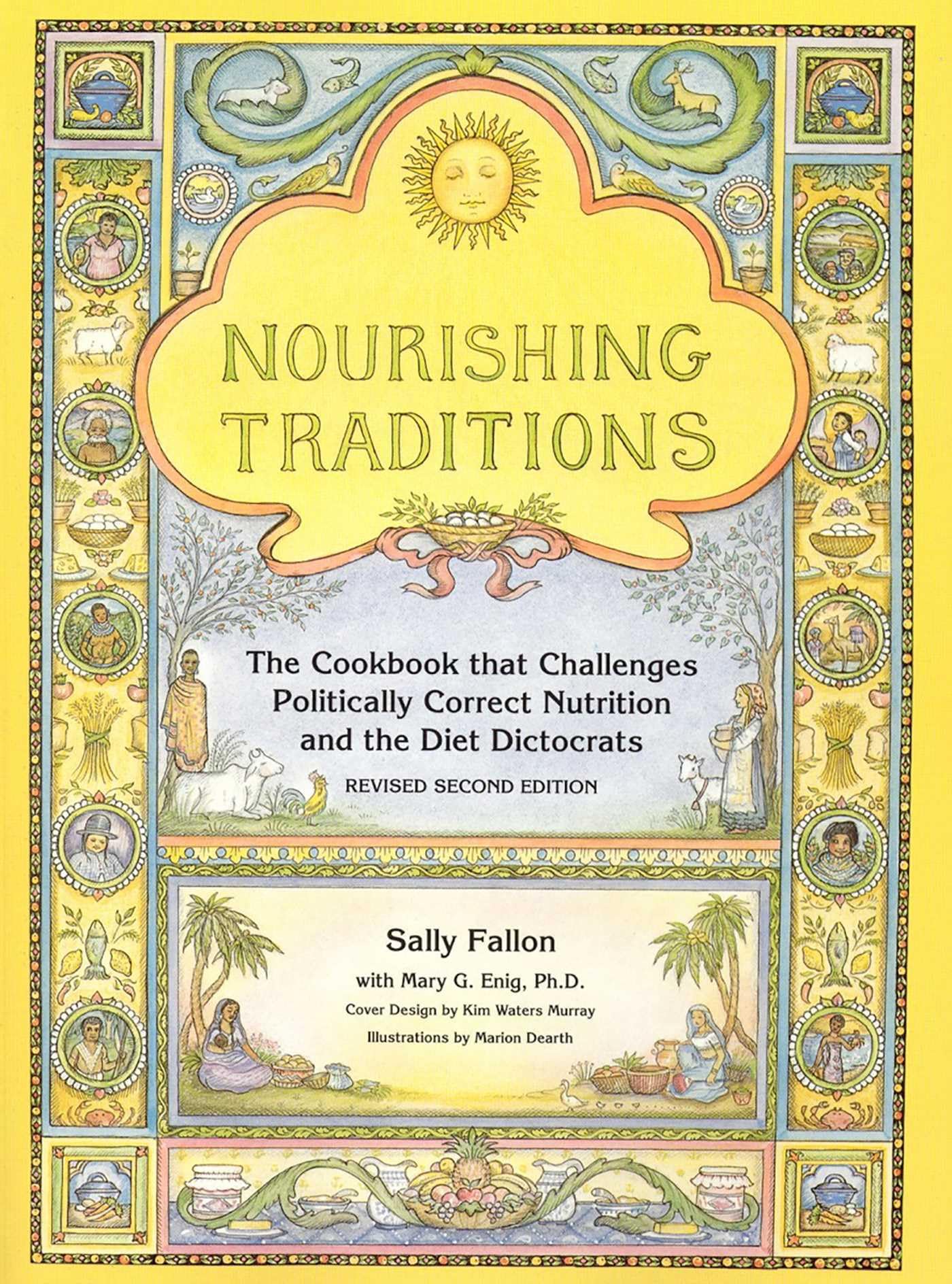
Nourishing Traditions: The Cookbook That Challenges Politically Correct Nutrition and the Diet Dictocrats
Product ID: 1443695
Buy anything from 5,000+ international stores. One checkout price. No surprise fees. Join 2M+ shoppers on Desertcart.
Desertcart purchases this item on your behalf and handles shipping, customs, and support to Denmark.
Nourishing Traditions: The Cookbook That Challenges Politically Correct Nutrition and the Diet Dictocrats [Fallon, Sally, Enig, Mary] on desertcart.com. *FREE* shipping on qualifying offers. Nourishing Traditions: The Cookbook That Challenges Politically Correct Nutrition and the Diet Dictocrats Review: Necessary reading - This book stays on my short list of reference books - and it has an incredible amount of information. I read every word in it and it completely changed how I look at food. It is apparent that a previous reviewer has not thoroughly read the book, and seems to be laying on as much 'propaganda' in her review as she accuses the authors of doing in their book. It is true that the authors do not encourage veganism or even vegetarianism - and this reviewer seems to take issue with this particular subject rather than the point of the whole book which has much to offer. I personally think that especially in the field of nutrition a study can be manipulated and produced to prove just about almost anything - depending on the researchers' views and background, and the views and agenda of the study's financial backers - in this field there are too many variables (cultural, genetic, biochemical, physical) to make definitive conclusions beyond bare basics - So I rely on my common sense and my powers of observation of myself and those around me - of what effects I see or feel with different dietary variables and what kind of diet I provide myself and my family. I read a lot of information from a lot of sources to see what is out there - and try to find the common sense, and for things that are less intuitive, I try them and see - Here are some highlights from this book that resonated with my common sense - - Whole grains are far nutritionally superior than refined grains, and how one prepares the whole grains matters - the author doesn't seem to take issue with grains in general, but does take issue with the refined state and prevalent preparation methods of them - I was delighted to see many recipes for alternative grains in this book - I am wheat sensitive and found these recipes refreshing and delicious and very nutritious - - Raw milk and cultured milk products are better for you and contain more nutrients than cooked (pasteurized) milk - this is a no-brainer - anyone who has had a biochemistry class or has ever cooked food before knows what happens to proteins and other heat sensitive molecules when they are heated - they are changed or destroyed - when milk is pasteurized, all of the enzymes, immuno-protective factors, heat sensitive vitamins, etc. are lost. Doctors carefully warn nursing human mothers to never heat their breast milk for these same reaons, but we, out of habit and outdated cleanliness issues drink only cooked milk - In addition, this book has recipes for producing your own cultured milk products - a good second best to raw milk - such as yogurt, piima cream, kefir, buttermilk, creme fraiche and others. - The right unrefined fats and oils, both saturated and unsaturated are necessary for proper functioning of the human body both structurally and metabolically, and wholesale limitation of all fats in the diet or consumption of refined or manufactured fats produces disease - this idea is currently gaining widespread acceptance - that it is the right fats you need to eat - the authors go further to assert that while there is a dietary correlation between diet and serum cholesterol, there is no evidence for a link between serum cholesterol and heart disease - something that many studies (if you support them) corroborate. The authors also assert that fats that have nourished humans for thousands of years, such as animal fat, butter, coconut oil, cold pressed olive oil, etc without producing heart disease or other ill effects are still capable of this feat today. - The authors assert that all traditional diets include some animal products, and are what kept these populations in the best health. In our current society with access to nearly any food grown on earth and in great abundance, I think one might be able to get by without animal products- but it takes careful attention and knowing what you are doing. I personally do better with a little meat in my diet, along with eggs and a little yogurt - I think meat should be eaten sparingly and without wastefulness, but my health is better, and my family's health is better when I include it - even sparingly - not much is needed. The authors include many recipes for many kinds of meat, organ meats, raw meat, and traditional meat preparations. There is a large section on preparing homemade stocks and broths and the great foundational and nutritional value of these. - The authors present a lot of information and recipes on traditionally made foods, many of them cultured - including condiments, vegetables, dressings, sauces, chutneys, beverages, etc - all great information and good recipes-! - There is a large alphabetical section on vegetables and many recipes for their preparation - the authors explain when a vegetable is better cooked or eaten raw and what nutrients are more available in one state or the other. - Soy is a poor food for humans unless it has been fermented (such as miso), and therefore changed to something easily assimilated and nutritious - I have found this very true for me and my family - - The authors assert that any manufactured food, commercially processed food, or food not found in a natural state should not be consumed - I agree absolutely-! I found this book most valuable as an opening to thinking differently about food - and that there is a reason that much popular and media endorsed nutrition is so confusing and contradictory - it is based in political, fad, or agenda thinking rather than biological history - and the absolute flood of processed and manufactured food into our diets and the resulting explosion of health problems has everyone scrambling to come up with answers that don't offend anyone or any industries that might be implicated - or challenge too far the 'everybody says' or 'everybody knows' syndrome. To Sum up: your health is worth your time - if you are too busy to cook or prepare good food, there is little room for complaint when consequences show up later. Eat only whole foods - prepare them well and deliciously - sit down with your meals and enjoy the gift of nourishment-! Review: If you trust doctors, food companies; DON'T BUY THIS BOOK! - There is no need to if you feel that way. However, if you have had trouble with your health, teeth, or wellbeing and are trying to find answers, this cookbook is one hell of a place to start! Nourishing Traditions is based on the work and travels of Weston A. Price, a dentist in the early 1930's who wondered why teeth on his young patients were getting so bad, (among other things) but not of their parents. The dichotomy of this was so relevant, it inspired Dr. Price to find out why. What Dr. Price learned was astonishing! He wrote a book called Nutrition and Physical Degeneration based on what he had learned seeking cultures that had little or no contact with white men, or their modern foods. To have a better (or bitter, depending on how you look at it) understanding of the "why" of Nourishing Traditions it is highly recommended you read Dr. Price's book first. Sally Fallon expands on what Dr. Price learned. (It's not necessarily what you are eating as much as what you AVOID eating). You will learn why modern foods really aren't foods at all. They are just highly-processed-eviscerated-commodity profit items for their makers, and a vacuous nutritional wasteland for the rest of us! We have been deceived and cheated! That is their principle - this is her warning. That said, here is my impression of Sally's cookbook. First, there is a bit too much of dairy products involved that it could easily be called the Midwesterner's Diary Handbook. A lot of the recipes (recipes I am mostly interested in anyway) call for cultured diary stuff, etc., especially whey. She gives some alternatives for whey (especially for soaking) to use lemon or vinegar. Whey must be created by buying or making yogurt then draining it through a cheese cloth. That takes a lot of yogurt. I don't own a cow you know. She also has some contradictory info, like white flour is bad, but not unbleached white flour, duh! Well, I guess some recipes just need white flour (modern ones anyway). She does give some alternatives, like using crushed nuts for pie shells. For those of you wondering why such contradictions, this book was written for broad appeal and for such things we now consider standard fare, such as sweets and pastries, etc. She tries to cover all bases and I think succeeds pretty good. There is a substitute recipe for just about anything modern in here, based on Dr. Price's findings. However, there is no substitute for corn syrup in her book. I like pecan pie (before I read her book), but there is no mention of what might be a good substitute for the ubiquitous corn syrup. What about using honey, or maple syrup or a dilution of some kind to make pecan pie, would that work? As long as were going to "treat" ourselves once in awhile, I wish she found a great substitute for that modern poison. Be forewarned, this book is not Bible based nutrition. It is based on empirical evidence. I still don't approve the eating of these non-biblical approved foods or fats, empirical or otherwise. I agree on everything else, though. I note, however, that this is a cookbook and not a religion book. Thankfully, there are many other biblically approved type fats and food recipes to choose from. There is also no mention in her book of animal intestines, like tripe etc., even though it is mentioned by Dr. Price in his travels and on the Weston Price website (run by Mrs. Fallon) of natives relishing this organ. It is a shame because it may be the "pasta" (without the grains) of an all meat/fat diet generally advocated by their research. Don't get me wrong, I like this cookbook and refer to it 95% of the time. I try to even "Fallonize" recipes I find outside of the book. It is my main recipe reference now. The sidebars of information and anecdotes (complete with references) make it more than a cookbook! It helps to reinforce and inspire the WHY you are doing this! AND, it is the only cookbook that I know of based entirely on Weston A. Price's principles! Recipe taste? I have tried several of her recipes and am very satisfied with everyone I have tried. My mother thought the liver recipe was the best she has ever tasted! She can't get enough of it! Our family leaves no "seconds" on the waffle recipe. For the waffle recipe I use half of whole spelt (freshly ground) and organic white flour for the remainder. I expect all the recipes to be very good because I expect them to be the "pick of the crop" when nearly any cookbook is made. This is not always true, of course. Conclusion: Take her cookbook in moderation (natives probably ate seasonal too) but keep practicing it. Shun the "displacing foods of modern commerce", and I think you'll make a big dent in whatever ails you. Remember, things take time, (we never really ate this way before) and "seek and ye shall find". Note: there are some things that are too late and can never be changed. As adults our teeth and bones are permanently malformed by modern foods, but our children and unborn may still have a chance. Buy this cookbook for them! Another excellent nutritionist is Rebecca Woods. She has a website filled with practical tips, advice, and recipes and can compliment this book.
| Best Sellers Rank | #6,672 in Books ( See Top 100 in Books ) #2 in Raw Cooking #53 in Other Diet Books #64 in Special Diet Cooking (Books) |
| Customer Reviews | 4.8 out of 5 stars 6,079 Reviews |
S**E
Necessary reading
This book stays on my short list of reference books - and it has an incredible amount of information. I read every word in it and it completely changed how I look at food. It is apparent that a previous reviewer has not thoroughly read the book, and seems to be laying on as much 'propaganda' in her review as she accuses the authors of doing in their book. It is true that the authors do not encourage veganism or even vegetarianism - and this reviewer seems to take issue with this particular subject rather than the point of the whole book which has much to offer. I personally think that especially in the field of nutrition a study can be manipulated and produced to prove just about almost anything - depending on the researchers' views and background, and the views and agenda of the study's financial backers - in this field there are too many variables (cultural, genetic, biochemical, physical) to make definitive conclusions beyond bare basics - So I rely on my common sense and my powers of observation of myself and those around me - of what effects I see or feel with different dietary variables and what kind of diet I provide myself and my family. I read a lot of information from a lot of sources to see what is out there - and try to find the common sense, and for things that are less intuitive, I try them and see - Here are some highlights from this book that resonated with my common sense - - Whole grains are far nutritionally superior than refined grains, and how one prepares the whole grains matters - the author doesn't seem to take issue with grains in general, but does take issue with the refined state and prevalent preparation methods of them - I was delighted to see many recipes for alternative grains in this book - I am wheat sensitive and found these recipes refreshing and delicious and very nutritious - - Raw milk and cultured milk products are better for you and contain more nutrients than cooked (pasteurized) milk - this is a no-brainer - anyone who has had a biochemistry class or has ever cooked food before knows what happens to proteins and other heat sensitive molecules when they are heated - they are changed or destroyed - when milk is pasteurized, all of the enzymes, immuno-protective factors, heat sensitive vitamins, etc. are lost. Doctors carefully warn nursing human mothers to never heat their breast milk for these same reaons, but we, out of habit and outdated cleanliness issues drink only cooked milk - In addition, this book has recipes for producing your own cultured milk products - a good second best to raw milk - such as yogurt, piima cream, kefir, buttermilk, creme fraiche and others. - The right unrefined fats and oils, both saturated and unsaturated are necessary for proper functioning of the human body both structurally and metabolically, and wholesale limitation of all fats in the diet or consumption of refined or manufactured fats produces disease - this idea is currently gaining widespread acceptance - that it is the right fats you need to eat - the authors go further to assert that while there is a dietary correlation between diet and serum cholesterol, there is no evidence for a link between serum cholesterol and heart disease - something that many studies (if you support them) corroborate. The authors also assert that fats that have nourished humans for thousands of years, such as animal fat, butter, coconut oil, cold pressed olive oil, etc without producing heart disease or other ill effects are still capable of this feat today. - The authors assert that all traditional diets include some animal products, and are what kept these populations in the best health. In our current society with access to nearly any food grown on earth and in great abundance, I think one might be able to get by without animal products- but it takes careful attention and knowing what you are doing. I personally do better with a little meat in my diet, along with eggs and a little yogurt - I think meat should be eaten sparingly and without wastefulness, but my health is better, and my family's health is better when I include it - even sparingly - not much is needed. The authors include many recipes for many kinds of meat, organ meats, raw meat, and traditional meat preparations. There is a large section on preparing homemade stocks and broths and the great foundational and nutritional value of these. - The authors present a lot of information and recipes on traditionally made foods, many of them cultured - including condiments, vegetables, dressings, sauces, chutneys, beverages, etc - all great information and good recipes-! - There is a large alphabetical section on vegetables and many recipes for their preparation - the authors explain when a vegetable is better cooked or eaten raw and what nutrients are more available in one state or the other. - Soy is a poor food for humans unless it has been fermented (such as miso), and therefore changed to something easily assimilated and nutritious - I have found this very true for me and my family - - The authors assert that any manufactured food, commercially processed food, or food not found in a natural state should not be consumed - I agree absolutely-! I found this book most valuable as an opening to thinking differently about food - and that there is a reason that much popular and media endorsed nutrition is so confusing and contradictory - it is based in political, fad, or agenda thinking rather than biological history - and the absolute flood of processed and manufactured food into our diets and the resulting explosion of health problems has everyone scrambling to come up with answers that don't offend anyone or any industries that might be implicated - or challenge too far the 'everybody says' or 'everybody knows' syndrome. To Sum up: your health is worth your time - if you are too busy to cook or prepare good food, there is little room for complaint when consequences show up later. Eat only whole foods - prepare them well and deliciously - sit down with your meals and enjoy the gift of nourishment-!
N**E
If you trust doctors, food companies; DON'T BUY THIS BOOK!
There is no need to if you feel that way. However, if you have had trouble with your health, teeth, or wellbeing and are trying to find answers, this cookbook is one hell of a place to start! Nourishing Traditions is based on the work and travels of Weston A. Price, a dentist in the early 1930's who wondered why teeth on his young patients were getting so bad, (among other things) but not of their parents. The dichotomy of this was so relevant, it inspired Dr. Price to find out why. What Dr. Price learned was astonishing! He wrote a book called Nutrition and Physical Degeneration based on what he had learned seeking cultures that had little or no contact with white men, or their modern foods. To have a better (or bitter, depending on how you look at it) understanding of the "why" of Nourishing Traditions it is highly recommended you read Dr. Price's book first. Sally Fallon expands on what Dr. Price learned. (It's not necessarily what you are eating as much as what you AVOID eating). You will learn why modern foods really aren't foods at all. They are just highly-processed-eviscerated-commodity profit items for their makers, and a vacuous nutritional wasteland for the rest of us! We have been deceived and cheated! That is their principle - this is her warning. That said, here is my impression of Sally's cookbook. First, there is a bit too much of dairy products involved that it could easily be called the Midwesterner's Diary Handbook. A lot of the recipes (recipes I am mostly interested in anyway) call for cultured diary stuff, etc., especially whey. She gives some alternatives for whey (especially for soaking) to use lemon or vinegar. Whey must be created by buying or making yogurt then draining it through a cheese cloth. That takes a lot of yogurt. I don't own a cow you know. She also has some contradictory info, like white flour is bad, but not unbleached white flour, duh! Well, I guess some recipes just need white flour (modern ones anyway). She does give some alternatives, like using crushed nuts for pie shells. For those of you wondering why such contradictions, this book was written for broad appeal and for such things we now consider standard fare, such as sweets and pastries, etc. She tries to cover all bases and I think succeeds pretty good. There is a substitute recipe for just about anything modern in here, based on Dr. Price's findings. However, there is no substitute for corn syrup in her book. I like pecan pie (before I read her book), but there is no mention of what might be a good substitute for the ubiquitous corn syrup. What about using honey, or maple syrup or a dilution of some kind to make pecan pie, would that work? As long as were going to "treat" ourselves once in awhile, I wish she found a great substitute for that modern poison. Be forewarned, this book is not Bible based nutrition. It is based on empirical evidence. I still don't approve the eating of these non-biblical approved foods or fats, empirical or otherwise. I agree on everything else, though. I note, however, that this is a cookbook and not a religion book. Thankfully, there are many other biblically approved type fats and food recipes to choose from. There is also no mention in her book of animal intestines, like tripe etc., even though it is mentioned by Dr. Price in his travels and on the Weston Price website (run by Mrs. Fallon) of natives relishing this organ. It is a shame because it may be the "pasta" (without the grains) of an all meat/fat diet generally advocated by their research. Don't get me wrong, I like this cookbook and refer to it 95% of the time. I try to even "Fallonize" recipes I find outside of the book. It is my main recipe reference now. The sidebars of information and anecdotes (complete with references) make it more than a cookbook! It helps to reinforce and inspire the WHY you are doing this! AND, it is the only cookbook that I know of based entirely on Weston A. Price's principles! Recipe taste? I have tried several of her recipes and am very satisfied with everyone I have tried. My mother thought the liver recipe was the best she has ever tasted! She can't get enough of it! Our family leaves no "seconds" on the waffle recipe. For the waffle recipe I use half of whole spelt (freshly ground) and organic white flour for the remainder. I expect all the recipes to be very good because I expect them to be the "pick of the crop" when nearly any cookbook is made. This is not always true, of course. Conclusion: Take her cookbook in moderation (natives probably ate seasonal too) but keep practicing it. Shun the "displacing foods of modern commerce", and I think you'll make a big dent in whatever ails you. Remember, things take time, (we never really ate this way before) and "seek and ye shall find". Note: there are some things that are too late and can never be changed. As adults our teeth and bones are permanently malformed by modern foods, but our children and unborn may still have a chance. Buy this cookbook for them! Another excellent nutritionist is Rebecca Woods. She has a website filled with practical tips, advice, and recipes and can compliment this book.
K**H
A God-sent
I found this book through the book "The Maker's Diet" which was given to me when I was 18 and sat on a shelf to be picked up 2 years later after the birth of my first child. I was struggling to breastfeed after having a major loss of blood (OBGYN's mistake led to this and a major birth trauma). I had virtually no milk supply. Tried everything! Persevered for 6 horrible long exhausting weeks before I finally gave up. I did not even become engorged upon stopping, that's how low my supply was. Looking back now i was very malnourished from a terrible diet of fast food and soda during pregnancy, plus the major loss of blood after birth- there's no way my body could produce anything. My teeth were crumbling, horrible cavities everywhere. I was very much against infant formula but I had no other choice, so i started my son of Enfamil. He was colicky, constipated, constant projectile spit up, not sleeping well, and I was DEPRESSED. I was even having to use infant suppositories for him. This is NOT NORMAL!! No matter how common it is, it's not normal... I began reading a lot to try and help keep my mind off of the deep depression I was experiencing (Lack of sleep, stress of being a young new wife and mother, no family in the area, plus my very unhealthy and hormone depleted body). Then, one day I came across the book that I had placed on a shelf two years prior (The Maker's Diet- a great book). When I started reading through some of the recipes, I noticed many of them were referencing this book called "Nourishing Traditions". I went to Barnes and Noble and bought this book the same week. Instantly saw how informative it was and how packed with recipes! I love it!! It opened my life to a completely new way of thinking/eating/ living. One of the first recipes i came across was the infant formula recipe. I thanked God because I knew he led me there, as I had PRAYED and cried out to God to help me find some way to feed my baby, and in the midst of feeling like such a massive failure for not being able to nurse my son, I realized that God had used my dad to give me The Maker's Diet, which I would pick up two years later out of desperation, which would in turn lead me to Nourishing Traditions... Long story short, I used the website provided in the book to scout out a source of raw milk locally, and within that week I found a raw milk cow share and signed up, and ordered all of the ingredients that I needed and started making my son's formula. From the first feeding, he was a much happier baby! He stopped fussing so much, he started SLEEPING through the night, AND he was NEVER AGAIN constipated! His bowel movements turned to mustard yellow, seedy, soft just as they were when I was nursing him. Fast forward to two years later and having completely embraced the Nourishing Traditions lifestyle, my husband and I decided to try for a second child. This pregnancy went much differently. I took care of myself, the nourishing traditions way. I drank superfood green smoothies every single day with home made raw milk kefir, ate healthy (not 100%, but I tried to give my body everything it needed!), plenty of butter and coconut oil and eggs, took whole food supplements and herbs instead of synthetic pharmaceutical prenatals, and never once saw a doctor- only my midwives who I had a home birth with. Gave birth to my 9lb 4oz 23" long baby girl, ELEVEN days late (hey, she knew when she was ready!), at home with no medication, in an inflatable birthing pool. It was awesome. My milk came in within 2 days (holy heck did it come in!!), she never lost weight, she slept much better, was very alert and nursed very well, had no digestion issues and has always been SO HEALTHY! My son is very healthy too (thanks to being able to start making his formula at 6/7 weeks of age), but he did catch and still does tend to catch more illnesses than she ever has. I really do attribute this to the type of diet i ate while pregnant with her, versus the SAD (standard american diet) i ate while pregnant with him, as well as the first 6 weeks of powdered formula and the drug exposure he had during birth in the hospital.... ONE THING I have noticed that is astounding to me is the difference in their facial structures and teeth/jaw formation. After reading Weston Price's "Nutrition and Physical Degeneration", as well as Francis Pottenger's "Pottenger's Cats", it makes sense to me why this is so. My little girl has such a beautiful and wide jaw, with perfectly straight and spaced teeth which i know will allow for her permanents to grow in without crowding, while my son has very crowded teeth and a more narrow jaw and has already had cavities while my daughter has had ZERO. (SEE PICS!) It really does make a difference what you eat before conception, during pregnancy, and what you feed your child.. (Btw, I supplemented with WAP homemade formula and eventually switched her to it completely when I decided to quit nursing- don't judge me) I'm not saying everything in this book is completely 100% for everyone, but it worked for me and my babies. All of the information also led me into a completely different life as far as nutrition and eating. I try to stay away from grains completely these days as I have some long standing digestive issues, but if I do have them I believe they are best soaked or sprouted like this book says. Also, try sprouted nuts- SO DELICIOUS and so much better for you than roasted or even raw. Lots of good recipes in the book, and you'll get a ton of practice in the cooking and preparing of different foos. If nothing else, get it for the baby formula recipe and information pertaining to childhood nutrition. My favorite and most used part of the recipes in this book are the fermented foods and dairy.
B**D
Scientific Support for Traditional Diets. Wonderful
This book by Sally Fallon (with Mary Enig, Ph.D.) is an inspiring polemic against both commercial, prepared food trends and some governmental and research leaders who appear to be making recommendations on nutrition under the influence of commercial interests. My first impression of the book is that it shows exactly how hard nutritional science actually is. The authors are citing hundreds of technical works from both demographic and controlled experiment studies regarding thousands of different food components in their way to painting a complete picture of good nutrition. Their starting point in painting this picture is the common sense assumption that historical, natural diets are invariably more healthy than those laden with commercially processed foods. This assumption is backed up by demographic research done in the first third of the last century. This is the import of the `traditions' in the title. It turns out that the potential allies of the authors' approach come from such different quarters as the Atkins diet advocates who endorse eating meat, eggs, and other proteins in preference to (processed) carbohydrates and the `Raw Food' wing of the vegetarian / vegan movement. The latter camp would wholeheartedly endorse the authors' issues with eating foods that retain their original enzymes to aid in digestion. I'm sure the vegans and the Atkins camp will not join forces any time soon, but their appearance in the same metaphorical room on the side of the authors' position is another indication of how multi-sided complex scientific theories can become. I have no facts to confirm or challenge the authors' claim of corruption on the part of some academics in endorsing a nutritional position to back commercial interests. I will only say that it is irrelevant to the central tenant of the book, which in very simple terms is `Eat the way your great grandparents ate'. Some of the more important details are: 1. Avoid processed fats, starches, sugars, and proteins. They are not of no value. They are unhealthy. 2. Eat animal protein and their accompanying fats. 3. Eat whole grain products. 4. Eat foods prepared in such a way that avoids loosing important nutrients. Almost all of the authors' statements on individual nutritional facts are backed up by published scientific research. One or two or even ten percent of their references may be flawed, but the overall weight of their evidence is truly impressive. The only problem I find in their characterization of the way things are today is in not giving full credit to medical science in lengthening our lifespans through the suppression of infectious diseases. This is likely to be the reason behind the increase in the frequency of deaths by degenerative diseases like cancer and heart disease, not a catastrophic loss of nutritional value in our diets. That is not to say their claims about the drop in the quality of our diet are not true. Always remember that these gals are making a case, they are not simply publishing scientific results. While I think the authors have a strong case against processed foods, I find it difficult to fully endorse their next step. Their solution takes us close to the land of food extremists such as both traditional vegetarians and the more radical proponents of `raw' diets. What this means is that they raise up foods which are hard to find or difficult to prepare or are prepared in ways unfamiliar to American kitchens. This may not necessarily be a bad thing. It tends to appeal to my `Whole Earth Catalog' mentality of the home-brew lifestyle. But this lifestyle is simply not practical for the millions who work long, stressful hours followed by time devoted to kids and spouses. My skepticism regarding their solutions is reinforced by some culinary misstatements such as the suggestion to refrigerate tomatoes after they ripen, to not add garlic to hot fat, and that artisinal breads are not good for sandwiches. The second and third statements are refuted daily by traditional Italian cooking practice. Their condemnation of all aluminum cookware and the microwave also seem more extreme than they need be. What I take from this work is the very cautious and undramatic conclusion that the safest (and most interesting) culinary path lies in the study and emulation of historical diets. This gives a strong theoretical underpinning to my admiration of educators such as Mario Batali and Paula Wolfert who examine and promote historical cuisines based on the `what grows together, goes together'. This could easily be a subtitle of this book. It also gives support to practitioners such as Rachael Ray who promote fast cooking without resorting to overly processed ingredients. I love a book that pulls together and validates a wide range of (my) opinions. While this book may not always be right, it is supremely valuable in its provocation to thinking. It is also supremely valuable in it's demonstrating the value of some less common foods such as sauerkraut, crème fraiche, and kim chee. This value doubles in that it actually tells you how to make this stuff. Lest it be overlooked, it is important to note that the lions share of the book is a fairly large cookbook of recipes with methods and materials that follow the book's doctrines. At a list price of $25, the catalogue of vegetables chapter alone is almost worth the price of admission. I'm happy that here, the authors part company with both the advocates of `raw' and the old Adele Davis doctrine of saving veggie cooking water. They reinforce again the conventional wisdom of old school culinary practice which rarely leaves veggies raw. Some raw vegetables contain some bad things and cooking almost always makes the good things more available to digestion. I recommend this book to everyone as the very next book you need to buy about food.
I**M
Wonderful Gift Idea for Newlyweds
Nourishing Traditions 1.) What is the Big Idea of this book? This book is part educational and part recipe book. Very easy to read, clear and concise. All the pages of recipes have little tid bits of nutritional information which make it entertaining to read. The beginning is an education on whole foods. It explains that the foods of our ancestors was un-adulterated, whole and pure. She explain why certain big food industry, along with other associations, funnel money into politics resulting in a bias of information, mis-information or old/unproven information about the foods we eat, should be eating, food guidelines and recommendations. But, if you eat natural, organic, whole foods, local, pastured, properly prepared, fermented and cultured products you will benefit with improved health and vitality. You will also be more satiated, enjoy better moods created by a perfect balance of nutrients helping hormone regulation and have improved muscle, skeletal & skin tone. All of our body's processes work in conjunction with each other so proper traditional foods supplies the correct balancing act. Getting the nutrients from good sources helps our body's get a complete nutrient profile as nature intended. Cooking properly helps retain foods nutrients and even fermenting a food product adds to nutrient value. There are many different traditional diets around the world but they have so much in common: protein from an animal (or insect), fermented & cultured foods, natural salts, carb source, & a variety of natural fats. 2.) Three interesting things I learned about nutrition from reading this book. 1) Range-fed beef that is finished with several weeks of grain feedings is fine, as long as the grains are organic and no cottonseed meal or soy protein are added to the feed. Grain finishing imitates the natural feeding habits of cattle & other ruminants, which get fat in the late summer & fall when they are feeding on natural grains in the field. I had read previously that a cow would not choose to eat a grain in a field, but I realize that the grass turns to seed at some point. 2) I learned in detail how hydrogenated fat is made into partially hydrogenated margarines & shortenings. Most of these made-made "trans" fats are toxic but our digestive systems does not recognize this. Instead of getting rid of them our body incorporates trans fats into the cell membrane- making our cells actually partially hydrogenated. 3) Clay. Adding small amounts of fine clay or mud as supplement to water or food is a practice found in many traditional societies throughout the world. Clay can provide a variety of macro & trace minerals, & can be used as a detoxifying agents to help assimilation and help prevent intestinal problems like diarrhea and food poisoning. They also bind with anti-nutrients found in plants to help prevent their absorption. Embraces, teaches & encourages the principles of Dentist, Dr. Weston A. Price. 4.) What are my thoughts/comments/perspectives about this book? This book is easy to read. It is not only a recipe book but the introduction backs up the nutritional advice throughout the book. I love cook books. This book also describes why traditional people's ate certain foods, includes an equipment list for the kitchen, food selection, frankenfoods to avoid, with sample menus too. I like the layout & will enjoy delving into the section about `Fermented Vegetables and Fruit.' Each section is appropriately described as to the "why's" along with historical facts. I am particularly interested in this chapter because the process of lacto-fermentation enhances the digestibility of lactobacilli & increases vitamin levels of those foods. These organisms help produce enzymes as well as antibiotic and anti-carcinogenic substances. I think it is hard to find good, properly prepared Fermented veggies other than KimChee from cabbage. I think this book would be wonderful Wedding gift to any newlywed.
B**Y
Excellent information IF YOU'RE WILLING TO LISTEN TO IT
I bought this book based primarily on D. Steinlage's excellent review. While I still feel her review is excellent, now that I own the book I wanted to add my two cents. D.Steinlage addresses criticism from people who expect a book on healthy food - which the standard American diet (SAD) emphatically is NOT - to make it possible for them to continue eating the unhealthy foods they're used to. Accept the uncomfortable FACT, people: if you want to be healthy, you must CHANGE THE WAY YOU EAT. C-H-A-N-G-E. You cannot continue to eat easy-to-prepare processed nutrient-free foods and see any improvement. This book will help you make the transition IF YOU ARE WILLING TO GIVE UP THE UNHEALTHY FOODS YOU NOW EAT. It will not be easy, most processed foods are addictive. Intentionally so, to encourage you to buy more of them. You will need will power to give them up. This book will give you the incentive to do it and provide recipes to replace them. Ms Fallon acknowledges, "...how difficult it is to give up these foods in a society whose eating habits are based on them..." To those people who think they can replace opening a can or package with a healthy meal and spend no more time cooking...GET REAL. You can't. I have done enough of my own research to know what a truly healthy diet entails and was hoping to find a cookbook that supported my research -- no gluten; no sugar; only sprouted nuts, grains, and beans; only raw dairy; only pasture raised meat and poultry with soy-free supplemental feed; only wild fish and shellfish; lots of fermented foods, and both raw AND COOKED foods. This book met me three-quarters of the way. Yes, Ms. Fallon does advocate these practices, and she explains why they're necessary, but she doesn't adhere to them totally in the book. She states that there is no chapter on "pasta" because it is inherently unhealthy but then presents a recipe for cobbler which contains 2 cups of wheat flour. Huh? Was there no way to use quinoa or nut flour instead? I would have preferred that the book contain ONLY healthy recipes and be a little smaller. Others may be glad there are some 'borderline' recipes. If you buy this book, you will save yourself from having to do the many year's worth of research I did looking for the truth. The truth that's suppressed by the mainstream food industry. It's all here, in one easy to read place. Until now, the only books I had found which supported my research were raw food books and, while many foods are healthier raw, there is evidence that you must eat some cooked foods as well. Ms. Fallon addresses that need. What I enjoy most about the book are the side bars. Every page has supplemental information on studies, reports and anecdotes which support her position and debunk the SAD. In that respect it really is my food 'bible'. I am glad I bought the book and I'm sure it will help anyone who is truly WILLING to make changes to achieve optimal health.
G**S
The book that changed my life, how I think about food and particularly fats.
Sally Fallon’s Nourishing Traditions changed my life. Over a decade ago, and in the midst of many life stresses, I got a flu shot at work one year, and suddenly developed all sorts of allergies. I started to develop serious health problems – Asthma, Digestive issues, Raynaud’s, Sjogrens. Worried, I went for the first time in years to my Kaiser doctor, who admonished me about my cholesterol levels (228), and recommended statins. Fearing drugs more than high cholesterol, I told him I’d use natural means to reduce my serum cholesterol. And I did. By ingesting large gobs of oatmeal and by shunning saturated fats, I got my cholesterol down to 180 within the year. I was very proud. But I did not get well. I got sicker. I got every office flu, cough, cold out there. After a final bout of flu on top of flu, and probably driven by some shred of self-preservation, I googled ‘cholesterol good’. That is when I stumbled into the WAPF’s realmilk.com site, sampled some raw milk…and never looked back. I read about the cholesterol skeptics. I read about the incredible conflict of interest between Pharma and human health, and I read about the statin scam (that I nearly fell for). I was hurtling down the modern health highway of food shortcuts, to surefire disaster, and it was pure accident (and the good luck of bad health), that I came upon Sally Fallon and Mary Enig. Not everybody is so lucky. Many people get sick on nutrient deficient diets, then try to cure this with drugs, which have more side effects, which cause more knock on diseases, a vicious cycle that frequently damages them beyond repair. Dr. Mary Enig, Sally’s co-author, was a brilliant lipid biochemist who jeopardized her career to get the message of transfatty acids vs. wholesome saturated fats out to the public. ‘Nourishing Traditions’ and ‘Know Your Fats’ are my go-to food and fat-science bibles. These amazing women resisted bullying and bludgeoning by industry to impart their knowledge and wisdom of traditional food-ways to common people like me. I grasped the notion of ‘body as terrain’ and ‘food as medicine’. I now eat delicious, pastured, fragrant, nutrient dense, food that is rich in butter, cream and coconut oil. I eat ferments, kefirs, kvasses, yogurts, organ meats, broths, stocks and vegetables of course (without pesticides). I prepare my breads the traditional way and the taste and aroma are incomparable. And my belly likes it too. My kitchen is fragrant once again with the Ghee that my mother and my grandmother before her made. Our insurance premiums are completely wasted because we have not been sick in the last eight years. Nary a cough, cold or flu. This way of living and eating has opened up my life in delightful ways to farmers markets, farmers and the wonderful kinship of likeminded people. If you have children, feeding them NT food will make them stronger, smarter and healthier. If you are sick, you will get well on this food. The body WANTS to heal, and is set up to heal, if properly nourished. Many people with chronic degenerative disease I know, got not just better, but were cured. My recommendation is, ignore all other isms, fads and trends. Don’t just borrow the book from your library. Buy it. Take a week off from work to read it, imbibe the wisdom, and pass it forward. Sally and Mary probably saved my life. I am forever indebted to them.
P**Y
well rounded, real food, non dieting, health focused cookbook.
A cookbook with a slew of healthy recipes, but also an educational source on nutrition. 674 pages chock full of dietary information ranging from a primer on nutrients, to learning the basics, to cooking various dishes. The introduction discusses some food matters that have been circulating for far too long- such as how we have avoided fats, increased sugar intake, decreased all carbs (rather than just refined sources) and so on. A significant portion of this discussion is the importance of fats and the role they play. By now, you may have learned more about this as there is a great discussion surrounding the topic, but if you or anyone you know has been through the fat free everything era, it can be hard to return to actual butter, healthy sources of fats, etc. Even within the recipes pages there are side lines of information and anecdotes, as well as Myths and Truths peppered in along the way. I also appreciate the "know your ingredients" highlights throughout the book. I can't say that THIS book got me back to real nutrition, but what did is the book and research that started it all, back in the 1930s by Weston A Price (hence the foundation that has since been created, and what these books are based off of). His long, arduous, research heavy book, "Nutrition and Physical Degeneration" was the once resource across anything I have ever read (even in college as a nutrition minor) that really opened my eyes to the affects of diet on humanity. I review that separately, and it is my #1 recommended book for anyone trying to put it all together, nutritionally. Anyway, with the subsequent foundation that emerged from his research, some wonderul books have come out, including this one, "Nourishing Traditions" . After reading this (and take notes, add sticky notes to pages- be active with it!), grab the "Nourishing Broth" book. Side by side these two cookbooks form a wonderful basis to a well rounded, real food, non dieting, health focused cookbook.
Trustpilot
2 months ago
3 weeks ago