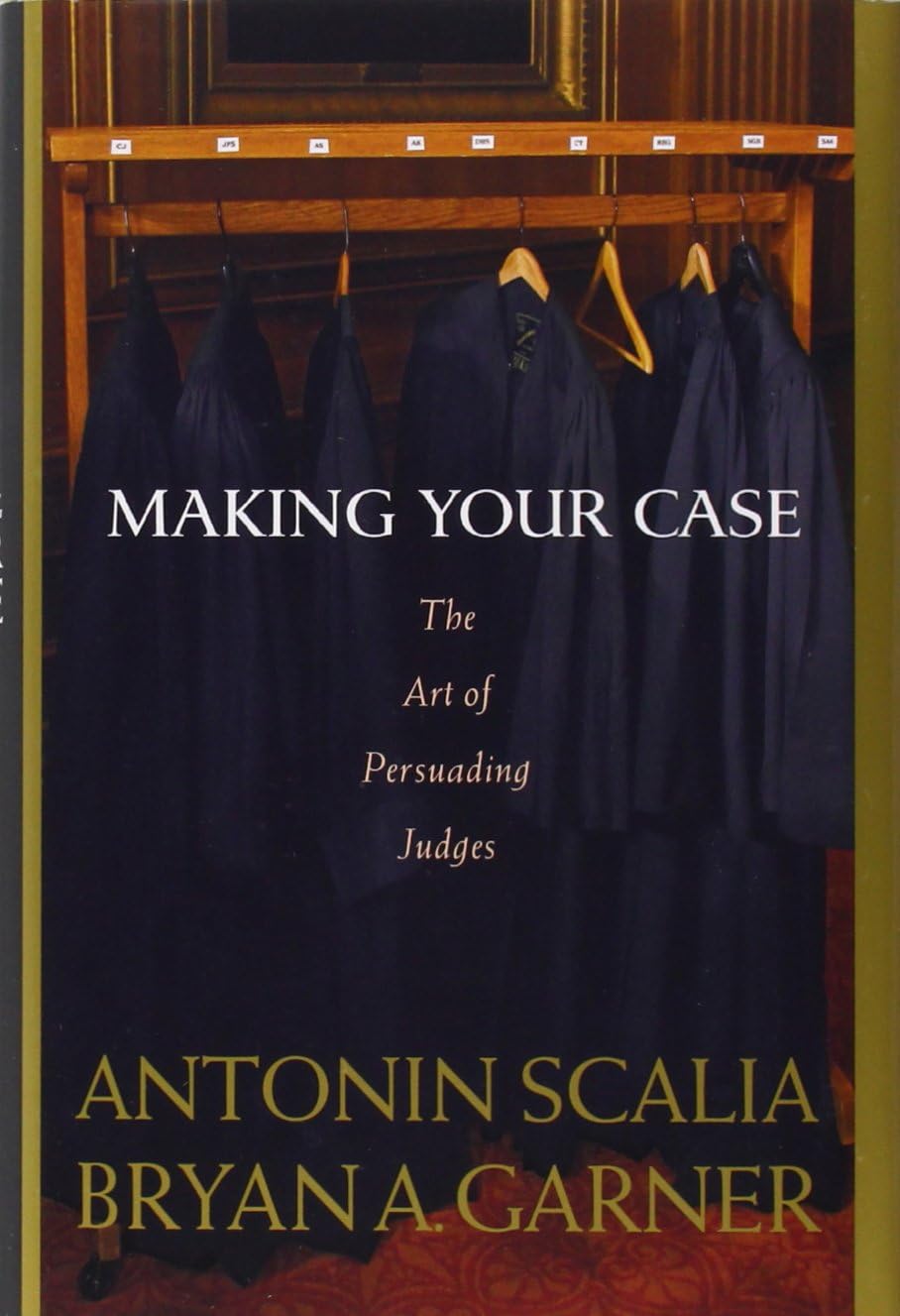
Making Your Case: The Art of Persuading Judges
Product ID: 1274076
Buy anything from 5,000+ international stores. One checkout price. No surprise fees. Join 2M+ shoppers on Desertcart.
Desertcart purchases this item on your behalf and handles shipping, customs, and support to Denmark.
Presents the basics of writing legal briefs and giving oral arguments, with discussions on the essentials of building a case through legal reasoning and the key elements of persuasive and successful oral pleading in the courtroom. Review: A valuable book for non-lawyers and lawyers - Why would non-lawyers want to read a book on persuading judges? For several reasons actually. First, many of us are involved in work that requires persuading others to adopt our views. While legal argument is substantially more formal and rule-driven than what most of us do, learning how to construct a logical argument as if it were to be delivered to the court, that Is governed by deadlines, restrictions on length, the need to adhere to established fact (or to establish those facts) and to be neither groveling nor inflammatory can be applied to selling your widgets. Perhaps more important is the fact that most people don't understand the impact of the court's decisions on our daily lives, our pocketbooks and our freedoms. Nine people sit on the Supreme Court. They cannot be removed except for the most grievous crimes and then only if Congress were to agree. More than one Justice has demonstrated that you can be senile and sit on the nation's highest court. Going down the food chain, the same applies to the federal appellate and trial courts. It is unlikely that one person in a hundred can even name a local federal district court judge and probably not one in a thousand could name the nine Supreme Court justices. Yet these men and women have tremendous impact on our lives, as do the thousands of state court justices. I am not a lawyer, but I consult to them and am not a stranger to the courtroom, writing drafts for legal briefs, doing legal research and the like. I have seen a lot of judges in action and have learned, in general, to fear them. They can - and do - cause tremendous harm through ill-considered decisions, making decisions with insufficient facts, assuming they know more than they do and myriad other reasons. They are gods in their courtrooms and if your lawyer fails to persuade them of the justness of your cause, you lose. Just how do these people reach their decisions? While justice is supposed to be blind (fat chance!), the justices are human and thus persuadable. Bryan Garner is a noted writer on legal writing. He is actually quite witty as he explains the use of the English language to lawyers who have had their understanding of words driven out of them in law school. Antonin Scalia is a hero to many for the courageousness of his decisions and dissents, his belief that the Constitution is to be strictly interpreted and his generally brilliant writing style. In 115, frequently witty, short chapters the two authors (who occasionally openly disagree) lay down their thoughts on how judges can be persuaded. It is not all about legal writing; e.g, advice to not chew your fingernails and dressing appropriately for court. They advise on giving your oral argument, which a lot of sales and marketing people would do well to read, especially the guidance to "never speak over a judge". In a sales situation, I am surprised at how often the sales person displays his or her contempt for me by not only not listening to me, but presuming they understand the point I was going to make before they spoke over me. I don't know about you, but a lot of salespeople have lost business with me for doing that. Some of the points the authors make are points of contention themselves: i.e., "swear off substantive footnotes - or not". None of the material in this book is truly new. Law students get elements of it in their first year as do some college students. A lot can be found in books on to be a better salesperson: i.e., don't chew your fingernails, etc. And a lot of it is plain commonsense. But that doesn't mean this book is unhelpful. First, it reveals in tiny part how Scalia evaluates the briefs he reads and arguments he hears, which in itself is a fascinating peek. The authors also put things many people may have forgotten through lack of use into perspective. Finally, they remind lawyers and non-lawyers alike that you often have only one shot at winning your argument so you had best put your best foot forward. Scalia and Garner show you how to do it. Overall, this is a fun, informative and helpful read. Jerry Review: Like Having an Expert Looking over Your Shoulder - I am a law professor who spent 25 years as a Plaintiff's lawyer before deciding to teach. I've been before the U.S. Circuit Courts of Appeal many times and state appellate courts a few times. One caveat to consider: I expect to be arguing before the United States Supreme Court in the future. I hesitate to be too ebullient, lest you think that I'm trying to curry favor. However, I think that this book is great. Why do I recommend it? First, it is short. This book will accomplish much of what other books try to teach about advocacy, but in many fewer pages. Secondly, it is practical. It teaches writing skills, speaking skills, and how to be persuasive with limited time. Finally, it is not just for lawyers. Anyone trying to be persuasive can apply the same skills to other situations. For those of you who are politically opposed to Justice Scalia (which, believe it or not, includes some law professors)this is a joint effort by Garner and Scalia, and they frequently disagree. Hearing both sides of the argument on how to write or speak persuasively will help you decide how you want to present your arguments. How do my political opinions and Justice Scalia's opinions mesh? Can I be fair? I think so. He's a Federalist, I consider myself an Anti-Federalist. He as supporter of administrative delegation, I think delegation of congressional responsibilities to administrative agencies is congressional abdication. In short, I'm not recommending this book because Justice Scalia and I agree on policy, because on many policy matters we don't. I'm recommending it because I think it will help you. You wont be disappointed with the book.
| Best Sellers Rank | #42,674 in Books ( See Top 100 in Books ) #3 in Trial Practice (Books) #7 in Courts & Law |
| Customer Reviews | 4.7 out of 5 stars 736 Reviews |
J**N
A valuable book for non-lawyers and lawyers
Why would non-lawyers want to read a book on persuading judges? For several reasons actually. First, many of us are involved in work that requires persuading others to adopt our views. While legal argument is substantially more formal and rule-driven than what most of us do, learning how to construct a logical argument as if it were to be delivered to the court, that Is governed by deadlines, restrictions on length, the need to adhere to established fact (or to establish those facts) and to be neither groveling nor inflammatory can be applied to selling your widgets. Perhaps more important is the fact that most people don't understand the impact of the court's decisions on our daily lives, our pocketbooks and our freedoms. Nine people sit on the Supreme Court. They cannot be removed except for the most grievous crimes and then only if Congress were to agree. More than one Justice has demonstrated that you can be senile and sit on the nation's highest court. Going down the food chain, the same applies to the federal appellate and trial courts. It is unlikely that one person in a hundred can even name a local federal district court judge and probably not one in a thousand could name the nine Supreme Court justices. Yet these men and women have tremendous impact on our lives, as do the thousands of state court justices. I am not a lawyer, but I consult to them and am not a stranger to the courtroom, writing drafts for legal briefs, doing legal research and the like. I have seen a lot of judges in action and have learned, in general, to fear them. They can - and do - cause tremendous harm through ill-considered decisions, making decisions with insufficient facts, assuming they know more than they do and myriad other reasons. They are gods in their courtrooms and if your lawyer fails to persuade them of the justness of your cause, you lose. Just how do these people reach their decisions? While justice is supposed to be blind (fat chance!), the justices are human and thus persuadable. Bryan Garner is a noted writer on legal writing. He is actually quite witty as he explains the use of the English language to lawyers who have had their understanding of words driven out of them in law school. Antonin Scalia is a hero to many for the courageousness of his decisions and dissents, his belief that the Constitution is to be strictly interpreted and his generally brilliant writing style. In 115, frequently witty, short chapters the two authors (who occasionally openly disagree) lay down their thoughts on how judges can be persuaded. It is not all about legal writing; e.g, advice to not chew your fingernails and dressing appropriately for court. They advise on giving your oral argument, which a lot of sales and marketing people would do well to read, especially the guidance to "never speak over a judge". In a sales situation, I am surprised at how often the sales person displays his or her contempt for me by not only not listening to me, but presuming they understand the point I was going to make before they spoke over me. I don't know about you, but a lot of salespeople have lost business with me for doing that. Some of the points the authors make are points of contention themselves: i.e., "swear off substantive footnotes - or not". None of the material in this book is truly new. Law students get elements of it in their first year as do some college students. A lot can be found in books on to be a better salesperson: i.e., don't chew your fingernails, etc. And a lot of it is plain commonsense. But that doesn't mean this book is unhelpful. First, it reveals in tiny part how Scalia evaluates the briefs he reads and arguments he hears, which in itself is a fascinating peek. The authors also put things many people may have forgotten through lack of use into perspective. Finally, they remind lawyers and non-lawyers alike that you often have only one shot at winning your argument so you had best put your best foot forward. Scalia and Garner show you how to do it. Overall, this is a fun, informative and helpful read. Jerry
R**N
Like Having an Expert Looking over Your Shoulder
I am a law professor who spent 25 years as a Plaintiff's lawyer before deciding to teach. I've been before the U.S. Circuit Courts of Appeal many times and state appellate courts a few times. One caveat to consider: I expect to be arguing before the United States Supreme Court in the future. I hesitate to be too ebullient, lest you think that I'm trying to curry favor. However, I think that this book is great. Why do I recommend it? First, it is short. This book will accomplish much of what other books try to teach about advocacy, but in many fewer pages. Secondly, it is practical. It teaches writing skills, speaking skills, and how to be persuasive with limited time. Finally, it is not just for lawyers. Anyone trying to be persuasive can apply the same skills to other situations. For those of you who are politically opposed to Justice Scalia (which, believe it or not, includes some law professors)this is a joint effort by Garner and Scalia, and they frequently disagree. Hearing both sides of the argument on how to write or speak persuasively will help you decide how you want to present your arguments. How do my political opinions and Justice Scalia's opinions mesh? Can I be fair? I think so. He's a Federalist, I consider myself an Anti-Federalist. He as supporter of administrative delegation, I think delegation of congressional responsibilities to administrative agencies is congressional abdication. In short, I'm not recommending this book because Justice Scalia and I agree on policy, because on many policy matters we don't. I'm recommending it because I think it will help you. You wont be disappointed with the book.
X**O
Great Read
Great book, I enjoyed reading it. I am non-lawyer so I spent time having to read and re-read sentences and paragraphs but darn good book. Highly recommend it. Sometimes a person can be in discussion with an official, doctor, lawyer, cop ..whatever--it helps to remember arguments made in this book. Most folks just try to explain a situation, heaven forbid standing in front of a court or judge in a legal matter. But, this type of reading builds confidence, a strong vocabulary and so forth. It matters most trying to persuade a person or an institution..just winning, making your point in a clear coherent and cognizant way. This book can teach you these things.
J**E
You don't have to like Justice Scalia to like his book.
Perhaps an appellate brief that you wrote would have been perfect if only the judge had read it. The lesson you learned, hopefully, was that there is no guarantee that a judge will read your brief. The lesson you can learn from "Making Your Case" is how to write so that the judges will read what you wrote - preferably before your oral argument. Writing in a quite candid, lucid and entertaining style, Scalia and Garner serve up tips that even the most experienced lawyers can learn from. If you find yourself approaching the court's word limit, for example, you may be minimizing the chances of having your brief read, as judges really do favor brevity. How do you write for a court that is notoriously dismissive of higher court precedents? How do you best respond to a judge who asks whether you would be content with a remand? These and other critical questions are addressed simply yet insightfully. If your legal education stressed the IRAC approach (Issue, Rule, Application, Conclusion), Scalia and Garner take you a step further by stressing a syllogistic approach. Even if you have already been exposed to all the best ideas about persuading appellate judges, you are still likely to gain much rom reading "Making Your Case" because the authors organize all those ideas in a way that makes them much easier to remember and keep them in mind as you prepare your written and oral arguments. Justice Scalia calls his approach to legal reasoning and argument "textualism," which I understand to mean that his decisions are driven by the language of the law and of the case. My impression from reading many of his decisions is that he is often driven by ideology, so I can't quite square his book with his decisions. I also question the book's fundamental statement that the overriding objective of a brief is to make the court's job easier, as I prefer to write primarily for the purpose of winning the case. My criticisms of "Making Your Case" are miniscule compared to those thrown at it by Richard Posner. But although I find Judge Posner's decisions generally more fair than those of Justice Scalia, I prefer the clarity of Justice Scalia's writing - especially when he teams up with Bryan Garmer. Judge Posner notwithstanding, Scalia and Garner have put together a gem that is likely to prove invaluable for law students as well as for trial and appellate lawyers who are still interested in improving their game. If you fall into either category, buy this book, read it two or three times, and then keep it handy as a reference. It should help you make your case.
F**Y
A Great Read... (for those in the legal field)
A great gift for those in the legal field. We ordered several for gifts throughout the year.. Made a great little gift basket with a bottle of whiskey :)
R**N
Elegant, useful
Simply the best book on legal persuasive writing ever written. Interesting, useful, fun, full of great anecdotes. Terrific discussion of statutory interpretation. Great references to scholarly classical treatises on rhetoric. This book is wonderful both for its analysis of oral argument and for its discussion of written forms of persuasion, like briefs. I wish I had had it earlier. My only complaint is the same one I have with virtually all modern style manuals: they advocate a simplistic prose style, characterized by short, conversational sentences, avoiding unusual words, eschewing Latin phrases. But I personally often find prose that breaks these rules a refreshing change. I enjoy reading a word or phrase I rarely see but that is perfectly chosen. And I enjoy learning new words or phrases. This book would condemn two of the greatest legal prose stylists out there: John Marshall and Learned Hand, both of whose opinions often contained sentences that would not work so well conversationally, that were full of long, convoluted sentences and classical allusions. My sense is that in this joint work Justice Scalia, who can write rich and interesting prose, pushed back against some of the simplifying strictures of his co-author. Furthermore, I think that often too much emphasis on simple words and sentences serves to make more complex ideas too difficult to express or to understand. Thus, the book (like most books) argues against "jargon," but jargon, once learned, is often a much clearer way of expressing something than a rephrasing. And the Roe v. Wade anecdote is great! It explains a lot... In any case, I am hardly qualified to criticize Justice Scalia, whose writing is far beyond my own. Anyway, this is a great book.
W**N
Recomendado para todo estudiante de Derecho
Libro fácil de leer y fácil de comprender. Recomendado
N**K
Wonderful and useful book.
I am very glad I purchased this book. I used it over and over again. Wrote many notes and it added much value to pursue my cases at courts. This is a true asset for providing an overall overview with much advice. I also purchased his other book The Winning Brief, but that is only available in paper format and it is mainly for linguistic help in writing briefs for appellate court, for the purpose of really perfecting your writing. At lower courts or supreme courts you just do not have the time to think in that much details and these courts may not even read it. You are lucky if you can say two sentences on court appearances. They do not put that much into details when making judgments, so most likely your case ends up in the appellate, and here that book becomes valuable too - The Winning Brief. Again, this book really excellent and pleasant to read. The Kindle version was easy to search for anything, word, phrase, notes. 5 star book. THANKS.
.**.
Absolutely Fantastic
This book though authored in context of US courts, however, many parts of it are true in Indian situation as well. It is a book which every lawyer practising in the High Courts and Supreme Court must read.
D**D
What a pleasure!
What a pleasure this book was! Although it was written for an American readership, there is plenty here that an English lawyer will enjoy. (Although the US system uses "briefs" in a different sense from us, there's plenty in that section of the book that you can apply to skeleton arguments in our own courts.) If you've been in practice then you will already know that brevity is a virtue, that you don't read a prepared speech to a court and that the key to good advocacy is preparation. The authors will generally confirm your existing prejudices about effective advocacy and amuse you while they do it. If you haven't yet been in practice, then you really should take note of the points the authors make. Personally, I have never believed that legal argument is as straightforwardly syllogistic as the authors contend, but they can probably live with my disagreement. Bryan Garner is well-known as an authority on legal writing in the US and deserves to be read here too; Scalia is well-known as a Justice of the US Supreme Court - surprisingly (to me, at any rate) this "intellectual anchor of the Court's conservative wing" has a sense of humour too. I enjoyed the bickering with his co-author over the best way of making citations (pp. 133 to 135).
D**D
Décevant mais court
On pouvait craindre que le plus tonitruant membre - désormais doyen de la faction conservatiste (républicaine) - de la cour suprême des Etats-Unis, puisse avoir à nous en apprendre ; ce d'autant que la jaquette destine l'ouvrage même aux plus expérimentés avocats... Même la photo en quatrième de couverture des auteurs posant replets, dans des costumes tout neuf avec des cravates immaculées sans aucune auréoles de gras, pouvait le laisser suspecter à la manière des ouvrages gastronomiques pratiquant le genre... Qu'on se rassure, il n'en est absolument rien ! Non seulement vous n'apprendrez aucune recette mais en plus vous perdrez votre temps. Que l'on comprenne que je me permets de "mettre un peu en boîte" car de son banc, Antonin Scalia - Nino voire Nini (pour le cénacle le plus intime) - ne se gêne jamais & n'épargne rien. Il a raison ; le métier le ne doit à personne. L'ouvrage présenté ici est donc une abomination qui n'a le mérite que d'être bref. Cet opuscule ne s'adresse qu'aux étudiants les moins éclairés par ce qu'il n'est truffé que d'évidences, lieux communs & autres balivernes. Le pire est qu'il n'est même pas drôle alors que Nino, sait être sarcastique à loisir ; ce qui est sa qualité la plus généralement reconnue et que j'aime. Mais avec l'âge & la routine, Scalia qui savait être appréciable jusqu'en 2005 (époque à laquelle il manqua la présidence de la cour faute de désignation par W Bush qui n'en voulut même pas...) est devenu aigri et commença à tourner en circuit fermé par une sorte de sclérose. Ce livre qui fut édité en 2008 illustre donc indéniablement un soucis de s'adresser aux autres ; ce qui n'a que très rarement été l'objectif de Scalia qui est l'inventeur d'un technique rigide de lecture de la constitution à la manière qu'il s'imagine lui-même de ce qu'elle était au XVIIIème. d"après une technique originale dont il est l'auteur décrié de façon de plus en plus copieuse. Dommage donc que ce géant produise si peu car il avait du matériel ; mais à décharge, je crains qu'il ne soit pas l'auteur du livre...
A**I
A very good book
Though intellectually honest and very well written - for instance when talking about the lawyer-judge relationship - the book does nothing but reinforce the idea that in court a lawyer can do all the bells and whistles of his logic, rethoric, public speaking and other abilities, while the final word is and will always be spell by somebody who simply might not care... Nevertheless this is an invaluable book because helps lawyers to make less mistakes, and - maybe - judges think about their behaviour on the bench.
A**A
A necessary addition to your library
Book came in great quality. Absolutely love it. You can almost hear former Justice Scalia speaking as you read.
Trustpilot
1 month ago
3 weeks ago