We remain fully operational. Our teams are working around the clock to ensure your deliveries continue safely.

DOWNLOAD THE APP


Customer Services
Copyright © 2025 Desertcart Holdings Limited
DOWNLOAD THE APP
Buy anything from 5,000+ international stores. One checkout price. No surprise fees. Join 2M+ shoppers on Desertcart.
Desertcart purchases this item on your behalf and handles shipping, customs, and support to Denmark.
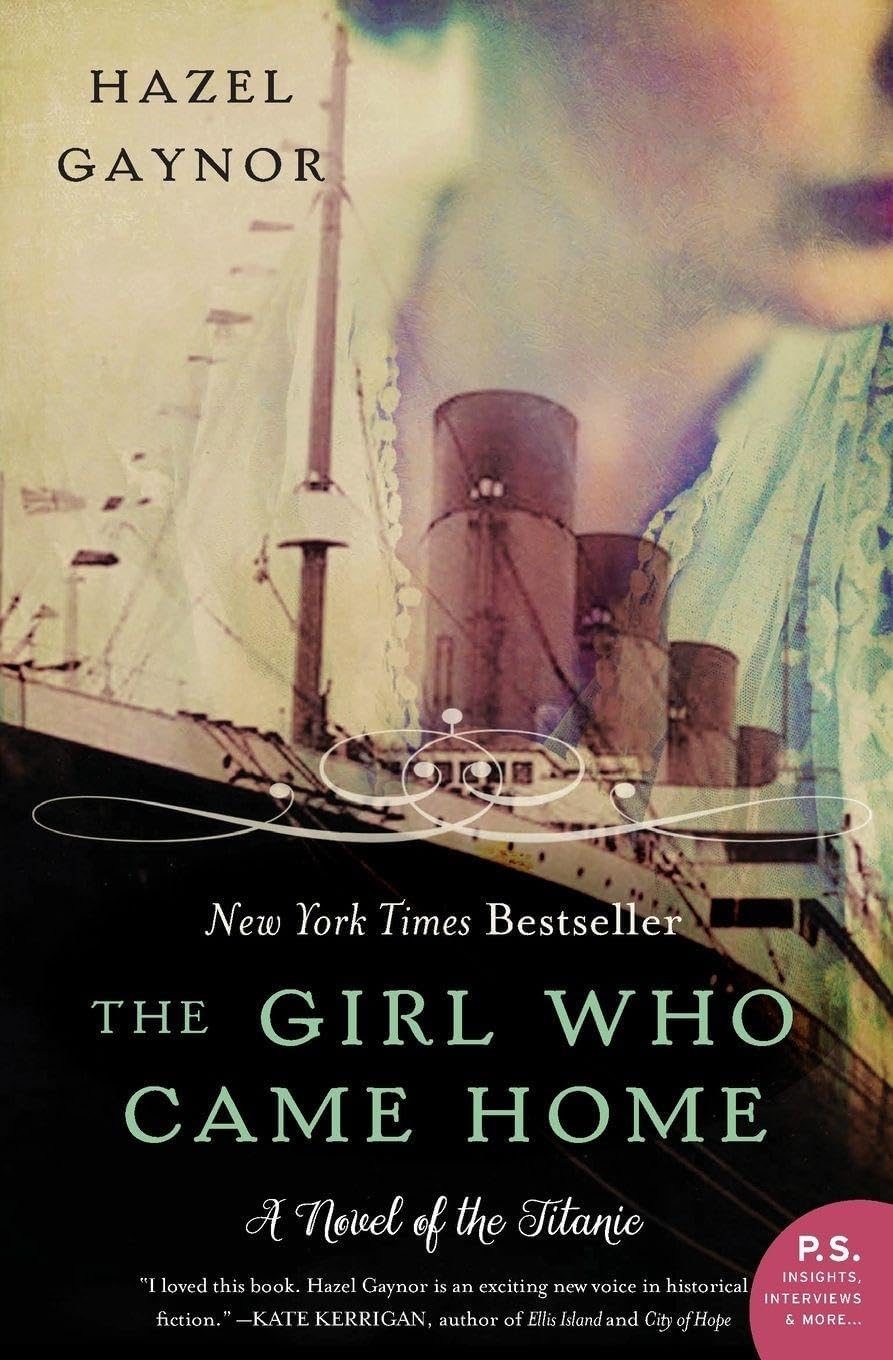
desertcart.com: The Girl Who Came Home: A Novel of the Titanic (P.S.): 9780062316868: Gaynor, Hazel: Books Review: A wonderful, heart-wrenching read - With the centenary of the sinking of the Titanic almost upon us, it's only right that we're reminded of one of the most awful maritime disasters in history. Hazel Gaynor's beautiful novel, The Girl Who Came Home, is not only a reminder of the actual disaster, but it's an exploration of human emotions - a gut-wrenching before and after look at lives that were forever changed on that momentous day. Hazel has based this novel on a true story of the Addergoole Fourteen, a group of men and women who left their small village in County Mayo inIreland to board the Titanic for its maiden voyage. In Chicago in 1982, Grace Butler is looking for a story to write in order to revive her journalism career. She needs something big - something that will tap into the readers' emotions and get her noticed. But never in a million years was she expecting her great grandmother, Maggie Murphy, to be the one to provide her with what she's looking for. Maggie has kept a secret for seventy years and decides that now is the time to open up and share it with her great granddaughter. And so the story takes us back to that rural Irish village in April 1912 when seventeen year old Maggie Murphy is preparing to sail on the Titanic, along with her aunt Kathleen and two of her best friends, Peggy and Katie. In all, fourteen men and women from the village are packing up their lives in hope of a better one over in America. Maggie is excited about her impending voyage, but devastated to be leaving behind her beloved Seamus. She hopes he'll be able to join her soon in America but in the meantime, he's written a selection of love letters to keep her company on the journey ahead. These letters form part of this amazing story, where we learn what's going through the minds of some who have been left behind. Maggie also keeps a private journal during the sailing and it allows us a glimpse into her innermost thoughts. Hazel's depiction of the characters in this novel is beautiful. She brings us right into their lives and we become invested in them. Although we know the fate of the ship, we're left rooting for the people we've come to know and hope that there's a way out for them. We also see the stories of some of those waiting on the other side - the relatives and friends who have gathered to hear news of the ill-fated ship. How unbearable it must have been to have to check a list of the dead, praying you wouldn't see your loved one's name on it. Through all the mayhem on the ship, we follow Maggie and learn her fate, but it's only as the full scale of the disaster unfolds that we begin to learn the fate of the rest of the Irish group. Hazel manages to weave plenty of twists and surprises into the story and I have to admit to shedding a tear on a few occasions. Forward to 1982 and Maggie and her great granddaughter decide to take a trip back to that little village in Ireland where it all began. Seventy years on, she feels it's about time she made peace with her past. It's an emotional scene as the past mingles with the present and we're left reeling as some unexpected plot twists reveal themselves. If you're a lover of all things Titanic, you'll love The Girl Who Came Home, but if you just like a great emotional read with amazing, relatable characters, this is also the book for you. Hazel has managed to take a story that we've all heard a million times and give us a new perspective. Her attention to the detail of the ship made me feel I was there and her ability to portray the innermost thoughts of the characters meant I was fully invested in them and their safety. It's a thoroughly enjoyable read and I'd highly recommend it. Review: A story well told - When there's something that you always want to do, there comes a time to do it, writes Brian Byrne. And if you don't do it at that time, then you probably never will. The trick is to know when the time comes. For local writer Hazel Gaynor, the time came, and she noticed it. The result is her first novel, 'The Girl who Came Home'. It's a Titanic novel, in the sense that it is located on that ship of terrible tragedy, and in the places where some of the Irish passengers came from and where some survivors might have gone to. Hazel has been fascinated by the story of the Titanic since she was a small child. Not for any particular reason, just that the enormity of the story grabbed her imagination when she first heard about it. She always gathered information about the tragic event, and any time she came across a related article she assimilated every word. The fictional characters and the fictional Irish village in 'The Girl who Came Home' are all based on a real set of people, and a real village near Killala in Co Mayo. The 'Addergoole Fourteen' were a group of men and women from there who sailed on the Titanic. Only three survived. Today there is a strong Titanic heritage in Addergoole, concerned with properly preserving the memory of what was a massive loss to a small community. Hazel's main character is Maggie Murphy, and it doesn't spoil the storyline to say that she survived the encounter with the iceberg. Another protagonist is Maggie's great-grand-daughter Grace, starting out on a career in journalism in the US. There are other people in the story, some close to Maggie, others who came in peripherally but in some cases became very important. It may be the fact that Hazel was raised in Yorkshire which gives her a grasp of old rural life, but she captures in 'The Girl' a very believable depiction of a Mayo village in the early years of the 20th century, the hopes and fears of its people, and the small details of life at the time. The book is written in a number of formats, flashbacks and flashforwards, letters from a lover, Maggie's private journal, actual telegrams from the ship. Through them all is the very clear detail of many aspects of the Titanic and its maiden voyage destined to be its final one. It is detail that only someone who has gathered a treasure chest of knowledge over many years could credibly provide. 'The Girl who Came Home' is a small treasury of love stories, among other things. It is primarily a woman's book, the main characters women, the perspective the particular romantic one from that side of the gender spectrum. But it is also a story of human journey, and the search for meaning and fulfillment on that journey. It's a story well told, with some unexpected twists as it works its way to conclusion. It is only available in Kindle form on the desertcart website. But even if you don't have a Kindle, you can download it to your computer or your smartphone on the relevant free apps. It's worth doing, and worth reading. In this centenary year of the Titanic tragedy, Hazel Gaynor has successfully reached a major moment on her own journey as a writer. We'll be reading more of them in coming years.


| Best Sellers Rank | #61,595 in Books ( See Top 100 in Books ) #83 in Sea Stories #886 in Coming of Age Fiction (Books) #2,711 in Literary Fiction (Books) |
| Customer Reviews | 4.4 out of 5 stars 13,948 Reviews |
M**A
A wonderful, heart-wrenching read
With the centenary of the sinking of the Titanic almost upon us, it's only right that we're reminded of one of the most awful maritime disasters in history. Hazel Gaynor's beautiful novel, The Girl Who Came Home, is not only a reminder of the actual disaster, but it's an exploration of human emotions - a gut-wrenching before and after look at lives that were forever changed on that momentous day. Hazel has based this novel on a true story of the Addergoole Fourteen, a group of men and women who left their small village in County Mayo inIreland to board the Titanic for its maiden voyage. In Chicago in 1982, Grace Butler is looking for a story to write in order to revive her journalism career. She needs something big - something that will tap into the readers' emotions and get her noticed. But never in a million years was she expecting her great grandmother, Maggie Murphy, to be the one to provide her with what she's looking for. Maggie has kept a secret for seventy years and decides that now is the time to open up and share it with her great granddaughter. And so the story takes us back to that rural Irish village in April 1912 when seventeen year old Maggie Murphy is preparing to sail on the Titanic, along with her aunt Kathleen and two of her best friends, Peggy and Katie. In all, fourteen men and women from the village are packing up their lives in hope of a better one over in America. Maggie is excited about her impending voyage, but devastated to be leaving behind her beloved Seamus. She hopes he'll be able to join her soon in America but in the meantime, he's written a selection of love letters to keep her company on the journey ahead. These letters form part of this amazing story, where we learn what's going through the minds of some who have been left behind. Maggie also keeps a private journal during the sailing and it allows us a glimpse into her innermost thoughts. Hazel's depiction of the characters in this novel is beautiful. She brings us right into their lives and we become invested in them. Although we know the fate of the ship, we're left rooting for the people we've come to know and hope that there's a way out for them. We also see the stories of some of those waiting on the other side - the relatives and friends who have gathered to hear news of the ill-fated ship. How unbearable it must have been to have to check a list of the dead, praying you wouldn't see your loved one's name on it. Through all the mayhem on the ship, we follow Maggie and learn her fate, but it's only as the full scale of the disaster unfolds that we begin to learn the fate of the rest of the Irish group. Hazel manages to weave plenty of twists and surprises into the story and I have to admit to shedding a tear on a few occasions. Forward to 1982 and Maggie and her great granddaughter decide to take a trip back to that little village in Ireland where it all began. Seventy years on, she feels it's about time she made peace with her past. It's an emotional scene as the past mingles with the present and we're left reeling as some unexpected plot twists reveal themselves. If you're a lover of all things Titanic, you'll love The Girl Who Came Home, but if you just like a great emotional read with amazing, relatable characters, this is also the book for you. Hazel has managed to take a story that we've all heard a million times and give us a new perspective. Her attention to the detail of the ship made me feel I was there and her ability to portray the innermost thoughts of the characters meant I was fully invested in them and their safety. It's a thoroughly enjoyable read and I'd highly recommend it.
B**E
A story well told
When there's something that you always want to do, there comes a time to do it, writes Brian Byrne. And if you don't do it at that time, then you probably never will. The trick is to know when the time comes. For local writer Hazel Gaynor, the time came, and she noticed it. The result is her first novel, 'The Girl who Came Home'. It's a Titanic novel, in the sense that it is located on that ship of terrible tragedy, and in the places where some of the Irish passengers came from and where some survivors might have gone to. Hazel has been fascinated by the story of the Titanic since she was a small child. Not for any particular reason, just that the enormity of the story grabbed her imagination when she first heard about it. She always gathered information about the tragic event, and any time she came across a related article she assimilated every word. The fictional characters and the fictional Irish village in 'The Girl who Came Home' are all based on a real set of people, and a real village near Killala in Co Mayo. The 'Addergoole Fourteen' were a group of men and women from there who sailed on the Titanic. Only three survived. Today there is a strong Titanic heritage in Addergoole, concerned with properly preserving the memory of what was a massive loss to a small community. Hazel's main character is Maggie Murphy, and it doesn't spoil the storyline to say that she survived the encounter with the iceberg. Another protagonist is Maggie's great-grand-daughter Grace, starting out on a career in journalism in the US. There are other people in the story, some close to Maggie, others who came in peripherally but in some cases became very important. It may be the fact that Hazel was raised in Yorkshire which gives her a grasp of old rural life, but she captures in 'The Girl' a very believable depiction of a Mayo village in the early years of the 20th century, the hopes and fears of its people, and the small details of life at the time. The book is written in a number of formats, flashbacks and flashforwards, letters from a lover, Maggie's private journal, actual telegrams from the ship. Through them all is the very clear detail of many aspects of the Titanic and its maiden voyage destined to be its final one. It is detail that only someone who has gathered a treasure chest of knowledge over many years could credibly provide. 'The Girl who Came Home' is a small treasury of love stories, among other things. It is primarily a woman's book, the main characters women, the perspective the particular romantic one from that side of the gender spectrum. But it is also a story of human journey, and the search for meaning and fulfillment on that journey. It's a story well told, with some unexpected twists as it works its way to conclusion. It is only available in Kindle form on the Amazon website. But even if you don't have a Kindle, you can download it to your computer or your smartphone on the relevant free apps. It's worth doing, and worth reading. In this centenary year of the Titanic tragedy, Hazel Gaynor has successfully reached a major moment on her own journey as a writer. We'll be reading more of them in coming years.
M**E
The Girl Who Came Home
I'm fascinated with the story of the Titanic, but not obsessed so I haven't read lots of books on it. This is a fictional account inspired by a real group of 14 Irish emigrants who left Ireland to visit relatives in America. The story focuses on 17-year-old Maggie Murphy. Maggie's parents have both died and her aunt Kathleen has come to Ireland and is taking Maggie back to Chicago with her. While there, others have decided to join them in making the journey. Maggie is sad to be leaving her boyfriend, Seamus, behind. His father is sick so he won't be able to come, but tells her he'll be waiting for her to come home. We also get two more stories: "Lucky Harry," and Grace Butler, Maggie's great-granddaughter. Harry is one of the stewards on the ship who Maggie and her friends get to know and who later helps her get into one of the last lifeboats to leave. Grace's story takes place in Illinois in 1982. Grace's life was going well until her father died. She left college and her boyfriend, Jimmy, to help her mother. Maggie starts to help her get her life back, starting with telling her about her journey on the Titanic, a story she has never told anyone. Learning her great-grandmother's story gives Grace the courage to move on with her life. I loved this book! Most of it is told in flashback so there's a lot of jumping back and forth. I didn't find it to be confusing and actually liked it. Maggie was young and excited to go on the ship, but she was sad to have left Seamus behind. It was interesting to experience the Titanic through her young eyes. Knowing what happened doesn't lessen the impact of the scenes of the tragic night of April 15, 1912. All the talk of the Titanic being unsinkable appeared to have caused confusion and disbelief at what was happening. The author didn't dwell too long on the actual sinking and I liked that. The aftermath is what gets lost sometimes. The journey to the Carpathia in the lifeboats was long and cold. The people waiting to welcome the ship in New York were in shock as they attempted to learn the fate of their loved ones, and even if they didn't see their names on the list of survivors, hoped they would still see them disembark. It's not too surprising that Maggie didn't want to remember and discuss the horror of that night until she was much older. I also enjoyed Harry and Grace's stories. It was interesting to see what happened to Harry. I thought his ending would be a little different. Grace was able to learn what was important to her and to go for it before it was too late. I also loved Maggie's story and hearing the ending to it. She was able to do something at the end that she'd been wanting to do for a long time and was able to make peace with all that happened. I like the section at the end where the author shares the story behind the book and tells the parts of the book based on fact. There is also a short Glossary of Irish Terms and Reading Group Discussion Questions. There is a lot to say about this book so it would be great for a book club! This is a clean read. If you enjoy reading about the Titanic, this is a book for you! I received a copy of this book to review. My opinion is 100% my own.
K**N
Poignant, loving and uplifting
A true gift to encourage Hope and Faith in humanity. Especially meaningful to anyone with Irish ancestry. So many Irish Traditions mentioned
M**R
Titanic - A Different Perspective
Let me begin by saying that I've read quite a lot of books and articles on Titanic. I've seen 'the' movie several times and watched various documentaries. I'm always on the lookout for something new or different. I liked that this book was presented from the perspective of a third-class steerage passenger. We meet seventeen year old Maggie Murphy who is about to embark on her journey to America on Titanic. She doesn't want to leave Ballysheen (her home village) and her boyfriend Seamus. But when her mother passes and her Aunt Kathleen comes from America to collect her, Maggie has no say in the matter. She and her aunt, along with twelve other folk from Ballysheen, decide to travel together. Maggie's friend, the outspoken Peggy Marden, is ready to leave. She dreams of marrying a rich American man and living in a fancy mansion. The story then switches us to Chicago in 1982 and we meet Grace Butler, a journalism student who sets aside her studies when her father passes so that she can stay home with her mother who is in a deep state of depression. After watching her great-granddaughter give so much of her self to her family, an 87 year-old Maggie decides to open up about that fateful voyage on Titanic. It is Maggie's story that helps Grace get on with her own life, take up her studies once more and reunite with her own boyfriend whom she hasn't seen in over two years. Maggie's story is moving, especially since her emotions embody those of her fellow travelers. Her realization that she should have stayed in Ballysheen with Seamus are reinforced as Titanic moves further away from Ireland. With her great-granddaughter's help she rediscovers her small travel case that contains two parting gifts from Seamus as well as her journal. Happily Grace writes the story of Maggie's journey on Titanic and it is printed in a prestigious newspaper. It is that article that reunites Maggie with people and artifacts that she thought she had lost long ago. Although I liked this book overall there were too many similarities to the movie that starred Leonardo DiCaprio and Kate Winslet: the narrator was an original Titanic survivor, an old woman; there were scenes that could have been lifted in their entirety from the movie, i.e., the lowering of the lifeboats; and I won't give any spoilers but the ending of the story was quite similar to the end of the movie (other than the ship sinking). Because the story has become over-told I suppose that all of these scenes could overlap in the various re-tellings. I did like the detail behind the New Yorkers who waited for word of their loved ones and the hospital scenes with young Maggie. If you are fascinated by the Titanic story, you'll like this book. Worth reading for the differing point of view and the story of the folk from Ballysheen which is based on the true story of the Irish folk who made the journey.
I**G
A GREAT read
I picked up this Kindle book when it hit the free list during the 100 year anniversary of the Titanic sinking this past April. Unfortunately I started this book on an extremely busy week - I say unfortunate because it was one of those books I didn't want to put down. I found myself up late at night reading, fighting sleep and having to get up really early in the morning. I'd rush through my "to do" lists for the day as fast as I could and would get to my son's water polo practice pick up early just so I could cram in a chapter while I was waiting in the car. The story is loosely based on actual Irish immigrants who boarded the Titanic on it's maiden voyage. Some chapters have Marconian messages in the beginning - messages sent from the Titanic by people, from the Carpathia etc. I wish I would have known these were the actual messages sent from people, Titanic and Carpathia when I was reading the book and only found out about that at the end so when you are reading them you are reading what was actually sent - you are reading history. An excellent first novel. A great historical fiction book even if you are not "into" everything Titanic (like I am). I gave it 4 stars because of some editing. While the story is top notch there are some pretty decent grammatical errors that should have been caught in the editing process so the knock down of the star is not because of a problem with the story at all. All in all, a great read, well researched, tugs at your emotions with some surprises. You will enjoy this read!
K**R
Another book about April 15, 1912
I have been fascinated by the tragedy of the sinking of the Titanic since I was 6 yrs old (50+ yrs ago), and I have read just about every book published about the ship, mostly non-fiction, but some novels too. I have stood on a replica of the grand staircase, been a member of Titanic Historical Society, seen Titanic memorabilia and found objects and watched every documentary and movie I could find. So, my expectations of this book were low; what could I learn that I hadn't already discovered in my own research over decades? Actually, I learned about a tiny village in Ireland which saw 14 of its residents set off for a better life in America, traveling in steerage on the Titanic. With the sinking, the percentage of residents who died was staggering: 12 of the 14 died, almosr 90% of those who left that tiny village died that night. The difficulty for an author writing about this tragedy is that the reader already knows what happened before picking up the book. The author's challenge is to find a new angle. Well, with the little-known victims and survivors from that real village, Gaynor has found a way to tell the story through new eyes. She has woven together the tales of a 90 yr old survivor from the village with that of her American great-granddaughter who learns of her great-grandmother's part in history in the 1980s, just when the real Titanic was about to be discovered. Gaynor creates believable characters interesting enough to pique and keep the reader's attention. Although I know a great deal about the event, this story of the 14 is one I had not encountered before. I was pleasantly surprised at how much I enjoyed this book. Yes, you know up front that the Titanic is going to hit an iceberg and sink and that many lives will be lost and few saved, but you don't know these people yet, and I think you might like them and want to follow their experiences. Not I only did I like the book, but I was forced to realize what an arrogant attitude I had when I approached the book. Mea culpa,mea culpa! I will not be so quick to assume I know all there is to know about anything, even the Titanic.
V**N
Great read of third class on Titanic
Many books you read and I have read many stories of the Titanic are mostly about the rich and famous. This was about the 3rd class Irish people traveling to America for a better life. I highly recommend this book to get an understanding of the poor and what they endured.
Trustpilot
5 days ago
2 weeks ago