Six Thinking Hats
Product ID: 11449369
Buy anything from 5,000+ international stores. One checkout price. No surprise fees. Join 2M+ shoppers on Desertcart.
Desertcart purchases this item on your behalf and handles shipping, customs, and support to Denmark.
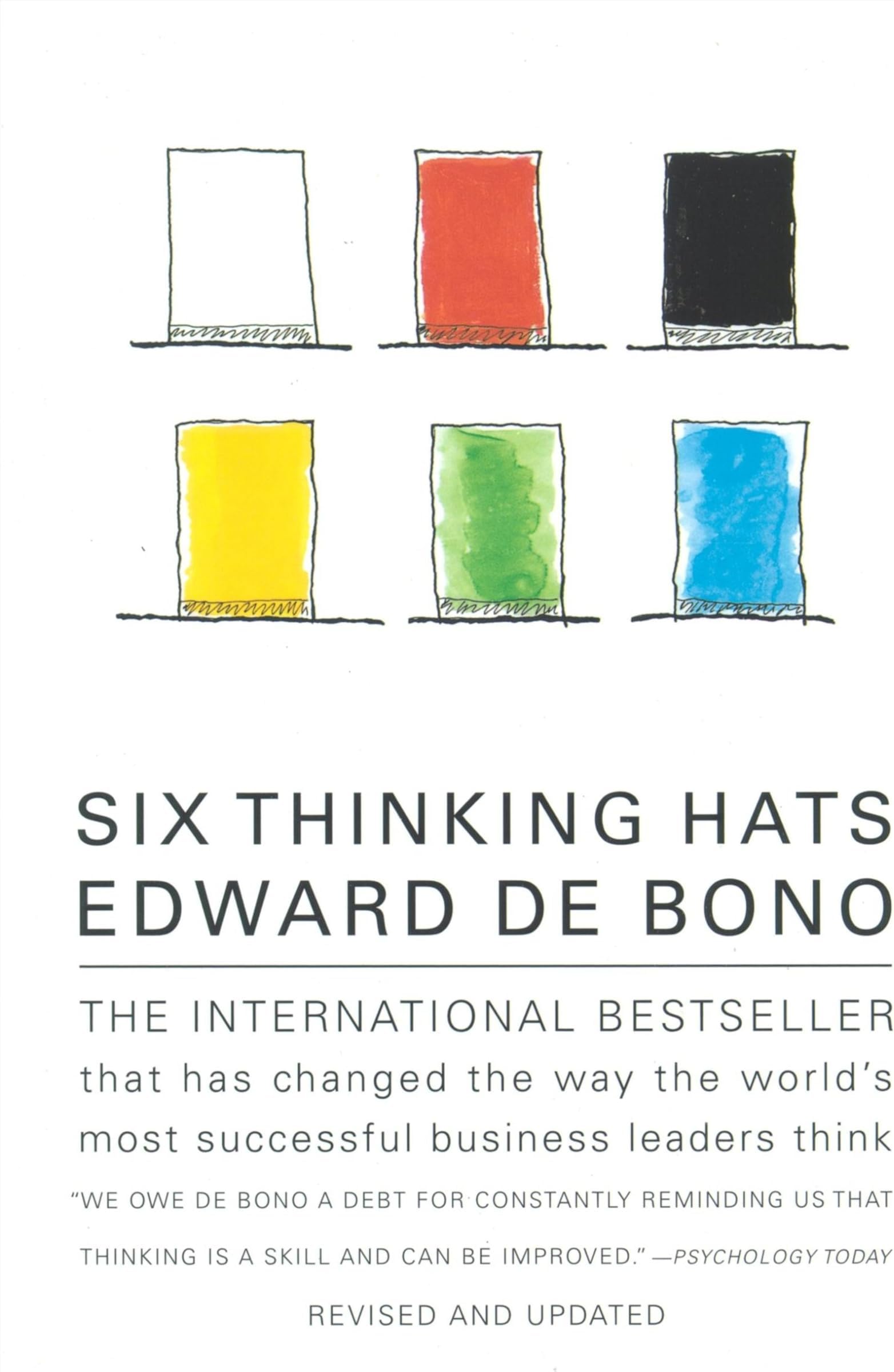
Used successfully by thousands of business managers, educators, and government leaders around the world, Six Thinking Hats offers a practical and uniquely positive approach to making decisions and exploring new ideas. Your success in business depends on how you think. "The main difficulty of thinking is confusion," writes Edward de Bono, long recognized as the foremost international authority on conceptual thinking and on the teaching of thinking as a skill. "We try to do too much at once. Emotions, information, logic, hope, and creativity all crowd in on us. It is like juggling with too many balls." The solution? De Bono unscrambles the thinking process with his "six thinking hats": WHITE HAT: neutral and objective, concerned with facts and figures RED HAT: the emotional view BLACK HAT: careful and cautious, the "devil's advocate" hat YELLOW HAT: sunny and positive GREEN HAT: associated with fertile growth, creativity, and new ideas BLUE HAT: cool, the color of the sky, above everything else-the organizing hat Through case studies and real-life examples, Dr. de Bono reveals the often surprising ways in which deliberate role playing can make you a better thinker. He offers a powerfully simple tool that you--and your business, whether it's a start-up or a major corporation--can use to create a climate of clearer thinking, improved communication, and greater creativity. His book is an instructive and inspiring text for anyone who makes decisions, in business or in life. Review: If you want to find a way to make smart decisions without taking too much time - If you want to find a way to make smart decisions without taking too much time, then this book is for you. “Six Thinking Hats” is written by Edward De Bono. He makes a comparison between critical and lateral thinking. As children, we are taught to do critical thinking. We have a problem, we find a solution, and then we spend time arguing why our solution is correct. This method of thinking creates arguments and that is what De Bono tries to eliminate. He came up with the concept of the six thinking hats in order to help people think better. With the six thinking hats, people are able to solve problems without causing arguments. Each hat is represented with different colors and each one has their own meaning. The book is, in a way, divided by the different hats. At the beginning of each section, he explains what the hat represents and he gives examples of how the hat is or can be used. At the end of the “section”, De Bono gives a good summary of the hat. This makes it easy for the reader to clear up misunderstandings that they may have had in the beginning. Also, the concept of the six thinking hats is explained well. Having different colors for each hat is easy to remember what each hat represents and the concept is easy to understand. It may take some time for people to get used to using the six thinking hats but once they get used to the method, their life will become easier. People are able to come up with solutions faster using this method compared to using critical thinking. Using the Six Thinking Hats may also provide better solutions to problems because they will go over different alternatives and the best one will be the final solution to be chosen. This method of thinking allows everyone to participate and they all see each others perspectives on an issue so it is easier to decrease arguments. De Bono explains that there are two purposes for the Six Thinking Hats. The first purpose is to simplify thinking. Focusing on one part of the problem at a time becomes less overwhelming for people. The second purpose is to allow a switch in thinking. Every person has the opportunity to switch their hats so they can see the different sides of their problem. This book can help a business or a group of people improve their communication, increase their creativity, and make better decisions. Overall, this is a book worth buying. The book is easy to read and it is also very educational. Review: New thinking, new method, new ideas. - When it comes to critical thinking, if we follow the same steps, are we truly thinking critically? Edward De Bono’s Six Thinking Hats takes a new point of view on the way we think, and categorized his ideas into six easy to understand points of view. The first area that I want to address and compliment is the way that the book is written. The style is unique from many other similar texts in that it is able to provide very in depth technical concepts in a simple and casual styled language. De Bono does a solid job in providing explanations for his ideas in a simple and broken down manner that makes it easy for almost anyone to interpret. He avoids focusing on the methodological and specialized terminology that can easily confuse readers. Additionally he recognizes areas where readers may have trouble understanding, and goes into further explanation citing both applicable real world and relatable situations to better explain the idea. Six thinking hats is a very interesting concept in that it completely reinvents conventional thinking, particularly in a group or team setting. It really pointed out some flaws that occur in modern days concepts of thinking and aims to cover all aspects of forming new ideas in an efficient and effective manner. Under each hat, a particular mindset is taken, and every aspect of this single point of view is reviewed. White for example, would include only factual and informational points. The hats are to be used in sequential order, and the end result is an idea that encompasses several aspects of thinking from all ends of the spectrum. Such a concept cuts down on the chaos that can occur at a meeting as it intends on gearing people toward focusing on a single goal and not throwing out any idea that comes to mind. Seeing this method in practice would be interesting to me as I have experienced many meetings where there was a lack of focus and order. The book is organized in such a manner that each hat is built upon the next, and as you read you begin to see the whole picture of what the author is trying to convey through this method. One caveat or weakness to the model itself however is the necessity for all levels of members to be on board. In order for each of the hats to be successful, everyone must be on the same page, and there must be acceptance and equality among the ideas. Individuals participating in a discussion cannot or should not be afraid to voice their ideas, concerns (black hat), etc depending on the particular hat. De Bono does address the dangers of the six thinking hat methods in a workplace that is not committed or misinterprets the usage, however I find that it can easily occur. Another issue that I wanted to point out to potential readers is that this method of thinking cannot necessarily be used to boost individual thought. Switching between the hats and focusing on a single hat requires a moderator to carefully ensure that everyone is on task and not reverting to other hats or impeding on other’s ideas. As an individual you lack that balance and cannot self check whether the hats are being used correctly. Overall however I found this book to be insightful and allowed me to develop another dimension and approach of thinking. Sometimes we under estimate the power of trying something different especially such a simple action, which in this case is thinking. As a college student in particular, this book is a necessity, as team settings and group projects are a common occurrence. This book can also apply to almost any individual interested in developing a new thinking method. The book even contains an anecdote about a couple using the six hats to make a decision on buying a house. Highly recommend to those looking to try something new and develop a new method of thinking.
| Best Sellers Rank | #25,483 in Books ( See Top 100 in Books ) #92 in Creativity (Books) #95 in Entrepreneurship (Books) #230 in Business Management (Books) |
| Customer Reviews | 4.6 out of 5 stars 2,004 Reviews |
A**A
If you want to find a way to make smart decisions without taking too much time
If you want to find a way to make smart decisions without taking too much time, then this book is for you. “Six Thinking Hats” is written by Edward De Bono. He makes a comparison between critical and lateral thinking. As children, we are taught to do critical thinking. We have a problem, we find a solution, and then we spend time arguing why our solution is correct. This method of thinking creates arguments and that is what De Bono tries to eliminate. He came up with the concept of the six thinking hats in order to help people think better. With the six thinking hats, people are able to solve problems without causing arguments. Each hat is represented with different colors and each one has their own meaning. The book is, in a way, divided by the different hats. At the beginning of each section, he explains what the hat represents and he gives examples of how the hat is or can be used. At the end of the “section”, De Bono gives a good summary of the hat. This makes it easy for the reader to clear up misunderstandings that they may have had in the beginning. Also, the concept of the six thinking hats is explained well. Having different colors for each hat is easy to remember what each hat represents and the concept is easy to understand. It may take some time for people to get used to using the six thinking hats but once they get used to the method, their life will become easier. People are able to come up with solutions faster using this method compared to using critical thinking. Using the Six Thinking Hats may also provide better solutions to problems because they will go over different alternatives and the best one will be the final solution to be chosen. This method of thinking allows everyone to participate and they all see each others perspectives on an issue so it is easier to decrease arguments. De Bono explains that there are two purposes for the Six Thinking Hats. The first purpose is to simplify thinking. Focusing on one part of the problem at a time becomes less overwhelming for people. The second purpose is to allow a switch in thinking. Every person has the opportunity to switch their hats so they can see the different sides of their problem. This book can help a business or a group of people improve their communication, increase their creativity, and make better decisions. Overall, this is a book worth buying. The book is easy to read and it is also very educational.
R**A
New thinking, new method, new ideas.
When it comes to critical thinking, if we follow the same steps, are we truly thinking critically? Edward De Bono’s Six Thinking Hats takes a new point of view on the way we think, and categorized his ideas into six easy to understand points of view. The first area that I want to address and compliment is the way that the book is written. The style is unique from many other similar texts in that it is able to provide very in depth technical concepts in a simple and casual styled language. De Bono does a solid job in providing explanations for his ideas in a simple and broken down manner that makes it easy for almost anyone to interpret. He avoids focusing on the methodological and specialized terminology that can easily confuse readers. Additionally he recognizes areas where readers may have trouble understanding, and goes into further explanation citing both applicable real world and relatable situations to better explain the idea. Six thinking hats is a very interesting concept in that it completely reinvents conventional thinking, particularly in a group or team setting. It really pointed out some flaws that occur in modern days concepts of thinking and aims to cover all aspects of forming new ideas in an efficient and effective manner. Under each hat, a particular mindset is taken, and every aspect of this single point of view is reviewed. White for example, would include only factual and informational points. The hats are to be used in sequential order, and the end result is an idea that encompasses several aspects of thinking from all ends of the spectrum. Such a concept cuts down on the chaos that can occur at a meeting as it intends on gearing people toward focusing on a single goal and not throwing out any idea that comes to mind. Seeing this method in practice would be interesting to me as I have experienced many meetings where there was a lack of focus and order. The book is organized in such a manner that each hat is built upon the next, and as you read you begin to see the whole picture of what the author is trying to convey through this method. One caveat or weakness to the model itself however is the necessity for all levels of members to be on board. In order for each of the hats to be successful, everyone must be on the same page, and there must be acceptance and equality among the ideas. Individuals participating in a discussion cannot or should not be afraid to voice their ideas, concerns (black hat), etc depending on the particular hat. De Bono does address the dangers of the six thinking hat methods in a workplace that is not committed or misinterprets the usage, however I find that it can easily occur. Another issue that I wanted to point out to potential readers is that this method of thinking cannot necessarily be used to boost individual thought. Switching between the hats and focusing on a single hat requires a moderator to carefully ensure that everyone is on task and not reverting to other hats or impeding on other’s ideas. As an individual you lack that balance and cannot self check whether the hats are being used correctly. Overall however I found this book to be insightful and allowed me to develop another dimension and approach of thinking. Sometimes we under estimate the power of trying something different especially such a simple action, which in this case is thinking. As a college student in particular, this book is a necessity, as team settings and group projects are a common occurrence. This book can also apply to almost any individual interested in developing a new thinking method. The book even contains an anecdote about a couple using the six hats to make a decision on buying a house. Highly recommend to those looking to try something new and develop a new method of thinking.
T**.
What seemed like 90% of the book was an elaboration of what ...
There is real reason to doubt this book but after reading it, it is undoubtedly worth a full and thorough read. Yes, as may be expected with any book about how to think it is full of information that is obvious and abstract. However, its biggest flaw if any is that much of its small and airy volume is full of reiterations of the same information and concepts. What seemed like 90% of the book was an elaboration of what had been summed up in a few sentences in the first chapter and therefore seemed fairly obvious. That being said, I’m glad for that because even after reading the entire book I had significant difficulty implementing the six thinking hats method in a discussion. Even though the entire book is based around a relatively simple concept, it’s an incredible concept and it’s a concept that’s incredibly difficult to fully understand after reading just the first chapter. Additionally, that 10% each chapter that wasn’t a reiteration of previous concepts like the purpose of a certain hat, was information that was very insightful and very useful. Like any skill worth learning, the six thinking hats method needs not only to be read about but also to be practiced to be most useful. Really meaningful things can come out of reading this book but only if you do more than just read it. The book includes short examples of how each hat should be used on almost every page. However, apart from a few pages near the beginning of the book and mention under the blue hat section, there are no simple and precise guidelines on how to tackle an entire conversation using this method. De Bono’s explanation for this is that there are no simple and precise guidelines for how to use this method because the best method is the one that is developed on an individual basis. When attempting to put this in practice however, I found this to be very difficult. In practice I wasn’t sure when to use what hat or whether I was really using the hat I thought I was. Despite this, I’m confident that with a little more practice I will have adopted a method of thinking that really is superior to the one I had before reading The Six Thinking Hats. The difficulty in implementing the six thinking hats method in itself goes lengths to show that it is a meaningful method that is worth reading a book about. There is no doubt that De Bono is one of the greatest minds of our time and that even if you consider yourself an organized and intelligent thinker, reading The Six Thinking Hats will give you a more powerful and effective mind.
O**H
Deliberate Thinking Defined!
The main premise of the book as summarized by the author is: "Thinking is the ultimate human resource...The main difficulty of thinking is confusion. We try to do too much at once...What I am putting forward in this book is a very simple concept which allows a thinker to do one thing at a time...The six thinking hats allows us to conduct our thinking as a conductor might lead an orchestra. We can call forth what we will...It is the sheer convenience of the six thinking hats that is the main value of the concept." Another core concept associated with the thinking hats is that of deliberate thinking which the switching of the hat signals. This type of thinking becomes clear with the following example from Edward: "When you are driving a car, you have to choose roads and follow roads and keep out of the way of other traffic...you are looking for signals and reacting to them. This is reactive thinking...You read signposts and make decisions. But you do not make the map. The other type of thinking has to do with mapmaking. You explore the subject and make the map. You make the map in an objective and neutral fashion. To do this you must look broadly." The book then goes on to details the mechanism of using the six hats: "You choose which of the six hats to put on at any one moment. You put on that hat and then play the role defined by that hat...When you change thinking hats you have to change roles. Each role should be distinct...Thinking now begins to flow from the acted parts and not from your ego. That is how maps are made. Then, in the end, the ego can choose a preferred route." These hats have the following purposes: " The first value of the six thinking hats is that of defined role-playing...The second value is that of attention directing...The third value is that of convenience...The forth value is the possible basis in brain chemistry...The fifth value arises from establishing the rules of the game." The hat colors have been chosen in a way that makes their corresponding function easier to recall. They are defined as follows: " 1- White Hat: White is neutral and objective. The white hat is concerned with objective facts and figures...virgin white, pure facts, figures and information. 2- Red Hat: Red suggests anger (seeing red), rage and emotions. The red fives the emotional view....seeing red, emotions and feelings, also hunch and intuition. 3- Black Hat: Black is gloomy and negative. The black hat covers the negative aspects - why it cannot be done...devil's advocate, negative judgement, why it will not work. 4- Yellow Hat: Yellow is sunny and positive. The yellow hat is optimistic and covers hope and positive thinking...sunshine, brightness and optimism, positive, constructive, opportunity. 5- Green Hat: Green is grass, vegetation and abundant, fertile growth. The green hat indicates creativity and new ideas...fertile, creative, plants springing from seeds, movement, provocation. 6- Blue Hat: Blue is cool, and it is also the color of the sky, which is above everything else. The blue hat is concerned with control and the organization of the thinking process. Also the use of the other hats...cool and control, orchestra conductor, thinking about thinking." This book offer a very creative, practical and applicable method of tackling any problem - and through its use achieve more effective outcomes and solutions. A recommended read!
C**V
A Six Thinking Hats Review of The Six Thinking Hats Book
🔵 Blue Hat (Introduction): To provide you with a six thinking hats exploration of this book to help you in your decision of whether to buy this book or not: ⚪️ White Hat (Information): 1. How many schools around the world have implemented Dr. Edward de Bono's six thinking hats correctly as mentioned in the book? For example, I’ve heard of students using the six hats in an incorrect way (each person acquires a different hat in the discussion) versus the way Dr. DeBono intended (everyone is wearing the same hat) as a thinking tool for parallel thinking. 2. How many companies use the six thinking hats regularly in their company culture? If not, what’s an alternative thinking framework they have found to be more effective, efficient, and enjoyable in exploring a subject? 3. If there was a world wide survey, what would be the most challenging aspect people find in using the six thinking hats? 🔴 Red Hat: 1. I feel confident that anyone who uses the six thinking hats will enhance the quality of their thinking (or their whole team). 2. I feel empowered whenever I (or a group) use the six thinking hats. 3. I feel fascinated whenever I (or a group) use the six thinking hats. ⚫️ Black Hat: 1. Those who are not familiar with the six hats might misunderstand the value of using this thinking framework. 2. The six thinking hats framework can be misused in a way that creates major consequences for the quality of thinking. 3. One might use the six thinking hats for awhile and then revert to staying in the comfort zone of traditional thinking processes such as pros/cons, brainstorming, and going by gut. 🟡 Yellow Hat: 1. It offers a more effective and efficient way of exploring a topic than going through spontaneous, point to point associations. 2. It gives you a comprehensive protocol for evaluating new ideas. 3. It can promote a more harmonious exchange of ideas within your team or groups. 🟢 Green Hat: 1. If the six thinking hats were expressed as a visual symbol, what would it look like? 2. If the six thinking hats framework were implemented within the social media world instead of the more traditional like/love, dislike, and comments, how would the impact be on conversations online? 3. If the six thinking hats were made into useful printed cards with different sequences of the hats, what would those look like and what could be the possibilities of their application? 🔵 Blue Hat (Conclusion): If you’re open to a new way of exploring a subject, evaluating ideas, or for another purpose that can enhance the quality of thinking led by Dr. Edward de Bono, then this book is a fantastic addition to your library. Chris von Spitzer Full disclosure: I own all of Dr. Edward de Bono’s books (except for the Love of Two Cockroaches) and I have immense respect for his work.
L**N
Good concepts
The book has very helpful ways to approach getting a team of people on the same page. It can work for a family or a corporation. Because the concepts are about aligning together with each hat color it brings harmony and creativity together. Each hat has a different way to look at a topic like black hat is all the negative things that could go wrong. Very helpful.
K**7
Increase the Productivity of Your Next Meeting!
Edward De Bono’s book, Six Thinking Hats, is a must read for employees and managers who conduct and participate in meetings all over the world. Edward is able to diagnose and find a solution to the current muddled thinking for decision-making. Most meetings are conducted in a very inefficient way and using his methods can drastically improve the effectiveness of any companies meetings. By using the different color hats, he creates a very easily understandable method of organizing thoughts so that each member of the meeting is on the same page, which eliminates the conflict of personalities and over focus on unimportant and irrelevant points. The “Six Thinking Hats” are different ways of looking at a problem or issue that needs to be decided. The white hat represents pure information and numbers, no opinions or emotions are considered. Members of the meeting only use facts that are quantitative. Under the red hat, members discuss how they feel about the issue and share their emotions to what has been said. Members are allowed to express their emotional opinions regarding the facts presented under the white hat. Under the black hat, all members are looking at the negative effects of the decision. Everyone plays devil advocate and determines the possible negative outcomes with the presented information. When everyone puts on the yellow hat then all the positives of the issue are talked about, and under the green hat members try to brainstorm to come up with new creative ideas that provide alternatives. The final blue hat is worn by the moderator who directs which hat is to be worn by the attendees at a given time to ensure everyone is thinking from the same perspective. The blue hat individual is in charge of the meeting, typically the manager, and is known as the facilitator. In the book, Edward provides solid examples of how each hat is to be used correctly. Overall, Edward is able to use a logical approach to thinking through the use of the various hat colors so that everyone can easily follow along. Egos and personalities become less apparent in the decision-making process, and discussions become more rational by separating the facts from the emotions and thus allow for a much more structured meeting environment.
A**R
Amber Nopwaskey Book Review
The author clearly explains the purpose behind using “hats” and what they can be used for as well as how to constructively form a meeting with the hats. The hats are used for determining a solution to a problem and they consist of white, red, black, yellow, green, and blue hats. Each of these hats can be used in a specific sequence in order to create an easy way to extract information in meetings or projects. I found this very interesting because often enough in meetings there is not a lot of good communication but rather a lot of arguing or silence in certain members of a group. When using the hats the white hat is used to focus on information only, the red hat is used for expressing emotions on a subject, the black hat is used for expressing caution and issues, the yellow hat is used for positive assessment, the green hat is used for expressing new ideas, and last but not least the blue hat is used for defining the problem/questions and organizing the focus on the issue at hand. I think that giving each topic its own allotted time creates a way for everyone to give their two cents on each aspect of the topic. As De Bono expresses in his book, people in meetings are often expressing information and arguing with those who disagree with them instead of providing information and letting the facts speak for themselves. The six thinking hat method separates each thing: feelings, facts, issues, structure, and improvements. When using the hats we separate each and specifically call on a hat when it is needed. Overall I enjoyed this book and found it very interesting. I think that if companies were to train their employees on how to use this method it could improve the overall process and mood of their meetings. I am eager to try the six thinking hat model on a group project, job meeting or some other form of collaboration. I personally had no negative comments for this book and I would highly recommend it to anyone who wants to learn how to better manage their time, information, and meetings.
R**U
Very Good Book
One of the best books for problem analysis
G**8
The content is much deeper than the title
Simple and inspiring book
M**A
Buen libro para fomentar la creatividad y el trabajo en equipo
La metodología de Edward de Bono es de fácil comprensión y aplicación. La técnica es muy visual y de sentido común. El libro puede leerse en muy poco tiempo y, aunque hay que practicar de forma habitual para lograr sacarle el máximo provecho, pueden obtenerse resultados desde el primer día.
B**S
英語でも判り易い内容です。
スタンフォードのティナ シーリング先生の「白熱教室」で学びましたが、非常にプレゼンスキルのフィルターとなります。
D**S
Ein Tolles Buch
Ein tolles Buch um die unterschjedlichen Denkweisen aus Sicht unterschiedlicher Charakterien zu beleuchten. Die in diesem Buch beschriebene Methode eignet sich besonders zur Bearbeitung und Beleuchtung komplexerer Aufgabenstellungen und zur Bewertung und Optimierung von bereits erarbeiteten Lösungen oder Ideen aus unterschiedlichen Perspektiven.
Trustpilot
5 days ago
3 weeks ago